GaN Laser Diode Market Size, Share & Growth Report By Type (Edge-Emitting GaN Laser Diodes, VCSEL (Vertical-Cavity Surface-Emitting Laser)), By Application (LiDAR Systems, Optical Communication, Consumer Electronics, Industrial Processing, Defense & Aerospace), By End-Use Industry (Automotive, Telecommunications, Consumer Electronics, Healthcare, Industrial Manufacturing) – Global Forecast Analysis, 2026–2034
USD 3950
Market Overview
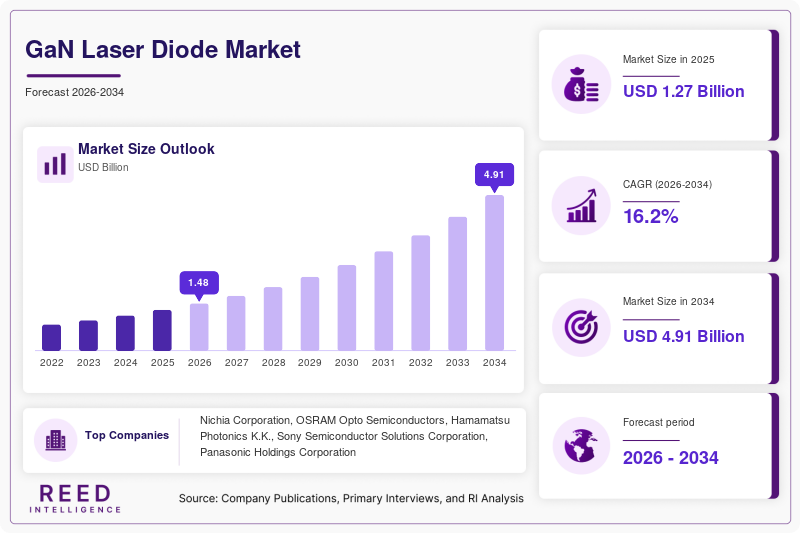
The GaN Laser Diode Market size is estimated at USD 1.48 billion, and it is projected to reach USD 4.92 billion by 2034, expanding at a CAGR of 16.2% (2026–2034). The growth of the GaN Laser Diode Market is primarily supported by the increasing adoption of next-generation sensing and communication technologies requiring compact, high-power, and energy-efficient laser sources.
A major global factor contributing to market growth is the rapid expansion of autonomous vehicle ecosystems, where GaN-based laser diodes are widely used in LiDAR systems for accurate distance measurement and object detection in real time. This has significantly enhanced demand across automotive OEMs and Tier-1 suppliers, reinforcing long-term adoption trends in the GaN Laser Diode Market.
Key Highlights
- Dominant Region (2025): Asia Pacific held 38.5% share of the GaN Laser Diode Market
- Fastest-Growing Region: North America with a projected CAGR of 17.1% (2026–2034)
- Leading Subsegment (Type): Edge-emitting GaN laser diodes dominated with 52% share in 2025
- Fastest-Growing Subsegment (Application): LiDAR systems, projected CAGR of 18.4%
- Dominant Country (2024–2025): China, valued at USD 0.41 billion in 2024 and USD 0.48 billion in 2025, driven by strong semiconductor manufacturing capacity and EV integration
Market Trends
Miniaturization of High-Power Laser Systems
The GaN Laser Diode Market is experiencing a strong shift toward miniaturized high-power laser systems. Manufacturers are focusing on reducing device footprint while maintaining high optical efficiency. This trend is particularly prominent in consumer electronics and automotive sensing modules, where compact design is essential for integration into constrained spaces.
Expansion of LiDAR-Enabled Mobility Solutions
The adoption of LiDAR technology in autonomous and semi-autonomous vehicles is significantly shaping the GaN Laser Diode Market. Automakers are increasingly integrating GaN-based laser diodes into advanced driver-assistance systems (ADAS), enhancing object detection accuracy and environmental mapping capabilities.
Market Drivers
Rising Demand for High-Speed Optical Communication
The increasing deployment of 5G and emerging 6G networks is a key driver of the GaN Laser Diode Market. These networks require high-frequency optical transmitters capable of maintaining signal stability over long distances. GaN laser diodes offer high modulation speed and thermal stability, making them suitable for next-generation communication infrastructure.
Growth in Automotive Electrification and Autonomy
The rapid expansion of electric vehicles and autonomous driving systems is driving demand in the GaN Laser Diode Market. GaN laser diodes are used in LiDAR sensors, driver monitoring systems, and advanced imaging technologies, enabling safer and more efficient autonomous navigation.
Market Restraint
High Manufacturing Complexity and Cost Constraints
A major restraint in the GaN Laser Diode Market is the high production cost associated with GaN substrate fabrication and epitaxial growth processes. The complexity of achieving defect-free crystal structures increases manufacturing expenses, limiting mass adoption in cost-sensitive applications.
Market Opportunities
Integration in Quantum and Photonic Computing Systems
The GaN Laser Diode Market presents significant opportunities in quantum computing and photonic processing. GaN-based lasers are increasingly being explored for qubit control and optical interconnects due to their precision wavelength control and low noise characteristics.
Expansion in Medical Imaging and Biophotonics
Growing use of laser-based diagnostic tools in medical imaging is creating new opportunities in the GaN Laser Diode Market. Applications such as fluorescence imaging, optical coherence tomography, and minimally invasive surgical tools are driving demand for compact and high-efficiency laser diodes.
Segmental Analysis
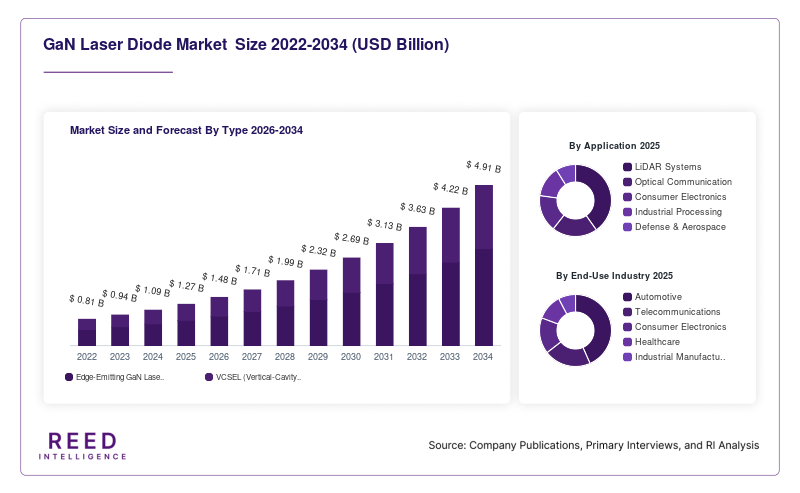
The GaN Laser Diode Market is segmented based on type, application, and end-use industry. Each segment plays a critical role in shaping overall market expansion, with evolving technological requirements influencing adoption patterns.
By Type
Edge-emitting GaN laser diodes represented the dominant subsegment in the GaN Laser Diode Market, accounting for 52% share in 2025. Their widespread adoption is attributed to high output power, directional beam quality, and suitability for long-range sensing applications. These characteristics make them ideal for automotive LiDAR and industrial scanning systems.
On the other hand, vertical-cavity surface-emitting lasers (VCSELs) are expected to be the fastest-growing subsegment, registering a CAGR of 17.9% (2026–2034). Growth in this segment is driven by increasing deployment in facial recognition systems, short-range sensing, and consumer electronics due to low power consumption and cost efficiency.
By Application
The application segment of the GaN Laser Diode Market includes LiDAR systems, optical communication, consumer electronics, industrial processing, and defense applications. LiDAR systems held the dominant position with 34% share in 2025, supported by increasing use in autonomous driving and robotics navigation systems.
Optical communication is expected to grow at the fastest rate, with a projected CAGR of 17.6% (2026–2034). Rising demand for high-speed data transmission in telecom networks and data centers is driving this segment, particularly as cloud computing and AI workloads increase globally.
By End-Use Industry
The automotive industry led the GaN Laser Diode Market, capturing 31% share in 2025 due to widespread adoption of ADAS and LiDAR-based navigation systems. The shift toward electric and autonomous vehicles continues to reinforce demand.
The consumer electronics segment is projected to grow at the fastest pace, with a CAGR of 18.2%, driven by applications in smartphones, AR/VR devices, and biometric systems. Increasing integration of advanced sensing and imaging technologies is accelerating adoption across this segment.
The telecommunications sector also contributes significantly, supported by infrastructure upgrades in fiber-optic networks. Meanwhile, defense and aerospace applications benefit from high-precision targeting and imaging requirements.
Regional Analysis
North America
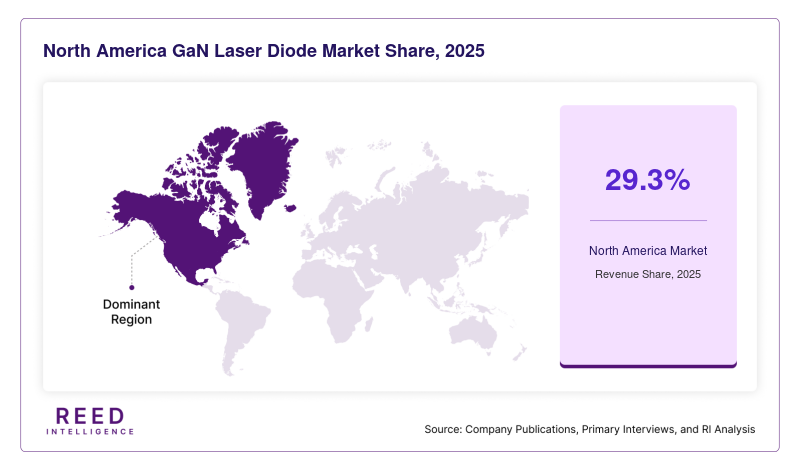
North America accounted for 29.3% share of the GaN Laser Diode Market in 2025 and is projected to grow at a CAGR of 17.1% (2026–2034). The region benefits from strong R&D investments and early adoption of LiDAR-based autonomous systems. The United States leads due to its advanced semiconductor ecosystem and increasing defense modernization programs.
Europe
Europe held 21.6% share in 2025 and is expected to expand at a CAGR of 15.4% (2026–2034). Germany dominates the regional market due to its strong automotive manufacturing base and integration of laser-based sensing technologies in premium vehicles.
Asia Pacific
Asia Pacific dominated the GaN Laser Diode Market with 38.5% share in 2025 and is projected to grow at a CAGR of 16.8% (2026–2034). China leads the region, driven by large-scale semiconductor production, EV adoption, and government-backed photonics research initiatives.
Middle East & Africa
The region held 5.8% share in 2025 and is expected to grow at a CAGR of 14.9% (2026–2034). The United Arab Emirates leads due to increasing investments in smart city infrastructure and defense communication systems.
Latin America
Latin America accounted for 4.8% share in 2025 and is projected to grow at a CAGR of 14.2% (2026–2034). Brazil dominates due to expanding telecom infrastructure and gradual adoption of advanced optical technologies.
Competitive Landscape
The GaN Laser Diode Market is moderately consolidated, with several global semiconductor and photonics companies investing in research and production capacity expansion. Key players include Nichia Corporation, OSRAM Opto Semiconductors, Hamamatsu Photonics, Sony Semiconductor Solutions, and Panasonic Holdings Corporation. These companies focus on improving efficiency, wavelength stability, and thermal performance of GaN-based laser diodes.
Nichia Corporation holds a strong position in the market due to its extensive LED and laser diode portfolio and continuous innovation in GaN epitaxy technology. Recent developments include expansion of high-power blue laser diode production lines to support automotive LiDAR and industrial applications. Strategic collaborations and capacity expansion remain central to competitive strategies in the GaN Laser Diode Market.
Key Players List
- Nichia Corporation
- OSRAM Opto Semiconductors
- Hamamatsu Photonics K.K.
- Sony Semiconductor Solutions Corporation
- Panasonic Holdings Corporation
- Epistar Corporation
- Seoul Viosys Co., Ltd.
- Lumentum Holdings Inc.
- II-VI Incorporated
- Broadcom Inc.
- Ushio Inc.
- Rohm Semiconductor
- Mitsubishi Electric Corporation
- Sharp Corporation
- Coherent Corp.
Recent Developments
- In 2026, several semiconductor manufacturers expanded GaN epitaxy production lines to support rising demand in the GaN Laser Diode Market for automotive LiDAR systems.
- In 2025, advancements in high-efficiency blue laser diodes improved optical output stability for industrial scanning applications.
- Strategic partnerships between photonics firms and automotive OEMs increased integration of GaN laser systems in ADAS platforms.
- Ongoing R&D investments are focusing on improving thermal resistance and reducing production costs in the GaN Laser Diode Market.
- Expansion of 5G infrastructure globally has driven additional demand for high-speed optical communication components.
GaN Laser Diode Market Segments
By Type
- Edge-Emitting GaN Laser Diodes
- VCSEL (Vertical-Cavity Surface-Emitting Laser)
By Application
- LiDAR Systems
- Optical Communication
- Consumer Electronics
- Industrial Processing
- Defense & Aerospace
By End-Use Industry
- Automotive
- Telecommunications
- Consumer Electronics
- Healthcare
- Industrial Manufacturing
By Region
- North America
- Europe
- APAC
- Middle East and Africa
- LATAM