GaN Power ICs Market Size, Share & Demand Report By Type (Discrete GaN ICs, Integrated GaN Power ICs), By Application (Consumer Electronics, Electric Vehicles, Data Centers, Telecommunications, Industrial Systems), By End-Use Industry (Consumer Electronics, Automotive, Industrial, Energy & Power, Aerospace & Defense), By Region & Segment Forecasts, 2026–2034
USD 3950
Market Overview
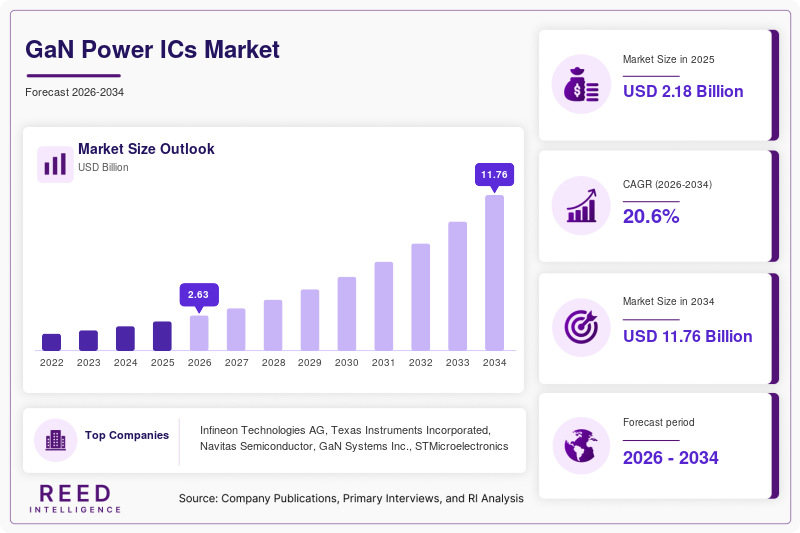
The global GaN Power ICs Market was valued at USD 2.18 billion in 2026 and is projected to reach USD 9.74 billion by 2034, expanding at a CAGR of 20.6% during the forecast period (2026–2034). The market is experiencing strong growth driven by the increasing demand for high-efficiency power electronics across industries such as consumer electronics, automotive, telecommunications, and industrial automation. Gallium Nitride (GaN) power integrated circuits offer superior switching performance, higher energy efficiency, and compact form factors compared to traditional silicon-based devices, making them suitable for next-generation applications.
One of the primary global factors supporting market growth is the rapid electrification of transportation and infrastructure. Electric vehicles (EVs), renewable energy systems, and fast-charging technologies are increasingly adopting GaN-based power ICs to improve efficiency and reduce energy losses. Additionally, the proliferation of data centers and 5G infrastructure has further accelerated the need for compact and high-frequency power solutions.
Key Highlights
- North America dominated the market with a 36.8% share in 2025.
- Asia Pacific is expected to grow at the fastest CAGR of 22.4% during 2026–2034.
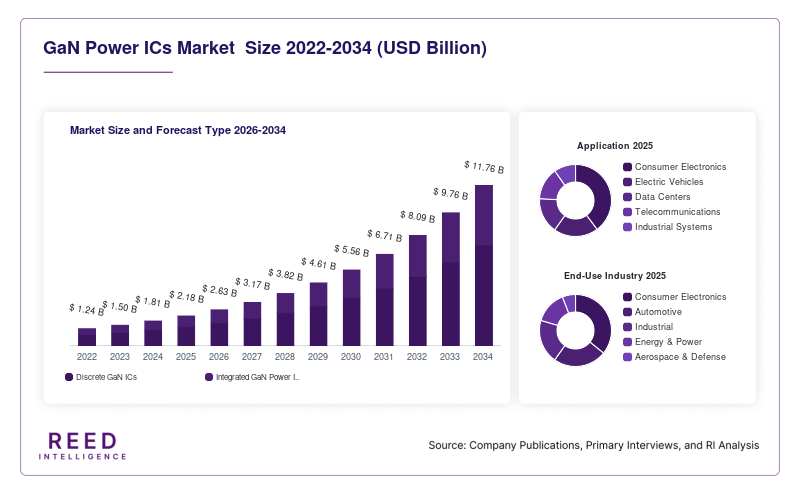
- By type, discrete GaN ICs accounted for the largest share of 42.6%.
- while integrated GaN power ICs are projected to grow at a CAGR of 23.1%.
- By application, consumer electronics led with a 39.2% share, whereas electric vehicles are expected to expand at a CAGR of 24.7%.
- The United States remained the dominant country, with market values of USD 620 million in 2024 and USD 710 million in 2025.
Market Trends
Increasing Adoption of GaN in Fast-Charging Technologies
The growing demand for fast-charging solutions in smartphones, laptops, and electric vehicles is significantly influencing the GaN Power ICs Market. GaN technology enables higher switching frequencies and lower energy losses, which results in faster charging times and reduced heat generation. Manufacturers are integrating GaN ICs into compact chargers that deliver higher power output without increasing size. This trend is particularly evident in consumer electronics, where portability and efficiency are key priorities. As users demand quicker charging cycles, companies are focusing on GaN-based adapters and power modules. The expansion of USB-C and universal charging standards is also supporting this trend, as GaN ICs can handle higher voltages and currents efficiently. This shift is expected to reshape power delivery systems across multiple device categories.
Expansion of GaN Technology in Data Centers and 5G Infrastructure
The rapid growth of data centers and 5G networks is creating strong demand for efficient power management solutions. GaN power ICs are increasingly used in server power supplies, telecom base stations, and network infrastructure due to their ability to operate at higher frequencies with minimal losses. This leads to reduced cooling requirements and improved energy efficiency, which are critical for large-scale data operations. As hyperscale data centers continue to expand, operators are prioritizing energy-efficient components to reduce operational costs and carbon footprint. Additionally, 5G deployment requires compact and high-performance power solutions, further driving the adoption of GaN ICs. The integration of GaN devices into power architectures is expected to become more widespread as digital infrastructure continues to grow globally.
Market Drivers
Rising Demand for Energy-Efficient Power Electronics
The increasing emphasis on energy efficiency across industries is a major driver for the GaN Power ICs Market. GaN devices offer significantly lower power losses compared to silicon-based counterparts, making them ideal for applications that require high efficiency. Governments and regulatory bodies are implementing stringent energy efficiency standards, encouraging manufacturers to adopt advanced semiconductor technologies. Industries such as renewable energy, industrial automation, and consumer electronics are actively transitioning toward GaN-based solutions to reduce energy consumption. This shift is also supported by the growing awareness of sustainability and environmental impact. As companies aim to meet energy efficiency targets, the adoption of GaN power ICs is expected to increase steadily.
Growth of Electric Vehicles and Renewable Energy Systems
The expansion of electric vehicles and renewable energy infrastructure is significantly boosting demand for GaN power ICs. EVs require efficient power conversion systems for battery management, charging, and motor control, where GaN technology offers improved performance and reduced system size. Similarly, renewable energy systems such as solar inverters and wind power converters benefit from the high efficiency and compact design of GaN ICs. As global investments in clean energy continue to rise, the need for advanced power electronics is becoming more critical. This trend is further supported by government incentives and policies promoting sustainable energy solutions. The integration of GaN technology into these systems is expected to accelerate market growth over the forecast period.
Market Restraint
High Initial Cost and Manufacturing Complexity
Despite the advantages of GaN power ICs, high initial costs and complex manufacturing processes remain significant challenges for market growth. GaN devices require advanced fabrication techniques and specialized substrates, which increase production costs compared to traditional silicon-based components. This cost factor can limit adoption, particularly among small and medium-sized enterprises that operate under budget constraints. Additionally, the integration of GaN ICs into existing systems often requires design modifications and specialized expertise, further increasing implementation costs.
The complexity of manufacturing also affects supply chain stability. Limited availability of high-quality GaN wafers and the need for precise processing techniques can lead to production bottlenecks. For example, companies transitioning from silicon to GaN technologies may face challenges in redesigning power systems and ensuring compatibility with existing components. These factors can slow down the adoption rate, especially in cost-sensitive markets. However, ongoing advancements in manufacturing processes and economies of scale are expected to gradually reduce costs and improve accessibility over time.
Market Opportunities
Integration of GaN ICs in Consumer Electronics Miniaturization
The trend toward smaller and more efficient electronic devices presents a significant opportunity for the GaN Power ICs Market. GaN technology enables higher power density, allowing manufacturers to design compact devices without compromising performance. This is particularly beneficial for smartphones, laptops, and wearable devices, where space constraints are critical. As consumer demand for lightweight and portable electronics continues to grow, manufacturers are increasingly adopting GaN ICs to achieve design flexibility. The integration of GaN technology also supports improved thermal performance, reducing the need for bulky cooling systems. This opportunity is expected to drive innovation and create new applications in the consumer electronics sector.
Emerging Applications in Aerospace and Defense Systems
GaN power ICs are gaining traction in aerospace and defense applications due to their ability to operate under extreme conditions and deliver high performance. These systems require reliable and efficient power solutions for radar, communication, and electronic warfare applications. GaN technology offers advantages such as high voltage tolerance, fast switching speeds, and reduced power losses, making it suitable for mission-critical operations. As defense budgets increase globally and investments in advanced technologies grow, the adoption of GaN ICs in this sector is expected to expand. This opportunity provides a strong growth avenue for manufacturers looking to diversify their application portfolio.
Segmental Analysis
By Type
Discrete GaN ICs dominated the market in 2024, accounting for a 42.6% share, due to their widespread use in various power conversion applications. These devices offer flexibility and are commonly used in applications where customized power solutions are required. Their relatively lower cost compared to integrated solutions also contributes to their dominance. Industries such as consumer electronics and industrial automation rely heavily on discrete GaN ICs for efficient power management.
Integrated GaN power ICs are expected to be the fastest-growing subsegment, with a CAGR of 23.1% during the forecast period. The growth is driven by increasing demand for compact and efficient power solutions. Integrated ICs combine multiple components into a single package, reducing system complexity and improving performance. This trend is particularly significant in applications requiring high power density and reliability, such as electric vehicles and data centers.
By Application
Consumer electronics held the largest share in 2024, accounting for 39.2% of the market. The widespread use of smartphones, laptops, and wearable devices drives demand for efficient power management solutions. GaN power ICs enable faster charging and improved energy efficiency, making them ideal for these applications. The continuous growth of the consumer electronics industry further supports this segment.
Electric vehicles are expected to be the fastest-growing application, with a CAGR of 24.7% during the forecast period. The increasing adoption of EVs and the need for efficient power conversion systems are key factors driving this growth. GaN technology offers advantages such as reduced energy losses and compact design, making it suitable for EV power systems. Government incentives and environmental regulations further support this trend.
By End-Use Industry
The consumer electronics industry dominated the market in 2024, accounting for a significant share due to high demand for portable and energy-efficient devices. The integration of GaN power ICs in chargers and adapters enhances performance and reduces energy consumption. This segment continues to benefit from technological advancements and increasing consumer demand for high-performance devices.
The automotive industry is expected to be the fastest-growing end-use segment, with a CAGR of 24.1% during the forecast period. The transition toward electric vehicles and advanced driver-assistance systems (ADAS) is driving demand for efficient power electronics. GaN ICs play a crucial role in improving vehicle performance and energy efficiency, supporting the growth of this segment.
Regional Analysis
North America
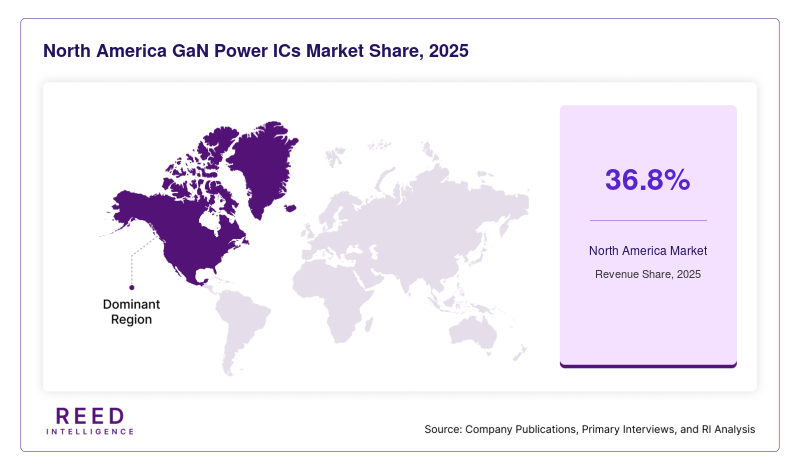
North America held a dominant share of 36.8% in 2025 and is expected to maintain steady growth with a CAGR of 19.8% during 2026–2034. The region benefits from strong technological infrastructure and high adoption of advanced semiconductor solutions. The presence of leading technology companies and early adoption of electric vehicles and renewable energy systems contribute to sustained demand for GaN power ICs. Additionally, increasing investments in data centers and 5G infrastructure further support market expansion.
The United States remains the dominant country in the region due to its advanced semiconductor ecosystem and strong focus on innovation. A key growth factor is the increasing deployment of fast-charging infrastructure for electric vehicles. Government support for clean energy and electrification initiatives is also encouraging the adoption of GaN technology across multiple industries, driving consistent market growth.
Europe
Europe accounted for 24.5% market share in 2025 and is projected to grow at a CAGR of 20.2% during the forecast period. The region is characterized by strong regulatory frameworks promoting energy efficiency and sustainability. Industries across automotive, industrial automation, and renewable energy are adopting GaN power ICs to meet efficiency standards and reduce carbon emissions.
Germany leads the European market due to its strong automotive industry and focus on electric mobility. A unique growth factor is the region’s emphasis on green energy initiatives, which drive the adoption of advanced power electronics. The integration of GaN ICs in renewable energy systems and electric vehicle infrastructure is expected to accelerate growth across the region.
Asia Pacific
Asia Pacific is expected to be the fastest-growing region with a CAGR of 22.4% during 2026–2034, holding a 28.3% share in 2025. Rapid industrialization, increasing consumer electronics production, and expanding telecommunications infrastructure are key factors driving market growth. The region’s strong manufacturing base also supports large-scale production of GaN power ICs.
China dominates the Asia Pacific market due to its extensive electronics manufacturing ecosystem. A major growth factor is the rapid expansion of 5G networks and data centers, which require efficient power management solutions. Government initiatives supporting semiconductor development and local manufacturing further enhance market growth prospects.
Middle East & Africa
The Middle East & Africa region held a 5.6% share in 2025 and is projected to grow at a CAGR of 18.7% during the forecast period. The market is driven by increasing investments in infrastructure and renewable energy projects. The adoption of GaN power ICs is gradually increasing as industries seek energy-efficient solutions.
Saudi Arabia is the leading country in this region due to its focus on diversifying the economy and investing in advanced technologies. A unique growth factor is the development of smart city projects, which require efficient power management systems. These initiatives are expected to boost the adoption of GaN technology in the coming years.
Latin America
Latin America accounted for 4.8% market share in 2025 and is expected to grow at a CAGR of 17.9% during 2026–2034. The region is witnessing gradual adoption of advanced power electronics, particularly in renewable energy and industrial applications. Economic development and infrastructure investments are contributing to market growth.
Brazil leads the Latin American market due to its expanding renewable energy sector. A key growth factor is the increasing adoption of solar energy systems, which require efficient power conversion technologies. The integration of GaN power ICs in these systems is expected to drive market expansion in the region.
Competitive Landscape
The GaN Power ICs Market is moderately competitive, with several key players focusing on innovation and strategic partnerships to strengthen their market position. Companies are investing in research and development to enhance product performance and expand application areas. The market is characterized by the presence of both established semiconductor manufacturers and emerging players specializing in GaN technology.
Infineon Technologies AG is a leading player in the market, known for its extensive portfolio of GaN-based solutions. The company has recently introduced advanced GaN power ICs designed for high-efficiency applications in consumer electronics and automotive sectors. Other companies are also focusing on expanding their production capabilities and forming collaborations to accelerate market growth.
Key Players List
- Infineon Technologies AG
- Texas Instruments Incorporated
- Navitas Semiconductor
- GaN Systems Inc.
- STMicroelectronics
- ON Semiconductor Corporation
- ROHM Semiconductor
- Panasonic Corporation
- Toshiba Corporation
- NXP Semiconductors
- Analog Devices Inc.
- Efficient Power Conversion Corporation
- MACOM Technology Solutions
- Transphorm Inc.
- Renesas Electronics Corporation
Recent Developments
- In 2025, Infineon Technologies launched a new series of GaN power ICs aimed at improving efficiency in fast-charging applications.
- In 2024, Navitas Semiconductor expanded its GaNFast product line to support high-power data center applications.
- In 2025, STMicroelectronics introduced integrated GaN solutions for automotive power systems, enhancing EV performance and efficiency
GaN Power ICs Market Segments
Type
- Discrete GaN ICs
- Integrated GaN Power ICs
Application
- Consumer Electronics
- Electric Vehicles
- Data Centers
- Telecommunications
- Industrial Systems
End-Use Industry
- Consumer Electronics
- Automotive
- Industrial
- Energy & Power
- Aerospace & Defense
By Region
- North America
- Europe
- APAC
- Middle East and Africa
- LATAM