Gardening and Agriculture Equipment Market Size, Share & Trends Analysis Report By Equipment Type, By Application, By Power Source, By End User and By Region, Forecasts 2026–2034
USD 3950
Gardening and Agriculture Equipment Market Size
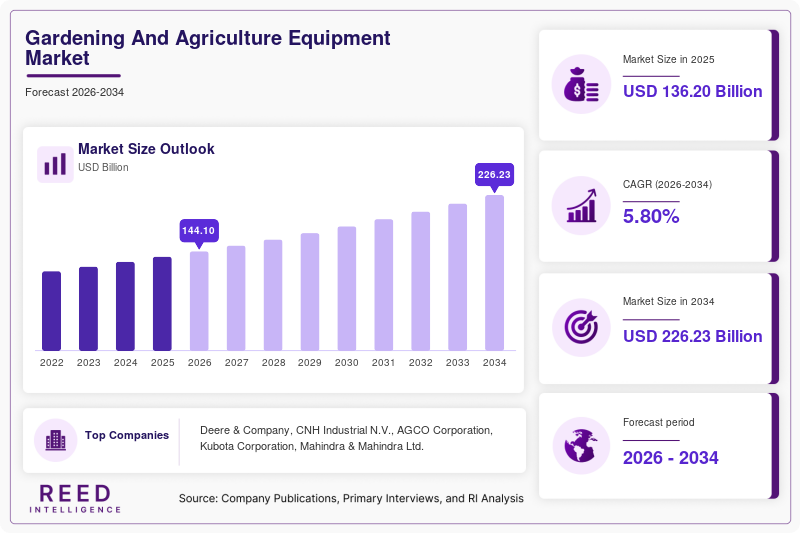
The global gardening and agriculture equipment market was valued at USD 136.20 billion in 2025 and is projected to grow from USD 144.10 billion in 2026 to USD 226.65 billion by 2034, registering a CAGR of 5.80% during the forecast period from 2026 to 2034.
Gardening and agriculture equipment includes machinery and tools used for cultivation, soil preparation, planting, irrigation, crop maintenance, harvesting, landscaping and garden management. The market covers equipment ranging from tractors and cultivators to lawn mowers, tillers, sprayers, irrigation equipment and specialized gardening tools.
Demand is supported by agricultural mechanization, increasing food production requirements, expansion of commercial farming, growth in landscaping activities and rising interest in efficient garden maintenance. Labor shortages and increasing labor costs are also encouraging farmers, landscapers and gardening professionals to adopt mechanized equipment.
Gardening and Agriculture Equipment Market Drivers
Increasing Agricultural Mechanization
Farmers are increasingly adopting machinery to improve productivity, reduce manual labor and complete agricultural operations within shorter timeframes.
Mechanization is particularly important in regions where agricultural labor availability is declining.
Rising Food Production Requirements
Global population growth and changing dietary patterns are increasing the need for agricultural productivity.
Farmers are investing in equipment that can improve land utilization, planting efficiency, crop maintenance and harvesting productivity.
Labor Shortages and Rising Labor Costs
Agricultural and landscaping operations can require substantial manual labor.
Shortages of farm workers and increasing labor costs are encouraging users to replace manual processes with mechanized equipment.
Expansion of Commercial Farming
The growth of large-scale farms and commercial agricultural operations is increasing demand for tractors, harvesters, cultivators, sprayers and other specialized equipment.
Larger farms also have greater requirements for high-capacity and automated machinery.
Growth in Landscaping and Gardening
Urbanization and development of residential communities, commercial properties, parks and recreational areas are supporting demand for gardening and landscaping equipment.
Professional landscaping companies are increasingly using specialized machinery to improve productivity.
Gardening and Agriculture Equipment Market Restraints
High Equipment Costs
Agricultural machinery and advanced gardening equipment can require significant upfront investment.
High acquisition costs can limit adoption among small-scale farmers and household users.
Maintenance and Repair Costs
Agricultural machinery requires periodic servicing, replacement parts and technical maintenance.
Maintenance expenses can increase total ownership costs, particularly for sophisticated equipment.
Seasonal Utilization
Many agricultural machines are used intensively during specific planting, cultivation or harvesting periods.
Lower utilization outside peak seasons can affect purchasing decisions and equipment economics.
Limited Mechanization Among Small Farms
Smallholder farmers may lack access to financing and adequate infrastructure needed to purchase modern agricultural machinery.
This can slow market penetration in certain developing markets.
Gardening and Agriculture Equipment Market Opportunities
Precision Agriculture
GPS guidance, sensors, automated controls and data-driven farm management are creating opportunities for smart agricultural equipment.
Precision technologies can help farmers optimize inputs and improve field productivity.
Battery-Powered Gardening Equipment
Battery-powered lawn mowers, trimmers, blowers and other gardening tools are gaining attention because of their lower local emissions, reduced noise and easier maintenance.
Advances in battery technology are creating opportunities for cordless equipment.
Autonomous Agricultural Machinery
Autonomous tractors, robotic harvesters and automated field equipment can reduce labor requirements and improve operational consistency.
The development of autonomous systems represents a significant long-term opportunity.
Smart Irrigation Equipment
Water scarcity and increasing focus on resource efficiency are supporting demand for irrigation systems equipped with sensors, automated controls and monitoring capabilities.
Equipment Rental and Leasing
High upfront machinery costs are creating opportunities for rental and leasing business models.
These models allow small and medium-sized agricultural operators to access modern equipment without purchasing it outright.
Equipment Type Segment Analysis
By Equipment Type
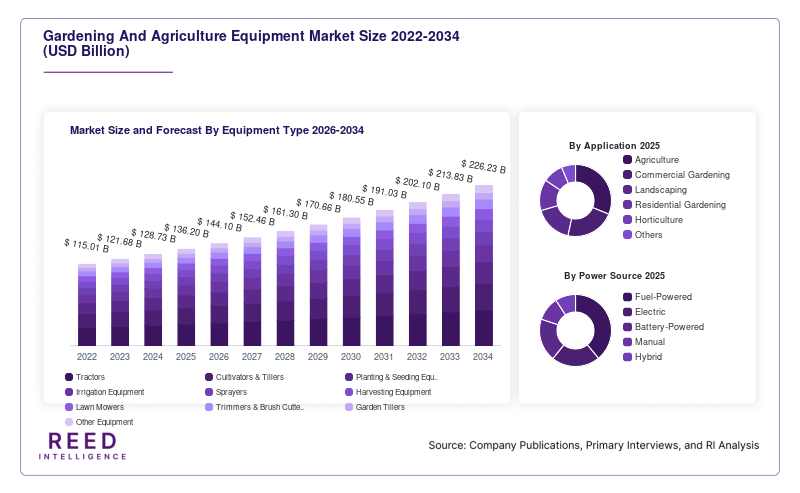
Tractors accounted for approximately 39% of the gardening and agriculture equipment market in 2025, making them the largest equipment segment. Their broad use across soil preparation, planting, cultivation, transportation and other farm activities supports sustained demand.
Battery-powered gardening equipment accounted for approximately 9% and is projected to grow at approximately 9.2% CAGR, making it the fastest-growing major equipment category. Increasing consumer preference for low-noise and lower-maintenance equipment and improvements in battery technology are supporting adoption.
Cultivators and tillers represented approximately 14%, irrigation equipment 11%, harvesting equipment 10%, sprayers 7%, lawn mowers 6%, planting and seeding equipment 5%, and other equipment approximately 8%.
Application Segment Analysis
By Application
Agricultural applications accounted for approximately 67% of the market in 2025, making agriculture the largest application segment. Large-scale crop production requires extensive use of tractors, cultivation machinery, irrigation equipment, sprayers and harvesting machinery.
Commercial gardening and landscaping accounted for approximately 14% and are projected to grow at approximately 7.1% CAGR, making them the fastest-growing major application segment. Urban development, commercial property maintenance and professional landscaping activity are supporting demand.
Residential gardening represented approximately 10%, horticulture 6%, and other applications approximately 3%.
Power Source Segment Analysis
By Power Source
Fuel-powered equipment accounted for approximately 64% of the market in 2025, making it the largest power-source segment. High power requirements and the extensive installed base of conventional agricultural machinery continue to support its position.
Battery-powered equipment accounted for approximately 12% and is projected to grow at approximately 10.2% CAGR, making it the fastest-growing major power-source segment. Improvements in battery capacity, charging technology and equipment performance are supporting adoption.
Electric equipment represented approximately 15%, manual equipment 6%, and hybrid equipment approximately 3%.
End-User Segment Analysis
By End User
Commercial farmers accounted for approximately 46% of the gardening and agriculture equipment market in 2025, making them the largest end-user segment. Large agricultural operations require high-capacity machinery to support extensive cultivation and harvesting activities.
Landscaping companies accounted for approximately 12% and are projected to grow at approximately 7.3% CAGR, making them the fastest-growing major end-user segment. Expansion of commercial landscaping, property development and urban green spaces is supporting equipment demand.
Small and medium farmers represented approximately 25%, gardening professionals 7%, residential users 7%, and government and municipal organizations approximately 3%.
Gardening and Agriculture Equipment Market Regional Analysis
Asia-Pacific Holds the Largest Share
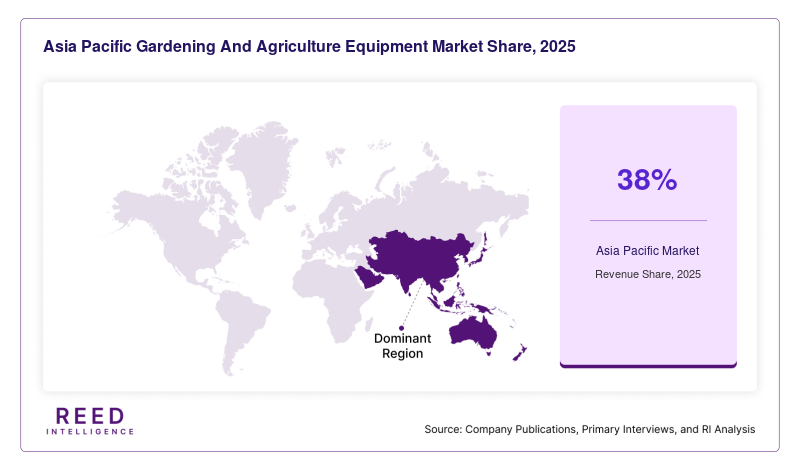
Asia-Pacific accounted for approximately 38% of the global gardening and agriculture equipment market in 2025, making it the largest regional market. The region benefits from extensive agricultural activity, large farming populations, increasing mechanization and growing investment in agricultural productivity.
Asia-Pacific is projected to grow at approximately 6.7% CAGR, making it the fastest-growing major region.
North America Maintains Strong Equipment Demand
North America accounted for approximately 27% of the market in 2025 and is projected to grow at approximately 5.1% CAGR.
Large-scale commercial farming, high machinery adoption and increasing use of precision agriculture technologies support regional demand.
Europe Focuses on Efficient and Sustainable Equipment
Europe accounted for approximately 21% of the market in 2025 and is projected to grow at approximately 4.6% CAGR.
Demand is supported by agricultural modernization, landscaping activity and increasing interest in electric and efficient machinery.
Latin America Shows Expanding Mechanization
Latin America accounted for approximately 9% of the market in 2025 and is projected to grow at approximately 5.8% CAGR.
Large agricultural production areas and continuing farm mechanization are supporting demand for tractors and other agricultural equipment.
Middle East & Africa Represents an Emerging Market
Middle East & Africa accounted for approximately 5% of the market in 2025 and is projected to grow at approximately 5.3% CAGR.
Agricultural modernization, irrigation investment and increasing focus on food production are creating opportunities for equipment manufacturers.
Gardening and Agriculture Equipment Market Competitive Landscape
Competition in the gardening and agriculture equipment market is based on equipment performance, fuel efficiency, durability, automation, precision capabilities, product reliability, dealer networks, financing options and after-sales service.
Major manufacturers are investing in autonomous machinery, connected equipment, electric powertrains, precision agriculture and digital farm-management technologies.
Key Market Players
- Deere & Company
- CNH Industrial N.V.
- AGCO Corporation
- Kubota Corporation
- Mahindra & Mahindra Ltd.
- Yanmar Holdings Co., Ltd.
- Stihl
- Husqvarna Group
- Toro Company
- Kärcher
Gardening and Agriculture Equipment Market Recent Developments
- Farm equipment manufacturers are increasingly integrating GPS, sensors, automated steering and data-management capabilities. These technologies allow farmers to improve field operations and optimize the use of seeds, fertilizers, water and other inputs.
- Manufacturers are developing autonomous tractors and robotic agricultural systems designed to perform field operations with reduced operator intervention. This technology is particularly relevant to farms facing labor shortages.
Gardening And Agriculture Equipment Market Segments
By Equipment Type
- Tractors
- Cultivators & Tillers
- Planting & Seeding Equipment
- Irrigation Equipment
- Sprayers
- Harvesting Equipment
- Lawn Mowers
- Trimmers & Brush Cutters
- Garden Tillers
- Other Equipment
By Application
- Agriculture
- Commercial Gardening
- Landscaping
- Residential Gardening
- Horticulture
- Others
By Power Source
- Fuel-Powered
- Electric
- Battery-Powered
- Manual
- Hybrid
By End User
- Commercial Farmers
- Small & Medium Farmers
- Landscaping Companies
- Gardening Professionals
- Residential Users
- Government & Municipal Organizations
By Region
- North America
- Europe
- APAC
- Middle East and Africa
- LATAM