Gas Delivery Systems Market Size, Share & Demand Report By Equipment Type (Gas Cabinets, Gas Manifolds, Pressure Regulators, Valves, Mass Flow Controllers, Gas Monitoring Systems, Others), By Application (Semiconductor Manufacturing, Chemical Processing, Pharmaceutical Production, Hydrogen Processing, Laboratory Research, Healthcare Facilities, Others), By End-Use Industry (Electronics and Semiconductor, Healthcare and Pharmaceuticals, Chemicals, Energy and Utilities, Renewable Energy, Research
USD 3950
Market Overview
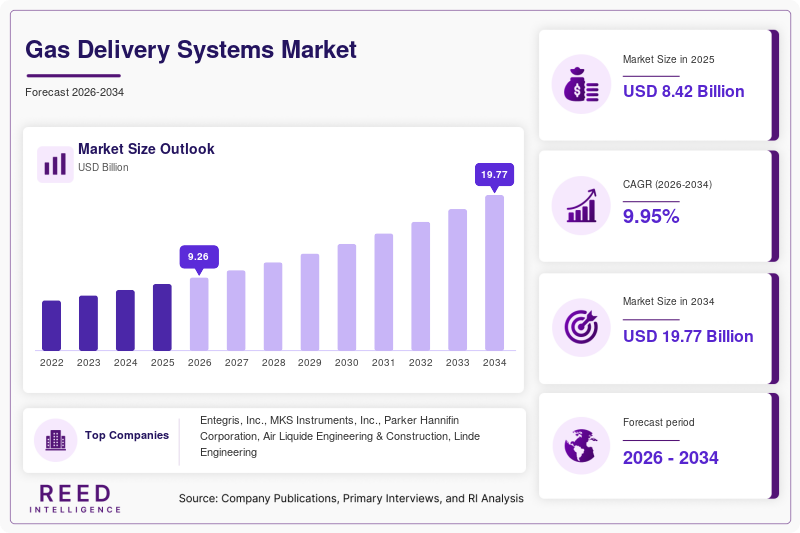
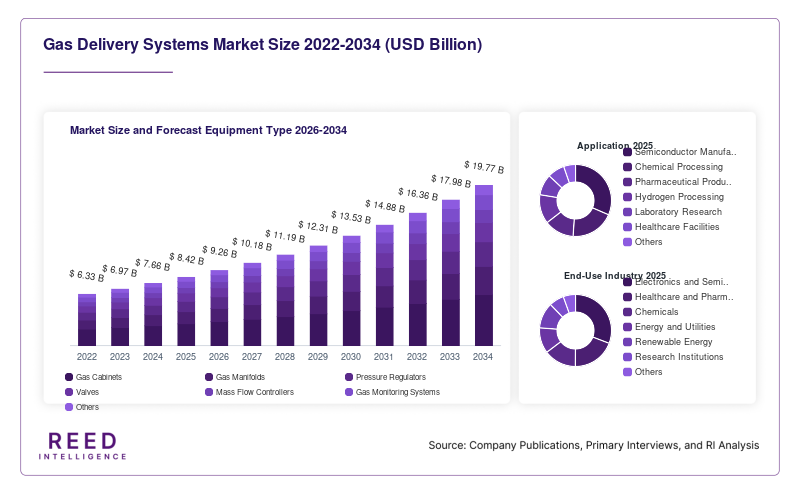
The global Gas Delivery Systems Market size was valued at USD 8.42 billion in 2026 and is projected to reach USD 17.96 billion by 2034, expanding at a CAGR of 9.95% during 2026–2034. Gas delivery systems play a critical role in the safe transportation, regulation, monitoring, and distribution of specialty, industrial, and high-purity gases across manufacturing facilities, laboratories, healthcare institutions, energy plants, and semiconductor fabrication facilities. These systems include gas cabinets, manifolds, regulators, valves, flow controllers, monitoring units, and automated control platforms designed to maintain precise gas flow and operational safety.
A major global factor supporting market growth is the continuous expansion of semiconductor manufacturing and advanced electronics production. The increasing demand for chips used in artificial intelligence infrastructure, electric vehicles, consumer electronics, and industrial automation has intensified the need for reliable high-purity gas management systems. Semiconductor fabrication facilities require accurate gas delivery networks to ensure production consistency and process efficiency. At the same time, investments in clean energy technologies, hydrogen projects, pharmaceutical production, and laboratory research have broadened the adoption of advanced gas delivery infrastructure.
Key Highlights
- North America dominated the market with a 35.1% share in 2025, while Asia Pacific is expected to grow at the fastest CAGR of 11.6% during 2026–2034.
- By equipment type, gas cabinets accounted for the largest share of 36.8%, while mass flow controllers are projected to grow at a CAGR of 12.5%.
- By application, semiconductor manufacturing led with a 42.6% share, whereas hydrogen processing is expected to expand at a CAGR of 13.1%.
- By end-use industry, electronics and semiconductor facilities held the largest share of 44.3%, while the renewable energy sector is projected to grow at a CAGR of 12.8%.
- The United States remained the dominant country, with market values of USD 1.82 billion in 2024 and USD 1.96 billion in 2025.
Market Trends
Integration of Smart Monitoring and Industrial IoT Technologies
The gas delivery systems market is witnessing increasing adoption of Industrial Internet of Things technologies and smart monitoring platforms. Modern facilities require real-time visibility into gas pressure levels, flow rates, leakage conditions, and system performance. Manufacturers are incorporating intelligent sensors, cloud-connected controllers, and predictive analytics software into gas delivery infrastructure to improve operational efficiency. These technologies allow operators to identify performance anomalies before they result in costly shutdowns. Remote monitoring capabilities have become particularly valuable for large semiconductor plants, pharmaceutical manufacturing facilities, and research laboratories that operate continuously. As digital transformation initiatives accelerate across industrial sectors, smart gas delivery systems are expected to become a standard component of advanced manufacturing environments.
Growing Deployment of Hydrogen-Based Infrastructure
The expansion of hydrogen production, storage, and utilization projects is creating significant demand for advanced gas delivery solutions. Governments and private organizations are investing in hydrogen ecosystems to support decarbonization goals and reduce dependence on conventional fuels. Hydrogen applications require highly specialized delivery systems capable of handling pressure-sensitive operations while maintaining strict safety standards. New hydrogen fueling stations, industrial hydrogen processing facilities, and renewable energy projects are increasing investments in precision gas distribution equipment. The trend is encouraging manufacturers to develop delivery systems with enhanced leak detection, corrosion resistance, and automated control features. As hydrogen adoption grows across transportation and industrial sectors, the need for sophisticated gas delivery infrastructure is expected to increase steadily.
Market Drivers
Expansion of Semiconductor Manufacturing Facilities Worldwide
The rapid expansion of semiconductor fabrication plants represents a significant growth driver for the gas delivery systems market. Semiconductor manufacturing processes depend heavily on specialty gases and ultra-high-purity gas delivery networks. Advanced chip production requires precise control of gas flow, pressure, and purity to ensure product quality and yield optimization. Governments across North America, Europe, and Asia Pacific are supporting domestic semiconductor production through substantial investments and incentive programs. New fabrication facilities are generating strong demand for gas cabinets, manifolds, regulators, and flow control systems. Furthermore, rising consumption of artificial intelligence processors, electric vehicle electronics, and data center infrastructure continues to stimulate semiconductor production, creating long-term opportunities for gas delivery system suppliers.
Rising Emphasis on Industrial Safety and Regulatory Compliance
Industrial facilities handling hazardous, toxic, or combustible gases face increasingly stringent safety requirements. Regulatory agencies and industry organizations continue to strengthen standards related to gas storage, transportation, monitoring, and leak prevention. As a result, companies are replacing outdated gas delivery infrastructure with advanced automated systems equipped with safety monitoring capabilities. Modern gas delivery systems help reduce workplace risks, improve operational transparency, and support compliance with evolving regulations. Industries such as pharmaceuticals, chemicals, electronics, healthcare, and energy increasingly view safety investments as essential for operational continuity. This regulatory environment is encouraging widespread modernization efforts and supporting consistent market growth across multiple end-use sectors.
Market Restraint
High Installation Costs and Complex System Integration Requirements
Despite favorable growth prospects, the gas delivery systems market faces challenges associated with high installation costs and integration complexity. Advanced gas delivery networks require substantial capital investment in specialized equipment, monitoring technologies, automation software, and safety infrastructure. Installation often involves extensive engineering assessments, facility modifications, and compliance verification procedures. Small and medium-sized enterprises may find these expenses difficult to justify, particularly when operating under budget constraints. Additionally, integrating new gas delivery platforms into existing production environments can create operational disruptions and require specialized technical expertise. Industries with aging infrastructure frequently encounter compatibility issues that increase implementation timelines and project costs. For example, a manufacturing facility upgrading from conventional gas distribution equipment to a fully automated monitoring system may need extensive redesign of pipelines, control systems, and safety mechanisms. These factors can delay purchasing decisions and limit adoption rates in cost-sensitive markets.
Market Opportunities
Expansion of Green Hydrogen Production Projects
The accelerating development of green hydrogen facilities presents a major opportunity for gas delivery system providers. Governments worldwide are introducing policies that encourage investments in low-carbon energy technologies and hydrogen infrastructure. Green hydrogen production requires sophisticated gas handling equipment capable of maintaining operational reliability and safety throughout production, storage, and distribution processes. Gas delivery system manufacturers can capitalize on this demand by offering specialized solutions designed for hydrogen applications. Enhanced pressure management, advanced monitoring capabilities, and leak detection technologies are becoming essential requirements in hydrogen projects. As new hydrogen production plants continue to emerge across developed and developing economies, demand for customized gas delivery infrastructure is expected to increase substantially.
Growth of Pharmaceutical and Biotechnology Manufacturing
The pharmaceutical and biotechnology industries are increasingly adopting advanced gas delivery systems to support research, development, and manufacturing activities. Laboratory environments and production facilities require highly controlled gas distribution networks to maintain process accuracy and regulatory compliance. Rising investments in biologics, vaccines, cell therapies, and advanced medical treatments are expanding the need for precision gas management solutions. Pharmaceutical manufacturers are also emphasizing contamination control and process consistency, creating opportunities for suppliers offering high-purity gas delivery technologies. The growth of contract manufacturing organizations and biotechnology startups further strengthens market potential. As healthcare innovation continues to accelerate globally, the demand for reliable and efficient gas delivery systems is likely to expand across pharmaceutical value chains.
Segmental Analysis
By Equipment Type
Gas cabinets emerged as the dominant subsegment within the equipment type category, accounting for approximately 36.8% of the market share in 2024. These systems are widely used to store and distribute hazardous and specialty gases while ensuring operational safety and regulatory compliance. Gas cabinets provide integrated safety features, leak detection capabilities, and controlled gas distribution functions that are essential in semiconductor fabrication facilities, laboratories, and industrial processing environments. Their ability to minimize contamination risks and improve workplace safety has made them a preferred solution across industries handling sensitive gases. Growing investments in advanced manufacturing facilities and research laboratories continue to support strong demand for gas cabinet installations worldwide.
Mass flow controllers are expected to be the fastest-growing subsegment, registering a CAGR of 12.5% during the forecast period. These devices enable highly accurate measurement and control of gas flow rates, making them critical components in precision manufacturing processes. Semiconductor fabrication, pharmaceutical production, and specialty chemical processing increasingly depend on advanced flow control technologies to achieve consistent product quality and process optimization. The growing adoption of automated manufacturing systems is creating additional demand for intelligent mass flow controllers equipped with digital monitoring capabilities. As industries continue to prioritize process efficiency and operational accuracy, the deployment of advanced flow control solutions is expected to accelerate significantly.
By Application
Semiconductor manufacturing represented the largest application segment, holding approximately 42.6% of the market share in 2024. Semiconductor production relies heavily on precise gas delivery systems to support etching, deposition, cleaning, and other critical fabrication processes. High-purity gases are essential for maintaining product quality and manufacturing consistency. The increasing global demand for advanced chips used in artificial intelligence, consumer electronics, electric vehicles, and data centers has strengthened investments in semiconductor fabrication facilities. As manufacturers expand production capacity and pursue technological advancements, demand for reliable gas delivery infrastructure continues to grow. This segment remains a primary revenue contributor for market participants.
Hydrogen processing is projected to be the fastest-growing application segment, expanding at a CAGR of 13.1% through 2034. Growing interest in hydrogen as a clean energy carrier is driving investments in hydrogen production, storage, transportation, and utilization infrastructure. These applications require specialized gas delivery systems capable of maintaining safety and performance under demanding operating conditions. Governments and private organizations are supporting hydrogen initiatives as part of broader decarbonization strategies. As hydrogen adoption increases across industrial and transportation sectors, the demand for advanced gas handling technologies is expected to rise substantially, creating significant growth opportunities for equipment manufacturers.
By End-Use Industry
The electronics and semiconductor industry dominated the end-use category, accounting for approximately 44.3% of the market share in 2024. The industry's reliance on specialty gases and high-purity gas distribution systems creates consistent demand for advanced gas delivery equipment. Semiconductor fabrication facilities require highly controlled environments where gas purity and flow precision directly influence production outcomes. The rapid growth of artificial intelligence applications, cloud computing infrastructure, and connected devices continues to drive semiconductor demand globally. Consequently, investments in gas delivery technologies remain a priority for electronics manufacturers seeking to maintain production efficiency, quality standards, and operational reliability.
The renewable energy sector is expected to record the fastest growth, achieving a CAGR of 12.8% during the forecast period. Increasing deployment of hydrogen projects, fuel cell technologies, and clean energy infrastructure is generating demand for advanced gas delivery systems. Renewable energy facilities require reliable gas handling equipment to support production processes while maintaining safety and efficiency. Governments are introducing supportive policies and funding programs to accelerate clean energy adoption, encouraging investments in associated infrastructure. As energy transition initiatives expand worldwide, the renewable energy segment is expected to become an increasingly important source of market growth for gas delivery system providers.
Regional Analysis
North America
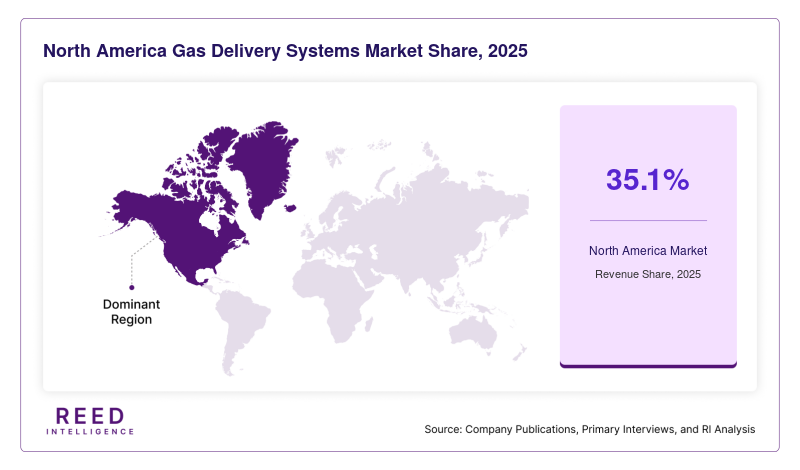
North America accounted for approximately 35.1% of the global gas delivery systems market in 2025 and maintained its position as the leading regional market. The region is expected to expand at a CAGR of 9.2% through 2034, supported by substantial investments in semiconductor manufacturing, healthcare infrastructure, and industrial automation. The presence of major technology companies and advanced manufacturing facilities continues to generate strong demand for high-purity gas management systems. Increasing modernization of production facilities and regulatory compliance requirements further contribute to sustained market growth across the region.
The United States represents the dominant country within North America. A unique growth factor supporting the market is the significant expansion of domestic semiconductor fabrication capacity. Public and private sector investments in advanced chip manufacturing facilities are increasing demand for gas cabinets, flow controllers, and automated gas monitoring platforms. The country's emphasis on technological innovation and supply chain resilience continues to strengthen demand for sophisticated gas delivery infrastructure.
Europe
Europe captured approximately 26.4% of the global market in 2025 and is projected to register a CAGR of 8.8% during the forecast period. Growth is supported by expanding pharmaceutical production, industrial automation initiatives, and sustainability-focused manufacturing investments. European industries continue to adopt advanced gas delivery systems to improve safety standards and operational efficiency. Strong environmental regulations are also encouraging facility upgrades and the implementation of more reliable gas distribution technologies across multiple industrial sectors.
Germany remains the leading country within the European market. A distinctive growth factor is the country's strong industrial engineering and advanced manufacturing ecosystem. German manufacturers are increasingly investing in automated production systems that require precise gas management capabilities. Demand from automotive electronics, chemical processing, and industrial research facilities continues to support steady market expansion while reinforcing the country's leadership position within the region.
Asia Pacific
Asia Pacific represented approximately 24.7% of the global market in 2025 and is forecast to grow at the fastest CAGR of 11.6% through 2034. Rapid industrialization, expanding electronics manufacturing, and rising investments in semiconductor production are major growth contributors. Countries throughout the region are establishing advanced manufacturing hubs to support domestic technology industries and global supply chains. This trend is increasing demand for reliable gas delivery systems capable of supporting high-volume and high-precision production environments.
China dominates the Asia Pacific market due to its extensive manufacturing base and continuous industrial expansion. A unique growth factor is the country's strategic investment in semiconductor self-sufficiency initiatives. Numerous fabrication facilities and electronics manufacturing projects are driving demand for sophisticated gas management equipment. Growing adoption of industrial automation technologies and increasing research activities also contribute to strong market growth throughout the forecast period.
Middle East & Africa
The Middle East & Africa region held approximately 7.2% of the global market in 2025 and is expected to record a CAGR of 9.1% between 2026 and 2034. Market growth is supported by expanding industrial diversification efforts, energy infrastructure investments, and increasing adoption of advanced manufacturing technologies. Governments across the region are focusing on reducing dependence on traditional energy sectors while encouraging industrial development. These initiatives are generating opportunities for gas delivery system suppliers serving energy, chemical, and industrial processing applications.
Saudi Arabia remains the dominant country in the region. A distinctive growth factor is the country's substantial investment in industrial diversification and hydrogen development projects. Large-scale industrial complexes and energy transition initiatives require sophisticated gas handling solutions capable of supporting complex operational environments. Continued investment in petrochemical expansion and clean energy infrastructure is expected to strengthen market demand over the coming years.
Latin America
Latin America accounted for approximately 6.6% of the global gas delivery systems market in 2025 and is anticipated to grow at a CAGR of 8.4% through 2034. Increasing industrial modernization efforts, expanding pharmaceutical production, and investments in energy infrastructure are supporting regional growth. Manufacturers across the region are upgrading production facilities to improve efficiency and comply with evolving safety requirements. These developments are encouraging greater adoption of advanced gas monitoring and delivery technologies.
Brazil leads the Latin American market due to its large industrial base and growing healthcare sector. A unique growth factor is the expansion of domestic pharmaceutical manufacturing capacity. Rising demand for high-quality medical products and laboratory services is increasing the need for reliable gas delivery systems. The country's efforts to strengthen industrial competitiveness and improve manufacturing productivity are expected to support long-term market development.
Competitive Landscape
The gas delivery systems market remains moderately consolidated, with leading companies focusing on product innovation, automation technologies, strategic partnerships, and geographic expansion. Competition is primarily based on system reliability, safety performance, customization capabilities, and technological advancement. Market participants are investing heavily in research and development to address evolving requirements from semiconductor manufacturers, pharmaceutical companies, and hydrogen infrastructure developers.
Entegris, Inc. continues to be a leading market participant due to its extensive portfolio of high-purity gas delivery solutions and strong presence in semiconductor manufacturing applications. The company recently expanded its advanced gas handling product offerings to support next-generation semiconductor fabrication facilities.
Key Players
- Entegris, Inc.
- MKS Instruments, Inc.
- Parker Hannifin Corporation
- Air Liquide Engineering & Construction
- Linde Engineering
- Swagelok Company
- Emerson Electric Co.
- Honeywell International Inc.
- Ichor Systems, Inc.
- Fujikin Incorporated
- Applied Energy Systems, Inc.
- Matheson Tri-Gas, Inc.
- CKD Corporation
- Hitachi High-Tech Corporation
- Taiyo Nippon Sanso Corporation
Recent Developments
- In 2025, a leading gas delivery systems manufacturer expanded its production facility dedicated to high-purity gas handling equipment to meet growing demand from semiconductor fabrication plants and advanced electronics manufacturers.
- In 2025, a major industrial automation company launched a next-generation smart gas delivery platform featuring real-time monitoring, predictive maintenance capabilities, and cloud-based system diagnostics.
- In 2024, a prominent engineering solutions provider introduced advanced hydrogen-compatible gas delivery systems designed to support emerging hydrogen production, storage, and distribution infrastructure projects.
- In 2024, a global gas technology company expanded its portfolio of automated mass flow controllers and pressure regulation systems to enhance precision and safety in pharmaceutical and laboratory applications.
- In 2025, a large industrial equipment manufacturer invested in advanced gas leak detection and remote monitoring technologies to improve operational safety and regulatory compliance across industrial processing facilities.
Gas Delivery Systems Market Segments
Equipment Type
- Gas Cabinets
- Gas Manifolds
- Pressure Regulators
- Valves
- Mass Flow Controllers
- Gas Monitoring Systems
- Others
Application
- Semiconductor Manufacturing
- Chemical Processing
- Pharmaceutical Production
- Hydrogen Processing
- Laboratory Research
- Healthcare Facilities
- Others
End-Use Industry
- Electronics and Semiconductor
- Healthcare and Pharmaceuticals
- Chemicals
- Energy and Utilities
- Renewable Energy
- Research Institutions
- Others
By Region
- North America
- Europe
- APAC
- Middle East and Africa
- LATAM