Gas Leak Detector Market Size, Share & Demand Report By Product Type (Fixed Gas Leak Detectors, Portable Gas Leak Detectors, Wireless Portable Gas Detectors), By Technology (Electrochemical Detection, Infrared Detection, Catalytic Detection), By End-Use Industry (Oil & Gas, Chemicals, Manufacturing, Healthcare, Mining), By Connectivity (Wired Systems, Wireless Systems) & Regional Forecasts, 2026–2034
USD 3950
Market Overview
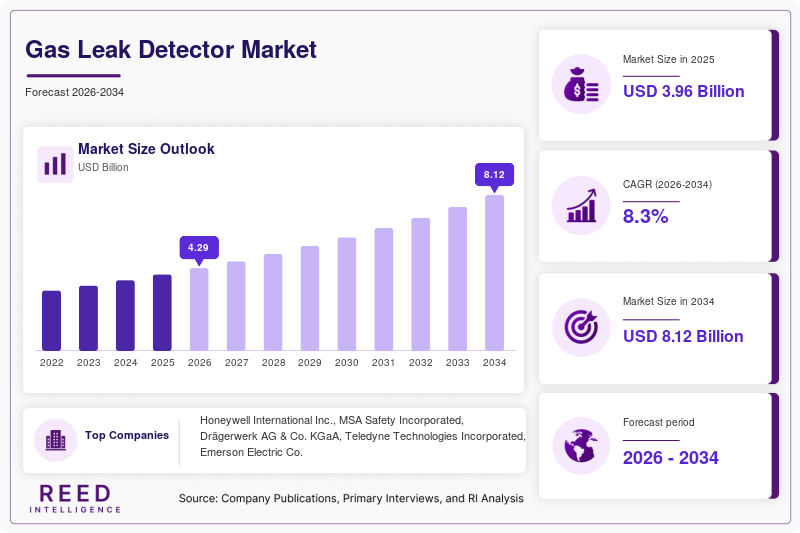
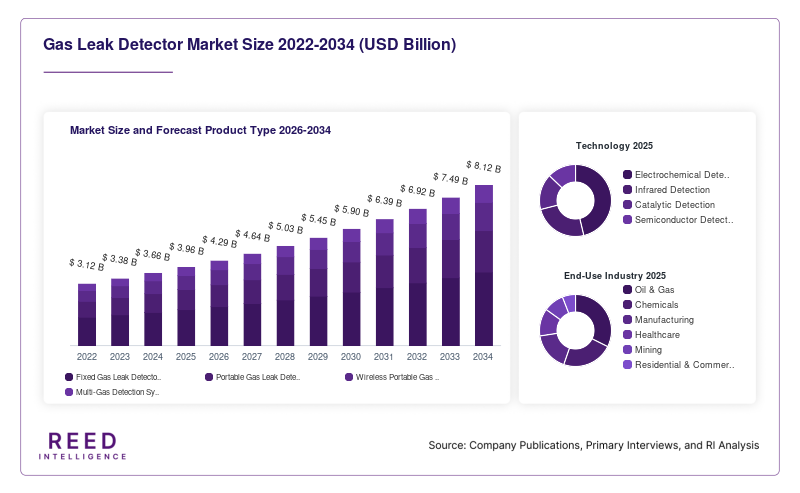
The Gas Leak Detector Market was valued at approximately USD 3.96 billion in 2026 and is projected to reach USD 7.48 billion by 2034, expanding at a CAGR of 8.3% during 2026–2034. The market is experiencing considerable growth due to increasing industrial safety regulations, rising awareness regarding hazardous gas exposure, and expanding deployment of gas monitoring systems across manufacturing, oil & gas, mining, chemicals, healthcare, and residential sectors. Gas leak detectors are becoming essential safety devices because they help identify combustible, toxic, and oxygen-deficient gases before they create operational or health hazards.
One of the primary global factors supporting the growth of the Gas Leak Detector Market is the increasing emphasis on workplace safety and environmental protection standards. Governments and industrial regulatory agencies across major economies are implementing strict occupational safety norms to reduce industrial accidents related to toxic gas exposure and explosions. Industries handling flammable and hazardous gases are increasingly investing in advanced gas monitoring systems to improve employee safety and maintain regulatory compliance. This trend is significantly increasing demand for fixed and portable gas leak detection systems across industrial facilities worldwide.
Key Highlights
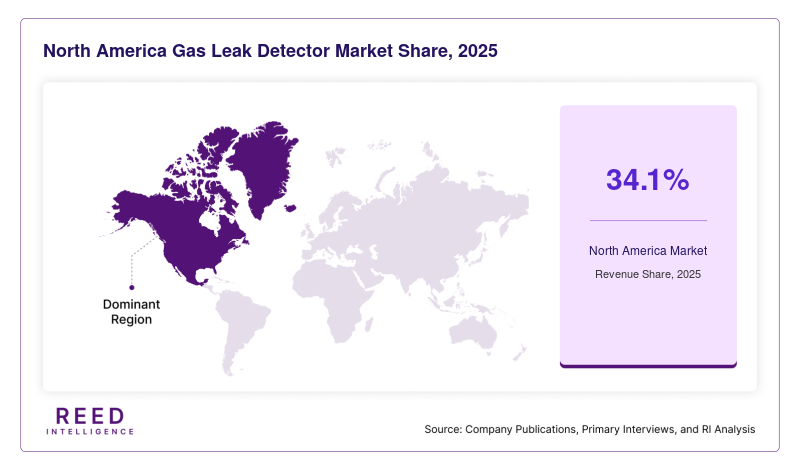
- North America dominated the Gas Leak Detector Market with a market share of 34.1% in 2025.
- Asia Pacific is expected to register the fastest growth with a projected CAGR of 9.4% during 2026–2034.
- By product type, fixed gas leak detectors held the dominant share of 59.6% in 2025.
- By product type, wireless portable gas detectors are projected to grow at a 10.1% CAGR during the forecast period.
- By technology, the electrochemical detection segment accounted for the largest market share in 2025.
- By technology, the infrared gas detection segment is forecast to expand at a 9.8% CAGR through 2034.
- The United States remained the dominant country with market values of approximately USD 924 million in 2024 and USD 1.01 billion in 2025.
Market Trends
Integration of Wireless and IoT-Based Monitoring Systems
The growing integration of wireless connectivity and IoT-enabled safety technologies is a major trend shaping the Gas Leak Detector Market. Industrial operators are increasingly adopting smart gas detection systems capable of transmitting real-time data to centralized monitoring platforms and cloud-based analytics software. These systems help improve workplace safety by enabling continuous monitoring and rapid response during gas leak incidents.
Wireless gas leak detectors are gaining popularity in industries such as oil & gas, mining, and chemicals where large operational environments require flexible safety infrastructure. The integration of predictive maintenance software and remote monitoring solutions is expected to enhance operational efficiency and reduce downtime across industrial facilities.
Increasing Adoption of Multi-Gas Detection Technologies
The demand for multi-gas detection systems is rising significantly across industrial applications. Companies are increasingly investing in advanced detectors capable of monitoring multiple hazardous gases simultaneously, including methane, carbon monoxide, hydrogen sulfide, ammonia, and oxygen levels.
This trend is particularly important in confined industrial spaces and complex manufacturing environments where workers may face exposure to several hazardous gases. Multi-gas detectors help improve safety management and operational reliability, supporting their increasing adoption across industrial and commercial sectors.
Market Drivers
Rising Industrial Safety Regulations Worldwide
Stringent workplace safety regulations remain a major driver of the Gas Leak Detector Market. Governments and regulatory agencies continue to enforce strict safety requirements for industries handling combustible and toxic gases. Companies operating in oil refineries, chemical plants, mining sites, and manufacturing facilities are increasingly required to install advanced gas monitoring systems to comply with occupational safety standards.
The growing focus on accident prevention and environmental risk management is significantly increasing the deployment of gas leak detection equipment across industrial sectors. This trend is expected to continue as industries prioritize worker protection and regulatory compliance.
Expansion of Oil & Gas and Chemical Industries
The continued growth of oil & gas exploration, refining operations, and chemical manufacturing is contributing substantially to the growth of the Gas Leak Detector Market. These industries require continuous monitoring of hazardous gases to prevent explosions, toxic exposure, and operational disruptions.
Gas leak detection systems are widely used across pipelines, storage facilities, offshore platforms, and processing plants. Increasing investment in energy infrastructure and industrial processing facilities continues to create strong demand for advanced gas monitoring technologies.
Market Restraint
High Installation and Maintenance Costs
One of the major restraints affecting the Gas Leak Detector Market is the high cost associated with installation, calibration, and maintenance of advanced gas detection systems. Large industrial facilities often require extensive safety infrastructure and regular sensor maintenance to ensure accurate performance. Small and medium-sized enterprises may face budget limitations when implementing advanced gas monitoring technologies.
Market Opportunities
Increasing Adoption in Smart Buildings and Residential Applications
The expansion of smart homes and intelligent building infrastructure presents significant opportunities for the Gas Leak Detector Market. Residential consumers are increasingly adopting connected safety systems capable of detecting natural gas leaks and transmitting alerts to smartphones or centralized security systems.
The growing awareness regarding home safety and rising adoption of smart building automation technologies are expected to support increased deployment of residential gas leak detection systems over the forecast period.
Growing Demand for Hydrogen Leak Detection Systems
The increasing adoption of hydrogen as an alternative energy source is creating new growth opportunities for the Gas Leak Detector Market. Hydrogen-based energy systems require highly sensitive leak detection technologies because hydrogen is extremely flammable and difficult to detect using conventional methods.
The expansion of hydrogen fueling infrastructure and fuel cell technologies is expected to increase demand for specialized gas leak detection systems capable of supporting clean energy applications.
Segmental Analysis
By Product Type
Fixed gas leak detectors dominated the Gas Leak Detector Market with a market share of 59.6% in 2025. These systems are extensively used in industrial facilities because they provide continuous monitoring and can be integrated with centralized alarm and safety control systems.
Wireless portable gas detectors are projected to witness the fastest CAGR of 10.1% during 2026–2034. Their mobility, real-time connectivity, and suitability for field inspections are expected to support increasing adoption across mining, oil & gas, and emergency response applications.
By Technology
Electrochemical gas detection systems accounted for the largest share of 38.7% in 2025 within the Gas Leak Detector Market. These detectors are widely used because they provide high sensitivity and accurate detection for toxic gases such as carbon monoxide and hydrogen sulfide.
Infrared gas detection systems are expected to expand at a 9.8% CAGR through 2034 due to increasing demand for non-contact gas sensing technologies capable of operating in harsh industrial environments.
By End-Use Industry
The oil & gas industry held the dominant share of 31.5% in 2025 in the Gas Leak Detector Market. Extensive use of hazardous gases in exploration, refining, and transportation operations significantly contributed to segment dominance.
The healthcare industry is projected to register the fastest growth with a 9.2% CAGR during the forecast period due to increasing use of medical gases and rising safety requirements in hospitals and laboratories.
By Connectivity
Wired gas leak detection systems accounted for the largest market share of 63.4% in 2025 because of their reliability and long-term deployment capabilities in industrial facilities.
Wireless connectivity systems are anticipated to witness the fastest CAGR of 10.4% during 2026–2034 due to increasing adoption of IoT-enabled industrial safety infrastructure and remote monitoring technologies.
Regional Analysis
North America
North America accounted for approximately 34.1% of the Gas Leak Detector Market in 2025 and is projected to grow at a 7.8% CAGR during 2026–2034. The United States dominated the regional market due to strong industrial safety regulations and increasing investment in industrial automation technologies.
The region benefits from extensive oil & gas infrastructure, advanced manufacturing operations, and high adoption of workplace safety technologies. Increasing deployment of connected industrial monitoring systems continues to support regional market growth.
Europe
Europe held a market share of 28.6% in 2025 and is expected to expand at a 7.5% CAGR through 2034. Germany remained the dominant country because of its strong manufacturing sector and emphasis on industrial safety compliance.
European industries are increasingly adopting advanced gas monitoring systems to improve operational safety and environmental protection. The region also benefits from increasing adoption of smart factory technologies and industrial IoT systems.
Asia Pacific
Asia Pacific represented 24.9% of the global Gas Leak Detector Market in 2025 and is anticipated to register the fastest CAGR of 9.4% during 2026–2034. China dominated the regional market because of rapid industrialization, growing chemical manufacturing activities, and expanding energy infrastructure investments.
The region is witnessing substantial growth in manufacturing facilities, oil refining operations, and mining activities. Rising industrial safety awareness and increasing regulatory enforcement are supporting regional market expansion.
Middle East & Africa
The Middle East & Africa accounted for 7.1% of the Gas Leak Detector Market in 2025 and is projected to grow at a 8.1% CAGR during the forecast period. Saudi Arabia remained the dominant country because of extensive oil & gas production activities and increasing investment in industrial safety systems.
The region continues to witness strong demand for gas monitoring technologies across energy production, petrochemical processing, and industrial infrastructure projects.
Latin America
Latin America held approximately 5.3% market share in 2025 and is expected to expand at a 7.6% CAGR through 2034. Brazil dominated the regional market due to increasing industrial production activities and growing investment in workplace safety systems.
The expansion of chemical processing facilities and energy infrastructure projects continues to create favorable conditions for market growth across the region.
Competitive Landscape
The Gas Leak Detector Market remains highly competitive, with manufacturers focusing on sensor innovation, wireless technologies, and smart industrial safety solutions.
Honeywell International Inc. emerged as a leading participant due to its broad industrial safety product portfolio and strong global distribution network. The company recently introduced advanced wireless gas monitoring systems integrated with cloud-based industrial analytics platforms.
MSA Safety Incorporated continues to focus on connected worker safety technologies and multi-gas monitoring systems. Drägerwerk AG & Co. KGaA remains active in industrial and healthcare gas detection solutions. Teledyne Technologies Incorporated is investing in advanced infrared gas sensing technologies. Emerson Electric Co. continues to expand industrial automation and integrated gas monitoring capabilities.
Key Players List
- Honeywell International Inc.
- MSA Safety Incorporated
- Drägerwerk AG & Co. KGaA
- Teledyne Technologies Incorporated
- Emerson Electric Co.
- Siemens AG
- ABB Ltd.
- Industrial Scientific Corporation
- RIKEN KEIKI Co., Ltd.
- New Cosmos Electric Co., Ltd.
- Sensidyne LP
- Trolex Ltd.
- Yokogawa Electric Corporation
- Crowcon Detection Instruments Ltd.
- Bacharach Inc.
Recent Developments
- In 2025, several manufacturers introduced AI-enabled gas monitoring systems capable of predictive leak analysis and automated emergency alerts.
- Honeywell International Inc. expanded its wireless industrial gas detection portfolio for smart manufacturing environments.
- Industrial safety companies increased investments in hydrogen leak detection technologies to support clean energy infrastructure development.
- Multiple industrial facilities upgraded from conventional wired systems to cloud-connected gas monitoring platforms.
- Gas detector manufacturers expanded development of compact multi-gas monitoring devices designed for wearable industrial safety applications.
Gas Leak Detector Market Segments
Product Type
- Fixed Gas Leak Detectors
- Portable Gas Leak Detectors
- Wireless Portable Gas Detectors
- Multi-Gas Detection Systems
Technology
- Electrochemical Detection
- Infrared Detection
- Catalytic Detection
- Semiconductor Detection
End-Use Industry
- Oil & Gas
- Chemicals
- Manufacturing
- Healthcare
- Mining
- Residential & Commercial Buildings
Connectivity
- Wired Systems
- Wireless Systems
- Cloud-Integrated Monitoring Systems
By Region
- North America
- Europe
- APAC
- Middle East and Africa
- LATAM