Gasketed Plate Heat Exchanger Market Size, Share Demand Report By Type (Single-pass, Multi-pass), By Material (Stainless Steel, Titanium, Nickel, Others), By Application (HVAC Systems, Food & Beverage Processing, Chemical Processing, Power Generation, Others), By End-Use Industry (Chemical Industry, Pharmaceutical Industry, Oil & Gas, Energy & Power, Others), By Region & Segment Forecasts, 2026–2034
USD 3950
Market Overview
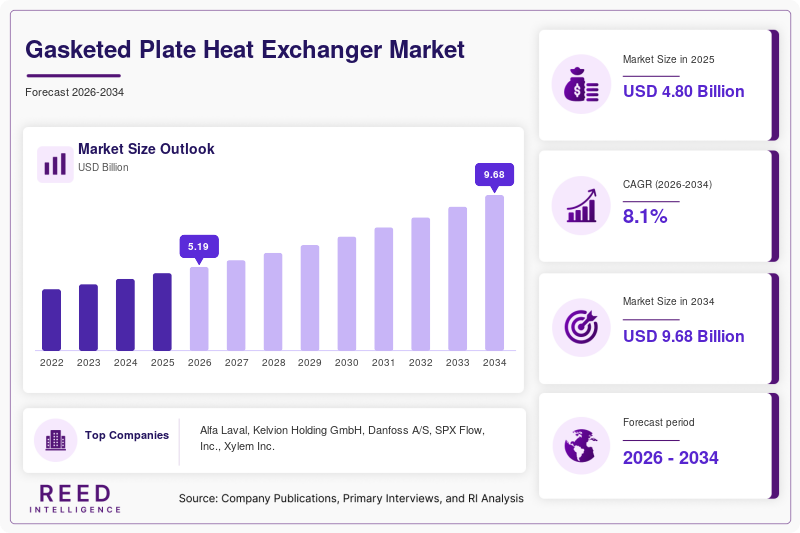
The Gasketed Plate Heat Exchanger Market was valued at USD 4.8 billion in 2026 and is projected to reach USD 8.9 billion by 2034, expanding at a CAGR of 8.1% during the forecast period (2026–2034). The market has demonstrated steady expansion driven by increasing demand for efficient thermal management systems across industries such as food processing, chemical manufacturing, HVAC, and power generation.
A key global factor supporting market growth is the rising emphasis on energy efficiency and carbon footprint reduction. Industries are increasingly adopting advanced heat exchange systems that minimize energy consumption while maximizing operational performance. Gasketed plate heat exchangers, known for their high heat transfer efficiency and flexibility, have become a preferred solution in energy-intensive applications.
Key Highlights:
- North America dominated the market with 34.2% share in 2025, while Asia Pacific is expected to register the fastest growth at a CAGR of 9.4%.
- By type, single-pass gasketed plate heat exchangers led with 41.6% share, while multi-pass systems are projected to grow at a CAGR of 8.9%.
- By application, HVAC systems held the largest share at 38.5%, whereas food & beverage processing is expected to grow at a CAGR of 9.1%.
- The United States remained the dominant country, with market values of USD 1.12 billion in 2024 and USD 1.19 billion in 2025.
Market Trends
Modular and Compact System Adoption
Industries are increasingly adopting compact, modular gasketed plate heat exchangers to optimize space utilization and simplify maintenance. These systems offer scalability and are particularly suitable for retrofitting in existing industrial setups.
Digital Monitoring Integration
The integration of IoT-enabled monitoring and predictive maintenance tools is transforming operational efficiency. Real-time performance tracking and automated alerts are helping reduce downtime and improve lifecycle management.
Market Drivers
Rising Demand for Energy-Efficient Equipment
The growing need to reduce operational costs and meet environmental regulations is driving the adoption of energy-efficient heat transfer solutions. Gasketed plate heat exchangers offer superior thermal efficiency compared to traditional systems, making them an attractive option across multiple industries.
Expansion of Process Industries
Rapid growth in industries such as chemicals, pharmaceuticals, and food processing is increasing the demand for reliable heat exchange systems. The flexibility and ease of maintenance associated with gasketed plate heat exchangers make them suitable for diverse industrial processes.
Market Restraint
Maintenance and Gasket Replacement Costs
Frequent maintenance requirements and periodic gasket replacement can increase operational costs. This factor may limit adoption in cost-sensitive industries, particularly in regions with limited access to skilled maintenance services.
Market Opportunities
Growth in Renewable Energy Applications
The increasing deployment of renewable energy systems, such as geothermal and solar thermal plants, presents new opportunities for gasketed plate heat exchangers. Their ability to handle variable temperatures and pressures makes them suitable for these applications.
Expansion in Emerging Economies
Rapid industrialization in emerging markets is creating demand for efficient thermal management solutions. Increasing investments in infrastructure and manufacturing sectors are expected to open new growth avenues for market players.
Segmental Analysis
By Type
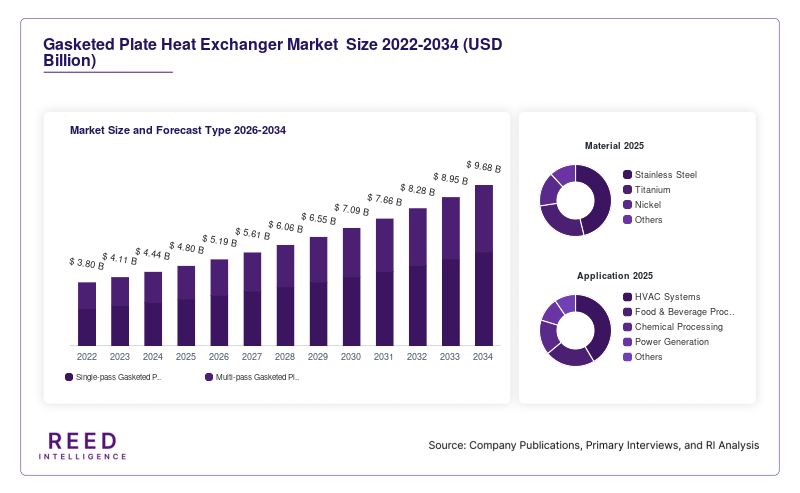
Single-pass gasketed plate heat exchangers dominated the market, accounting for 41.6% share in 2025 due to their simplicity and cost-effectiveness in standard applications.
Multi-pass gasketed plate heat exchangers are expected to witness the fastest growth, with a projected CAGR of 8.9%, driven by their ability to handle complex thermal requirements in industrial processes.
By Material
Stainless steel-based heat exchangers held the largest share of 52.3% in 2025, owing to their corrosion resistance and durability.
Titanium-based systems are anticipated to grow at a CAGR of 9.2%, supported by increasing demand in marine and chemical applications where high corrosion resistance is required.
By Application
HVAC systems dominated the application segment with a 38.5% share in 2025, driven by widespread use in commercial and residential buildings.
Food and beverage processing is expected to grow at a CAGR of 9.1%, fueled by increasing demand for hygienic and efficient heat exchange solutions.
By End-Use Industry
The chemical industry accounted for 33.7% share in 2025, supported by extensive use in process heating and cooling applications.
The pharmaceutical industry is projected to grow at a CAGR of 9.0%, driven by stringent temperature control requirements and increasing production capacity.
Regional Analysis
North America
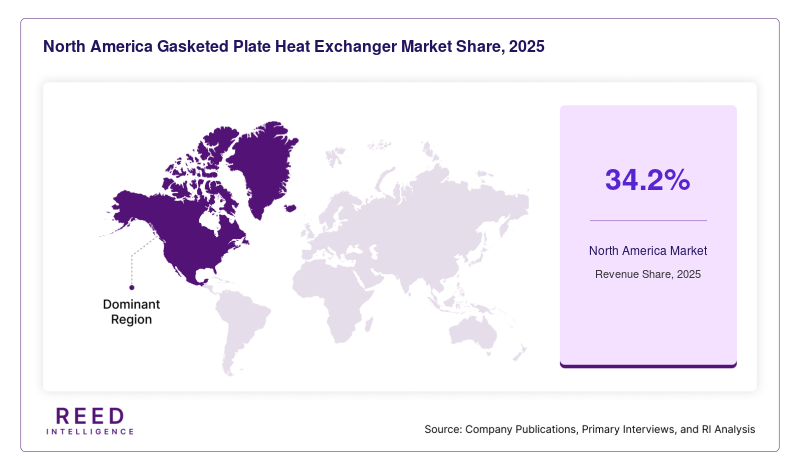
North America accounted for 34.2% of the market share in 2025 and is expected to grow at a CAGR of 7.6% during 2026–2034. The United States dominated the region due to strong industrial infrastructure and adoption of advanced technologies. The presence of established HVAC and chemical industries has contributed significantly to market growth.
Europe
Europe held 27.5% market share in 2025 and is projected to grow at a CAGR of 7.8%. Germany emerged as the dominant country, supported by its robust manufacturing sector and focus on energy efficiency regulations. Stringent environmental policies have encouraged the adoption of advanced heat exchange systems.
Asia Pacific
Asia Pacific captured 22.8% of the market share in 2025 and is anticipated to expand at the fastest CAGR of 9.4%. China led the region, driven by rapid industrialization and infrastructure development. Increasing investments in power generation and chemical industries are fueling market growth.
Middle East & Africa
The Middle East & Africa region held 8.1% share in 2025 and is expected to grow at a CAGR of 8.2%. Saudi Arabia dominated the region due to its strong oil and gas sector. The need for efficient heat transfer solutions in energy-intensive industries is driving demand.
Latin America
Latin America accounted for 7.4% market share in 2025 and is projected to grow at a CAGR of 8.0%. Brazil emerged as the leading country, supported by expanding food processing and industrial sectors. Increasing focus on energy efficiency is contributing to market expansion.
Competitive Landscape
The Gasketed Plate Heat Exchanger Market is characterized by the presence of established global players and regional manufacturers. Companies are focusing on product innovation, energy efficiency, and digital integration to strengthen their market position. The competitive environment is moderately consolidated, with leading firms investing in research and development to enhance product performance and durability.
Alfa Laval is recognized as a market leader, offering a wide range of high-performance gasketed plate heat exchangers. The company recently introduced an advanced product line featuring improved thermal efficiency and reduced maintenance requirements. Other key players are adopting strategies such as mergers, partnerships, and geographic expansion to increase their market presence.
Manufacturers are also emphasizing customization to meet specific industry requirements. The growing demand for energy-efficient solutions and digital monitoring capabilities is expected to intensify competition among market participants over the forecast period.
Key Players List
- Alfa Laval
- Kelvion Holding GmbH
- Danfoss A/S
- SPX Flow, Inc.
- Xylem Inc.
- Hisaka Works Ltd.
- API Heat Transfer Inc.
- Tranter Inc.
- SWEP International AB
- GEA Group AG
- HRS Heat Exchangers Ltd.
- Thermowave GmbH
- Funke Wärmeaustauscher Apparatebau GmbH
- Barriquand Technologies Thermiques
- Sondex A/S
Recent Developments
- Alfa Laval launched a new series of energy-efficient gasketed plate heat exchangers with enhanced durability.
- Danfoss expanded its production capacity to meet growing demand in Asia Pacific.
- Kelvion introduced digital monitoring solutions for predictive maintenance.
- SPX Flow announced a strategic partnership to strengthen its distribution network.
- GEA Group invested in R&D to develop next-generation heat exchange technologies.
Gasketed Plate Heat Exchanger Market Segments
Type
- Single-pass Gasketed Plate Heat Exchangers
- Multi-pass Gasketed Plate Heat Exchangers
Material
- Stainless Steel
- Titanium
- Nickel
- Others
Application
- HVAC Systems
- Food & Beverage Processing
- Chemical Processing
- Power Generation
- Others
End-Use Industry
- Chemical Industry
- Pharmaceutical Industry
- Oil & Gas
- Energy & Power
- Others
By Region
- North America
- Europe
- APAC
- Middle East and Africa
- LATAM