Gellan Gum Market Size, Share Demand Report By Type (High-Acyl Gellan Gum, Low-Acyl Gellan Gum), By Application (Food & Beverage, Pharmaceuticals, Personal Care, Industrial), By Form (Powder, Liquid), By Function (Stabilizer, Gelling Agent, Thickener, Emulsifier), By Region & Segment Forecasts, 2026–2034
USD 3950
Market Overview
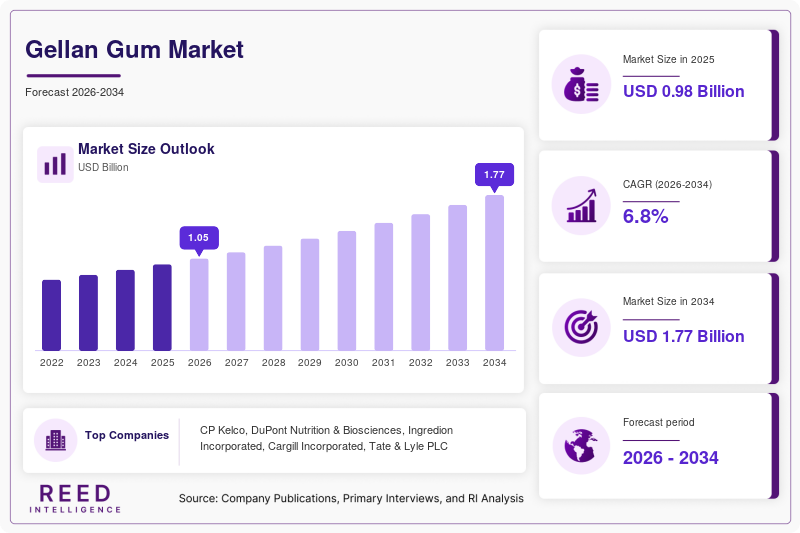
The global Gellan Gum Market size was estimated at USD 1.05 billion in 2026 and is projected to reach approximately USD 1.78 billion by 2034, expanding at a CAGR of 6.8% during the forecast period (2026–2034). Gellan gum, a high-performance polysaccharide widely used as a gelling, stabilizing, and thickening agent, has gained increasing traction across food & beverages, pharmaceuticals, and personal care industries due to its superior functional properties and plant-based origin.
A key global factor supporting market expansion is the rising demand for clean-label and vegan ingredients across food formulations. Manufacturers are increasingly replacing synthetic additives with naturally derived hydrocolloids such as gellan gum, which offers excellent thermal stability and versatility across a wide pH range. This shift aligns with evolving consumer preferences for transparency, sustainability, and health-conscious consumption patterns.
Key Highlights:
- North America dominated the market with a 34.2% share in 2025, while Asia Pacific is projected to grow at the fastest CAGR of 7.6% during 2026–2034.
- The food & beverage application segment led with 52.8% share, whereas pharmaceutical applications are expected to grow at a CAGR of 7.9%.
- High-acyl gellan gum accounted for the largest type segment share at 58.5%, while low-acyl gellan gum is forecasted to grow at 7.4% CAGR.
- The U.S. remained the dominant country with market values of USD 315 million in 2024 and USD 332 million in 2025.
Market Trends
Rising Adoption in Plant-Based and Functional Foods
The increasing popularity of plant-based diets is influencing ingredient selection in food processing. Gellan gum is widely used in dairy alternatives, plant-based beverages, and vegan desserts due to its ability to mimic the texture and stability of traditional ingredients like gelatin. It also enhances mouthfeel without adding calories, making it suitable for low-fat and functional foods. Food manufacturers are leveraging this property to innovate new product lines that meet consumer demand for health-focused and sustainable food solutions.
Expansion in Pharmaceutical and Biomedical Applications
Another emerging trend shaping the Gellan Gum Market is its growing utilization in pharmaceutical formulations and biomedical applications. Gellan gum is used in controlled drug delivery systems, ophthalmic solutions, and tissue engineering due to its biocompatibility and gel-forming ability. Its role in sustained-release formulations has gained importance as pharmaceutical companies focus on improving drug efficacy and patient compliance. Additionally, ongoing research into hydrogel-based drug delivery systems is expected to further strengthen its position in advanced healthcare applications.
Market Drivers
Increasing Demand for Clean-Label Ingredients
Consumers are increasingly scrutinizing product labels, driving manufacturers to adopt natural and recognizable ingredients. Gellan gum, derived through fermentation processes, fits well within the clean-label movement. Its multifunctional properties allow manufacturers to reduce the number of additives in formulations, thereby enhancing product appeal. This trend is particularly strong in developed markets, where regulatory bodies and consumer awareness are shaping purchasing decisions.
Functional Versatility Across Industries
Gellan gum’s ability to perform multiple roles—such as stabilizer, emulsifier, and thickener—has made it highly valuable across industries. In beverages, it prevents sedimentation; in confectionery, it provides structure; and in pharmaceuticals, it ensures controlled release. This versatility reduces formulation complexity and improves product consistency, encouraging its adoption in new applications. As industries continue to prioritize efficiency and performance, the demand for multifunctional ingredients like gellan gum is expected to increase steadily.
Market Restraint
High Production and Processing Costs
One of the primary restraints impacting the Gellan Gum Market is the relatively high cost associated with its production and purification processes. Gellan gum is produced through microbial fermentation, which requires controlled conditions, specialized equipment, and stringent quality standards. These factors contribute to higher manufacturing costs compared to conventional hydrocolloids such as gelatin or starch-based thickeners.
Additionally, fluctuations in raw material availability and energy costs further impact overall pricing. Small and medium-scale manufacturers often face challenges in adopting gellan gum due to its higher price point, especially in cost-sensitive markets. This limits its penetration in certain regions where affordability plays a significant role in ingredient selection.
Moreover, the availability of alternative hydrocolloids such as xanthan gum and carrageenan poses competitive pressure. These substitutes offer similar functional benefits at comparatively lower costs, making them more attractive for budget-conscious applications.
Despite its advantages, the cost factor remains a critical barrier, particularly in emerging economies where price sensitivity is high. Addressing this restraint will require technological advancements in production processes and improved economies of scale to make gellan gum more accessible across diverse applications.
Market Opportunities
Growth in Nutraceutical and Functional Beverage Sector
The expanding nutraceutical and functional beverage industry presents a promising opportunity for the Gellan Gum Market. As consumers seek products that offer health benefits beyond basic nutrition, manufacturers are incorporating ingredients that enhance stability and texture without compromising nutritional value. Gellan gum’s ability to suspend particles uniformly in beverages makes it ideal for fortified drinks, protein shakes, and vitamin-enriched formulations. This application is expected to gain traction as demand for functional beverages continues to rise globally.
Advancements in Biopolymer and Hydrogel Technologies
Technological advancements in biopolymer research are opening new avenues for gellan gum in high-value applications. Its use in hydrogel formation has significant potential in areas such as wound care, regenerative medicine, and bioengineering. Researchers are exploring modified gellan gum formulations to improve mechanical strength and responsiveness to environmental stimuli. These innovations could expand its application scope beyond traditional industries, creating new revenue streams and driving long-term market growth.
Segmental Analysis
By Type
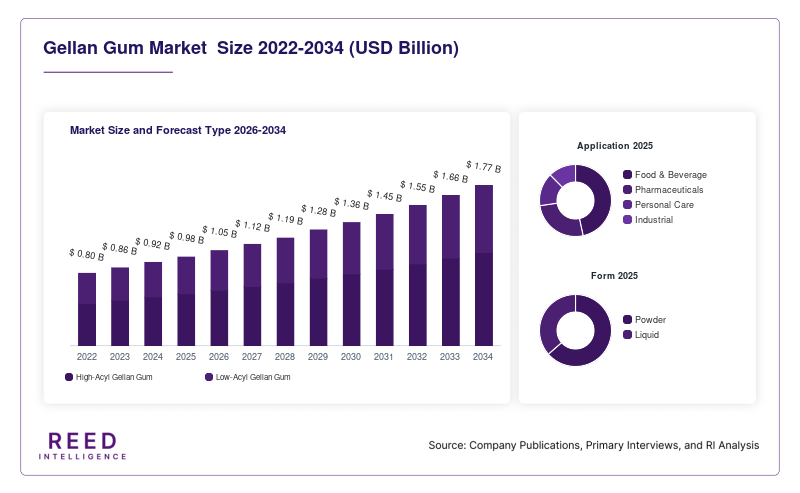
High-acyl gellan gum dominated the segment with a 58.5% share in 2025. Its ability to form soft and elastic gels made it suitable for applications requiring smooth textures, particularly in dairy alternatives and desserts.
Low-acyl gellan gum is projected to grow at a CAGR of 7.4% during the forecast period. Its capability to form firm and brittle gels will drive its adoption in confectionery and structured food products where rigidity is essential.
By Application
The food & beverage segment held the largest share of 52.8% in 2025. Its widespread use in beverages, sauces, and desserts supported its dominance.
The pharmaceutical segment is expected to grow at a CAGR of 7.9%. Increasing demand for controlled drug delivery systems and advanced formulations will drive growth in this segment.
By Form
Powdered gellan gum accounted for the largest share of 64.3% in 2025 due to its ease of handling and long shelf life. It is widely used in industrial applications where consistency is required.
Liquid gellan gum is anticipated to grow at a CAGR of 6.9% as manufacturers seek ready-to-use formulations for improved processing efficiency.
By Function
The stabilizing agent segment dominated with a 41.7% share in 2025, driven by its role in maintaining product consistency and preventing ingredient separation.
The gelling agent segment is projected to grow at a CAGR of 7.2%, supported by its increasing use in innovative food textures and pharmaceutical gels.
Regional Analysis
North America
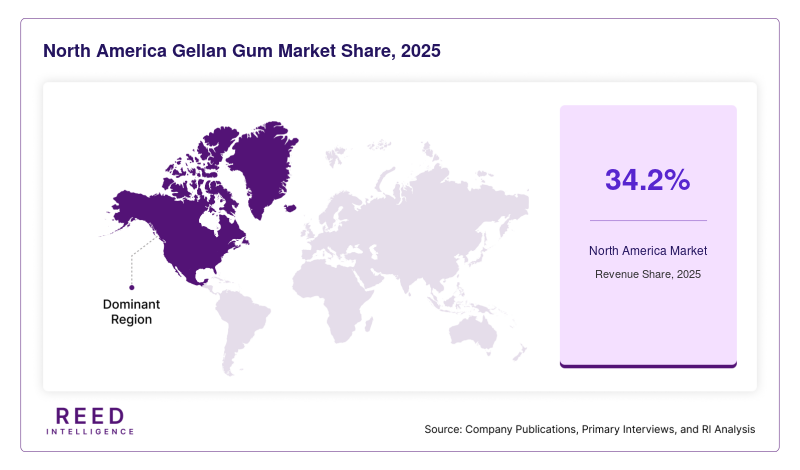
North America accounted for 34.2% of the Gellan Gum Market share in 2025 and is expected to grow at a CAGR of 6.1% during the forecast period. The region’s mature food processing industry and strong demand for clean-label products supported its dominant position.
The United States led the regional market due to its advanced food innovation ecosystem. The country’s focus on plant-based food development and functional beverages contributed significantly to the adoption of gellan gum in various formulations.
Europe
Europe held a 26.5% market share in 2025 and is projected to expand at a CAGR of 6.3% through 2034. Stringent regulations promoting natural additives and sustainable ingredients supported market growth in the region.
Germany emerged as the dominant country, driven by its well-established food manufacturing sector and emphasis on high-quality ingredients. The demand for organic and specialty food products further strengthened the market outlook.
Asia Pacific
Asia Pacific captured 22.8% of the market share in 2025 and is anticipated to grow at the fastest CAGR of 7.6% during the forecast period. Rapid urbanization and increasing consumption of processed foods contributed to regional growth.
China dominated the region, supported by its large-scale food production industry and expanding pharmaceutical sector. The growing middle-class population and rising disposable income further accelerated demand.
Middle East & Africa
The Middle East & Africa accounted for 8.1% of the market share in 2025 and is expected to grow at a CAGR of 6.5% through 2034. Increasing demand for packaged food products and improving retail infrastructure supported market expansion.
Saudi Arabia led the region, driven by its growing food processing industry and increasing adoption of advanced ingredients in product formulations.
Latin America
Latin America held an 8.4% share of the Gellan Gum Market in 2025 and is projected to grow at a CAGR of 6.7% during the forecast period. Rising consumption of convenience foods and beverages contributed to market growth.
Brazil emerged as the dominant country due to its expanding food & beverage industry and increasing focus on product innovation. The country’s growing urban population further supported demand.
Competitive Landscape
The Gellan Gum Market is moderately consolidated, with key players focusing on product innovation, capacity expansion, and strategic partnerships. Leading companies are investing in research to enhance product functionality and expand application areas.
CP Kelco remains a market leader, supported by its extensive product portfolio and global distribution network. The company recently introduced advanced gellan gum variants designed for improved performance in plant-based beverages, strengthening its competitive position.
Other players are emphasizing sustainability and clean-label solutions to align with evolving market trends. Strategic collaborations with food and pharmaceutical manufacturers are also contributing to market growth.
Key Players List
- CP Kelco
- DuPont Nutrition & Biosciences
- Ingredion Incorporated
- Cargill Incorporated
- Tate & Lyle PLC
- DSM-Firmenich
- Ashland Global Holdings Inc.
- Fufeng Group
- Zhejiang Tech-Way Biochemical Co., Ltd.
- Hebei Xinhe Biochemical Co., Ltd.
- Inner Mongolia Rainbow Biotech Co., Ltd.
- Sinofi Ingredients
- Shandong Fufeng Fermentation Co., Ltd.
- Deosen Biochemical Ltd.
- Hawkins Watts Limited
Recent Developments
- CP Kelco launched a new gellan gum solution tailored for plant-based dairy alternatives.
- Ingredion Incorporated expanded its hydrocolloid production capacity to meet rising demand.
- Cargill Incorporated introduced clean-label texturizing solutions incorporating gellan gum.
- Tate & Lyle PLC focused on sustainable ingredient sourcing and product innovation.
- DSM-Firmenich invested in research for advanced biopolymer applications.
Gellan Gum Market Segments
Type
- High-Acyl Gellan Gum
- Low-Acyl Gellan Gum
Application
- Food & Beverage
- Pharmaceuticals
- Personal Care
- Industrial
Form
- Powder
- Liquid
Function
- Stabilizer
- Gelling Agent
- Thickener
- Emulsifier
By Region
- North America
- Europe
- APAC
- Middle East and Africa
- LATAM