Germanium IR Camera Market Size, Share & Demand Report By Type (Cooled IR Cameras, Uncooled IR Cameras), By Application (Industrial Inspection, Surveillance & Security, Medical Imaging, Automotive, Others), By End-Use Industry (Defense & Military, Industrial, Healthcare, Commercial), By Wavelength (Short-Wave IR, Mid-Wave IR, Long-Wave IR), By Region & Segment Forecasts, 2025–2034
USD 3950
Market Overview
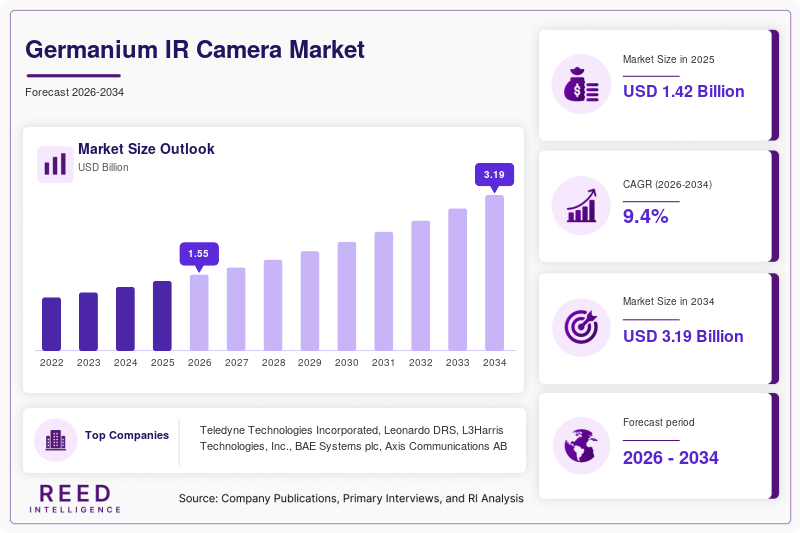
The Germanium IR Camera Market size was valued at USD 1.42 billion in 2025 and is projected to reach approximately USD 3.18 billion by 2034, expanding at a CAGR of 9.4% during 2025–2034. The market growth has been primarily supported by the increasing global demand for advanced thermal imaging technologies across industrial inspection, defense, and surveillance applications. Germanium lenses, known for their superior infrared transmission properties, play a critical role in enhancing the performance of IR cameras, thereby driving widespread adoption.
A key global factor supporting market expansion is the rising need for predictive maintenance and safety monitoring in industrial environments. Companies are increasingly deploying infrared cameras to detect heat anomalies in machinery, reducing downtime and improving operational efficiency. Additionally, growing investments in smart infrastructure and automation are further contributing to market growth.
Key Highlights
- North America dominated the market with 36.8% share in 2025, while Asia Pacific is expected to grow at the fastest CAGR of 11.2% during the forecast period.
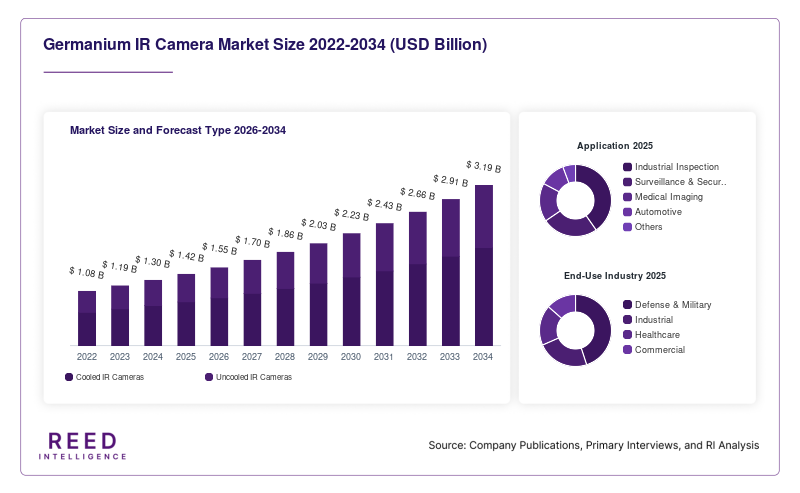
- By type, cooled IR cameras led the market with 58.4% share, whereas uncooled IR cameras are projected to grow at a CAGR of 10.1%.
- By application, industrial inspection accounted for the largest share, while medical imaging is expected to be the fastest-growing segment at a CAGR of 10.8%.
- The U.S. remained the dominant country with a market size of USD 420 million in 2025, projected to reach USD 455 million in 2026.
Market Trends
Integration of AI and Smart Analytics in Thermal Imaging
The Germanium IR Camera Market is witnessing a shift toward the integration of artificial intelligence and machine learning algorithms in thermal imaging systems. These advanced features enable real-time data analysis, automated anomaly detection, and predictive diagnostics. Industries are increasingly leveraging AI-powered IR cameras to enhance accuracy and reduce manual intervention. This trend is particularly prominent in manufacturing and energy sectors, where precision monitoring is essential for operational efficiency.
Miniaturization and Portability of IR Cameras
Another notable trend is the growing demand for compact and portable infrared cameras. Manufacturers are focusing on reducing the size and weight of devices without compromising performance. This trend is driven by the increasing adoption of handheld and wearable thermal imaging devices in applications such as firefighting, law enforcement, and field inspections. Enhanced portability is enabling broader usability across various sectors, thereby contributing to the overall growth of the Germanium IR Camera Market.
Market Drivers
Rising Demand for Industrial Automation and Predictive Maintenance
The expansion of industrial automation has significantly driven the demand for infrared cameras. Germanium IR cameras are widely used to monitor temperature variations in machinery, detect faults, and prevent equipment failures. This capability helps industries reduce maintenance costs and improve productivity. As industries continue to adopt smart manufacturing practices, the need for advanced thermal imaging solutions is expected to grow steadily.
Increasing Defense and Surveillance Investments
Governments worldwide are investing heavily in defense and surveillance technologies, which has boosted the adoption of Germanium IR cameras. These cameras are essential for night vision, border security, and target detection in low-visibility conditions. The growing focus on national security and modernization of military equipment is expected to continue driving market growth over the forecast period.
Market Restraint
High Cost of Germanium Material and Supply Constraints
One of the major challenges in the Germanium IR Camera Market is the high cost of germanium, a critical raw material used in infrared optics. Germanium is relatively scarce and expensive to extract and process, which increases the overall cost of IR cameras. Additionally, fluctuations in supply due to geopolitical factors and limited mining sources can impact production and pricing.
These cost-related challenges may restrict the adoption of Germanium IR cameras, particularly among small and medium-sized enterprises. Furthermore, the availability of alternative materials such as chalcogenide glass is creating competitive pressure, as these substitutes offer lower-cost options for certain applications. As a result, manufacturers are under pressure to optimize production processes and explore cost-effective solutions to maintain market competitiveness.
Market Opportunities
Expansion in Healthcare and Medical Diagnostics
The growing use of thermal imaging in healthcare presents a significant opportunity for the Germanium IR Camera Market. Infrared cameras are increasingly used for non-invasive diagnostics, including fever screening and early detection of medical conditions. The demand for advanced imaging technologies in hospitals and clinics is expected to create new growth avenues for market players.
Growth in Smart Cities and Infrastructure Monitoring
The development of smart cities is opening new opportunities for the adoption of Germanium IR cameras. These cameras are used for infrastructure monitoring, energy efficiency analysis, and public safety applications. Governments and urban planners are increasingly incorporating thermal imaging solutions to enhance city management and sustainability. This trend is expected to drive long-term growth in the market.
Segmental Analysis
By Type
Cooled IR cameras dominated the Germanium IR Camera Market, accounting for 58.4% share in 2025. These cameras offer higher sensitivity and superior image quality, making them suitable for defense and scientific applications. Their ability to detect minute temperature differences has contributed to their widespread adoption.
Uncooled IR cameras are expected to be the fastest-growing segment, with a projected CAGR of 10.1%. The growth is driven by their cost-effectiveness and ease of use. These cameras do not require complex cooling systems, making them ideal for commercial and industrial applications.
By Application
Industrial inspection held the largest share in 2025, accounting for 34.6% of the market. The use of thermal imaging for equipment monitoring and fault detection has been a key factor driving this segment. Industries rely on IR cameras to ensure operational efficiency and reduce downtime.
Medical imaging is anticipated to be the fastest-growing application segment, with a CAGR of 10.8%. The increasing use of thermal imaging for diagnostics and patient monitoring is expected to drive growth. The non-invasive nature of infrared imaging makes it highly suitable for healthcare applications.
By End-Use Industry
The defense and military sector dominated the market with a 29.8% share in 2025. The use of infrared cameras for surveillance, night vision, and target acquisition has been a major growth driver. Continuous investments in defense modernization have supported this segment.
The healthcare sector is projected to grow at the fastest CAGR of 10.5%. The rising demand for advanced diagnostic tools and increased adoption of thermal imaging technologies are expected to drive growth in this segment.
By Wavelength
Long-wave infrared (LWIR) cameras accounted for the largest share in 2025, at 41.2%. These cameras are widely used in industrial and security applications due to their ability to operate in varying environmental conditions.
Mid-wave infrared (MWIR) cameras are expected to grow at the fastest CAGR of 9.8%. Their high sensitivity and performance in long-range detection applications make them suitable for defense and aerospace uses.
Regional Analysis
North America
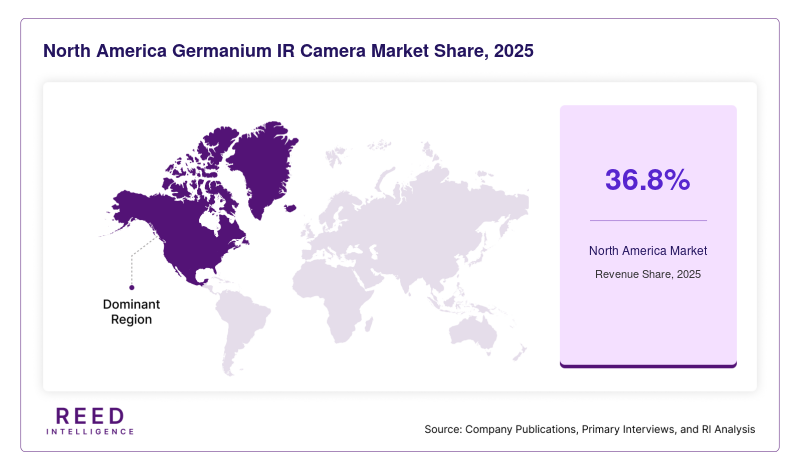
North America accounted for 36.8% of the Germanium IR Camera Market share in 2025 and is expected to grow at a CAGR of 8.9% during the forecast period.
The United States dominated the regional market due to strong investments in defense and industrial automation. The presence of advanced manufacturing facilities and high adoption of thermal imaging technologies contributed to market growth. Additionally, increasing demand for predictive maintenance solutions across industries supported the expansion of the Germanium IR Camera Market in this region.
Europe
Europe held approximately 27.5% share in 2025 and is projected to grow at a CAGR of 8.7%.
Germany emerged as the dominant country in the region, driven by its strong industrial base and emphasis on energy efficiency. The adoption of infrared cameras for building inspection and energy audits has increased significantly. Regulatory frameworks promoting sustainability have further supported market growth in Europe.
Asia Pacific
Asia Pacific captured around 22.3% market share in 2025 and is anticipated to grow at the fastest CAGR of 11.2%.
China led the regional market due to rapid industrialization and increasing investments in smart infrastructure. The growing adoption of thermal imaging in manufacturing and surveillance applications has significantly contributed to market expansion. Government initiatives supporting technological advancements have further accelerated growth.
Middle East & Africa
The Middle East & Africa region held 7.1% share in 2025 and is expected to grow at a CAGR of 9.1%.
Saudi Arabia dominated the market, driven by investments in oil and gas infrastructure. The use of infrared cameras for equipment monitoring and safety inspections has increased in the region. Additionally, infrastructure development projects have contributed to market growth.
Latin America
Latin America accounted for 6.3% share in 2025 and is projected to grow at a CAGR of 8.5%.
Brazil emerged as the leading country, supported by the adoption of thermal imaging in industrial and energy sectors. Increasing awareness about predictive maintenance and safety measures has driven demand for Germanium IR cameras in the region.
Competitive Landscape
The Germanium IR Camera Market is moderately competitive, with key players focusing on innovation, product development, and strategic collaborations. The market leader, FLIR Systems (now part of Teledyne Technologies), continues to dominate due to its extensive product portfolio and strong global presence. The company has recently introduced advanced AI-integrated thermal cameras, enhancing its competitive position.
Other prominent players include Leonardo DRS, L3Harris Technologies, BAE Systems, and Axis Communications. These companies are investing in research and development to improve camera performance and expand application areas. Partnerships with industrial and defense organizations are also common strategies to strengthen market presence.
Key Players List
- Teledyne Technologies Incorporated
- Leonardo DRS
- L3Harris Technologies, Inc.
- BAE Systems plc
- Axis Communications AB
- Xenics NV
- InfraTec GmbH
- Opgal Optronic Industries Ltd.
- FLUKE Corporation
- Seek Thermal, Inc.
- Hanwha Vision Co., Ltd.
- Hikvision Digital Technology Co., Ltd.
- Dahua Technology Co., Ltd.
- Testo SE & Co. KGaA
- Sierra-Olympic Technologies, Inc.
Recent Developments
- Teledyne Technologies launched a new AI-enabled thermal imaging platform to enhance industrial monitoring capabilities.
- L3Harris Technologies introduced advanced IR cameras designed for aerospace and defense applications.
- Axis Communications expanded its thermal camera portfolio for security and surveillance applications.
- InfraTec GmbH developed high-resolution thermal cameras for industrial diagnostics.
- Hanwha Vision announced new compact IR cameras targeting commercial markets.
Germanium IR Camera Market Segments
Type
- Cooled IR Cameras
- Uncooled IR Cameras
Application
- Industrial Inspection
- Surveillance & Security
- Medical Imaging
- Automotive
- Others
End-Use Industry
- Defense & Military
- Industrial
- Healthcare
- Commercial
Wavelength
- Short-Wave IR (SWIR)
- Mid-Wave IR (MWIR)
- Long-Wave IR (LWIR)
By Region
- North America
- Europe
- APAC
- Middle East and Africa
- LATAM