Glacial Methacrylic Acid Market Size, Share & Demand Report By Application (Polymers & Resins, Adhesives & Sealants, Specialty Coatings, Others), By End-Use Industry (Automotive, Construction, Electronics, Packaging, Others), By Grade (Industrial Grade, Electronic Grade, Specialty Grade), By Distribution Channel (Direct Sales, Distributors, Online Platforms), By Region & Segment Forecasts, 2025–2034
USD 3950
Market Overview
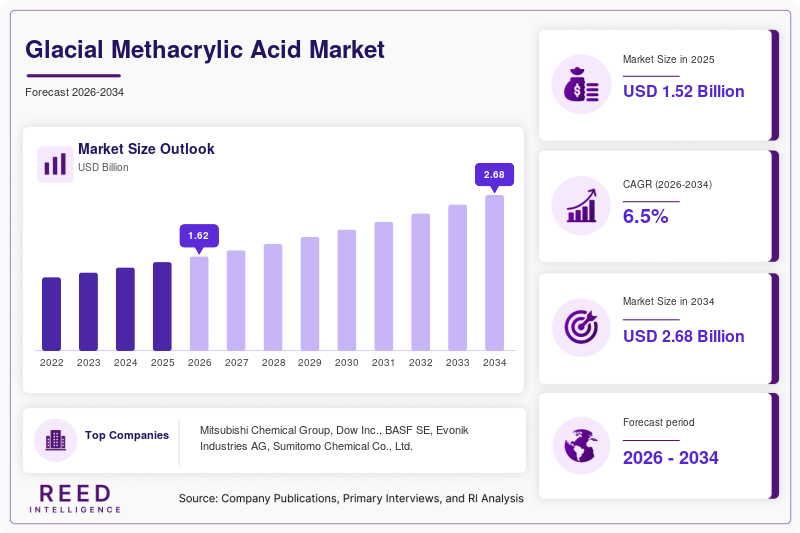
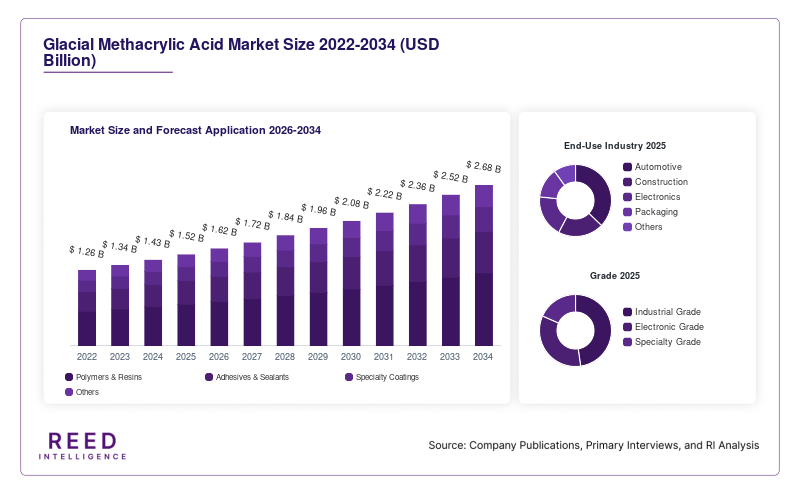
The global Glacial Methacrylic Acid Market size was valued at approximately USD 1.52 billion in 2025 and is projected to reach USD 2.68 billion by 2034, expanding at a CAGR of 6.5% during the forecast period (2025–2034). The market has experienced stable expansion driven by its critical role as a key intermediate in the production of polymers, coatings, adhesives, and specialty resins. Glacial methacrylic acid, characterized by its high purity, is widely utilized across industries such as automotive, construction, electronics, and packaging.
A major global factor supporting market growth is the steady rise in demand for high-performance polymers in emerging industrial economies. Increasing infrastructure development and automotive manufacturing have significantly contributed to the consumption of methacrylic derivatives, particularly in coatings and plastic modifiers. Additionally, advancements in polymer chemistry and the adoption of specialty materials in electronics manufacturing have strengthened the long-term outlook of the Glacial Methacrylic Acid Market.
Key Highlights
- Asia Pacific dominated the market with a share of 41.8% in 2025, while it will also be the fastest-growing region with a CAGR of 7.3%.
- By application, Polymers & Resins led with a 46.2% share, while Specialty Coatings will grow at the fastest CAGR of 7.6%.
- By end-use industry, Automotive remained dominant with 29.4% share, whereas Electronics is expected to expand at 7.9% CAGR.
- China, the dominant country, recorded a market value of USD 412 million in 2025 and is estimated to reach USD 438 million in 2026.
Market Trends
Increasing Adoption of High-Performance Polymers
The Glacial Methacrylic Acid Market is witnessing a consistent shift toward high-performance polymers with enhanced durability, chemical resistance, and flexibility. Manufacturers are increasingly integrating methacrylic acid derivatives into advanced polymer formulations to meet the growing demand from automotive lightweighting and construction materials. This trend is further supported by the need for long-lasting materials that can withstand extreme environmental conditions.
Expansion of Electronics and Semiconductor Applications
Another notable trend shaping the market is the rising use of methacrylic acid in electronic-grade materials. With the expansion of semiconductor manufacturing and printed circuit board production, there is an increasing requirement for high-purity chemicals. Glacial methacrylic acid is gaining traction in photoresists, adhesives, and coatings used in electronics, driving innovation and expanding its application scope. This trend is expected to intensify as global demand for consumer electronics and advanced computing devices continues to rise.
Market Drivers
Growth in Automotive Coatings Demand
The expansion of the global automotive sector has significantly contributed to the growth of the Glacial Methacrylic Acid Market. Methacrylic acid derivatives are widely used in automotive coatings due to their excellent adhesion, weather resistance, and gloss retention properties. As vehicle production increases, especially in developing economies, the demand for high-quality coatings is also rising, thereby driving market growth.
Rising Demand in Construction Applications
The construction industry’s increasing need for durable and high-performance materials is another key driver. Glacial methacrylic acid is used in the formulation of adhesives, sealants, and acrylic sheets that are essential in modern construction practices. Rapid urbanization and infrastructure development projects worldwide have created sustained demand for such materials, supporting the steady expansion of the market.
Market Restraint
Volatility in Raw Material Prices
One of the primary challenges facing the Glacial Methacrylic Acid Market is the fluctuation in raw material prices. Methacrylic acid production relies heavily on petrochemical feedstocks, which are subject to price volatility due to changes in crude oil markets and geopolitical factors. This unpredictability can increase production costs and affect profit margins for manufacturers.
Additionally, price instability can disrupt supply chains and create uncertainty in long-term procurement planning. Smaller manufacturers, in particular, may face difficulties in maintaining competitive pricing, which can hinder market growth. While technological advancements and alternative production methods are being explored, raw material price volatility remains a significant restraint for the industry.
Market Opportunities
Development of Bio-Based Methacrylic Acid
The growing focus on sustainability presents a significant opportunity for the Glacial Methacrylic Acid Market. Research and development efforts are increasingly directed toward bio-based alternatives derived from renewable resources. These eco-friendly solutions can help reduce dependence on fossil fuels and align with global environmental regulations, creating new growth avenues.
Expansion in Emerging Economies
Emerging markets in Asia, Africa, and Latin America offer untapped potential for market expansion. Rapid industrialization, urban development, and increasing manufacturing activities in these regions are expected to drive demand for methacrylic acid derivatives. Companies investing in regional production facilities and distribution networks are likely to benefit from this growth opportunity.
Segmental Analysis
By Application
Polymers & Resins dominated the Glacial Methacrylic Acid Market with a 46.2% share in 2025. This segment benefited from extensive usage in the production of acrylic polymers, which are widely applied in coatings, adhesives, and plastics. The versatility and performance characteristics of methacrylic acid-based polymers contributed to their widespread adoption across multiple industries.
Specialty Coatings will emerge as the fastest-growing segment, with a projected CAGR of 7.6%. This growth will be driven by increasing demand for high-performance coatings in automotive, marine, and industrial applications. Enhanced durability and resistance properties will make specialty coatings a preferred choice, supporting segment expansion.
By End-Use Industry
The Automotive segment accounted for 29.4% of the market share in 2025. The segment’s dominance was attributed to the extensive use of methacrylic acid derivatives in coatings and lightweight materials. Automotive manufacturers relied on these materials for improved aesthetics and performance.
The Electronics segment is expected to grow at the fastest CAGR of 7.9%. Rising demand for electronic devices and advanced components will drive the need for high-purity chemicals. Methacrylic acid will play a crucial role in manufacturing adhesives and coatings used in electronic assemblies.
By Grade
Industrial Grade dominated the market with a 62.5% share in 2025. This segment was widely used in large-scale applications such as construction materials and industrial coatings, where high volumes were required.
Electronic Grade will witness the fastest growth, with a CAGR of 7.8%. Increasing demand for ultra-pure chemicals in semiconductor manufacturing will drive this segment. The need for precision and reliability in electronic applications will support its expansion.
By Distribution Channel
Direct Sales accounted for 68.1% of the market share in 2025. Large manufacturers preferred direct procurement to ensure consistent supply and quality control. This channel provided better pricing and long-term supply agreements.
Online Distribution is expected to grow at a CAGR of 7.2%. The increasing adoption of digital platforms for chemical procurement will drive this growth. Convenience, transparency, and wider supplier access will contribute to the expansion of online channels.
Regional Analysis
North America
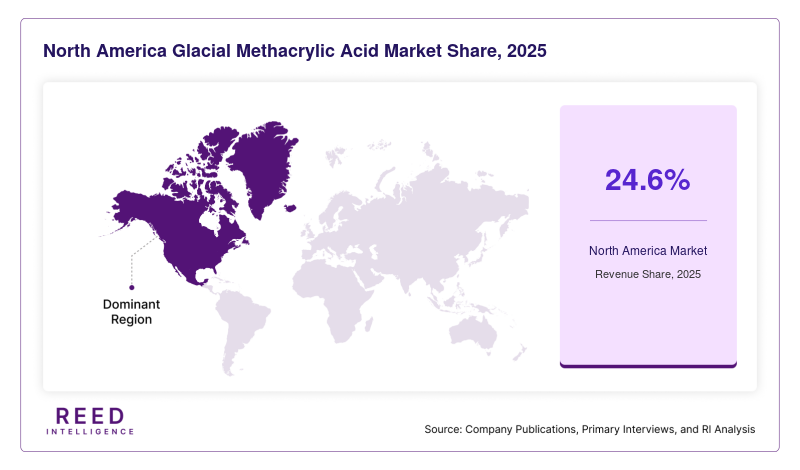
North America accounted for 24.6% of the Glacial Methacrylic Acid Market share in 2025 and will grow at a CAGR of 5.8% through 2034. The region demonstrated stable demand due to its established industrial base and advanced manufacturing capabilities. Strong presence of chemical and polymer industries contributed to consistent consumption patterns.
The United States dominated the regional market, supported by its well-developed automotive and construction sectors. The country’s emphasis on advanced material innovation and high-performance coatings has strengthened demand for methacrylic acid. Additionally, investments in research and development have enabled manufacturers to introduce specialized formulations tailored to niche applications.
Europe
Europe held 21.3% market share in 2025 and is projected to grow at a CAGR of 5.6%. The region’s growth has been supported by stringent environmental regulations and a strong focus on sustainable materials. Demand for high-quality coatings and adhesives in automotive and construction industries has contributed to steady market expansion.
Germany emerged as the dominant country due to its robust automotive manufacturing sector. The country’s focus on engineering excellence and advanced material usage has driven the adoption of methacrylic acid derivatives in coatings and polymer applications.
Asia Pacific
Asia Pacific led the market with 41.8% share in 2025 and will grow at the fastest CAGR of 7.3%. The region’s rapid industrialization and expanding manufacturing base have significantly boosted demand for glacial methacrylic acid. Increasing investments in infrastructure and electronics production have further supported market growth.
China dominated the regional market due to its large-scale chemical production and strong demand from end-use industries. The country’s extensive manufacturing ecosystem and export-oriented industries have played a crucial role in driving consumption of methacrylic acid.
Middle East & Africa
The Middle East & Africa accounted for 6.7% market share in 2025 and is expected to grow at a CAGR of 6.1%. Growth in the region has been driven by increasing industrial diversification and investments in downstream chemical industries.
Saudi Arabia led the regional market, supported by its expanding petrochemical sector. The country’s strategic focus on value-added chemical production has contributed to the growing demand for methacrylic acid and its derivatives.
Latin America
Latin America held 5.6% share in 2025 and is projected to grow at a CAGR of 6.0%. The region has experienced moderate growth due to increasing industrial activities and infrastructure development.
Brazil dominated the market, driven by its expanding construction sector. The country’s growing demand for adhesives, coatings, and polymer materials has supported the steady adoption of glacial methacrylic acid.
Competitive Landscape
The Glacial Methacrylic Acid Market is moderately consolidated, with key players focusing on capacity expansion, product innovation, and strategic partnerships. Leading companies are investing in advanced production technologies to enhance efficiency and meet growing demand.
The market leader, Mitsubishi Chemical Group, has strengthened its position through continuous innovation and expansion of its methacrylic acid production capacity. The company recently announced the development of sustainable production methods aimed at reducing environmental impact.
Other major players such as Dow, BASF, Evonik Industries, and Sumitomo Chemical are actively engaged in expanding their global footprint. These companies are focusing on research and development to introduce high-performance products and cater to evolving industry requirements.
Key Players List
- Mitsubishi Chemical Group
- Dow Inc.
- BASF SE
- Evonik Industries AG
- Sumitomo Chemical Co., Ltd.
- Arkema S.A.
- LG Chem Ltd.
- Kuraray Co., Ltd.
- Asahi Kasei Corporation
- Nippon Shokubai Co., Ltd.
- Mitsubishi Gas Chemical Company
- Formosa Plastics Corporation
- SABIC
- Lotte Chemical Corporation
- Röhm GmbH
Recent Developments
- Mitsubishi Chemical Group expanded its methacrylic acid production capacity to meet rising global demand.
- BASF introduced a new sustainable production process for methacrylic acid derivatives.
- Evonik Industries invested in R&D to enhance product purity for electronic applications.
- Arkema announced strategic collaborations to strengthen its specialty chemicals portfolio.
- LG Chem increased its focus on high-performance polymer applications using methacrylic acid.
Glacial Methacrylic Acid Market Segments
Application
- Polymers & Resins
- Adhesives & Sealants
- Specialty Coatings
- Others
End-Use Industry
- Automotive
- Construction
- Electronics
- Packaging
- Others
Grade
- Industrial Grade
- Electronic Grade
- Specialty Grade
Distribution Channel
- Direct Sales
- Distributors
- Online Platforms
By Region
- North America
- Europe
- APAC
- Middle East and Africa
- LATAM