Glass Bending Machine Market Size, Share, Demand Report By Machine Type (CNC Glass Bending Machines, Manual Glass Bending Machines, Automated Robotic Glass Bending Systems), By Application (Architectural Glass Processing, Automotive Curved Glass Manufacturing, Electronics Display Glass, Industrial Glass Fabrication), By End-Use Industry (Construction, Automotive, Electronics, Industrial Manufacturing) By Region & Segment Forecasts, 2026–2034
USD 3950
Market Overview
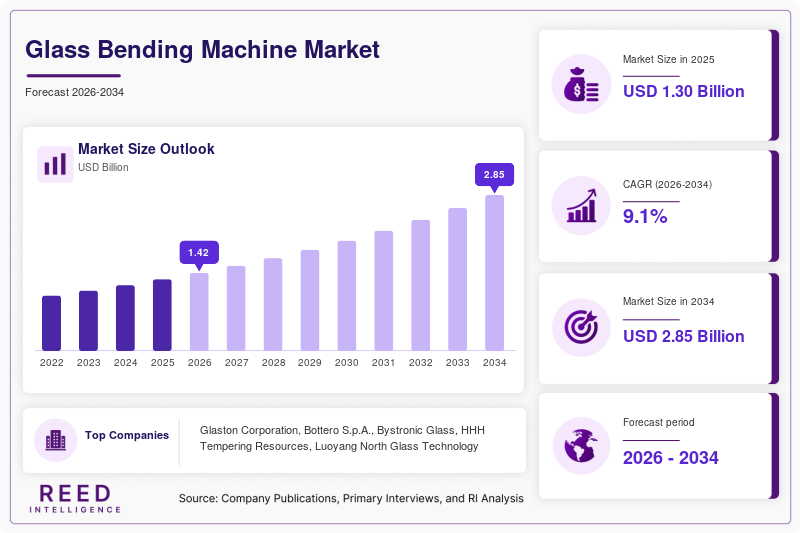
The Glass Bending Machine Market size is projected to witness steady expansion, with the market size estimated at USD 1.42 billion in 2026 and expected to reach approximately USD 2.85 billion by 2034, registering a compound annual growth rate (CAGR) of 9.1% during the forecast period. Growth in the market is primarily driven by increasing adoption of curved glass in automotive design, architectural applications, and premium consumer electronics. Rising demand for energy-efficient buildings and aesthetic glass structures has further strengthened the deployment of advanced glass bending machinery across manufacturing facilities worldwide.
A major global factor supporting market growth is the rapid expansion of smart city infrastructure projects, particularly in developing economies. Governments are investing heavily in modern construction materials, where curved and tempered glass plays a critical role in enhancing visual appeal and structural performance. Additionally, advancements in CNC-based glass bending machines and automation technologies are improving production precision, reducing waste, and increasing manufacturing efficiency, thereby accelerating industry adoption.
Key Highlights
- North America dominated the market with a 34.2% share in 2025.
- Asia Pacific is expected to grow at the fastest CAGR of 11.3% during 2026–2034.
- By machine type, CNC glass bending machines accounted for the largest share of 39.4%, while automated robotic bending systems are projected to grow at a CAGR of 12.6%.
- By application, architectural glass processing led with a 42.1% share, whereas automotive curved glass manufacturing is expected to expand at a CAGR of 11.5%.
- The United States remained the dominant country, with market values of USD 620 million in 2024 and USD 670 million in 2025.
Market Trends
Rising Integration of CNC and Automation Technologies
The Glass Bending Machine Market is experiencing a significant shift toward CNC-enabled and fully automated systems. Manufacturers are increasingly adopting computer numerical control (CNC) technology to improve bending accuracy, reduce human error, and enable complex curved designs. Automation is also enhancing production scalability, allowing manufacturers to meet growing demand from automotive and architectural industries. These advanced systems integrate real-time monitoring, temperature control, and precision forming capabilities, which collectively improve product consistency. Furthermore, the integration of Industry 4.0 technologies such as IoT sensors and predictive maintenance tools is transforming production efficiency and reducing machine downtime across large-scale manufacturing facilities.
Increasing Demand for Energy-Efficient and Aesthetic Glass Structures
Another prominent trend in the Glass Bending Machine Market is the rising demand for energy-efficient and visually appealing glass structures in modern architecture. Curved glass is increasingly used in commercial buildings, luxury residential projects, and high-rise facades due to its ability to improve aerodynamics and reduce energy consumption. Architectural firms are prioritizing innovative glass designs to enhance building aesthetics while meeting sustainability standards. This trend is further supported by regulatory frameworks promoting green construction materials. As a result, glass bending machines capable of producing large, complex, and energy-efficient glass panels are gaining strong traction globally.
Market Drivers
Expanding Automotive Industry and Lightweight Vehicle Design
The growth of the automotive sector is a key driver for the Glass Bending Machine Market, particularly due to the rising use of curved glass in modern vehicle designs. Automakers are increasingly incorporating lightweight and aerodynamically efficient materials to improve fuel efficiency and reduce emissions. Curved windshields, panoramic sunroofs, and advanced display panels require high-precision bending processes that only advanced glass bending machines can deliver. The increasing production of electric vehicles has further intensified demand, as manufacturers focus on innovative designs and enhanced passenger experience, thereby accelerating machine adoption globally.
Growth in Smart Infrastructure and Construction Activities
Rapid urbanization and expansion of smart infrastructure projects are significantly driving the Glass Bending Machine Market. Governments across emerging economies are investing heavily in commercial complexes, airports, and smart cities, all of which utilize curved glass structures for modern architectural appeal. Glass bending machines play a crucial role in producing customized architectural glass panels that meet structural and aesthetic requirements. Additionally, the growing focus on sustainable buildings has increased demand for energy-efficient glass solutions, further boosting machine installation in construction material manufacturing facilities.
Market Restraint
High Initial Investment and Maintenance Costs
One of the primary restraints affecting the Glass Bending Machine Market is the high initial investment required for advanced machinery. CNC and automated glass bending systems involve significant capital expenditure, making them less accessible to small and medium-sized manufacturers. In addition to purchase costs, maintenance expenses, skilled labor requirements, and energy consumption further increase operational costs. Many companies in developing regions hesitate to adopt these machines due to budget constraints, which limits overall market penetration despite growing demand.
Market Opportunities
Expansion in Emerging Economies and Industrialization
Emerging economies present a significant opportunity for the Glass Bending Machine Market due to rapid industrialization and infrastructure development. Countries in Asia Pacific, Latin America, and parts of Africa are witnessing increased construction activity, leading to higher demand for advanced glass processing equipment. Local manufacturers are gradually upgrading their production facilities to meet international quality standards. This shift is expected to drive adoption of modern glass bending machines, especially in mid-sized manufacturing units aiming to expand their production capabilities.
Technological Advancements in Smart Manufacturing Systems
Technological innovation in smart manufacturing presents another key opportunity for the Glass Bending Machine Market. Integration of artificial intelligence, robotics, and IoT-enabled monitoring systems is enabling manufacturers to achieve higher precision and operational efficiency. Smart glass bending machines can automatically adjust parameters based on material thickness and curvature requirements, reducing production errors. These advancements also enable remote monitoring and predictive maintenance, reducing downtime and operational disruptions, which enhances overall productivity and market demand.
Segmental Analysis
Machine Type Segment
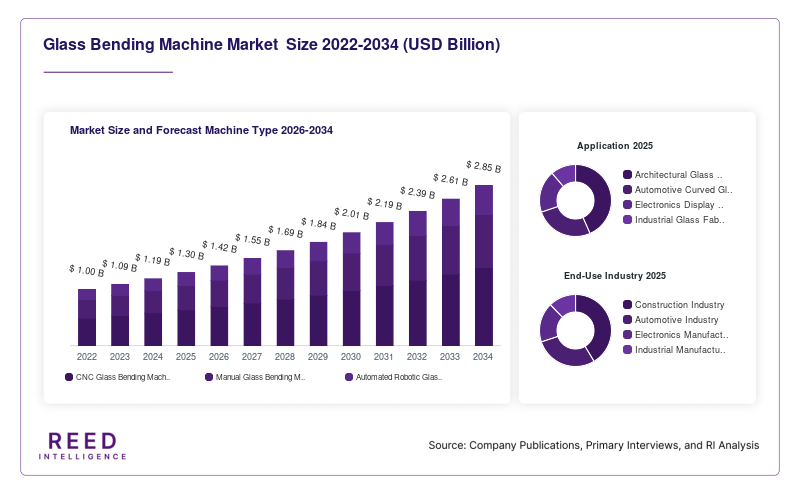
The machine type segment of the Glass Bending Machine Market is dominated by CNC glass bending machines, which accounted for approximately 42.3% market share in 2024. This dominance is attributed to their high precision, programmability, and ability to produce complex curved glass shapes required in automotive windshields, architectural facades, and electronic displays. CNC systems are widely preferred by large-scale manufacturers due to their ability to reduce operational errors and improve production consistency. Additionally, increasing adoption of automated production lines in developed economies is further strengthening the demand for CNC-based systems across industrial glass processing facilities.
The fastest-growing subsegment within machine type is automated robotic glass bending systems, expected to expand at a CAGR of 12.6% during 2026–2034. Growth in this segment is driven by the rising integration of Industry 4.0 technologies, including robotics, IoT-based monitoring, and AI-driven process optimization. Manufacturers are increasingly adopting robotic systems to reduce labor dependency, improve production efficiency, and enhance workplace safety. These machines are particularly gaining traction in high-volume production environments such as automotive glass manufacturing and smart building material production facilities, where precision and scalability are critical requirements.
Application Segment
Within the application segment, architectural glass processing held the dominant position with a 41.8% share in 2024. This leadership is supported by rising global demand for modern building designs that incorporate curved and aesthetic glass structures in commercial complexes, airports, and luxury residential projects. The growing emphasis on energy-efficient and visually appealing construction materials has significantly boosted the use of bent glass in façades, skylights, and interior designs. As urban infrastructure continues to expand, architectural applications remain a core revenue-generating segment for glass bending machine manufacturers worldwide.
The fastest-growing application is automotive curved glass manufacturing, projected to register a CAGR of 11.5% during 2026–2034. This growth is driven by increasing vehicle production and the shift toward lightweight, aerodynamic, and premium vehicle designs. Electric vehicles, in particular, are fueling demand for panoramic sunroofs, curved windshields, and integrated display glass systems. Automotive manufacturers are increasingly relying on advanced glass bending machines to achieve high precision and durability in complex curved glass components, supporting both safety standards and design innovation.
End-Use Industry Segment
The construction industry dominated the end-use segment with a 44.1% market share in 2024, driven by rapid urbanization and large-scale infrastructure development projects across both developed and emerging economies. Glass bending machines are widely used in producing customized architectural glass components for skyscrapers, commercial buildings, and smart city infrastructure. The increasing adoption of green building materials and energy-efficient construction practices has further strengthened demand for curved and insulated glass, reinforcing the dominance of this segment globally.
The fastest-growing end-use industry is electronics manufacturing, projected to grow at a CAGR of 10.9% during 2026–2034. This growth is fueled by rising demand for curved display panels in smartphones, tablets, wearable devices, and automotive infotainment systems. Manufacturers are increasingly using precision glass bending technologies to develop ultra-thin, durable, and flexible glass components. The rapid expansion of consumer electronics and the continuous innovation in display technologies are expected to significantly accelerate machine adoption in this segment.
Regional Analysis
North America
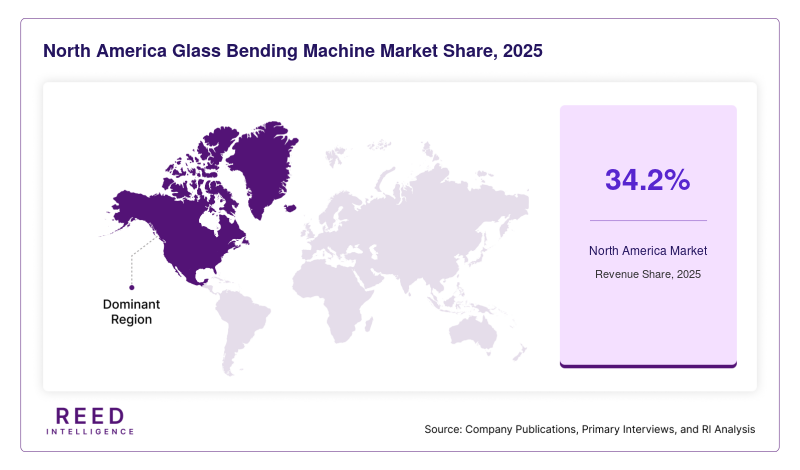
North America accounted for approximately 34.2% of the global Glass Bending Machine Market in 2025, and is projected to grow at a CAGR of 8.7% during 2026–2034. The region’s dominance is supported by advanced manufacturing infrastructure, strong automotive production, and early adoption of automated glass processing technologies. Demand is particularly high in the United States, where premium automotive manufacturing and smart construction projects continue to drive machine installations.
The United States remains the leading country in the region due to its strong automotive industry and large-scale architectural development projects. A key growth factor is the increasing investment in electric vehicle manufacturing, which requires advanced curved glass components for aerodynamic and design efficiency. Canada also contributes significantly through its integration with U.S. automotive supply chains and government-backed industrial modernization initiatives.
Europe
Europe held around 27.6% market share in 2025, with an expected CAGR of 8.3% during 2026–2034. The region benefits from strong demand for high-precision glass processing equipment and stringent energy efficiency regulations. European manufacturers are highly focused on sustainable construction practices and advanced automotive glass technologies, which support steady market expansion.
Germany leads the European market due to its strong automotive manufacturing base and advanced engineering capabilities. A major growth factor is the increasing demand for luxury and electric vehicles, which require complex curved glass components. Italy and France also contribute significantly, driven by architectural innovation and high adoption of CNC-based glass bending systems in industrial manufacturing facilities.
Asia Pacific
Asia Pacific accounted for approximately 23.9% of the market share in 2025 and is expected to grow at the fastest CAGR of 11.3% during 2026–2034. Rapid urbanization, industrial expansion, and increasing automotive production are the primary drivers of regional growth. The region is also witnessing strong investments in smart city development and infrastructure modernization.
China dominates the Asia Pacific market due to its massive automotive production capacity and large-scale construction projects. A key growth factor is the expanding electronics manufacturing industry, which heavily relies on curved glass components for display technologies. India is emerging as a high-growth market, supported by rapid infrastructure development and increasing adoption of automated glass processing technologies.
Middle East & Africa
The Middle East & Africa region accounted for approximately 7.1% market share in 2025, with a projected CAGR of 9.2% during 2026–2034. Growth is driven by large-scale infrastructure projects, tourism development, and smart city initiatives, particularly in Gulf countries. Demand for modern architectural glass structures is increasing significantly in commercial and residential construction projects.
The United Arab Emirates leads the regional market due to its strong focus on luxury infrastructure and futuristic architectural designs. A major growth factor is the development of mega construction projects such as skyscrapers, airports, and commercial complexes that heavily utilize curved glass materials. Saudi Arabia also contributes to growth through its Vision 2030 initiatives, which emphasize urban modernization and infrastructure diversification.
Latin America
Latin America held approximately 7.2% market share in 2025, with a CAGR of 8.9% during 2026–2034. The region is gradually expanding due to increasing industrialization and construction activities. Automotive manufacturing and urban development projects are key contributors to regional demand.
Brazil is the leading country in the region, supported by its strong automotive industry and growing construction sector. A key growth factor is increasing foreign direct investment in manufacturing facilities, which is driving adoption of advanced glass processing machinery. Mexico also plays a significant role due to its integration with North American automotive supply chains and rising industrial modernization efforts.
Competitive Landscape
The Glass Bending Machine Market is moderately consolidated, with leading players focusing on automation, precision engineering, and technological upgrades. Key companies include Glaston Corporation, Bottero S.p.A., HHH Tempering Resources, Bystronic Glass, and Luoyang North Glass Technology.
Glaston Corporation remains a market leader due to its advanced automation solutions and global distribution network. Recently, the company introduced a new high-speed CNC bending system designed for large-scale architectural glass production, enhancing efficiency and reducing processing time.
Key Players
- Glaston Corporation
- Bottero S.p.A.
- Bystronic Glass
- HHH Tempering Resources
- Luoyang North Glass Technology
- LandGlass Technology Co., Ltd.
- Glassline GmbH
- Shenzhen Handong Glass Machinery
- Bent Glass Design
- Glassrobots Oy
- Schiatti Angelo Srl
- NorthGlass Group
- Glass Equipment Development Inc.
- Hegla GmbH & Co. KG
- Sphinx Glass Machinery
Recent Developments
- Glaston Corporation launched an AI-integrated glass bending system enhancing precision and reducing material waste.
- Bottero S.p.A. expanded its production facility in Europe to increase output capacity for automated bending machines.
- Bystronic Glass introduced a next-generation CNC bending line optimized for energy-efficient architectural glass production.
Glass Bending Machine Market Segments
Machine Type
- CNC Glass Bending Machines
- Manual Glass Bending Machines
- Automated Robotic Glass Bending Systems
Application
- Architectural Glass Processing
- Automotive Curved Glass Manufacturing
- Electronics Display Glass
- Industrial Glass Fabrication
End-Use Industry
- Construction Industry
- Automotive Industry
- Electronics Manufacturing
- Industrial Manufacturing
By Region
- North America
- Europe
- APAC
- Middle East and Africa
- LATAM