Glass Handling Robot Market Size, Share & Demand Report By Type (Articulated Robots, SCARA Robots, Cartesian Robots, Collaborative Robots), By Application (Glass Manufacturing, Automotive Glass Handling, Solar Panel Handling, Others), By End-Use Industry (Automotive, Construction, Electronics, Energy), By Payload Capacity (Low Payload, Medium Payload, High Payload) & Segment Forecasts, 2026–2034
USD 3950
Market Overview
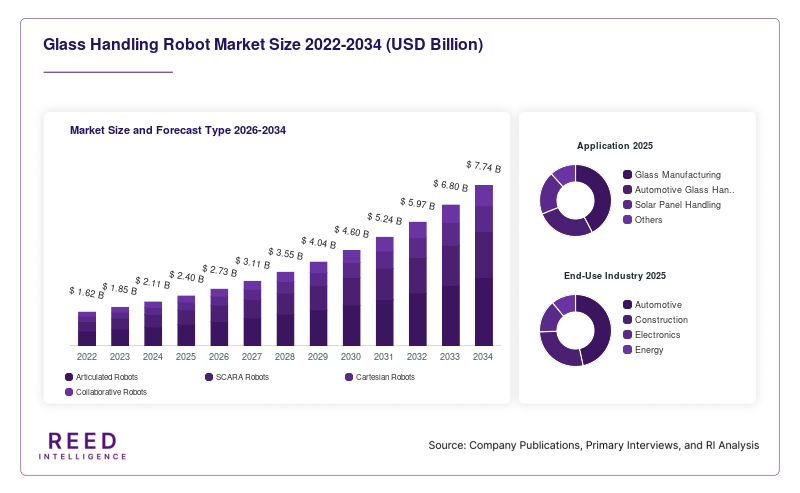
The Glass Handling Robot Market was valued at approximately USD 2.4 billion in 2026 and is projected to reach USD 6.8 billion by 2034, expanding at a CAGR of 13.9% during the forecast period (2026–2034). The market is experiencing steady expansion due to increasing automation across glass manufacturing, automotive, and construction industries, where precision, safety, and productivity are critical operational requirements.
A key global factor supporting market growth is the rising demand for high-quality glass products across industries, particularly in automotive glazing, solar panels, and architectural glass. Manufacturers are increasingly adopting robotic systems to reduce breakage rates, improve handling efficiency, and ensure worker safety in hazardous environments.
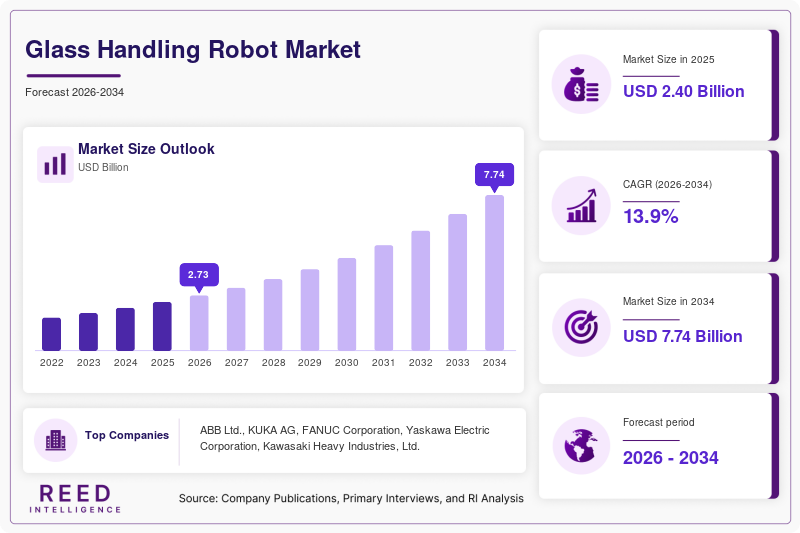
Key Highlights
- Asia Pacific dominated the market with a 41.2% share in 2025, while Latin America is projected to register the fastest CAGR of 15.4% (2026–2034).
- By type, articulated robots accounted for the largest share of 38.6% in 2025, while collaborative robots (cobots) are expected to grow fastest at a CAGR of 17.1%.
- By application, glass manufacturing led with a 45.3% share in 2025, whereas solar panel handling is projected to grow at a CAGR of 16.5%.
- The U.S. market was valued at USD 510 million in 2024 and increased to USD 560 million in 2025, driven by industrial automation investments.
Market Trends
Integration of Smart Sensors and AI-Based Vision Systems
The adoption of advanced vision systems and AI-enabled sensors is transforming the Glass Handling Robot Market. These technologies allow robots to identify glass thickness, detect defects, and adjust grip strength dynamically. This trend is improving operational accuracy and reducing material waste, particularly in high-precision applications such as semiconductor glass and display panels.
Shift Toward Collaborative Robots in Glass Processing
Collaborative robots are gaining traction due to their ability to work alongside human operators without extensive safety barriers. In small and medium-scale glass processing units, cobots offer flexibility, lower installation costs, and ease of programming. This trend is expanding the adoption of robotic solutions beyond large-scale industrial facilities.
Market Drivers
Rising Demand for Automation in Fragile Material Handling
Glass is inherently fragile and prone to breakage, making manual handling inefficient and risky. The increasing need to minimize product loss and ensure consistent quality is driving the adoption of robotic handling systems. Automated solutions reduce human error, improve throughput, and enhance operational safety, thereby accelerating market growth.
Growth of Automotive and Construction Industries
The expansion of automotive manufacturing and infrastructure development is boosting demand for processed glass products such as windshields, windows, and architectural panels. This growth is driving the need for advanced handling systems capable of managing large, heavy, and delicate glass components with precision.
Market Restraints
High Initial Investment and Integration Complexity
The adoption of glass handling robots requires significant upfront investment, including system integration, training, and maintenance costs. Small and medium enterprises often face challenges in justifying these expenditures, which may limit market penetration in cost-sensitive regions.
Market Opportunities
Expansion of Solar Energy Sector
The rapid growth of the solar energy industry presents a significant opportunity for the Glass Handling Robot Market. Solar panel manufacturing requires precise handling of thin glass sheets, creating demand for automated solutions that ensure minimal breakage and high efficiency.
Adoption in Emerging Economies
Developing regions are witnessing increased industrialization and automation adoption. Governments and private players are investing in modern manufacturing infrastructure, creating opportunities for robot manufacturers to expand their presence and tap into new customer bases.
Segmental Analysis
By Type
The Glass Handling Robot Market is segmented into articulated robots, SCARA robots, Cartesian robots, and collaborative robots.
- Articulated robots dominated the segment with a 38.6% share in 2025, owing to their flexibility and ability to handle complex movements required in glass manufacturing processes.
- Collaborative robots are anticipated to grow at the fastest CAGR of 17.1%, driven by their ease of deployment, safety features, and suitability for small-scale operations.
By Application
The market is segmented into glass manufacturing, automotive glass handling, solar panel handling, and others.
- Glass manufacturing led with a 45.3% share in 2025, supported by large-scale production requirements and the need for precision handling.
- Solar panel handling is projected to grow at a CAGR of 16.5%, fueled by the increasing adoption of renewable energy solutions and expansion of solar panel production facilities.
By End-Use Industry
The market is segmented into automotive, construction, electronics, and energy.
- The automotive sector held the largest share of 34.7% in 2025, driven by high demand for safety glass and increasing vehicle production.
- The energy sector is expected to grow at the fastest CAGR of 15.9%, supported by rising investments in solar energy projects.
By Payload Capacity
Segments include low payload (up to 50 kg), medium payload (50–150 kg), and high payload (above 150 kg).
- Medium payload robots dominated with a 42.1% share in 2025, as they are suitable for a wide range of applications.
- High payload robots are expected to grow at a CAGR of 14.8%, driven by increasing demand for handling large glass panels in construction.
Regional Analysis
North America
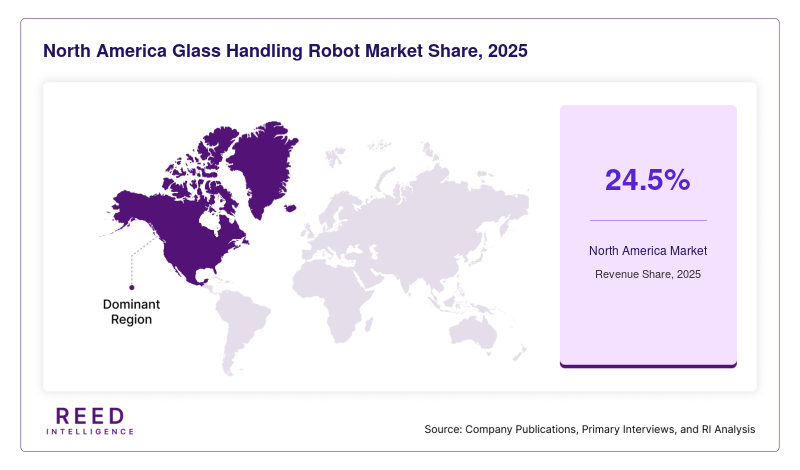
North America held a 24.5% market share in 2025 and is expected to grow at a CAGR of 12.6% during 2026–2034. The United States dominated the region due to strong adoption of automation technologies and advanced manufacturing practices. The presence of established automotive and aerospace industries has driven demand for precision glass handling solutions.
Europe
Europe accounted for 21.8% of the market share in 2025 and will grow at a CAGR of 12.9%. Germany emerged as the dominant country, supported by its advanced engineering sector and strong focus on industrial automation. The region’s emphasis on energy-efficient buildings is also increasing demand for high-quality glass products.
Asia Pacific
Asia Pacific captured the largest share of 41.2% in 2025 and is projected to grow at a CAGR of 14.6%. China dominated the region due to its large-scale glass manufacturing industry and rapid industrialization. The availability of low-cost manufacturing and increasing investments in automation technologies have significantly contributed to regional growth.
Middle East & Africa
The Middle East & Africa region held a 6.7% share in 2025 and is expected to grow at a CAGR of 13.8%. The United Arab Emirates led the region, driven by infrastructure development and increasing demand for architectural glass in construction projects.
Latin America
Latin America accounted for 5.8% of the market share in 2025 and is projected to grow at the fastest CAGR of 15.4%. Brazil dominated the region due to expanding industrial activities and increasing adoption of automation in manufacturing sectors.
Competitive Landscape
The Glass Handling Robot Market is moderately consolidated, with key players focusing on innovation, product development, and strategic partnerships. Leading companies include ABB Ltd., KUKA AG, FANUC Corporation, Yaskawa Electric Corporation, and Kawasaki Heavy Industries. Among these, ABB Ltd. holds a leading position due to its extensive product portfolio and strong global presence. The company recently introduced advanced robotic solutions with enhanced vision systems for precision glass handling.
KUKA AG is known for its high-performance automation solutions tailored for industrial applications, while FANUC Corporation emphasizes reliability and efficiency in robotic systems. Yaskawa Electric Corporation focuses on expanding its footprint in emerging markets, and Kawasaki Heavy Industries offers specialized robots for heavy-duty applications. These companies are investing in research and development to integrate AI and IoT technologies, enhancing operational efficiency and expanding their market share.
Key Players List
- ABB Ltd.
- KUKA AG
- FANUC Corporation
- Yaskawa Electric Corporation
- Kawasaki Heavy Industries, Ltd.
- Mitsubishi Electric Corporation
- DENSO Corporation
- Universal Robots A/S
- Epson Robots
- Nachi-Fujikoshi Corp.
- Comau S.p.A.
- Stäubli International AG
- Omron Corporation
- Hyundai Robotics
- Techman Robot Inc.
Recent Developments
- In 2025, ABB Ltd. launched a new series of AI-enabled robotic arms designed specifically for fragile material handling, improving accuracy and reducing damage rates.
- KUKA AG expanded its manufacturing facility in Asia to meet rising demand for automation solutions in glass processing industries.
- FANUC Corporation introduced upgraded robotic systems with enhanced payload capacity and energy efficiency.
- Yaskawa Electric Corporation partnered with regional distributors to strengthen its presence in Latin America.
- Universal Robots introduced next-generation collaborative robots tailored for small-scale glass manufacturers.
Glass Handling Robot Market Segments
Type
- Articulated Robots
- SCARA Robots
- Cartesian Robots
- Collaborative Robots
Application
- Glass Manufacturing
- Automotive Glass Handling
- Solar Panel Handling
- Others
End-Use Industry
- Automotive
- Construction
- Electronics
- Energy
Payload Capacity
- Low Payload (Up to 50 kg)
- Medium Payload (50–150 kg)
- High Payload (Above 150 kg)
By Region
- North America
- Europe
- APAC
- Middle East and Africa
- LATAM