Glass Mat Thermoplastic Market Size, Share & Demand Report By Material Type (Polypropylene (PP), Polyamide (PA), Others), By Manufacturing Process (Compression Molding, Injection Molding), By Application (Automotive, Electrical & Electronics, Construction, Industrial), By End-Use Industry (Automotive, Construction, Electrical & Electronics, Industrial), By Product Form (Sheets, Pellets), By Region & Segment Forecasts, 2025–2034
USD 3950
Market Overview
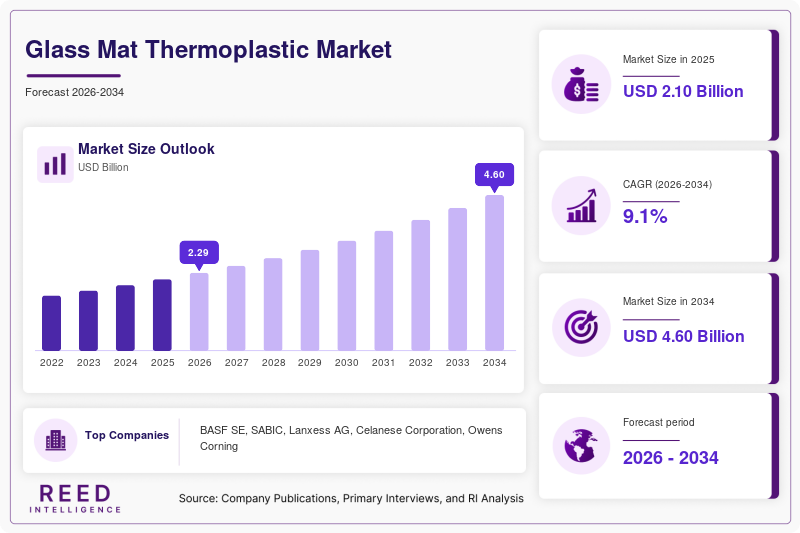
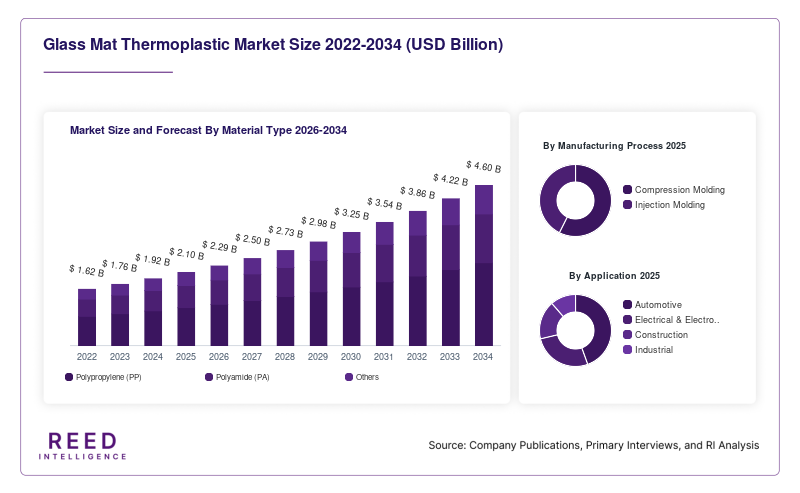
The Glass Mat Thermoplastic Market size was valued at approximately USD 2.1 billion in 2025 and is projected to reach USD 4.6 billion by 2034, expanding at a CAGR of 9.1% during the forecast period (2025–2034). The market growth is largely supported by the increasing global demand for lightweight and durable materials across automotive, construction, and industrial sectors. Glass mat thermoplastics (GMT) are widely used due to their high strength-to-weight ratio, corrosion resistance, and recyclability, making them suitable for structural and semi-structural applications.
A key global factor driving the Glass Mat Thermoplastic Market is the growing emphasis on lightweight materials in automotive manufacturing to improve fuel efficiency and reduce emissions. As regulatory frameworks tighten around carbon emissions, manufacturers are shifting toward advanced composite materials, which is accelerating GMT adoption.
Key Highlights:
- Asia Pacific dominated the market with a share of 42% in 2025, while North America is expected to register the fastest CAGR of 9.6%.
- Polypropylene-based GMT led the material segment with a 48% share, while polyamide-based GMT is projected to grow fastest at a CAGR of 9.8%.
- Automotive applications accounted for 52% share in 2025, while electrical & electronics applications are expected to grow at a CAGR of 10.1%.
- China accounted for USD 620 million in 2025 and is estimated to reach USD 670 million in 2026.
Market Trends
Rising Adoption of Lightweight Composites in Automotive Manufacturing
The Glass Mat Thermoplastic Market is witnessing a steady increase in the adoption of lightweight composite materials in automotive production. Manufacturers are focusing on reducing vehicle weight to meet emission regulations and improve fuel efficiency. GMT materials offer structural integrity while maintaining lower weight, making them suitable for components such as underbody shields, seat structures, and battery enclosures. This trend is expected to continue as electric vehicle production scales globally.
Increasing Use in Sustainable Construction Applications
Another significant trend shaping the market is the growing use of GMT materials in construction. Their durability, moisture resistance, and recyclability make them suitable for panels, roofing elements, and infrastructure components. The shift toward sustainable building materials has encouraged the adoption of GMT as an alternative to traditional materials such as metals and wood. This trend is particularly evident in regions focusing on green building standards and long-term infrastructure resilience.
Market Drivers
Expansion of Electric Vehicle Production
The rapid growth of electric vehicles is creating demand for lightweight and high-performance materials. GMT materials are increasingly used in EV battery housings, structural components, and interior parts due to their strength and thermal stability. As EV production continues to rise, the Glass Mat Thermoplastic Market is expected to benefit from increased material demand.
Growth in Industrial and Infrastructure Development
The expansion of industrial and infrastructure projects globally has increased the need for durable and cost-effective materials. GMT products are widely used in construction and industrial applications due to their resistance to corrosion and environmental degradation. This has driven their adoption in applications such as transportation infrastructure, industrial equipment, and building components.
Market Restraint
High Initial Processing and Material Costs
The Glass Mat Thermoplastic Market faces challenges related to the relatively high cost of raw materials and processing technologies. Compared to conventional materials such as steel and aluminum, GMT production requires specialized equipment and expertise, which increases overall costs. This can limit adoption, particularly among small and medium-sized manufacturers. Additionally, fluctuations in raw material prices, especially polymers and glass fibers, can impact production costs and profit margins. These factors may slow down market growth in price-sensitive regions and industries.
Market Opportunities
Advancements in Recycling Technologies
The development of advanced recycling processes for thermoplastic composites presents a strong opportunity for the Glass Mat Thermoplastic Market. Improved recyclability aligns with global sustainability goals and encourages adoption among environmentally conscious industries. Companies investing in circular economy practices are likely to benefit from increased demand.
Growth in Renewable Energy Sector Applications
The renewable energy sector offers new opportunities for GMT materials, particularly in wind and solar infrastructure. Their durability and resistance to environmental stress make them suitable for structural components in renewable energy systems. As investments in renewable energy projects increase globally, the demand for GMT materials is expected to rise.
Segmental Analysis
By Material Type
Polypropylene-based GMT dominated the Glass Mat Thermoplastic Market in 2025, accounting for 48% share. Its popularity is attributed to its cost-effectiveness, recyclability, and versatility across multiple applications.
Polyamide-based GMT will grow at the fastest CAGR of 9.8% through 2034. This growth will be driven by its superior mechanical properties and heat resistance, making it suitable for high-performance applications.
By Manufacturing Process
Compression molding held the largest share in 2025 due to its efficiency in producing large and complex components with consistent quality.
Injection molding is expected to grow at a CAGR of 9.5%, driven by increasing demand for precision components and advancements in molding technologies.
By Application
Automotive applications dominated the market with a 52% share in 2025, as GMT materials are widely used in structural and interior components.
Electrical & electronics applications will grow at a CAGR of 10.1%, supported by increasing demand for lightweight and durable materials in electronic devices and systems.
By End-Use Industry
The automotive industry held the largest share in 2025 due to the widespread use of GMT materials in vehicle manufacturing.
The construction industry is expected to grow at a CAGR of 9.7%, driven by increasing adoption of durable and sustainable building materials.
By Product Form
Sheets accounted for the largest share in 2025, as they are widely used in manufacturing processes for various applications.
Pellets are projected to grow at a CAGR of 9.4%, driven by their ease of processing and suitability for injection molding applications.
Regional Analysis
North America
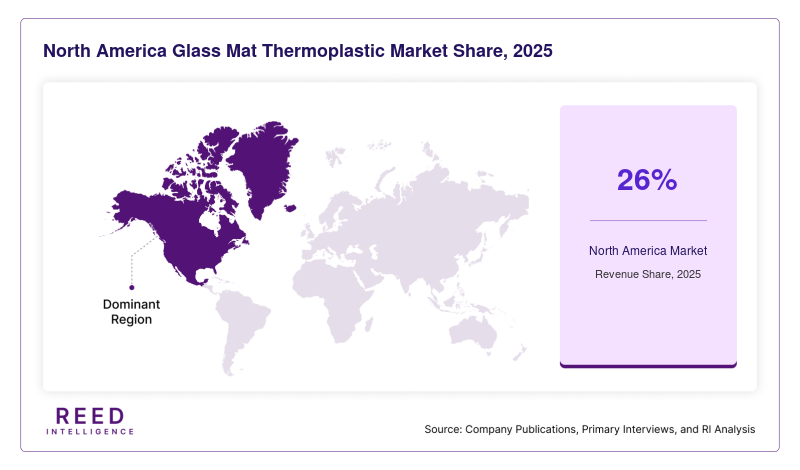
North America accounted for 26% of the Glass Mat Thermoplastic Market share in 2025 and will expand at a CAGR of 9.6% through 2034. The region’s growth is supported by strong demand from automotive and construction industries, along with increasing adoption of advanced composite materials.
The United States dominated the regional market due to its well-established manufacturing sector. A key growth factor is the increasing integration of lightweight materials in electric vehicle production, which is driving demand for GMT components.
Europe
Europe held 23% market share in 2025 and is projected to grow at a CAGR of 8.8% during the forecast period. The region benefits from strict environmental regulations and a strong focus on sustainability, which has encouraged the use of recyclable materials such as GMT.
Germany emerged as the dominant country, supported by its advanced automotive industry. A significant growth factor is the adoption of composite materials in vehicle manufacturing to meet emission reduction targets.
Asia Pacific
Asia Pacific captured 42% of the market in 2025 and is expected to grow at a CAGR of 9.3% through 2034. The region’s large manufacturing base and expanding infrastructure projects are driving demand for GMT materials.
China led the regional market due to its extensive industrial production capabilities. A major growth factor is the increasing investment in infrastructure development, which is boosting the use of durable composite materials.
Middle East & Africa
The Middle East & Africa held 5% market share in 2025 and will grow at a CAGR of 7.9%. The market is developing gradually, supported by infrastructure expansion and industrial diversification efforts.
Saudi Arabia dominated the region, driven by its focus on large-scale construction projects. The growth factor lies in the adoption of advanced materials for long-lasting infrastructure solutions.
Latin America
Latin America accounted for 4% market share in 2025 and is projected to grow at a CAGR of 8.4%. The region is experiencing steady growth due to increasing industrialization and construction activities.
Brazil emerged as the dominant country, supported by its growing automotive sector. A key growth factor is the rising demand for lightweight materials in vehicle manufacturing to improve performance and efficiency.
Competitive Landscape
The Glass Mat Thermoplastic Market is characterized by a moderately consolidated competitive landscape, with key players focusing on product innovation and strategic partnerships. Companies are investing in research and development to enhance material properties and expand application areas.
BASF SE is a leading player in the market, known for its strong portfolio of thermoplastic composite materials. The company has recently introduced advanced GMT solutions designed for electric vehicle applications, focusing on improved performance and sustainability.
Other major players are expanding their production capacities and strengthening their global presence through collaborations with automotive and industrial manufacturers. The competitive environment is shaped by technological advancements and the growing emphasis on lightweight and sustainable materials.
Key Players List
- BASF SE
- SABIC
- Lanxess AG
- Celanese Corporation
- Quadrant AG
- Owens Corning
- Teijin Limited
- Mitsubishi Chemical Group
- Toray Industries
- SGL Carbon
- PolyOne Corporation (Avient)
- DSM Engineering Materials
- RTP Company
- Arkema Group
- Jushi Group
Recent Developments
- 2024: BASF SE launched new GMT materials for electric vehicle battery enclosures.
- 2023: SABIC expanded its thermoplastic composite production capacity.
- 2023: Lanxess AG introduced advanced lightweight materials for automotive applications.
- 2022: Celanese Corporation developed new composite solutions for industrial use.
- 2022: Teijin Limited focused on expanding its thermoplastic composite portfolio.
Glass Mat Thermoplastic Market Segments
By Material Type
- Polypropylene (PP)
- Polyamide (PA)
- Others
By Manufacturing Process
- Compression Molding
- Injection Molding
By Application
- Automotive
- Electrical & Electronics
- Construction
- Industrial
By End-Use Industry
- Automotive
- Construction
- Electrical & Electronics
- Industrial
By Product Form
- Sheets
- Pellets
By Region
- North America
- Europe
- APAC
- Middle East and Africa
- LATAM