Glass Partition Market Size, Share, Demand Report By Type (Framed Glass Partitions, Frameless Glass Partitions, Demountable Glass Partitions), By Application (Commercial Buildings, Institutional Buildings, Residential Buildings), By Region & Segment Forecasts, 2026–2034
USD 3950
Glass Partition Market Size
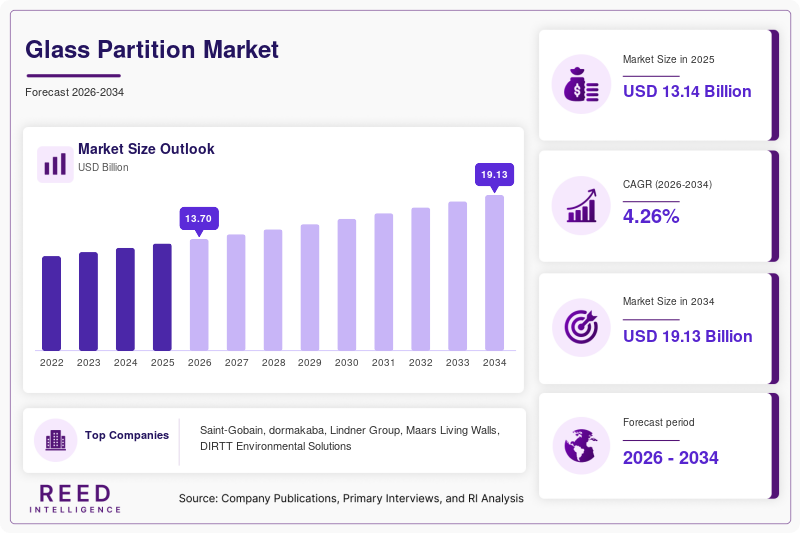
The global glass partition market size is projected at USD 13.7 billion in 2026 and is expected to hit USD 19.13 billion by 2034 with a CAGR of 4.26%. Growing demand for flexible interior layouts, natural-light optimization, acoustic privacy, and aesthetically focused workplace design is increasing the need for detailed market data, segment-level analysis, production estimates, and competitive intelligence. The competitive landscape is increasingly shaped by manufacturers offering modular, demountable, acoustic, sliding, and technologically enhanced glass partition systems.
Key takeaways
- Regional leadership: Asia Pacific is estimated to hold the largest share at approximately 40% in 2026, while the Middle East & Africa is among the fastest-growing regional markets, expanding at approximately 5.1% CAGR through 2034.
- Type leadership: Framed glass partitions account for approximately 42% of global revenue in 2026, while demountable glass partitions are expected to register one of the fastest growth rates at approximately 5.2% CAGR.
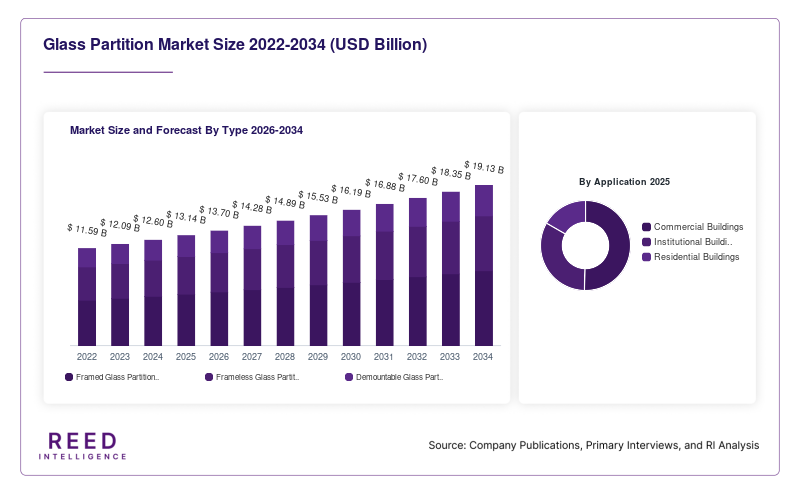
- Application leadership: Commercial buildings dominate with approximately 58% market share in 2026, supported by corporate offices, coworking facilities, retail environments, and hospitality projects.
- Emerging country: India is projected to reach approximately USD 1.12 billion by 2034, expanding at around 7.0% CAGR, supported by office construction, commercial real estate, and urban infrastructure development.
- Technology trend: Acoustic glass, double-glazed systems, smart glass, automated sliding solutions, and demountable systems are gaining adoption as customers prioritize privacy, flexibility, and lifecycle efficiency.
The global glass partition market comprises the manufacturing, supply, installation, and integration of glass-based interior separation systems used to divide offices, meeting rooms, commercial spaces, institutions, residential interiors, and specialized facilities. The market generated an estimated production volume of approximately 82 million square meters of partition systems in 2025 and is expected to exceed 107 million square meters by 2034. Adoption is strongest in commercial construction, where glass partitions combine daylight transmission with space flexibility. Commercial buildings represented about 58% of 2025 demand, followed by institutional buildings at approximately 24% and residential applications at approximately 18%. Tempered and laminated glass remain the principal materials, while insulated, acoustic, low-emissivity, and switchable glass solutions are gaining penetration in premium projects.
Glass Partition Market Trends
Shift toward flexible, acoustic, and technology-enabled interiors
The market is moving from conventional fixed glass walls toward modular, demountable, sliding, and operable systems that can be reconfigured as workplace requirements change. Frameless designs continue to gain attention because they maximize transparency and create visually open interiors, while framed systems remain preferred where acoustic performance, structural stability, and door integration are priorities. Double-glazed configurations and acoustic interlayers are increasingly specified for meeting rooms, executive offices, healthcare environments, and high-density workplaces.
Technology integration is also influencing product development. Smart and switchable glass enables privacy to be changed electronically, while automated sliding and movable systems support flexible space utilization. Demand is particularly strong in corporate offices, coworking facilities, hotels, healthcare facilities, educational institutions, and premium residential developments. Sustainability considerations are encouraging manufacturers to emphasize recyclable aluminum components, longer product life, demountability, and retrofit-friendly installation methods.
Glass Partition Market Drivers
Expansion of flexible commercial workspaces
Increasing investment in office modernization, coworking environments, commercial fit-outs, and hybrid workplace layouts is a major growth driver. Glass partitions allow organizations to create private meeting areas and enclosed offices while maintaining daylight and visual connectivity. Their relatively modular installation also enables businesses to modify layouts without undertaking extensive structural construction.
Glass Partition Market Restraints
High installation costs and performance requirements
Premium glass partition systems can require higher upfront investment than conventional drywall or low-cost partitioning solutions, particularly when acoustic glass, specialized hardware, fire-rated assemblies, automated doors, or smart-glass technology is incorporated. Transportation, handling, precision installation, and maintenance requirements can further increase project costs and restrict adoption in price-sensitive construction markets.
Glass Partition Market Opportunities
Growth of demountable and smart partition systems
Demountable systems represent a significant opportunity because they support circular construction, office relocation, retrofit projects, and repeated space reconfiguration. Smart glass, integrated access control, automated sliding systems, acoustic glazing, and digitally specified BIM-ready products provide manufacturers with opportunities to differentiate premium offerings and increase value per installation.
Challenges in Glass Partition Market
Balancing transparency, safety, acoustics, and privacy
Manufacturers must balance aesthetic transparency with safety, sound insulation, fire performance, impact resistance, and visual privacy. Building codes and testing requirements vary across countries, increasing certification complexity. Glass breakage risks, acoustic leakage at joints, installation tolerances, and the need for skilled installers can also affect project performance and customer satisfaction.
Glass Partition Market Segmentation Analysis
By type, framed glass partitions represented approximately 42% of global market revenue in 2025, followed by frameless systems at around 34% and demountable systems at approximately 24%. By application, commercial buildings remained dominant at about 58%, institutional buildings represented approximately 24%, and residential buildings accounted for nearly 18%. Global production across major partition formats was estimated at approximately 82 million square meters in 2025.
By Type
Framed Glass Partitions: Framed systems accounted for approximately 42% of market revenue in 2025, supported by strong demand for structural stability, acoustic performance, and integrated door systems. Estimated production reached approximately 34.4 million square meters. Typical systems use tempered or laminated safety glass with aluminum or steel perimeter framing, with common glass thicknesses ranging from approximately 10 mm to 13.5 mm. These systems are widely used for executive offices, conference rooms, healthcare facilities, and institutional interiors where higher privacy and sound control are required.
Frameless Glass Partitions: Frameless partitions represented approximately 34% of the market and generated an estimated 27.9 million square meters of production in 2025. These systems emphasize uninterrupted sightlines and minimalist aesthetics, commonly using tempered glass panels of approximately 10–12 mm thickness with point-fixed, channel, or minimal-profile hardware. Their adoption is particularly strong in modern offices, reception areas, retail environments, hospitality interiors, and premium residential projects.
Demountable Glass Partitions: Demountable systems represented approximately 24% of revenue and approximately 19.7 million square meters of production in 2025. These systems are designed for repeated installation, removal, and reconfiguration and commonly combine aluminum profiles with single- or double-glazed panels. Acoustic configurations can achieve high sound-reduction performance, making them suitable for meeting rooms, flexible offices, educational facilities, and retrofit projects. This segment is projected to expand at approximately 5.2% CAGR through 2034.
By Application
Commercial Buildings: Commercial buildings accounted for approximately 58% of global demand in 2025, equivalent to roughly 47.6 million square meters of partition production. Corporate offices, coworking facilities, retail outlets, financial institutions, hotels, and business centers are the principal users. Demand is driven by office refurbishment, hybrid-work layouts, meeting-room creation, daylight optimization, and the need to rapidly adapt floor plans without major structural changes.
Institutional Buildings: Institutional applications contributed approximately 24% of demand, representing about 19.7 million square meters in 2025. Healthcare facilities, universities, schools, government buildings, laboratories, and public facilities increasingly use glass partitions to improve visibility and daylight while creating controlled spaces. Acoustic, laminated, hygienic, and safety-focused glass configurations are particularly important in this segment.
Residential Buildings: Residential applications represented approximately 18% of demand and an estimated 14.8 million square meters in 2025. High-end apartments, villas, serviced residences, and modern urban homes are increasingly adopting glass partitions for kitchens, living areas, home offices, bathrooms, and dressing spaces. Frameless and sliding configurations are particularly popular because they provide flexible separation without visually reducing room size.
Glass Partition Market Regional Analysis
North America Glass Partition Market
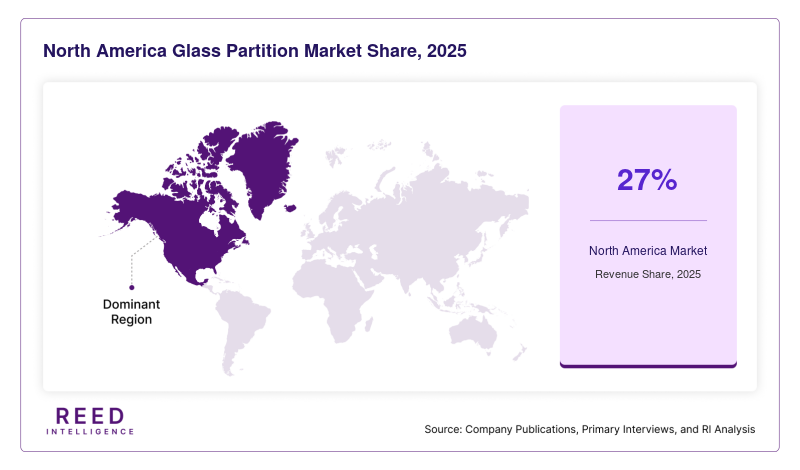
North America represented approximately 27% of the global market in 2025. The United States contributes the majority of regional revenue, supported by office renovation, flexible workplace construction, healthcare modernization, and hospitality investment. Commercial offices account for the largest regional application share, while demand for acoustic and demountable systems is increasing as companies redesign office footprints.
Europe Glass Partition Market
Europe held approximately 25% of global revenue in 2025, with Germany, the United Kingdom, France, Italy, and the Nordic markets serving as major contributors. The region has strong demand for energy-efficient interiors, recyclable materials, acoustic systems, and demountable solutions. Commercial and institutional projects dominate, while renovation of existing buildings provides additional demand for retrofit-friendly glass partitions.
Asia Pacific Glass Partition Market
Asia Pacific led the global market with approximately 40% share in 2025. China represented the largest regional contributor, followed by Japan, South Korea, and India. Rapid urbanization, office development, technology parks, hotels, retail construction, and infrastructure investment support demand. Commercial buildings account for the largest sector share, while India is expected to remain one of the fastest-growing country markets through 2034.
Latin America Glass Partition Market
Latin America accounted for approximately 5% of global revenue in 2025. Brazil and Mexico represent the principal contributors, with demand concentrated in commercial offices, hotels, retail spaces, and institutional projects. Growing modernization of corporate interiors and investment in urban commercial infrastructure are expected to support moderate market expansion through 2034.
Middle East & Africa Glass Partition Market
The Middle East & Africa region represented approximately 3% of global revenue in 2025 but is expected to record comparatively strong growth. The UAE and Saudi Arabia are major contributors because of commercial real estate, hospitality, airports, tourism developments, and large-scale urban projects. Premium frameless, acoustic, automated, and smart-glass partition systems are increasingly specified in high-value projects.
Top players in the Glass Partition Market
- Saint-Gobain
- dormakaba
- Lindner Group
- Maars Living Walls
- DIRTT Environmental Solutions
- Haworth Inc.
- Hufcor
- MetroWall
- Modernfold
- Avanti Systems
- Optima Systems
- Komfort Workspace
- FOM Industries
- CR Laurence
- Criterion Industries
Recent Developments in Glass Partition Market
- January 2026: MetroWall highlighted acoustic standards and performance considerations for transparent interior environments, reinforcing the growing importance of sound control in glass partition specifications.
- February 2026: MetroWall introduced an updated Slimline Sliding Door with an ultra-thin profile, targeting minimalist architectural interiors and space-efficient glass wall applications.
- March 2026: dormakaba expanded its architectural-interior product communication with updated Interior Glass Wall Systems materials covering frameless, framed, sliding, pivoting, and acoustic solutions.
- April 2026: MetroWall's updated Slimline Sliding Door received industry visibility, highlighting increased market emphasis on durable, compact sliding-door solutions for glass partition systems.
- June 2026: dormakaba published updated environmental documentation for its Variflex Glass movable wall system, reflecting the industry's increasing focus on product transparency and sustainability credentials.
Glass Partition Market Segments
By Type
- Framed Glass Partitions
- Frameless Glass Partitions
- Demountable Glass Partitions
By Application
- Commercial Buildings
- Institutional Buildings
- Residential Buildings
By Region
- North America
- Europe
- APAC
- Middle East and Africa
- LATAM