Glass Prepreg Market Size, Share & Demand Report By Type (Thermoset Prepreg, Thermoplastic Prepreg), By Application (Aerospace & Defense, Wind Energy, Automotive, Construction, Marine, Sports Equipment), By End-Use Industry (Aerospace, Automotive, Construction, Energy, Marine & Recreation) By Region & Segment Forecasts, 2026–2034
USD 3950
Market Overview
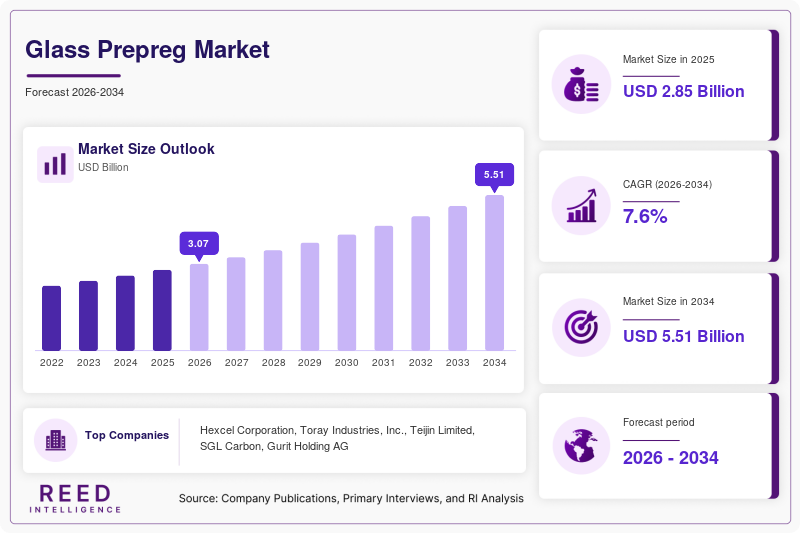
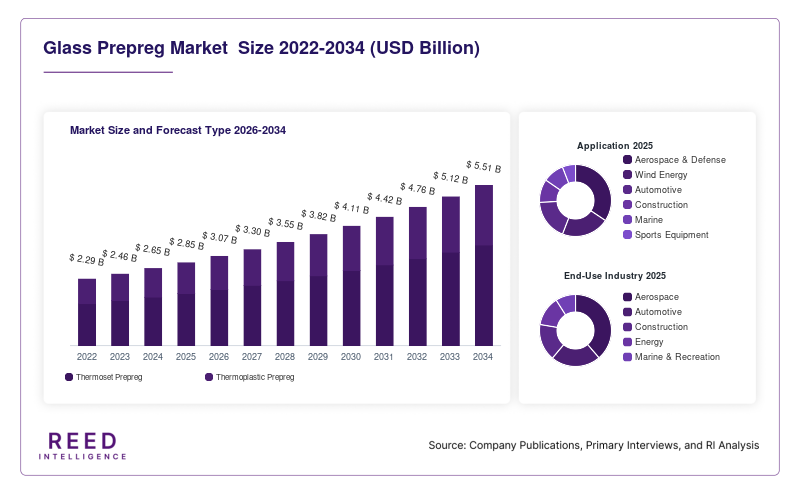
The global Glass Prepreg Market size was valued at approximately USD 2.85 billion in 2026 and is projected to reach around USD 5.12 billion by 2034, expanding at a CAGR of 7.6% during the forecast period (2026–2034). Glass prepregs, which are pre-impregnated reinforcement fibers combined with resin systems, are widely utilized across industries such as aerospace, automotive, wind energy, and construction due to their superior mechanical strength, lightweight properties, and ease of processing. Increasing demand for durable yet lightweight composite materials has played a central role in market expansion, especially as industries continue to focus on performance optimization and energy efficiency.
A significant global factor contributing to the growth of this market is the rising emphasis on lightweight materials in transportation and renewable energy sectors. Manufacturers are increasingly replacing traditional metals with composite materials to enhance fuel efficiency and reduce emissions. Glass prepregs offer a cost-effective alternative to carbon prepregs, making them suitable for large-scale applications where cost sensitivity is crucial. Additionally, advancements in resin systems and curing technologies have further improved the adoption rate across high-performance industrial applications.
Key Highlights
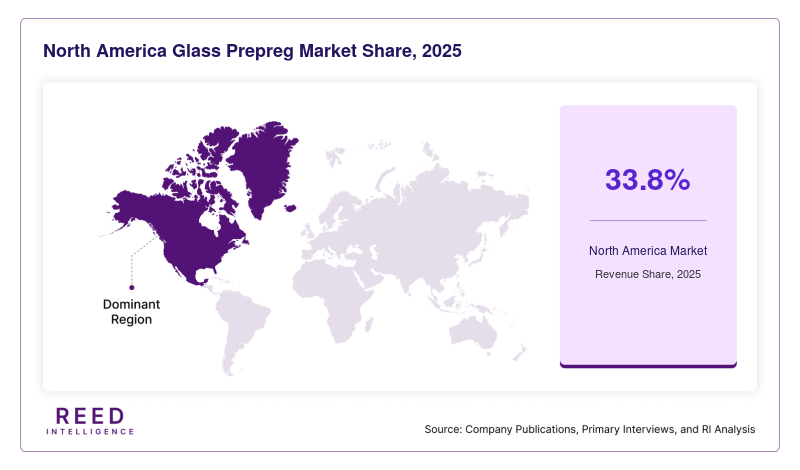
- North America dominated the market with a 33.8% share in 2025.
- Asia Pacific is expected to grow at the fastest CAGR of 9.4% during 2026–2034.
- By type, thermoset prepregs accounted for the largest share of 61.2%, while thermoplastic prepregs are projected to grow at a CAGR of 8.9%.
- By application, aerospace & defense led with a 36.5% share, whereas wind energy is expected to expand at a CAGR of 9.7%.
- The United States remained the dominant country, with market values of USD 620 million in 2024 and USD 675 million in 2025.
Market Trends
Growing adoption in renewable energy infrastructure
The integration of glass prepregs into renewable energy systems has gained strong momentum, particularly in wind turbine manufacturing. These materials offer excellent fatigue resistance and durability, which are critical for turbine blades exposed to harsh environmental conditions. As global investments in renewable energy projects increase, manufacturers are focusing on high-performance materials that ensure longer service life and reduced maintenance costs. Glass prepregs provide a balanced combination of cost efficiency and mechanical performance, making them a preferred choice in large-scale energy infrastructure projects. The trend is further supported by government policies promoting clean energy adoption and technological improvements in composite manufacturing processes.
Increasing innovation in resin systems and curing technologies
Technological advancements in resin systems are reshaping the Glass Prepreg Market by improving performance characteristics such as thermal stability, chemical resistance, and processing speed. Manufacturers are investing in research to develop advanced epoxy, polyester, and phenolic resins that enhance product durability while reducing curing time. These innovations enable faster production cycles and lower manufacturing costs, which are essential for industries such as automotive and construction. Additionally, the introduction of out-of-autoclave curing technologies has expanded the usability of glass prepregs in cost-sensitive applications. This trend is expected to drive market penetration across emerging economies where affordability and efficiency are key considerations.
Market Drivers
Rising demand for lightweight materials in transportation
The growing need for lightweight materials in the automotive and aerospace sectors has significantly driven the demand for glass prepregs. These materials help reduce overall vehicle weight, leading to improved fuel efficiency and lower emissions. In the aerospace industry, weight reduction directly impacts operational efficiency and cost savings. Glass prepregs offer a viable alternative to heavier metals and more expensive carbon composites, providing an optimal balance between cost and performance. As regulatory bodies enforce stricter emission norms, manufacturers are increasingly adopting composite materials to meet compliance requirements, further boosting market growth.
Expansion of construction and infrastructure projects
The rapid expansion of construction activities worldwide has also contributed to the growth of the Glass Prepreg Market. Glass prepregs are widely used in structural reinforcement, roofing panels, and façade systems due to their strength, corrosion resistance, and design flexibility. Urbanization and infrastructure development in emerging economies are driving the demand for advanced construction materials that offer durability and reduced maintenance. Additionally, the growing trend of sustainable construction practices is encouraging the use of composite materials that enhance energy efficiency and reduce environmental impact. This driver is expected to sustain long-term demand across both residential and commercial construction sectors.
Market Restraint
High production costs and complex manufacturing processes
Despite their advantages, glass prepregs face challenges related to high production costs and complex manufacturing requirements. The process of impregnating glass fibers with resin and maintaining consistent quality involves advanced equipment and strict quality control measures. This increases the overall cost of production, making it less accessible for small and medium-scale manufacturers. Additionally, the need for controlled storage conditions and limited shelf life further complicates supply chain management. These factors can hinder market growth, particularly in price-sensitive regions where alternative materials may be preferred. For instance, in developing markets, manufacturers often opt for traditional composites or lower-cost substitutes to maintain profitability, thereby limiting the adoption of glass prepregs.
Market Opportunities
Emerging applications in electric vehicles and battery systems
The rapid growth of the electric vehicle (EV) industry presents new opportunities for glass prepregs. These materials are increasingly being used in battery enclosures, structural components, and insulation systems due to their lightweight and thermal resistance properties. As EV manufacturers focus on improving vehicle efficiency and safety, the demand for advanced composite materials is expected to rise. Glass prepregs offer a cost-effective solution compared to carbon fiber alternatives, making them suitable for mass-market EV production. This opportunity is further supported by government incentives and investments in EV infrastructure, which are accelerating industry growth.
Increasing demand in marine and sports equipment industries
Another promising opportunity lies in the marine and sports equipment sectors, where glass prepregs are used to manufacture high-performance products such as boat hulls, surfboards, and protective gear. These applications require materials that offer strength, flexibility, and resistance to environmental factors such as moisture and UV exposure. Glass prepregs meet these requirements while maintaining cost efficiency, making them attractive for manufacturers targeting both professional and recreational markets. The growing popularity of water sports and outdoor activities is expected to drive demand in this segment, creating new revenue streams for market participants.
Segmental Analysis
By Type
Thermoset prepregs dominated the market with a share of 61.2% in 2024 due to their excellent mechanical properties and wide applicability across industries. These materials are widely used in aerospace and construction applications where high strength and durability are required. Thermoset resins, such as epoxy and polyester, provide strong bonding with glass fibers, resulting in superior performance. Their ability to withstand high temperatures and resist chemical degradation makes them suitable for demanding environments. Additionally, established manufacturing processes and widespread availability contribute to their dominant position in the market.
Thermoplastic prepregs are expected to grow at the fastest CAGR of 8.9% during the forecast period. The growth is driven by their recyclability, faster processing time, and improved impact resistance. Unlike thermosets, thermoplastics can be reshaped and reused, making them more sustainable. This characteristic is particularly important in industries focusing on environmental responsibility. Advances in material science have also enhanced their performance, making them suitable for high-strength applications. As industries continue to prioritize sustainability and efficiency, the demand for thermoplastic prepregs is expected to increase significantly.
By Application
Aerospace & defense applications accounted for the largest share of 36.5% in 2024, driven by the need for lightweight and high-performance materials. Glass prepregs are used in aircraft interiors, structural components, and insulation systems due to their strength and durability. The growing demand for fuel-efficient aircraft has further increased the adoption of composite materials. Additionally, stringent safety standards in the aerospace industry require materials that offer consistent performance and reliability, reinforcing the dominance of this segment.
Wind energy is projected to grow at the fastest CAGR of 9.7% during the forecast period. The expansion of renewable energy projects worldwide is driving demand for high-performance materials used in turbine blades. Glass prepregs offer excellent fatigue resistance and cost efficiency, making them suitable for large-scale applications. Technological advancements in blade design and manufacturing processes have further enhanced their adoption. As governments continue to invest in renewable energy infrastructure, this segment is expected to witness strong growth.
By End-Use Industry
The construction industry held a significant share of 29.8% in 2024 due to the increasing use of composite materials in infrastructure projects. Glass prepregs are used in reinforcement, roofing, and façade systems, offering durability and resistance to environmental factors. Rapid urbanization and infrastructure development have driven demand for advanced construction materials. Additionally, the growing trend of sustainable construction practices has encouraged the use of composites that enhance energy efficiency and reduce maintenance costs.
The automotive industry is expected to grow at the fastest CAGR of 8.7% during the forecast period. The shift toward lightweight vehicles to improve fuel efficiency and reduce emissions is a major growth factor. Glass prepregs provide a cost-effective alternative to traditional materials, enabling manufacturers to achieve performance goals without significantly increasing costs. The rise of electric vehicles has further accelerated demand, as these materials are used in battery enclosures and structural components. Continuous innovation in automotive design and materials is expected to drive this segment’s growth.
Regional Analysis
North America
North America accounted for a significant share of 33.8% in 2025 and is expected to grow at a CAGR of 6.8% during the forecast period. The region’s dominance is driven by strong demand from aerospace, defense, and automotive industries. Advanced manufacturing capabilities and high investment in research and development further support market growth.
The United States remains the dominant country in this region, supported by a well-established aerospace sector. A key growth factor is the increasing adoption of composite materials in defense applications, where performance and durability are critical.
Europe
Europe held a market share of 27.5% in 2025 and is projected to grow at a CAGR of 7.1% through 2034. The region benefits from strong automotive and renewable energy sectors, particularly in countries focusing on sustainability and emission reduction.
Germany leads the European market, driven by its advanced automotive manufacturing industry. A unique growth factor is the region’s emphasis on green building standards, which promotes the use of durable composite materials in construction.
Asia Pacific
Asia Pacific accounted for 24.3% of the market in 2025 and is expected to register the fastest CAGR of 9.4% during the forecast period. Rapid industrialization and infrastructure development are key contributors to market growth in this region.
China dominates the regional market due to its large-scale manufacturing capabilities. A significant growth factor is the expansion of wind energy projects, which require high-performance materials such as glass prepregs.
Middle East & Africa
The Middle East & Africa region held a smaller share of 7.2% in 2025 and is projected to grow at a CAGR of 7.3%. The market is driven by increasing construction activities and investments in infrastructure development.
Saudi Arabia is a leading country in this region, supported by large-scale construction projects. A unique growth factor is the development of smart cities, which require advanced materials for sustainable infrastructure.
Latin America
Latin America accounted for 7.2% of the market in 2025 and is expected to grow at a CAGR of 7.0%. The region’s growth is supported by expanding industrial activities and increasing demand for durable construction materials.
Brazil leads the market in this region, driven by its growing manufacturing sector. A key growth factor is the rising adoption of composite materials in marine applications, particularly in coastal regions.
Competitive Landscape
The Glass Prepreg Market is moderately consolidated, with several key players focusing on product innovation and strategic partnerships to strengthen their market position. Companies are investing in research and development to enhance material performance and expand their application scope. The market is characterized by the presence of global manufacturers as well as regional players catering to specific industries.
Hexcel Corporation is recognized as a leading player in the market, known for its advanced composite materials and strong presence in aerospace applications. A recent development includes the expansion of its production capacity to meet growing demand from the renewable energy sector. Other major companies are also focusing on mergers, acquisitions, and collaborations to enhance their product portfolios and geographic reach.
Key Players
- Hexcel Corporation
- Toray Industries, Inc.
- Teijin Limited
- SGL Carbon
- Gurit Holding AG
- Solvay S.A.
- Mitsubishi Chemical Group
- Park Aerospace Corp.
- Axiom Materials Inc.
- Royal Ten Cate
- Owens Corning
- Huntsman Corporation
- Jushi Group Co., Ltd.
- TPI Composites
- Barrday Inc.
Recent Developments
- Several companies have expanded their production facilities to meet rising demand from renewable energy and automotive sectors.
- New product launches focusing on advanced resin systems have improved performance characteristics such as heat resistance and durability.
- Strategic collaborations between manufacturers and research institutions have accelerated innovation in composite materials and processing technologies.
Glass Prepreg Market Segments
Type
- Thermoset Prepreg
- Thermoplastic Prepreg
Application
- Aerospace & Defense
- Wind Energy
- Automotive
- Construction
- Marine
- Sports Equipment
End-Use Industry
- Aerospace
- Automotive
- Construction
- Energy
- Marine & Recreation
By Region
- North America
- Europe
- APAC
- Middle East and Africa
- LATAM