Glass Scintillator Market Size, Share & Demand Report By Type (Silicate Glass Scintillators, Phosphate Glass Scintillators, Borate Glass Scintillators), By Application (Medical Imaging, Homeland Security, Industrial Inspection, Scientific Research), By End-Use Industry (Healthcare, Defense & Security, Energy & Nuclear, Industrial), By Material Composition (Oxide-Based, Non-Oxide-Based), By Region & Segment Forecasts, 2025–2034
USD 3950
Market Overview
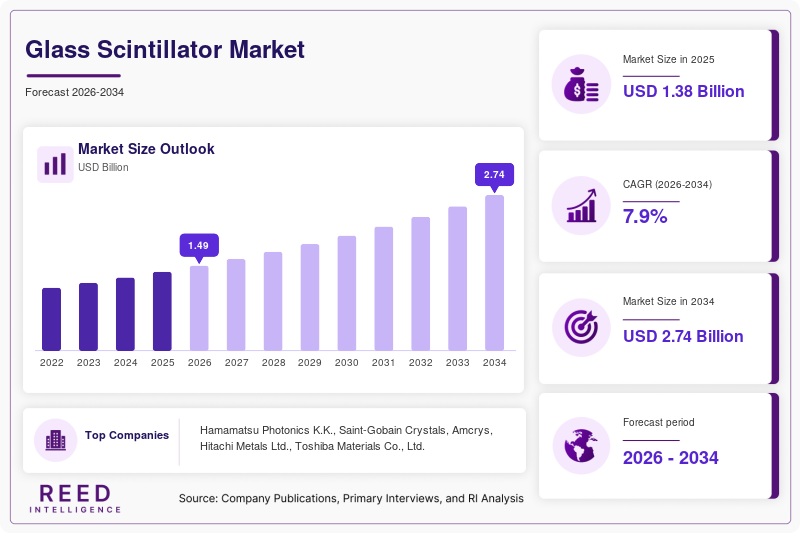
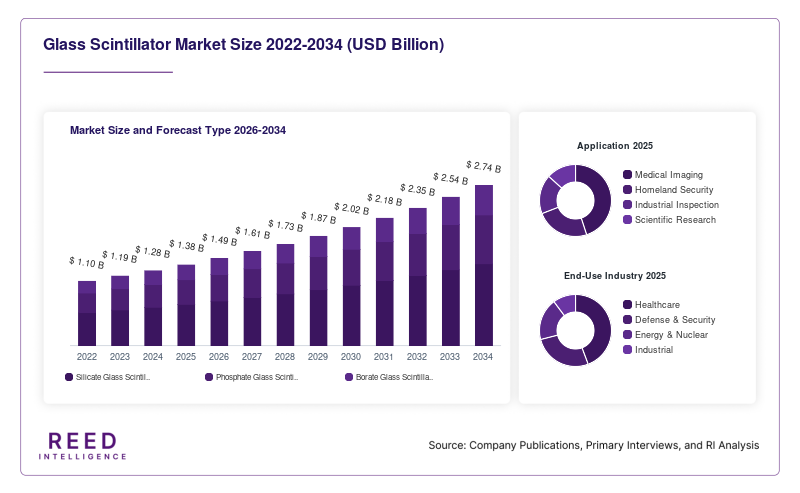
The global Glass Scintillator Market size was valued at approximately USD 1.38 billion in 2025 and is projected to reach around USD 2.74 billion by 2034, expanding at a CAGR of 7.9% from 2025 to 2034. Glass scintillators, widely used in radiation detection and imaging applications, are gaining traction due to their durability, cost efficiency, and ease of manufacturing compared to crystal-based alternatives.
A key global factor supporting market growth is the rising adoption of radiation detection technologies across healthcare and nuclear safety applications. Increasing investments in diagnostic imaging systems, coupled with stricter radiation monitoring regulations, have significantly contributed to the demand for advanced scintillation materials. Additionally, the integration of glass scintillators in homeland security and industrial inspection systems has broadened their application base.
Key Highlights
- North America dominated the market with a 38.6% share in 2025, while Asia Pacific is expected to register the fastest growth at a CAGR of 9.1%.
- Among segments, silicate-based glass scintillators led with a 42.3% share, whereas phosphate-based glass scintillators are projected to grow fastest at a CAGR of 8.7%.
- The medical imaging application segment accounted for the largest share at 36.8%, while homeland security applications are expected to expand at a CAGR of 9.4%.
- The United States led globally, with a market value of USD 420 million in 2025, projected to reach USD 455 million in 2026.
Market Trends
Integration with Advanced Imaging Technologies
The Glass Scintillator Market is witnessing increasing integration with advanced imaging systems such as PET and CT scanners. Manufacturers are focusing on enhancing light yield and timing resolution to improve imaging precision. This trend is particularly prominent in healthcare, where demand for accurate diagnostics continues to rise. Additionally, hybrid imaging systems are adopting glass scintillators for improved performance and cost efficiency.
Shift Toward Customized Scintillator Solutions
Customization has emerged as a key trend, with manufacturers developing application-specific glass scintillators tailored for industrial, defense, and research applications. End users are demanding materials with specific properties such as higher radiation resistance, faster decay times, and improved thermal stability. This has led to increased R&D investments and collaborative product development. As industries diversify their use of radiation detection technologies, customized glass scintillators are expected to gain widespread adoption.
Market Drivers
Growing Demand for Medical Imaging Systems
The increasing prevalence of chronic diseases and the need for early diagnosis are driving the adoption of advanced imaging technologies. Glass scintillators are widely used in imaging equipment due to their ability to detect ionizing radiation effectively. The healthcare sector’s ongoing expansion and modernization are contributing significantly to market growth.
Rising Investments in Nuclear Safety and Security
Governments and organizations worldwide are investing heavily in nuclear safety infrastructure and radiation monitoring systems. Glass scintillators are integral components in these systems, enabling accurate detection of radioactive materials. The growing emphasis on safety in nuclear power plants and border security has accelerated the demand for reliable scintillation materials.
Market Restraint
Performance Limitations Compared to Crystal Scintillators
Despite their advantages, glass scintillators face performance limitations when compared to crystal-based scintillators. They typically exhibit lower light yield and energy resolution, which can impact their effectiveness in high-precision applications. This limitation restricts their adoption in advanced scientific research and certain medical imaging technologies where higher sensitivity is required. Additionally, ongoing advancements in crystal scintillator technologies pose competitive challenges, potentially limiting the growth of the Glass Scintillator Market in high-end applications.
Market Opportunities
Expansion in Emerging Economies
Emerging economies are investing in healthcare infrastructure, nuclear energy, and industrial safety systems. This presents significant growth opportunities for the Glass Scintillator Market. Increasing government funding and foreign investments are enabling the adoption of advanced radiation detection technologies in these regions.
Advancements in Material Science
Innovations in material engineering are creating opportunities to enhance the performance of glass scintillators. Research efforts are focused on improving light output, decay time, and radiation hardness. These advancements are expected to expand the application scope of glass scintillators, particularly in high-performance imaging and scientific research.
Segmental Analysis
By Type
Silicate-based glass scintillators dominated the market, accounting for 42.3% of the share in 2025. Their widespread use was attributed to their stability, cost-effectiveness, and suitability for various radiation detection applications.
Phosphate-based glass scintillators are expected to grow at the fastest CAGR of 8.7%, driven by their superior optical properties and enhanced radiation resistance. Their adoption will increase in advanced imaging and scientific applications.
By Application
Medical imaging held the largest share at 36.8% in 2025, owing to the increasing use of scintillators in diagnostic equipment such as CT and PET scanners.
Homeland security is projected to grow at a CAGR of 9.4%, driven by rising concerns over nuclear threats and the need for efficient radiation detection systems at borders and public spaces.
By End-Use Industry
The healthcare sector dominated with a 39.5% share in 2025, supported by growing demand for diagnostic imaging technologies and improved healthcare infrastructure.
The defense and security sector is expected to witness the fastest growth at a CAGR of 8.9%, driven by increasing investments in surveillance and detection systems.
By Material Composition
Oxide-based glass scintillators led the segment with a 44.1% share in 2025, due to their durability and performance in radiation detection.
Non-oxide glass scintillators are anticipated to grow at a CAGR of 8.5%, owing to their unique properties such as higher sensitivity and improved efficiency in specific applications.
Regional Analysis
North America
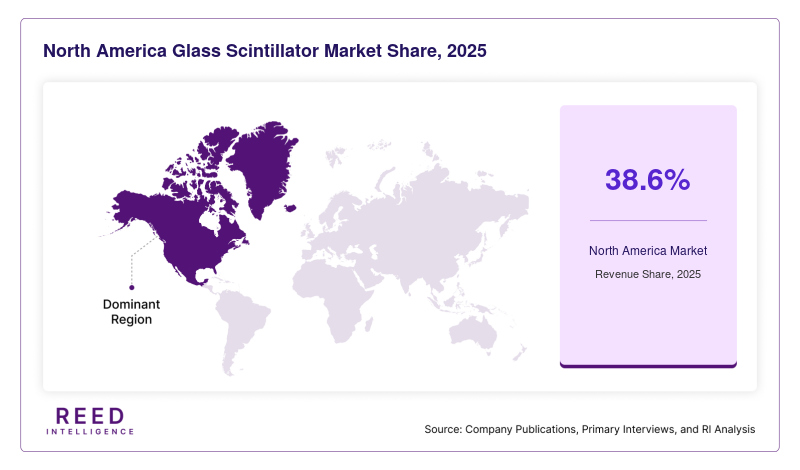
North America accounted for 38.6% of the Glass Scintillator Market share in 2025 and is expected to grow at a CAGR of 7.5% during the forecast period. The region benefited from strong investments in healthcare infrastructure and advanced imaging technologies.
The United States dominated the regional market due to its extensive network of diagnostic imaging centers and nuclear facilities. The presence of leading research institutions and continuous technological advancements in radiation detection systems supported market expansion.
Europe
Europe held approximately 27.4% of the market share in 2025 and is projected to grow at a CAGR of 7.2%. The region experienced steady growth driven by stringent regulations related to radiation safety and environmental monitoring.
Germany emerged as the dominant country, supported by its robust industrial base and focus on technological innovation. The country’s investments in nuclear safety and industrial inspection systems contributed significantly to market demand.
Asia Pacific
Asia Pacific captured around 21.8% of the market share in 2025 and is expected to register the fastest growth at a CAGR of 9.1%. Rapid industrialization and increasing healthcare investments drove regional growth.
China led the market due to its expanding nuclear energy sector and growing adoption of medical imaging technologies. Government initiatives to strengthen radiation monitoring systems further boosted market development.
Middle East & Africa
The Middle East & Africa region accounted for 6.5% of the market share in 2025 and is anticipated to grow at a CAGR of 6.8%. Growth was supported by increasing investments in energy and infrastructure projects.
Saudi Arabia dominated the region, driven by its focus on developing nuclear energy capabilities and enhancing industrial safety standards. The country’s strategic initiatives in energy diversification contributed to market expansion.
Latin America
Latin America held 5.7% of the market share in 2025 and is projected to grow at a CAGR of 6.9%. The region showed gradual adoption of radiation detection technologies across healthcare and industrial sectors.
Brazil emerged as the leading country, supported by its expanding healthcare sector and investments in diagnostic imaging systems. Government efforts to improve public health infrastructure played a crucial role in market growth.
Competitive Landscape
The Glass Scintillator Market is moderately competitive, with key players focusing on product innovation and strategic collaborations. Leading companies are investing in research and development to enhance material performance and expand application areas.
A major market leader is Hamamatsu Photonics K.K., known for its advanced scintillation technologies and strong global presence. The company recently introduced a new range of high-performance glass scintillators designed for medical imaging applications, strengthening its competitive position.
Other prominent players are actively expanding their product portfolios and entering emerging markets to gain a competitive edge. Partnerships with research institutions and end-use industries are also common strategies to drive innovation and market growth.
Key Players List
- Hamamatsu Photonics K.K.
- Saint-Gobain Crystals
- Amcrys
- Hitachi Metals Ltd.
- Toshiba Materials Co., Ltd.
- Scionix Holland B.V.
- Detec Europe Ltd.
- Rexon Components Inc.
- EPIC Crystal Co., Ltd.
- Shanghai SICCAS High Technology Corporation
- Beijing Glass Research Institute
- Eljen Technology
- Dynasil Corporation
- Radiation Monitoring Devices Inc.
- Mirion Technologies Inc.
Recent Developments
- In 2024, Hamamatsu Photonics launched a new series of glass scintillators with improved light output for imaging systems.
- Saint-Gobain Crystals expanded its production capacity to meet rising global demand.
- Mirion Technologies introduced enhanced radiation detection solutions incorporating glass scintillators.
- Toshiba Materials developed advanced scintillator materials for industrial applications.
- EPIC Crystal Co. focused on expanding its presence in Asia Pacific through strategic partnerships.
Glass Scintillator Market Segments
Type
- Silicate Glass Scintillators
- Phosphate Glass Scintillators
- Borate Glass Scintillators
Application
- Medical Imaging
- Homeland Security
- Industrial Inspection
- Scientific Research
End-Use Industry
- Healthcare
- Defense & Security
- Energy & Nuclear
- Industrial
Material Composition
- Oxide-Based
- Non-Oxide-Based
By Region
- North America
- Europe
- APAC
- Middle East and Africa
- LATAM