Glaucoma Diagnostics Market Size, Share Demand Report By Product Type (Optical Coherence Tomography (OCT) Systems, Tonometry Devices), By Application (Disease Monitoring and Progression Assessment), By End Use (Hospitals and Ophthalmology Clinics, Ambulatory Diagnostic Centers), By Technology (Imaging-Based Diagnostics, Functional Assessment Diagnosticss), By Portability (Conventional Fixed Systems, Portable Diagnostic Systems), By Region & Segment Forecasts, 2026–2034
USD 3950
Market Overview
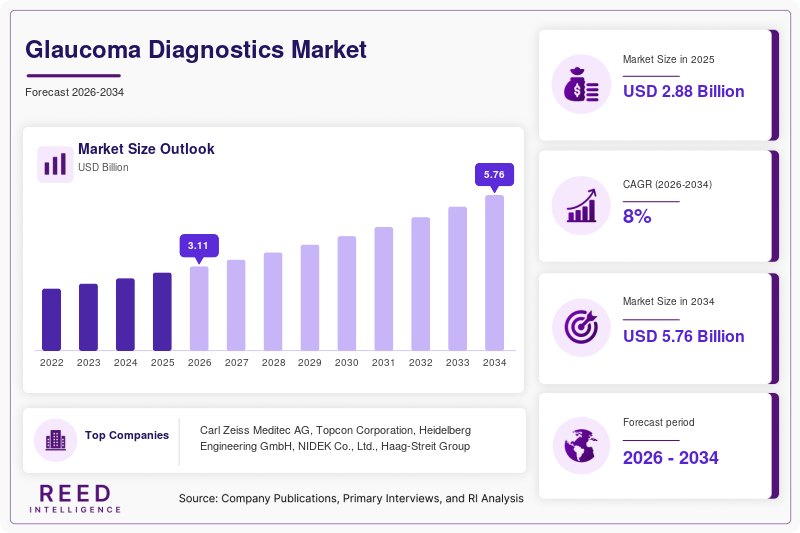
The global Glaucoma Diagnostics Market size was valued at USD 2.88 billion in 2026 and is projected to reach USD 5.34 billion by 2034, expanding at a CAGR of 8.0% from 2026 to 2034. The market growth is being supported by rising glaucoma prevalence, increasing adoption of early disease detection tools, and growing demand for advanced ophthalmic diagnostic technologies. Glaucoma diagnostics continue to be widely used across hospitals, specialty eye clinics, ambulatory centers, and screening programs for disease detection, monitoring, and progression assessment.
A major global factor supporting growth in the Glaucoma Diagnostics Market has been the increasing emphasis on preventive eye care and early diagnosis. Expanding screening initiatives and rising awareness regarding irreversible vision loss have supported adoption of advanced diagnostic technologies. The Glaucoma Diagnostics Market has also benefited from technological improvements in imaging systems, diagnostic software, and integrated ophthalmic devices. Manufacturers continue to focus on diagnostic precision, workflow efficiency, and digital connectivity to support evolving clinical needs.
Key Highlights
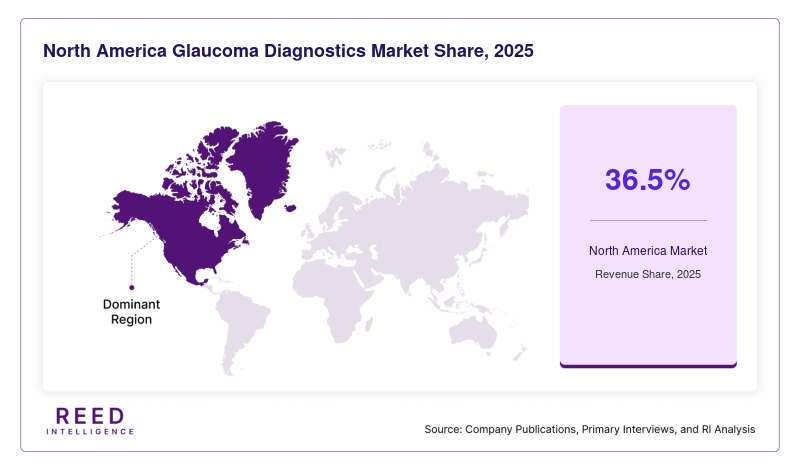
- North America held the dominant regional share of 36.5% in 2025, while Asia Pacific is projected to register the fastest CAGR of 8.7% through 2034.
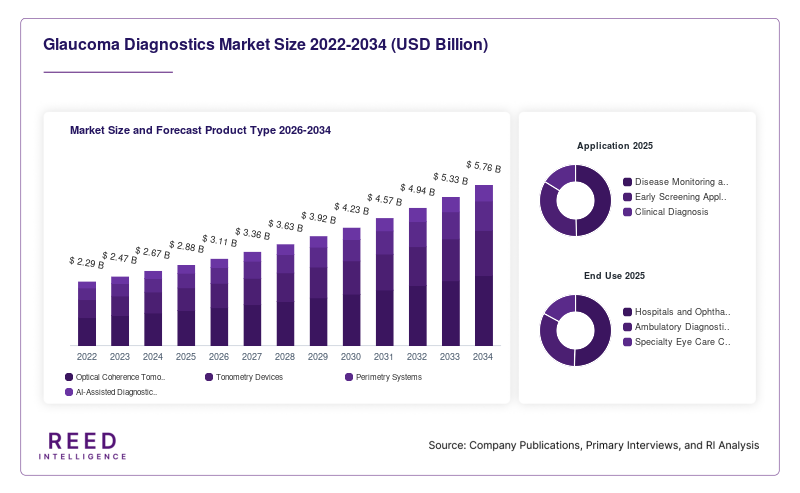
- By product type, Optical Coherence Tomography (OCT) Systems accounted for 42.8% share in 2025, while AI-Assisted Diagnostic Platforms are projected to grow at 9.4% CAGR.
- By application, Disease Monitoring and Progression Assessment held 46.9% share in 2025, while Early Screening Applications are forecast to expand at 8.9% CAGR.
- By end use, Hospitals and Ophthalmology Clinics accounted for 58.2% share, while Ambulatory Diagnostic Centers are expected to grow at 8.5% CAGR.
- The United States, the dominant country, was valued at USD 402 million in 2024 and USD 428 million in 2025.
Market Trends
Growth in AI-Assisted Ophthalmic Diagnostics
One major trend shaping the Glaucoma Diagnostics Market is increasing adoption of AI-assisted ophthalmic diagnostics. Providers are integrating software-driven tools aimed at improving disease detection and supporting clinical decision-making.
Expansion of Multimodal Diagnostic Platforms
Another notable trend is rising demand for multimodal glaucoma diagnostic systems. Integrated devices combining imaging, tonometry, and visual field testing are gaining traction in clinical workflows.
Market Drivers
Rising Glaucoma Disease Burden
Increasing prevalence of glaucoma continues to support Glaucoma Diagnostics Market growth. Demand for routine disease screening and monitoring has accelerated adoption of diagnostic technologies.
Demand for Early Detection Technologies
Growing focus on early disease detection has supported increased demand for advanced diagnostic tools capable of identifying glaucoma progression risk.
Market Restraints
High Equipment Costs in Advanced Diagnostics
A major restraint in the Glaucoma Diagnostics Market is the relatively high cost of advanced imaging and diagnostic systems, which can affect adoption in cost-sensitive healthcare settings.
Market Opportunities
Demand for Portable Diagnostic Solutions
Growing interest in portable ophthalmic diagnostics creates opportunities for manufacturers developing compact glaucoma screening technologies.
Expansion in Teleophthalmology Screening Models
Increasing adoption of remote screening models presents opportunities for diagnostic platforms integrated with teleophthalmology workflows.
Segmental Analysis
By Product Type
Optical Coherence Tomography (OCT) Systems: Optical coherence tomography systems held the dominant share of 42.8% in 2025 due to broad adoption for structural glaucoma assessment.
AI-Assisted Diagnostic Platforms: AI-assisted diagnostic platforms are projected to grow at 9.4% CAGR through 2034. Growth will be driven by rising demand for software-supported diagnostic efficiency.
By Application
Disease Monitoring and Progression Assessment: Disease monitoring and progression assessment held 46.9% of the market in 2025, supported by recurring clinical demand.
Early Screening Applications: Early screening applications are forecast to grow at 8.9% CAGR through 2034, driven by expanding preventive eye care programs.
By End Use
Hospitals and Ophthalmology Clinics: Hospitals and ophthalmology clinics accounted for 58.2% market share in 2025 due to direct demand for comprehensive diagnostic systems.
Ambulatory Diagnostic Centers: Ambulatory diagnostic centers are projected to grow at 8.5% CAGR, supported by increasing outpatient diagnostic demand.
By Technology
Imaging-Based Diagnostics: Imaging-based diagnostics represented 53.4% share in 2025 due to widespread use in structural disease evaluation.
Functional Assessment Diagnostics: Functional assessment diagnostics are expected to grow at 8.3% CAGR, driven by increasing demand for complementary diagnostic analysis.
By Portability
Conventional Fixed Systems: Conventional fixed systems accounted for 61.6% market share in 2025 due to established deployment across clinical facilities.
Portable Diagnostic Systems: Portable diagnostic systems are projected to grow at 9.1% CAGR, supported by demand for decentralized screening tools.
Regional Analysis
North America
North America accounted for 36.5% of the Glaucoma Diagnostics Market in 2025. The regional market will expand at a 7.5% CAGR through 2034.
The United States remained the dominant country, supported by adoption of advanced ophthalmic technologies and structured disease screening programs.
Europe
Europe held 28.1% market share in 2025 and will grow at a 7.4% CAGR through 2034.
Germany dominated the regional market due to demand for advanced ophthalmic diagnostics and increasing emphasis on preventive eye care.
Asia Pacific
Asia Pacific represented 23.7% of the market in 2025 and is projected to register the fastest growth at 8.7% CAGR during the forecast period.
Japan led the regional market, supported by aging population trends and rising adoption of precision ophthalmic diagnostic technologies.
Middle East & Africa
Middle East & Africa accounted for 6.3% market share in 2025. The market will expand at a 7.6% CAGR through 2034.
Saudi Arabia dominated the regional market due to increasing investments in ophthalmic care infrastructure.
Latin America
Latin America held 5.4% share in 2025 and is expected to grow at 7.8% CAGR over the forecast period.
Brazil led the regional market due to expanding eye care access and demand for glaucoma screening services.
Competitive Landscape
The Glaucoma Diagnostics Market remains moderately consolidated, with competition centered on diagnostic precision, imaging capabilities, software integration, and clinical workflow efficiency. Manufacturers are prioritizing digital diagnostics, AI integration, and multimodal platforms to strengthen market positioning.
Carl Zeiss Meditec emerged as a market leader due to its broad ophthalmic diagnostics portfolio and strong position in imaging systems. The company recently expanded development of AI-enabled glaucoma diagnostic technologies aimed at improving disease assessment efficiency.
Topcon maintained a strong market position through integrated ophthalmic diagnostic solutions. Heidelberg Engineering focused on advanced imaging innovation for glaucoma analysis. NIDEK emphasized diagnostic platform enhancements supporting ophthalmology workflows. Haag-Streit continued strengthening its position through precision diagnostic equipment solutions.
Strategic initiatives across the market include product innovation, software development, and expansion of digital diagnostic capabilities.
Key Players List
- Carl Zeiss Meditec AG
- Topcon Corporation
- Heidelberg Engineering GmbH
- NIDEK Co., Ltd.
- Haag-Streit Group
- Canon Medical Systems
- Reichert Technologies
- OCULUS Optikgeräte GmbH
- Optovue Inc.
- Keeler Ltd.
- Kowa Company Ltd.
- Essilor Instruments
- Bausch + Lomb
- Takagi Seiko
- Huvitz Co., Ltd.
- Sonomed Escalon
- Tomey Corporation
- Ziemer Ophthalmic Systems
Recent Developments
- In 2025, several manufacturers increased investment in AI-assisted glaucoma diagnostics to support growing demand for software-enhanced disease detection.
- Carl Zeiss Meditec introduced expanded digital diagnostic solutions designed to improve glaucoma progression analysis.
- Topcon increased product development focused on multimodal diagnostic platforms integrating imaging and functional assessment technologies.
- Several market participants expanded focus on portable ophthalmic diagnostics aimed at supporting decentralized glaucoma screening.
- Manufacturers also increased investment in teleophthalmology-compatible diagnostic solutions.
- Growing demand for preventive eye care programs supported continued innovation across the Glaucoma Diagnostics Market.
Glaucoma Diagnostics Market Segments
Product Type
- Optical Coherence Tomography (OCT) Systems
- Tonometry Devices
- Perimetry Systems
- AI-Assisted Diagnostic Platforms
Application
- Disease Monitoring and Progression Assessment
- Early Screening Applications
- Clinical Diagnosis
End Use
- Hospitals and Ophthalmology Clinics
- Ambulatory Diagnostic Centers
- Specialty Eye Care Centers
Technology
- Imaging-Based Diagnostics
- Functional Assessment Diagnostics
- Integrated Multimodal Diagnostics
Portability
- Conventional Fixed Systems
- Portable Diagnostic Systems
By Region
- North America
- Europe
- APAC
- Middle East and Africa
- LATAM