Air Core Inductor Coils Market Size, Share & Demand Report By Type (RF Air Core Inductor Coils, Power Air Core Inductor Coils, Custom Air Core Inductor Coils), By Application (Consumer Electronics, Telecommunications Equipment, Automotive Electronics), By Region & Segment Forecasts, 2026–2034
USD 3950
Air Core Inductor Coils Market Size
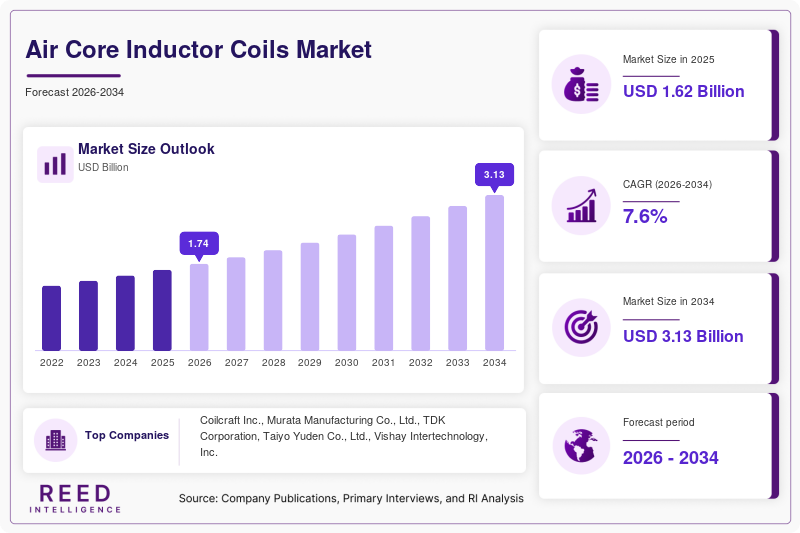
Air Core Inductor Coils market size is projected at USD 1.74 billion in 2026 and is expected to hit USD 3.12 billion by 2034 with a CAGR of 7.6%. The report provides detailed analysis of production volumes, technology developments, competitive benchmarking, and end-use industry adoption. The study evaluates historical trends from 2022–2024, establishes 2025 as the base year, and forecasts market performance through 2034 using comprehensive quantitative and qualitative assessments.
Air Core Inductor Coils are passive electronic components that use an air-filled core instead of magnetic materials to provide inductance with minimal core losses and superior high-frequency performance. These components are extensively utilized in radio frequency circuits, wireless communication devices, signal filtering systems, and advanced electronic applications. Global production of Air Core Inductor Coils exceeded 18 billion units in 2025, driven by increasing deployment in consumer electronics and telecommunications infrastructure.
Air Core Inductor Coils Market Trends
Increasing Adoption in High-Frequency Communication Systems
The growing deployment of 5G infrastructure, Wi-Fi 6 devices, and advanced communication systems is significantly increasing demand for Air Core Inductor Coils. More than 7 billion RF-enabled electronic devices were shipped globally in 2025, with approximately 65% incorporating air core inductors for signal conditioning and impedance matching applications. These developments continue to influence the Air Core Inductor Coils market trend.
Manufacturers are focusing on miniaturized coil designs capable of operating at frequencies above 6 GHz while maintaining low resistance and high efficiency. Adoption of compact air core inductors increased by nearly 15% year-over-year, particularly in smartphones, routers, and communication modules, strengthening Air Core Inductor Coils market demand.
Growth in Automotive and Wireless Technologies
Automotive electronics and connected vehicle systems are emerging as major end-use sectors. Global production of connected vehicles exceeded 45 million units in 2025, increasing demand for RF communication modules and wireless connectivity systems. Air core inductors are increasingly utilized in vehicle infotainment systems, telematics, and advanced driver assistance technologies.
Wireless charging systems and IoT devices also contribute to rising demand. More than 20 billion IoT devices were operational globally in 2025, with adoption rates above 60% in industrial and smart home applications. These developments support ongoing Air Core Inductor Coils market trend evolution.
Air Core Inductor Coils Market Drivers
Expansion of Wireless Communication Infrastructure
The rapid expansion of wireless communication infrastructure is a major driver for the market. Global 5G subscriptions surpassed 2.5 billion in 2025, while telecommunications operators invested more than USD 120 billion in network expansion projects. Air core inductors are essential for RF circuits, antenna matching, and signal filtering applications. Increasing demand for wireless connectivity and high-frequency electronics continues to stimulate Air Core Inductor Coils market growth.
Air Core Inductor Coils Market Restraints
Competition from Alternative Inductor Technologies
The availability of ferrite core and multilayer inductor technologies creates competitive pressure within the market. Alternative solutions offer advantages in specific low-frequency applications and account for nearly 45% of overall inductor shipments globally. Pricing competition and performance trade-offs in mass-market electronics affect profitability and present challenges for Air Core Inductor Coils market development.
Air Core Inductor Coils Market Opportunities
Growing Demand for Advanced RF and IoT Applications
Increasing deployment of IoT devices, smart infrastructure, and advanced communication technologies creates significant opportunities for manufacturers. Global IoT device shipments exceeded 20 billion units in 2025, while smart city investments surpassed USD 250 billion annually. Air core inductors play critical roles in wireless communication modules and RF circuits, creating favorable opportunities for Air Core Inductor Coils market expansion.
Challenges in Air Core Inductor Coils Market
Miniaturization and Performance Optimization Requirements
Manufacturers face challenges in reducing component size while maintaining inductance stability and performance. Modern communication devices require compact components operating at frequencies above 5 GHz with minimal signal loss. Production tolerances below ±2% and quality control requirements increase manufacturing complexity by approximately 18%, creating challenges for the Air Core Inductor Coils market.
Air Core Inductor Coils Market Segmentation
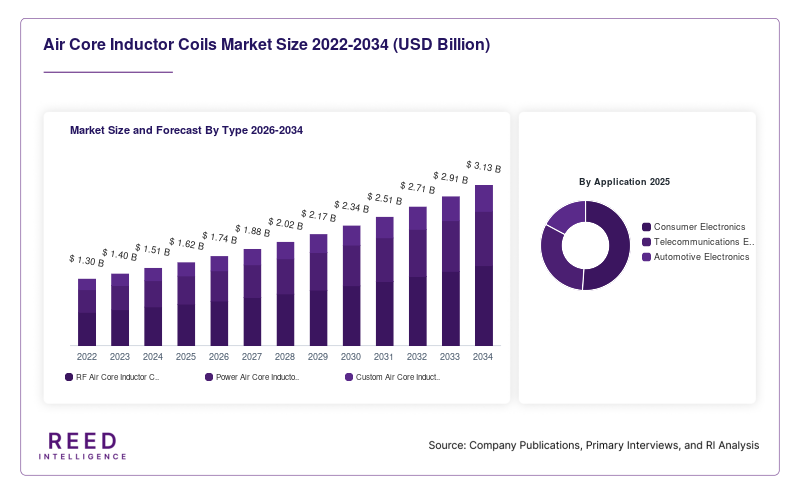
The market is segmented by type and application based on operating frequency, performance requirements, and end-use industry demand. RF Air Core Inductor Coils held approximately 47% market share in 2025, while consumer electronics accounted for nearly 44% of total application demand.
By Type
RF Air Core Inductor Coils represented approximately 47% market share in 2025. Production exceeded 8 billion units globally due to extensive utilization in smartphones, communication modules, and wireless networking equipment. These coils provide inductance values ranging from nanohenries to microhenries and support frequencies above 6 GHz. Their low energy loss and high signal integrity support widespread adoption.
Power Air Core Inductor Coils accounted for nearly 32% of market demand. Annual production exceeded 5.5 billion units, driven by applications in power management circuits, wireless charging systems, and industrial electronics. These components support current ratings above 20A and deliver improved thermal stability for demanding applications.
Custom Air Core Inductor Coils held approximately 21% market share. Production volumes surpassed 4 billion units annually. These components are designed for specialized applications in aerospace, defense, medical devices, and advanced telecommunications systems requiring unique inductance values and performance specifications.
By Application
Consumer electronics dominated the market with approximately 44% share. More than 8 billion electronic devices utilized air core inductors during 2025. Applications include smartphones, tablets, laptops, gaming systems, and wearable devices. Adoption rates exceeded 80% in advanced wireless communication products requiring high-frequency signal processing.
Telecommunications equipment accounted for nearly 30% market share. More than 3 million telecommunications base stations and networking systems incorporated air core inductors in 2025. These components support signal filtering, frequency tuning, and RF power amplification functions critical to communication networks.
Automotive electronics represented approximately 18% of market demand. Over 45 million connected vehicles and advanced automotive systems integrated air core inductors for wireless communication, infotainment, and telematics applications. Adoption continues to increase with vehicle connectivity advancements and electric vehicle deployment.
Air Core Inductor Coils Market Regional Outlook
Asia-Pacific Air Core Inductor Coils Market
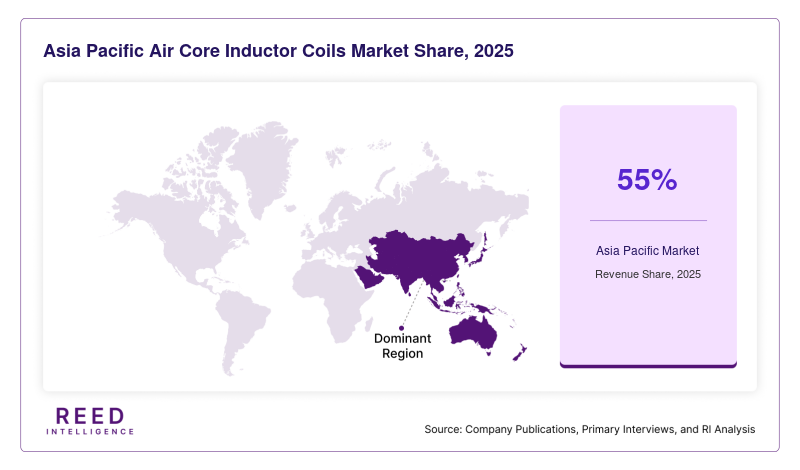
Asia-Pacific dominated the market with approximately 55% share in 2025. China, Japan, South Korea, and Taiwan accounted for more than 75% of global electronics manufacturing output. Production exceeded 10 billion units annually within the region. Consumer electronics represented nearly 50% of regional demand, while telecommunications equipment contributed approximately 28%.
North America Air Core Inductor Coils Market
North America accounted for nearly 21% market share. The United States remained the largest regional contributor due to strong telecommunications infrastructure investments and advanced electronics manufacturing. More than 3.5 billion units were consumed across consumer electronics and networking applications during 2025.
Europe Air Core Inductor Coils Market
Europe represented approximately 16% of global demand. Germany, France, and the United Kingdom contributed significantly through automotive electronics and industrial communication systems. Automotive applications accounted for nearly 35% of regional consumption, while telecommunications equipment represented approximately 30%.
Rest of the World Air Core Inductor Coils Market
The Rest of the World accounted for approximately 8% market share. Growth in wireless infrastructure, consumer electronics adoption, and industrial automation projects across Latin America, the Middle East, and Africa supported demand. Annual consumption exceeded 1.5 billion units during 2025.
Top players in Air Core Inductor Coils Market
- Coilcraft Inc.
- Murata Manufacturing Co., Ltd.
- TDK Corporation
- Taiyo Yuden Co., Ltd.
- Vishay Intertechnology, Inc.
- Johanson Technology, Inc.
- Bourns, Inc.
- AVX Corporation
- Würth Elektronik Group
- Pulse Electronics Corporation
- Yageo Corporation
- Sumida Corporation
Coilcraft Inc.
- Holds a leading position in the industry with an estimated market share above 11%.
- The company provides extensive RF and power inductor portfolios serving telecommunications, automotive, aerospace, and industrial sectors.
- Its manufacturing network supports production of billions of precision inductors annually while maintaining strict performance and quality standards.
- Strong focus on high-frequency applications, custom designs, and continuous product innovation strengthens its competitive position across global markets.
Murata Manufacturing Co., Ltd.
- Accounts for an estimated market share exceeding 9% within the global market.
- The company offers advanced inductor technologies supporting wireless communication, consumer electronics, and automotive applications.
- Strong investments in miniaturization technologies and RF component development enable leadership in high-performance electronic systems.
- Extensive customer relationships and global manufacturing capabilities support continued market expansion and technological advancement.
Recent Developments in Air Core Inductor Coils Market
- 2026: Leading manufacturers launched ultra-miniature air core inductors optimized for Wi-Fi 7 and advanced 5G applications.
- 2025: Telecommunications equipment suppliers increased procurement of high-frequency inductors for next-generation network infrastructure.
- 2025: Several companies introduced low-loss air core coil designs for wireless charging and IoT devices.
Air Core Inductor Coils Market Segments
By Type
- RF Air Core Inductor Coils
- Power Air Core Inductor Coils
- Custom Air Core Inductor Coils
By Application
- Consumer Electronics
- Telecommunications Equipment
- Automotive Electronics
By Region
- North America
- Europe
- APAC
- Middle East and Africa
- LATAM