Anti-Static Collapsible Tote Bin Market Size, Share, Growth & Demand Report By Material Type (Conductive Plastic, Anti-Static Polypropylene, ESD-Safe Composite Materials), By Application (Electronics Manufacturing, Semiconductor Handling, Automotive Components), By End-User Industry (Consumer Electronics, Semiconductor & Microelectronics, Automotive & Electric Vehicles, Industrial Manufacturing, Aerospace & Defense Electronics), By Region & Segment Forecasts, 2026–2034
USD 3950
Anti-Static Collapsible Tote Bin Market Size
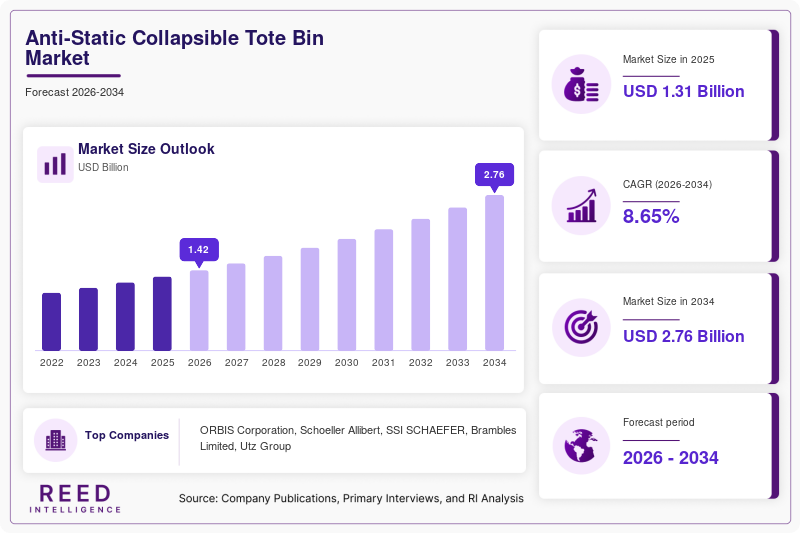
Anti-Static Collapsible Tote Bin market size is projected at USD 1.42 billion in 2026 and is expected to hit USD 2.76 billion by 2034 with a CAGR of 8.65%. The market growth is supported by increasing demand for electrostatic discharge (ESD) protection solutions across electronics, semiconductor, automotive, and industrial manufacturing sectors. The report provides detailed segmentation analysis, competitive landscape evaluation, production trends, technology adoption, and regional performance assessment covering historical years 2022–2024, base year 2025, and forecast period 2026–2034.
The Anti-Static Collapsible Tote Bin Market represents the global industry focused on manufacturing reusable, foldable storage and transportation containers designed to prevent electrostatic discharge damage during material handling. These bins are widely used for protecting sensitive electronic components, printed circuit boards, semiconductor wafers, and automotive electronic assemblies. Global production of anti-static collapsible tote bins exceeded 18 million units in 2025, with Asia-Pacific contributing nearly 52% of total manufacturing output. Electronics and semiconductor applications accounted for approximately 46% of market consumption, while automotive component handling contributed around 28%. Increasing adoption of Industry 4.0 manufacturing systems, automated warehouses, and ESD-controlled environments continues to strengthen Anti-Static Collapsible Tote Bin Market demand.
Anti-Static Collapsible Tote Bin Market Trends
Rising Adoption of Smart ESD Handling Solutions
The Anti-Static Collapsible Tote Bin Market is witnessing a shift toward advanced reusable material handling solutions integrated with RFID tracking, IoT monitoring, and automated storage compatibility. In 2025, more than 35% of newly installed electronics manufacturing facilities adopted smart-compatible ESD containers, increasing operational efficiency by 20–30%. Manufacturers are developing lightweight conductive polymers that reduce bin weight by approximately 15% while maintaining surface resistance between 10⁴ and 10⁹ ohms. Semiconductor production facilities handling over 150 billion components annually are increasingly deploying anti-static collapsible bins to reduce contamination and damage risks, reinforcing Anti-Static Collapsible Tote Bin Market trends.
Growing Demand for Sustainable Reusable Packaging
Sustainability initiatives are accelerating the replacement of single-use packaging with reusable anti-static containers. Approximately 60% of large electronics manufacturers implemented reusable transport packaging programs by 2025, reducing packaging waste by nearly 25 million kilograms annually. Advanced polypropylene-based anti-static bins provide more than 500 reuse cycles compared with conventional packaging alternatives. The automotive electronics sector, representing nearly 30% of application demand, is increasingly adopting collapsible tote solutions for battery systems, sensors, and control modules, driving Anti-Static Collapsible Tote Bin Market demand.
Anti-Static Collapsible Tote Bin Market Drivers
Expansion of Electronics and Semiconductor Manufacturing
The rapid expansion of semiconductor and electronics manufacturing is the primary driver for the Anti-Static Collapsible Tote Bin Market. Global semiconductor production capacity increased by approximately 8% in 2025, with more than 600 billion semiconductor units manufactured annually. Anti-static tote bins help minimize electrostatic failures, which can cause losses exceeding millions of dollars in high-value production environments. Electronics manufacturing facilities contribute nearly 46% of total market revenue, while semiconductor applications represent about 32%, supporting continuous Anti-Static Collapsible Tote Bin Market growth.
Anti-Static Collapsible Tote Bin Market Restraints
High Initial Investment Compared with Conventional Storage Solutions
The higher upfront cost of anti-static collapsible tote bins remains a major restraint. These specialized containers are generally 25–40% more expensive than standard plastic storage bins due to conductive materials and ESD protection technologies. Small and medium-sized manufacturers, accounting for nearly 45% of global industrial facilities, often face adoption barriers because of limited investment capacity. Additionally, replacement costs and maintenance requirements contribute to operational expenses, limiting Anti-Static Collapsible Tote Bin Market penetration in cost-sensitive regions.
Anti-Static Collapsible Tote Bin Market Opportunities
Increasing Automation and Smart Factory Implementation
The expansion of automated manufacturing facilities creates significant opportunities for the Anti-Static Collapsible Tote Bin Market. More than 70% of newly developed semiconductor and electronics factories are integrating automated material handling systems requiring standardized reusable containers. Demand for collapsible bins compatible with robotic systems is expected to increase by over 9% annually through 2034. Growing investments exceeding USD 100 billion in semiconductor infrastructure globally are expected to generate new opportunities for advanced ESD-safe storage solutions.
Challenges in Anti-Static Collapsible Tote Bin Market
Material Cost Fluctuations and Supply Chain Constraints
Fluctuating prices of conductive polymers and specialty additives create challenges for manufacturers. Raw material costs increased by nearly 12% between 2023 and 2025 due to supply chain disruptions. Around 30% of manufacturers reported difficulty maintaining consistent material availability for ESD-grade plastics. Regional dependency on polymer suppliers and logistics constraints can impact production capacity, creating challenges for Anti-Static Collapsible Tote Bin Market expansion.
Anti-Static Collapsible Tote Bin Market Segmentation
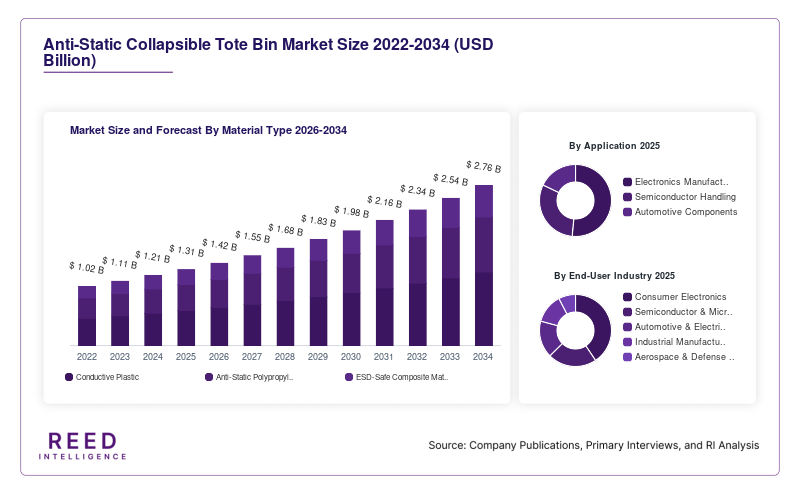
The Anti-Static Collapsible Tote Bin Market segmentation is categorized by material type and application, with conductive plastic solutions accounting for approximately 42% market share in 2025 due to their durability and cost efficiency. Electronics manufacturing remains the largest application segment, contributing nearly 46% of total demand.
By Type
Conductive plastic anti-static collapsible tote bins dominated the market with approximately 42% share in 2025. More than 7.5 million units were produced globally using carbon-filled polypropylene and polyethylene materials. These bins provide surface resistance levels ranging from 10⁴ to 10⁹ ohms and are preferred in semiconductor and electronics assembly environments. Their lightweight structure, with average weight reductions of 10–20% compared with metal alternatives, supports large-scale industrial adoption.
Anti-static polypropylene bins accounted for nearly 35% market share in 2025, with annual production exceeding 6 million units. These bins offer high chemical resistance, temperature stability between -20°C and 80°C, and more than 500 handling cycles. Automotive electronics manufacturers increasingly utilize polypropylene solutions for transporting sensors, control units, and battery components.
ESD-safe composite material bins represented around 23% market share and produced approximately 4 million units in 2025. These advanced materials combine polymers with conductive fibers to deliver improved mechanical strength and static protection. High-end semiconductor facilities and aerospace electronics manufacturers are major users due to their requirement for strict ESD compliance standards.
By Application
Electronics manufacturing accounted for approximately 46% of Anti-Static Collapsible Tote Bin Market demand in 2025. More than 8 million units were utilized globally for circuit boards, microcontrollers, connectors, and precision electronic components. Nearly 75% of large electronics factories use ESD-safe handling systems to reduce component failure rates and improve production reliability.
Semiconductor handling contributed nearly 32% market share, with more than 5.5 million bins deployed across wafer fabrication and assembly facilities. These bins support contamination control, automated transport, and static protection for semiconductor components valued at billions of dollars annually.
Automotive component applications represented around 22% market share, supported by increasing electronic content in vehicles. Over 4 million units were used in 2025 for electric vehicle components, sensors, battery modules, and control systems. Adoption penetration among automotive electronics suppliers exceeded 55%, increasing demand for durable reusable packaging.
Anti-Static Collapsible Tote Bin Market Regional Outlook
North America
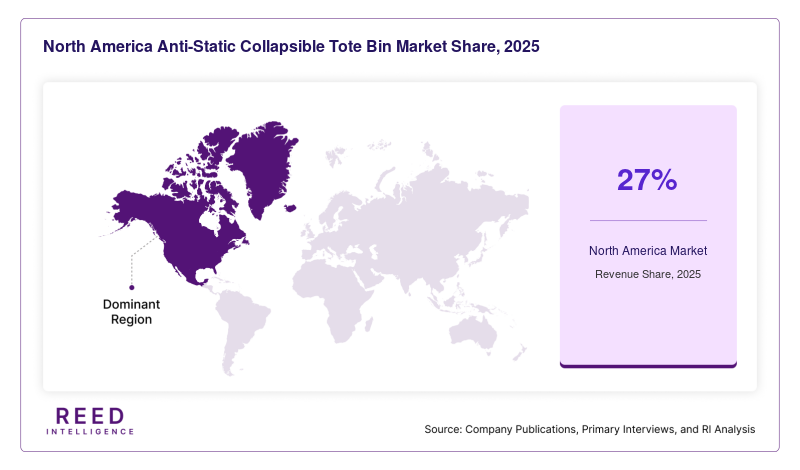
North America accounted for approximately 27% of the Anti-Static Collapsible Tote Bin Market in 2025, generating revenue of nearly USD 380 million. The United States represented more than 80% of regional demand due to semiconductor investments and advanced electronics manufacturing. The region produced over 4 million units annually, with semiconductor applications contributing 40% and automotive electronics contributing 30%.
Europe
Europe held around 22% market share in 2025, supported by automotive electronics and industrial automation sectors. Germany, France, and the United Kingdom collectively contributed nearly 75% of regional consumption. European manufacturers increasingly adopt reusable ESD packaging solutions to achieve sustainability targets and reduce industrial waste.
Asia-Pacific
Asia-Pacific dominated the Anti-Static Collapsible Tote Bin Market with approximately 52% share in 2025. China, Japan, South Korea, and Taiwan accounted for more than 85% of regional production. The region manufactured over 9 million units annually due to semiconductor fabrication expansion and electronics manufacturing growth.
Latin America and Middle East & Africa
These regions collectively contributed nearly 9% market share in 2025. Increasing electronics assembly activities and industrial modernization projects are supporting adoption. Brazil, Mexico, UAE, and Saudi Arabia are emerging markets with annual demand growth exceeding 6%.
Top players in Anti-Static Collapsible Tote Bin Market
- SSI SCHAEFER
- ORBIS Corporation
- Schoeller Allibert
- DS Smith Plastics
- Brambles Limited
- Utz Group
- Supreme Industries
- RPP Containers
- Buckhorn Inc.
- Flexcon Container
- Sintex Plastics Technology
- CABKA Group
ORBIS Corporation
- Holds an estimated 15–18% share in reusable industrial container solutions.
- Strong positioning in automotive and electronics supply chains.
- Provides ESD-safe reusable packaging systems designed for automated manufacturing environments.
- Operates extensive global production networks supporting millions of containers annually.
- Focuses on lightweight materials, sustainability, and customized engineering solutions.
Schoeller Allibert
- Maintains approximately 12–15% market positioning in reusable transport packaging.
- Offers advanced collapsible container technologies for industrial applications.
- Strong presence across Europe and Asia-Pacific markets.
- Invests in recyclable polymer solutions and smart logistics technologies.
- Supports automotive, electronics, and semiconductor customers with durable ESD-compatible solutions.
Recent Developments in Anti-Static Collapsible Tote Bin Market
- 2026: Manufacturers introduced RFID-enabled anti-static collapsible tote bins for automated warehouse tracking systems.
- 2025: Leading suppliers expanded production capacity for ESD-safe polypropylene containers in Asia-Pacific.
- 2025: Electronics manufacturers increased adoption of reusable anti-static packaging to reduce waste generation.
Anti-Static Collapsible Tote Bin Market Segments
By Material Type
- Conductive Plastic
- Anti-Static Polypropylene
- ESD-Safe Composite Materials
By Application
- Electronics Manufacturing
- Semiconductor Handling
- Automotive Components
By End-User Industry
- Consumer Electronics
- Semiconductor & Microelectronics
- Automotive & Electric Vehicles
- Industrial Manufacturing
- Aerospace & Defense Electronics
By Region
- North America
- Europe
- APAC
- Middle East and Africa
- LATAM