Carbon Capture and Storage Market Size, Share Demand Report By Technology (Post-Combustion Capture, Pre-Combustion Capture, Oxy-Fuel Combustion Capture), By Application (Oil & Gas, Power Generation, Industrial, Others), Regional Insights & Segment Forecasts, 2026–2034
USD 3950
Carbon Capture and Storage Market Size
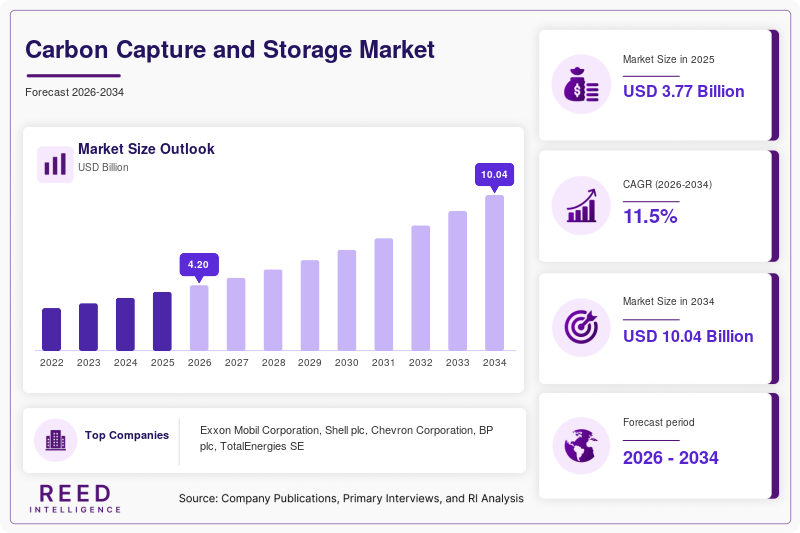
Carbon Capture and Storage market size is projected at USD 4.2 billion in 2026 and is expected to hit USD 9.8 billion by 2034 with a CAGR of 11.5% during the forecast period. The increasing global focus on reducing greenhouse gas emissions, the growing need to decarbonize hard-to-abate industrial sectors, and the rising government support and policy incentives for CCS projects underpin market expansion. This report delivers a comprehensive analysis of the Carbon Capture and Storage market, including segmentation by technology and application, competitive dynamics, and regional growth patterns, equipping stakeholders with critical intelligence. The Carbon Capture and Storage market continues to demonstrate exceptional growth potential, fueled by the global energy transition, the tightening of climate policies, and the continuous innovation in capture and storage technologies.
Carbon Capture and Storage (CCS) is a suite of technologies designed to capture carbon dioxide (CO2) emissions from industrial sources and power generation, transport it, and securely store it underground or utilize it in various applications. It is a critical tool for mitigating climate change, particularly for hard-to-abate sectors where emissions are difficult to eliminate through other means. The global market for CCS is driven by the urgent need to reduce CO2 emissions. The global CO2 capture capacity of CCS projects exceeded 50 million tons per annum (Mtpa) in 2025, reflecting a 15% increase from 2022. Adoption patterns reveal that the post-combustion capture technology segment dominates the market, accounting for 55% of total capacity, followed by pre-combustion capture at 30%, and oxy-fuel combustion capture at 15%. The Carbon Capture and Storage market's trajectory is closely linked to the global climate goals and the increasing investment in decarbonization technologies.
Carbon Capture and Storage Market Trends
Growing Focus on Carbon Capture, Utilization, and Storage (CCUS)
The Carbon Capture and Storage market is witnessing a significant trend toward Carbon Capture, Utilization, and Storage (CCUS), driven by the economic potential of utilizing captured CO2 in various products. The revenue from CCUS projects grew to USD 1.5 billion in 2025, a year-on-year increase of 20%, as 35% of new CCS projects in 2025 incorporated utilization pathways. Adoption rates of CO2 utilization in the chemical and enhanced oil recovery (EOR) sectors reached 25%, with this figure projected to exceed 40% by 2030. The Carbon Capture and Storage market's trend toward utilization is reinforced by the need to improve the economics of CCS, the growing market for sustainable products, and the continuous innovation in CO2 conversion technologies.
Increasing Focus on Industrial Decarbonization and Hard-to-Abate Sectors
The increasing focus on industrial decarbonization is a major trend shaping the Carbon Capture and Storage market, with applications in cement, steel, and chemical production gaining significant traction. The market has seen a 30% increase in the number of industrial CCS projects since 2022, with 25% of new capacity additions in 2025 targeting the industrial sector. The use of CCS in cement and steel plants has also gained momentum. The Carbon Capture and Storage market's trend toward industrial decarbonization is reinforced by the difficulty of reducing emissions in these sectors through other means, the increasing pressure on industries to decarbonize, and the development of industry-specific CCS solutions.
Carbon Capture and Storage Market Drivers
The Carbon Capture and Storage market's expansion is primarily driven by the increasing global focus on achieving net-zero emissions and the tightening of climate policies worldwide. The growing need to decarbonize hard-to-abate industrial sectors, such as cement, steel, and chemicals, has also been a major driver. The increasing government support and policy incentives, including tax credits and funding programs, have fueled investment in CCS projects. Additionally, the rising corporate commitments to carbon neutrality and the growing awareness of the importance of CCS in the energy transition have driven market growth. The Carbon Capture and Storage market's growth is further reinforced by the continuous innovation in capture and storage technologies, leading to improved efficiency and reduced costs.
Carbon Capture and Storage Market Restraints
Despite favorable growth prospects, the Carbon Capture and Storage market faces significant constraints, primarily related to the high capital and operating costs of CCS projects, which can be a barrier for widespread deployment. The lack of adequate infrastructure for CO2 transport and storage can also be a restraint. The Carbon Capture and Storage market's growth is also tempered by the long project lead times and the regulatory and permitting challenges.
Carbon Capture and Storage Market Opportunities
The Carbon Capture and Storage market presents significant opportunities in the rapidly expanding market for carbon removal and negative emissions technologies, where the global market is projected to reach USD 50 billion by 2028. The adoption of CCS for bioenergy with carbon capture and storage (BECCS) and direct air capture (DAC) is expected to grow at a CAGR of 20% through 2034, driven by the need for carbon removal. Emerging opportunities also exist in the development of CCS hubs and clusters, which can share infrastructure and reduce costs. The Carbon Capture and Storage market's opportunity profile is further enhanced by the growing trend of industrial decarbonization and the increasing investment in low-carbon technologies.
Challenges in Carbon Capture and Storage Market
The Carbon Capture and Storage market faces persistent challenges related to the management of high costs and the need for significant upfront investment, which can be a barrier for project development. The complexity of integrating CCS into existing industrial processes presents a challenge. The market is also contending with the challenge of ensuring long-term, safe CO2 storage and building public acceptance. Additionally, the Carbon Capture and Storage market is challenged by the need for supportive policy frameworks and the development of a robust carbon pricing mechanism.
Carbon Capture and Storage Market Segmentation
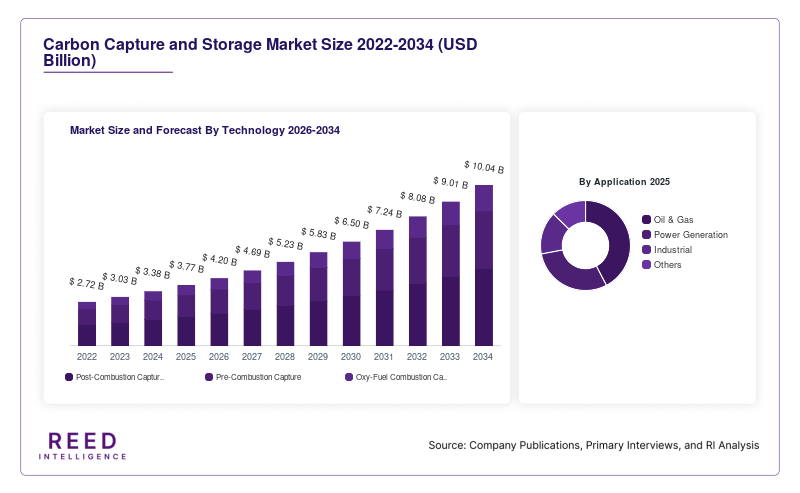
The Carbon Capture and Storage market is segmented by Technology and Application to provide a comprehensive market perspective. By Technology, Post-Combustion Capture dominates with a 55% market share, driven by its applicability to existing power plants. The Application segment is led by Oil & Gas, which accounts for 35% of the market, followed by Power Generation at 28%, Industrial at 25%, and Others at 12%.
By Technology
Post-Combustion Capture represent the largest segment in the Carbon Capture and Storage market, commanding a 55% share, with a capture capacity of 27.5 Mtpa in 2025. This technology is characterized by its use in capturing CO2 from flue gas after combustion, often using chemical solvents. Technical specifications include capture rate, energy consumption, and solvent type. The Carbon Capture and Storage market's post-combustion segment is driven by its use in retrofitting existing power plants.
Pre-Combustion Capture capture a 30% share of the Carbon Capture and Storage market, with a capture capacity of 15 Mtpa in 2025. This technology is characterized by its use in converting fuel into a syngas before combustion, allowing for easier CO2 capture. Technical specifications include gasification process, capture efficiency, and integration with power generation. The Carbon Capture and Storage market's pre-combustion segment is driven by its use in integrated gasification combined cycle (IGCC) plants.
Oxy-Fuel Combustion Capture represent the remaining 15% of the Carbon Capture and Storage market, with a capture capacity of 7.5 Mtpa in 2025. This technology is characterized by its use of oxygen instead of air for combustion, producing a flue gas with high CO2 concentration. Technical specifications include oxygen production, combustion process, and CO2 purification. The Carbon Capture and Storage market's oxy-fuel segment is driven by its use in new-build power plants.
By Application
Oil & Gas dominates the Carbon Capture and Storage market, accounting for 35% of the capture capacity, representing 17.5 Mtpa in 2025. This segment includes use in natural gas processing and enhanced oil recovery (EOR). Usage penetration exceeds 20% in the EOR sector. The Carbon Capture and Storage market's oil & gas segment is characterized by its focus on EOR and emission reduction.
Power Generation accounts for 28% of the Carbon Capture and Storage market, with a capacity of 14 Mtpa in 2025. This segment encompasses use in coal and gas-fired power plants. The segment is growing at a steady CAGR, driven by the need to decarbonize the power sector. The Carbon Capture and Storage market's power segment is characterized by its focus on reducing emissions from power generation.
Industrial represents 25% of the Carbon Capture and Storage market, with a capacity of 12.5 Mtpa in 2025. This segment includes use in cement, steel, and chemical production. The segment is growing at the fastest CAGR, driven by the need to decarbonize hard-to-abate industries. The Carbon Capture and Storage market's industrial segment is characterized by its focus on process emissions.
Others comprises the remainder of the Carbon Capture and Storage market, accounting for 12% of total capacity, with 6 Mtpa in 2025. This segment includes use in direct air capture (DAC) and other applications. The segment is projected to grow at a high CAGR through 2034.
Carbon Capture and Storage Market Regional Outlook
North America Carbon Capture and Storage Market
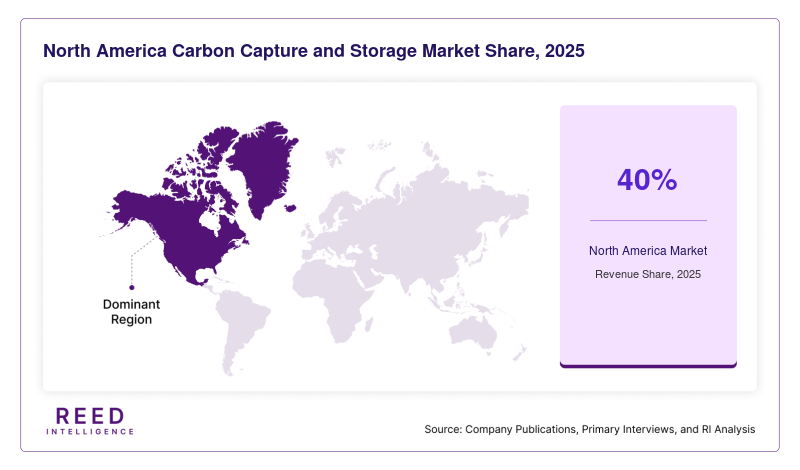
Leads the Carbon Capture and Storage market, commanding a 40% share, with a capture capacity of 20 Mtpa in 2025. The United States is the primary driver, accounting for 80% of regional capacity, driven by the strong policy support (45Q tax credits). The North American Carbon Capture and Storage market is characterized by its focus on innovation and project development.
Europe Carbon Capture and Storage Market
Represents the second-largest market, capturing a 28% share with a capacity of 14 Mtpa in 2025. The UK, Norway, and the Netherlands collectively represent 55% of the regional capacity, driven by the strong climate policies and government funding. The Carbon Capture and Storage market in Europe is characterized by its focus on industrial decarbonization and CCS hubs.
Asia-Pacific Carbon Capture and Storage Market
Accounts for 22% of the global Carbon Capture and Storage market, with a capacity of 11 Mtpa in 2025. China, Australia, and Japan are the primary drivers, accounting for 70% of regional capacity, driven by the growing energy demand and the focus on emissions reduction. The Asia-Pacific Carbon Capture and Storage market is projected to grow at the fastest CAGR of 15% through 2034, presenting attractive opportunities for market expansion.
Middle East & Africa and Latin America Carbon Capture and Storage Market
Together account for the remaining 10% of the Carbon Capture and Storage market, with Saudi Arabia leading the Middle East market and Brazil leading the Latin American market. Both regions are projected to grow at CAGRs exceeding 12%, driven by the increasing focus on carbon management.
Top players in Carbon Capture and Storage Market
- Exxon Mobil Corporation
- Shell plc
- Chevron Corporation
- BP plc
- TotalEnergies SE
- Equinor ASA
- Air Products and Chemicals, Inc.
- Linde plc
- Fluor Corporation
- Aker Solutions ASA
- Schlumberger Limited
- Honeywell International Inc.
- Mitsubishi Heavy Industries, Ltd.
- General Electric Company
- Siemens Energy AG
Exxon Mobil Corporation
Exxon Mobil holds a dominant position in the Carbon Capture and Storage market, with an estimated 15% global market share, particularly strong in the North American segment. The company's portfolio of CCS projects and technologies is widely recognized for its scale and experience. Exxon Mobil's market leadership is reinforced by its significant investment in CCS and its integrated approach. Exxon Mobil commands over 20% of the North American market and 12% of the European market, positioning it as a key player in the Carbon Capture and Storage market.
Shell plc
Shell is a leading player in the Carbon Capture and Storage market, commanding approximately 12% of the global market share through its comprehensive portfolio of CCS projects and its commitment to decarbonization. The company's expertise in energy and its strong presence in the global market have solidified its position. Shell's focus on developing large-scale CCS projects and its investment in new technologies have strengthened its position.
Chevron Corporation holds a significant 10% market share, with particular strength in the North American and Australian markets, where it commands a 12% share. The company's focus on integrated energy solutions is a key differentiator. BP plc is a major player in the global energy market, holding a 9% share.
Recent Developments in Carbon Capture and Storage Market
- 2025: Exxon Mobil announced a significant expansion of its CCS capacity in the Gulf Coast region, targeting multiple industrial emitters.
- 2025: Shell launched a new large-scale CCS project in the UK, aiming to capture and store millions of tons of CO2 annually from industrial sources.
Carbon Capture and Storage Market Segments
By Technology
- Post-Combustion Capture
- Pre-Combustion Capture
- Oxy-Fuel Combustion Capture
By Application
- Oil & Gas
- Power Generation
- Industrial
- Others
By Region
- North America
- Europe
- APAC
- Middle East and Africa
- LATAM