Chemical Tanker Market Size, Share Demand Report By Type (IMO Type 1, IMO Type 2, IMO Type 3), By Application (Organic Chemicals, Inorganic Chemicals, Vegetable Oils & Fats, Others), Regional Insights & Segment Forecasts, 2026–2034
USD 3950
Chemical Tanker Market Size
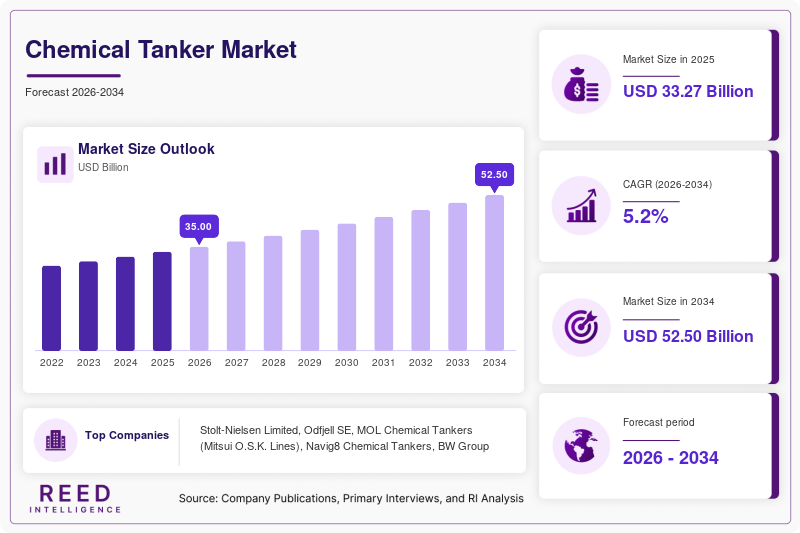
Chemical Tanker market size is projected at USD 35 billion in 2026 and is expected to hit USD 52 billion by 2034 with a CAGR of 5.2% during the forecast period. The increasing global trade of chemicals and petrochemicals, the growing demand for specialized shipping for hazardous and sensitive cargoes, and the expansion of the chemical industry in emerging economies underpin market expansion. This report delivers a comprehensive analysis of the Chemical Tanker market, including segmentation by type and application, competitive dynamics, and regional growth patterns, equipping stakeholders with critical intelligence. The Chemical Tanker market continues to demonstrate steady growth potential, fueled by the global industrialization and urbanization trends, the increasing complexity of the chemical supply chain, and the continuous innovation in tanker design and safety.
Chemical tankers are specialized vessels designed for the safe transport of various liquid chemicals in bulk. These ships feature sophisticated tank coatings, cargo handling systems, and safety equipment to handle a wide range of products, from corrosive and hazardous chemicals to food-grade oils. The global market for chemical tankers is driven by the need for safe and efficient maritime chemical transport. The global fleet of chemical tankers exceeded 4,500 vessels in 2025, reflecting a 4% increase from 2022. Adoption patterns reveal that the IMO Type 2 segment dominates the market, accounting for 40% of the total fleet, followed by IMO Type 3 at 35%, and IMO Type 1 at 25%. The Chemical Tanker market's trajectory is closely linked to the growth of the global chemical industry, which is projected to reach USD 6 trillion by 2030, and the increasing demand for specialized chemical shipping.
Chemical Tanker Market Trends
Growing Demand for Specialized and Stainless Steel Tankers
The Chemical Tanker market is witnessing a significant trend toward specialized and stainless steel tankers, driven by the need to carry high-purity and corrosive cargoes. The revenue from stainless steel tankers grew to USD 12 billion in 2025, a year-on-year increase of 6%, as 30% of newbuilding orders in 2025 specified stainless steel construction. Adoption rates of specialized tankers in the organic chemicals segment reached 35%, with this figure projected to exceed 50% by 2030. The Chemical Tanker market's trend toward specialization is reinforced by the increasing complexity of the chemical trade, the growing demand for high-quality transport, and the stringent safety regulations.
Increasing Focus on Eco-Friendly and Fuel-Efficient Vessels
The increasing focus on eco-friendly and fuel-efficient vessels is a major trend shaping the Chemical Tanker market, driven by environmental regulations and the need to reduce operating costs. The market has seen a 20% increase in the number of eco-friendly chemical tankers (e.g., LNG-ready, scrubber-fitted) since 2022, with 25% of newbuilds in 2025 featuring eco-friendly technologies. The use of advanced hull designs and energy-efficient systems has also gained traction. The Chemical Tanker market's trend toward sustainability is reinforced by the tightening of emissions regulations (IMO 2020, EEXI, CII), the increasing cost of fuel, and the growing pressure from charterers for greener shipping options.
Chemical Tanker Market Drivers
The Chemical Tanker market's expansion is primarily driven by the increasing global production and consumption of chemicals, with the global chemical industry projected to grow at a CAGR of 4.5% through 2030. The growing trade of petrochemicals and specialty chemicals, particularly from the Middle East and North America to Asia, has also been a major driver. The increasing demand for liquid bulk transport of vegetable oils, animal fats, and other food-grade products has fueled the market. Additionally, the rising focus on supply chain security and diversification has driven demand for reliable tanker shipping. The Chemical Tanker market's growth is further reinforced by the continuous investment in newbuilding and fleet modernization.
Chemical Tanker Market Restraints
Despite favorable growth prospects, the Chemical Tanker market faces significant constraints, primarily related to the high cost of newbuilding and operating specialized chemical tankers, which can be a barrier for smaller operators. The stringent regulations on safety, environmental protection, and cargo handling add to the operational complexity and cost. The Chemical Tanker market's growth is also tempered by the volatility of freight rates, geopolitical uncertainties, and the competition from other shipping segments.
Chemical Tanker Market Opportunities
The Chemical Tanker market presents significant opportunities in the rapidly expanding market for the transport of renewable and alternative fuels, where the global market is projected to reach USD 100 billion by 2028. The adoption of chemical tankers for the carriage of biofuels and methanol is expected to grow at a CAGR of 10% through 2034. Emerging opportunities also exist in the development of tankers for carbon capture and storage (CCS) and the transport of hydrogen carriers. The Chemical Tanker market's opportunity profile is further enhanced by the growing trend of digitalization and data analytics in shipping.
Challenges in Chemical Tanker Market
The Chemical Tanker market faces persistent challenges related to the management of cargo safety and environmental compliance, as the carriage of hazardous chemicals requires rigorous safety procedures. The complexity of operating in a fragmented market with a wide range of vessel types and cargoes presents a challenge. The market is also contending with the challenge of managing the supply-demand balance and the potential for overcapacity. Additionally, the Chemical Tanker market is challenged by the need for continuous investment in crew training and the adoption of new technologies.
Chemical Tanker Market Segmentation
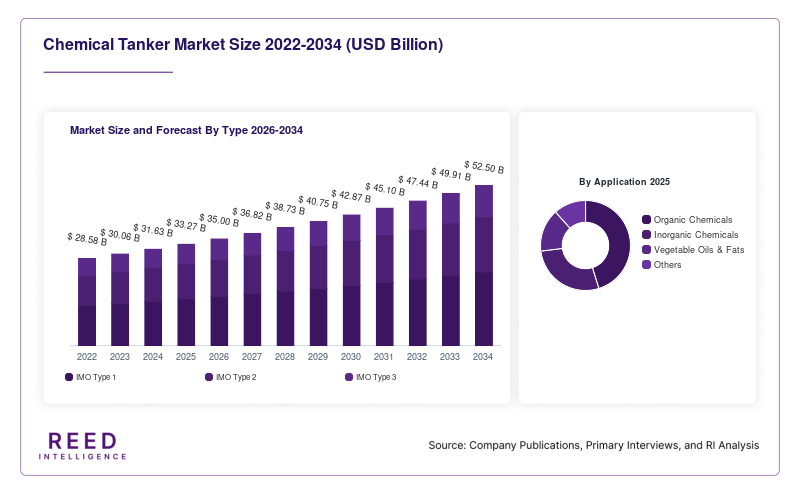
The Chemical Tanker market is segmented by Type and Application to provide a comprehensive market perspective. By Type, IMO Type 2 dominates with a 40% share, driven by its versatility. The Application segment is led by Organic Chemicals, which accounts for 35% of the market, followed by Inorganic Chemicals at 25%, Vegetable Oils & Fats at 22%, and Others at 18%.
By Type
IMO Type 2 represent the largest segment in the Chemical Tanker market, commanding a 40% share, with a fleet of 1,800 vessels in 2025. These tankers are characterized by their ability to carry a wide range of chemicals with significant environmental and safety hazards. Technical specifications include double hulls, segregated ballast, and sophisticated cargo handling systems. The Chemical Tanker market's IMO Type 2 segment is driven by its versatility.
IMO Type 3 capture a 35% share of the Chemical Tanker market, with a fleet of 1,575 vessels in 2025. These tankers are characterized by their carriage of less hazardous chemicals. Technical specifications include less stringent requirements compared to Type 1 and 2. The Chemical Tanker market's IMO Type 3 segment is driven by its use in the transport of vegetable oils and less hazardous chemicals.
IMO Type 1 represent the remaining 25% of the Chemical Tanker market, with a fleet of 1,125 vessels in 2025. These tankers are characterized by their ability to carry the most hazardous chemicals. Technical specifications include the highest safety standards and specialized tank coatings. The Chemical Tanker market's IMO Type 1 segment is driven by the transport of highly hazardous chemicals.
By Application
Organic Chemicals dominates the Chemical Tanker market, accounting for 35% of the cargo volume, representing a significant portion of the trade. This segment includes the transport of petrochemicals, solvents, and other organic compounds. The Chemical Tanker market's organic segment is characterized by its large volume and diverse cargo types.
Inorganic Chemicals accounts for 25% of the Chemical Tanker market. This segment encompasses the transport of acids, bases, and other inorganic compounds. The segment is growing at a steady CAGR, driven by the demand for industrial chemicals. The Chemical Tanker market's inorganic segment is characterized by its focus on safe and specialized handling.
Vegetable Oils & Fats represents 22% of the Chemical Tanker market. This segment includes the transport of edible oils and fats for the food industry. The segment is growing at a steady CAGR, driven by the global food trade. The Chemical Tanker market's vegetable oils segment is characterized by its requirement for food-grade tankers.
Others comprises the remainder of the Chemical Tanker market, accounting for 18% of total cargo volume. This segment includes the transport of various other liquid products. The segment is projected to grow at a steady CAGR through 2034.
Chemical Tanker Market Regional Outlook
Asia-Pacific Chemical Tanker Market
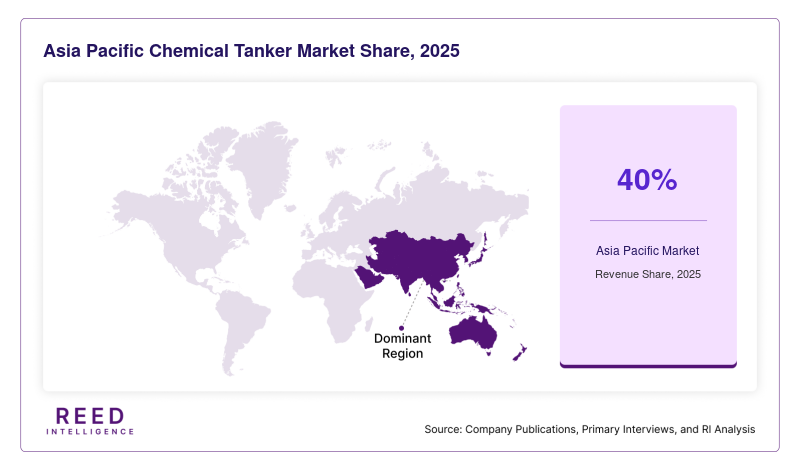
Leads the Chemical Tanker market, commanding a 40% share, with a revenue of USD 14 billion in 2025. China, India, and South Korea are the primary drivers, accounting for 70% of regional demand, driven by the large chemical manufacturing base and the high import/export volumes. The Asia-Pacific Chemical Tanker market is characterized by its high growth rate and focus on cost-effective solutions.
Europe Chemical Tanker Market
Represents the second-largest market, capturing a 25% share with a revenue of USD 8.75 billion in 2025. The Netherlands, Germany, and Belgium collectively represent 55% of the regional market, driven by the major chemical hubs. The Chemical Tanker market in Europe is characterized by its focus on sustainability and technology.
North America Chemical Tanker Market
Accounts for 20% of the global Chemical Tanker market, with a revenue of USD 7 billion in 2025. The United States dominates regional demand, accounting for 80% of consumption, driven by the large chemical and refining sectors. The Chemical Tanker market in North America is characterized by its focus on innovation and safety.
Middle East & Africa and Latin America Chemical Tanker Market
Together account for the remaining 15% of the Chemical Tanker market, with Saudi Arabia leading the Middle East market and Brazil leading the Latin American market. Both regions are projected to grow at CAGRs exceeding 6%, driven by the increasing chemical exports.
Top players in Chemical Tanker Market
- Stolt-Nielsen Limited
- Odfjell SE
- MOL Chemical Tankers (Mitsui O.S.K. Lines)
- Navig8 Chemical Tankers
- BW Group
- D'Amico International Shipping
- Euronav NV
- Frontline Ltd.
- Teekay Corporation
- K Line (Kawasaki Kisen Kaisha, Ltd.)
- NYK Line (Nippon Yusen Kabushiki Kaisha)
- Hafnia Limited
- Scorpio Tankers Inc.
- Ardmore Shipping Corporation
- Nordic American Tankers Limited
Stolt-Nielsen Limited
Stolt-Nielsen holds a dominant position in the Chemical Tanker market, with an estimated 12% global market share, particularly strong in the global deep-sea chemical tanker segment. The company's portfolio of specialized chemical tankers and logistics services is widely recognized for its quality and expertise. Stolt-Nielsen's market leadership is reinforced by its integrated logistics solutions and its focus on safety and sustainability. Stolt-Nielsen commands over 15% of the global chemical tanker market, positioning it as a key player.
Odfjell SE
Odfjell is a leading player in the Chemical Tanker market, commanding approximately 10% of the global market share through its comprehensive portfolio of chemical tankers and terminals. The company's expertise in safe and efficient chemical transport and its strong presence in the global market have solidified its position. Odfjell's focus on developing sustainable and innovative solutions has strengthened its position. The company's commitment to quality has enhanced its brand equity.
MOL Chemical Tankers holds a significant 8% market share, with particular strength in the Asian market, where it commands a 10% share. The company's focus on integrated marine services is a key differentiator. Navig8 Chemical Tankers is a major player in the pool and commercial management segment, holding a 7% share.
Recent Developments in Chemical Tanker Market
- 2025: Stolt-Nielsen announced the order of several newbuild chemical tankers with LNG dual-fuel propulsion, significantly reducing emissions.
- 2025: Odfjell SE launched a new digital platform for optimized fleet management and cargo tracking, enhancing operational efficiency.
Chemical Tanker Market Segments
By Type
- IMO Type 1
- IMO Type 2
- IMO Type 3
By Application
- Organic Chemicals
- Inorganic Chemicals
- Vegetable Oils & Fats
- Others
By Region
- North America
- Europe
- APAC
- Middle East and Africa
- LATAM