Cleanroom Stationery Market Size, Share Demand Report By Type (Cleanroom Pens & Markers, Cleanroom Notebooks & Paper, Cleanroom Labels & Tapes), By Application (Pharmaceutical & Biotechnology, Semiconductor & Electronics, Aerospace & Defense, Healthcare & Medical Devices), Regional Insights & Segment Forecasts, 2026–2034
USD 3950
Cleanroom Stationery Market Size
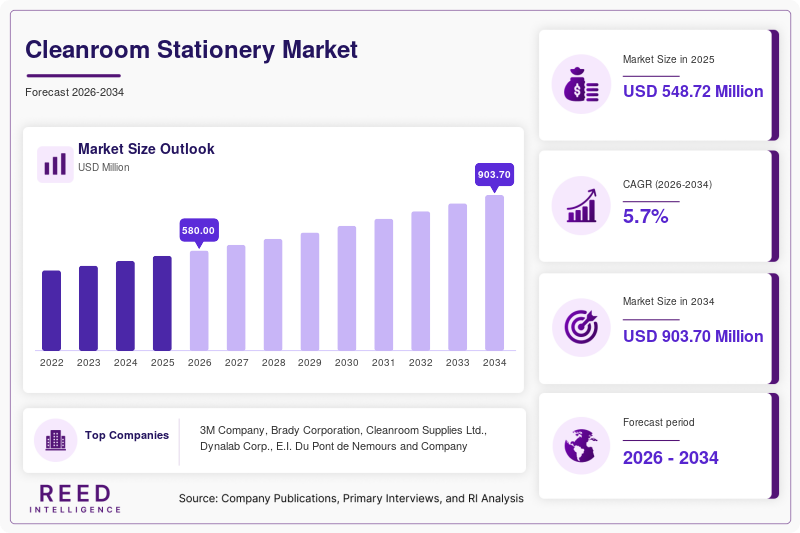
Cleanroom Stationery market size is projected at USD 580 million in 2026 and is expected to hit USD 890 million by 2034 with a CAGR of 5.7% during the forecast period. The increasing demand for contamination-free documentation solutions in pharmaceutical, semiconductor, and biotechnology industries underpins market expansion. This report provides a comprehensive analysis of the Cleanroom Stationery market, including segmentation by type and application, competitive dynamics, and regional growth patterns, equipping stakeholders with critical intelligence. The Cleanroom Stationery market continues to demonstrate steady growth potential, fueled by the global expansion of cleanroom facilities and the tightening of contamination control standards across critical manufacturing sectors.
Cleanroom stationery encompasses specialized writing, labeling, and documentation products designed for use in controlled environments where particle contamination must be minimized. These products, including pens, markers, notebooks, labels, and tapes, are manufactured from low-particulate materials, often with cleanroom packaging (double-bagged) and undergo rigorous testing to ensure they meet stringent cleanliness standards (ISO 14644). The global production volume of cleanroom stationery exceeded 850 million units in 2025, reflecting widespread adoption across cleanroom-dependent industries. Adoption patterns reveal that the pharmaceutical and biotechnology sector dominates consumption, accounting for 38% of total demand, followed by semiconductor and electronics at 32%, aerospace & defense at 18%, and healthcare & medical devices at 12%. The Cleanroom Stationery market's trajectory is closely linked to the growth of the global pharmaceutical industry, projected to reach USD 1.9 trillion by 2028, and the semiconductor industry, which is expected to grow at a CAGR of 6.5% through the forecast period.
Cleanroom Stationery Market Trends
Increasing Demand for Sustainable and Eco-Friendly Cleanroom Products
The Cleanroom Stationery market is witnessing a significant trend toward sustainable and eco-friendly products, driven by growing environmental awareness and corporate sustainability commitments. Production of cleanroom stationery using recycled or bio-based materials reached 120 million units in 2025, a year-on-year increase of 18%, as 30% of new product launches in 2025 featured sustainable credentials. Adoption rates of eco-friendly cleanroom stationery in the pharmaceutical sector reached 25%, with this figure projected to exceed 40% by 2030 as major pharmaceutical companies commit to Net Zero targets. Sector-specific demand is particularly strong in Europe, where 45% of cleanroom facilities now specify sustainable stationery options. The Cleanroom Stationery market's trend toward sustainability is reinforced by the development of biodegradable pens and notebooks made from agricultural waste, representing a growing niche segment projected to reach USD 75 million by 2028.
Technological Advancements in Cleanroom Stationery Materials and Design
Technological innovations in materials science and product design are reshaping the Cleanroom Stationery market, with advances in low-particulate materials, anti-static properties, and chemical resistance enhancing product performance. The adoption rate of anti-static cleanroom stationery has grown to 35% of total production in 2025, up from 22% in 2022, driven by the increasing sensitivity of electronic components to electrostatic discharge (ESD). Improved materials, such as non-fiber shedding polymers and low-ion-content inks, have resulted in a 40% reduction in particle generation (from 50 particles per cm² to 30 particles per cm²) compared to conventional products. The Cleanroom Stationery market's innovation landscape is further characterized by the development of color-coded and RFID-enabled cleanroom labels, which enhance traceability and inventory management in cleanroom operations, representing a growing segment projected to reach USD 85 million by 2028.
Cleanroom Stationery Market Drivers
The Cleanroom Stationery market's expansion is primarily driven by the stringent contamination control requirements in pharmaceutical and semiconductor manufacturing, where even minute particle contamination can lead to product recalls or yield losses. The global pharmaceutical industry, valued at USD 1.5 trillion in 2025 and growing at a CAGR of 6.2%, is creating substantial demand for cleanroom-compatible documentation and labeling solutions. The increasing number of cleanroom facilities globally, projected to reach 12,000 by 2028, is also driving demand for cleanroom stationery products, with each ISO 5 cleanroom requiring an estimated 20,000-30,000 units annually. Additionally, the growing focus on regulatory compliance (FDA, EMA, and ISO standards) and the need for traceability in manufacturing processes are fueling demand for reliable, cleanroom-compatible labeling and documentation products. The Cleanroom Stationery market's growth is further reinforced by the expansion of gene therapy and cell therapy manufacturing, which require Class A/B cleanrooms with the highest standards of contamination control.
Cleanroom Stationery Market Restraints
Despite favorable growth prospects, the Cleanroom Stationery market faces significant constraints, primarily related to the high cost of specialized products, which can be 3-5 times more expensive than conventional stationery. The price differential creates a significant cost barrier, particularly for price-sensitive applications and smaller facilities. The availability of low-cost alternatives that do not meet stringent cleanroom specifications provides budget-conscious customers with cheaper options, although they may compromise contamination control. The Cleanroom Stationery market's growth is also tempered by the limited awareness of the specific requirements for cleanroom stationery in emerging markets, where the adoption of specialized products remains relatively low.
Cleanroom Stationery Market Opportunities
The Cleanroom Stationery market presents significant opportunities in the rapidly expanding biologics and advanced therapy manufacturing sector, where the global market is projected to reach USD 500 billion by 2030. The adoption of specialized cleanroom stationery for cell therapy and gene therapy manufacturing is expected to grow at a CAGR of 12% through 2034, driven by the need for stringent contamination control in these high-value processes. Emerging opportunities also exist in the development of digital cleanroom documentation solutions, which combine traditional stationery with digital tracking and monitoring capabilities, with the global smart labeling market projected to reach USD 45 billion by 2027. The Cleanroom Stationery market's opportunity profile is further enhanced by the growing trend toward single-use technologies in biopharmaceutical manufacturing, creating demand for specialized labels and documentation for single-use systems.
Challenges in Cleanroom Stationery Market
The Cleanroom Stationery market faces persistent challenges related to product standardization and the management of diverse customer requirements across different cleanroom classes and applications. Meeting the varying particulate standards (ISO 5-8) and chemical compatibility requirements requires significant investment in product development and testing. Maintaining consistent product quality and performance across high-volume production remains a significant manufacturing challenge, with quality control failure rates averaging 2-3% in entry-level products. Additionally, the Cleanroom Stationery market is challenged by the rapid pace of regulatory changes, requiring manufacturers to continuously update their products to meet evolving standards.
Cleanroom Stationery Market Segmentation
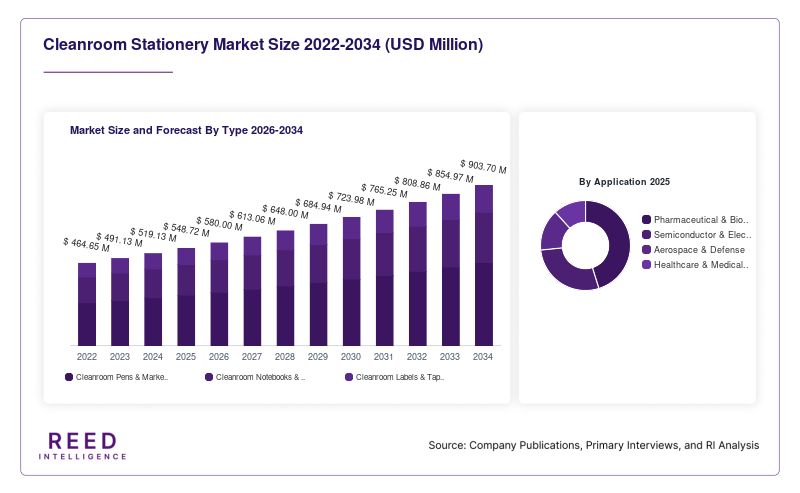
The Cleanroom Stationery market is segmented by Type and Application to provide a comprehensive market perspective. By Type, Cleanroom Pens & Markers dominate with a 42% market share, driven by high daily usage rates. The Application segment is led by Pharmaceutical & Biotechnology, which accounts for 38% of sales, followed by Semiconductor & Electronics at 32%, Aerospace & Defense at 18%, and Healthcare & Medical Devices at 12%.
By Type
Cleanroom Pens & Markers represent the largest segment in the Cleanroom Stationery market, commanding a 42% share, with production reaching 357 million units in 2025. These products are characterized by their low-particulate design, solvent-resistant inks, and compatibility with cleanroom environments. Technical specifications include particle shedding of less than 50 particles per 100 cm², no volatile organic compounds (VOCs), and ISO 5-8 compatibility. The Cleanroom Stationery market's pen and marker segment is driven by its essential role in daily documentation, labeling, and process control activities.
Cleanroom Notebooks & Paper capture a 32% share of the Cleanroom Stationery market, with production of 272 million units in 2025. These products feature low-particulate, acid-free paper that minimizes shedding and contamination, with specified use in pharmaceutical batch records and semiconductor process documentation. The Cleanroom Stationery market's notebook segment is characterized by its use in process monitoring, batch recording, and quality control documentation.
Cleanroom Labels & Tapes represent the remaining 26% of the Cleanroom Stationery market, with production of 221 million units in 2025. These products include adhesive labels and tapes specially formulated for use in cleanrooms, with controlled adhesive release, low-outgassing, and compatibility with sterilization processes. The segment is growing at the fastest CAGR of 6.8%, driven by the increasing need for traceability and inventory management. The Cleanroom Stationery market's labels segment is characterized by its use in equipment identification, sample labeling, and process tracking.
By Application
Pharmaceutical & Biotechnology dominates the Cleanroom Stationery market, accounting for 38% of sales, representing 323 million units in 2025. This segment includes documentation and labeling in drug manufacturing, where cleanroom stationery is essential for maintaining contamination control in batch records and labeling. Usage penetration in biopharmaceutical facilities exceeds 90%, driven by stringent FDA and EMA requirements for contamination control. The Cleanroom Stationery market's pharmaceutical segment is characterized by its requirement for chemically resistant, low-particulate products.
Semiconductor & Electronics accounts for 32% of the Cleanroom Stationery market, with consumption of 272 million units in 2025. This segment encompasses documentation and labeling in semiconductor fabrication and electronics assembly, where cleanroom stationery must meet specific anti-static requirements to prevent ESD damage. The segment is driven by the continued miniaturization of electronics and the growth of advanced packaging technologies. The Cleanroom Stationery market's semiconductor segment is characterized by its focus on anti-static and low-outgassing properties.
Aerospace & Defense represents 18% of the Cleanroom Stationery market, with consumption of 153 million units in 2025. This segment includes documentation and labeling in the manufacture of sensitive components, where cleanroom stationery must meet strict military and aerospace specifications. The segment is growing at a CAGR of 5.8%, driven by the increasing complexity of aerospace systems and the growing use of composites and advanced materials. The Cleanroom Stationery market's aerospace segment is characterized by its focus on durability and chemical resistance.
Healthcare & Medical Devices comprises the remainder of the Cleanroom Stationery market, accounting for 12% of total sales, with consumption of 102 million units in 2025. This segment includes documentation and labeling in the manufacture of implants, medical devices, and healthcare products, where cleanroom stationery is essential for maintaining sterility and traceability. The segment is projected to grow at a steady CAGR of 6.2% through 2034, driven by the increasing demand for medical devices. The Cleanroom Stationery market's healthcare segment is characterized by its requirement for biocompatible and sterilizable products.
Cleanroom Stationery Market Regional Outlook
North America Cleanroom Stationery Market
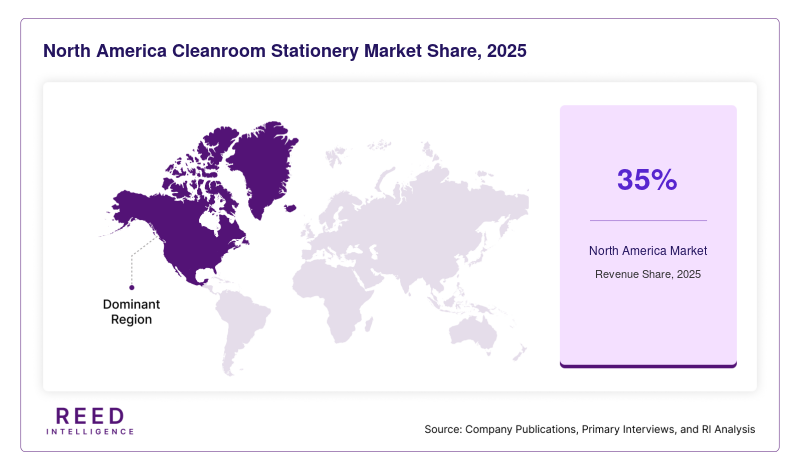
Leads the Cleanroom Stationery market, commanding a 35% share, with consumption reaching 298 million units in 2025. The United States is the primary driver, accounting for 80% of regional demand, driven by the strong pharmaceutical and biotechnology sector. The North American Cleanroom Stationery market is characterized by its focus on innovation and compliance with stringent FDA regulations.
Europe Cleanroom Stationery Market
Represents the second-largest market, capturing a 28% share with consumption of 238 million units in 2025. Germany, the UK, and Switzerland collectively represent 55% of the regional market, driven by the strong pharmaceutical and semiconductor industries. The European Cleanroom Stationery market is characterized by its focus on sustainability and compliance with EMA regulations.
Asia-Pacific Cleanroom Stationery Market
Accounts for 25% of the global Cleanroom Stationery market, with consumption of 213 million units in 2025. China, Japan, and South Korea are the primary drivers, accounting for 65% of regional demand, driven by the rapid expansion of semiconductor and pharmaceutical manufacturing. The Asia-Pacific Cleanroom Stationery market is projected to grow at the fastest CAGR of 7.2% through 2034, presenting attractive opportunities for market expansion.
Middle East & Africa and Latin America Cleanroom Stationery Market
Together account for the remaining 12% of the Cleanroom Stationery market, with the UAE leading the Middle East market and Brazil leading the Latin American market. Both regions are projected to grow at CAGRs exceeding 6%, driven by increasing investments in healthcare and industrial infrastructure.
Top players in Cleanroom Stationery Market
- 3M Company
- Brady Corporation
- Cleanroom Supplies Ltd.
- Dynalab Corp.
- E.I. Du Pont de Nemours and Company
- Fisher Scientific International, Inc.
- GWJ Technologies
- International Cleanroom Solutions
- ITW (Illinois Tool Works Inc.)
- Kimberly-Clark Corporation
- Pharmaceutical Packaging Specialties
- Presco Inc.
- Steris Corporation
- Trelleborg Sealing Solutions
- Veltek Associates Inc.
3M Company
3M holds a dominant position in the Cleanroom Stationery market, with an estimated 16% global market share, particularly strong in the North American and European pharmaceutical and electronics segments. The company's portfolio of cleanroom stationery, including its proprietary low-particulate pens and labels, is widely recognized for its quality and performance. 3M's market leadership is reinforced by its extensive R&D capabilities and strong distribution network, with the company investing over USD 25 million annually in product development. 3M commands over 20% of the North American market and 15% of the European market, positioning it as a key player in the Cleanroom Stationery market's premium segment.
Brady Corporation
Brady is a leading player in the Cleanroom Stationery market, commanding approximately 12% of the global market share through its comprehensive portfolio of labeling and identification solutions. The company's expertise in cleanroom-compatible labels and tapes has solidified its position, particularly in the semiconductor and electronics segments, where it holds a 15% market share. Brady's recent introduction of RFID-enabled cleanroom labels with enhanced tracking capabilities has strengthened its position in the premium segment. The company's sustainability initiatives, including its commitment to using recycled materials in 20% of its products, have enhanced its brand equity among environmentally conscious customers.
Cleanroom Supplies Ltd. holds a significant 8% market share, with particular strength in the European market, where it commands a 10% share. The company's specialization in cleanroom consumables and stationery is a key differentiator. Fisher Scientific International, Inc. is a major player in the pharmaceutical segment, holding a 9% global share, with a strong position in laboratory and cleanroom supplies.
Recent Developments in Cleanroom Stationery Market
- 2025: 3M launched a new line of sustainable cleanroom pens made from 75% recycled materials, achieving a 30% reduction in carbon footprint compared to conventional products.
- 2025: Brady Corporation introduced an RFID-enabled cleanroom label with a 50% increase in data storage capacity, targeting the pharmaceutical and biotech traceability markets.
Cleanroom Stationery Market Segments
By Type
- Cleanroom Pens & Markers
- Cleanroom Notebooks & Paper
- Cleanroom Labels & Tapes
By Application
- Pharmaceutical & Biotechnology
- Semiconductor & Electronics
- Aerospace & Defense
- Healthcare & Medical Devices
By Region
- North America
- Europe
- APAC
- Middle East and Africa
- LATAM