Closed-End Wire Connectors Market Size, Share, Growth Report By Type (Nylon Closed-End Wire Connectors, Vinyl Closed-End Wire Connectors, Heat Shrink Closed-End Wire Connectors), By Application (Residential Electrical, Commercial Electrical, Industrial Electrical), Regional Insights & Segment Forecasts, 2026–2034
USD 3950
Closed-End Wire Connectors Market Size
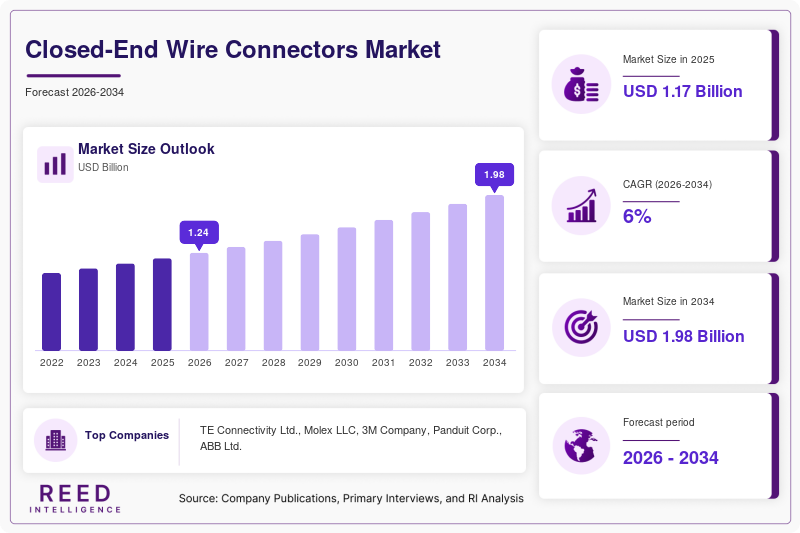
Closed-End Wire Connectors market size is projected at USD 1.24 billion in 2026 and is expected to hit USD 1.98 billion by 2034 with a CAGR of 6.0%. The market growth is supported by increasing electrical infrastructure investments, rising demand for secure wire termination solutions, and expansion of automation systems. This report provides detailed segmentation, competitive landscape analysis, technology trends, regional insights, and strategic developments shaping the Closed-End Wire Connectors Market.
The Closed-End Wire Connectors Market includes electrical components designed to permanently terminate multiple wire ends by crimping or compression, providing insulation, safety, and reliable conductivity. Global production of closed-end wire connectors exceeded 18 billion units in 2025, supported by demand from residential wiring, industrial automation, renewable energy systems, and automotive applications. Nylon-based connectors accounted for approximately 42% of total consumption, while heat shrink variants represented nearly 28% due to enhanced moisture protection capabilities.
Closed-End Wire Connectors Trends
Increasing Adoption of Heat Shrink and High-Performance Connectors
The Closed-End Wire Connectors Market is witnessing a shift toward advanced heat shrink connectors, which accounted for nearly 28% of global demand in 2025. Production volumes surpassed 5 billion units annually as industries prioritized corrosion resistance, vibration protection, and long-term electrical reliability. Manufacturers are integrating improved polymer materials and automated crimping compatibility, increasing adoption rates by approximately 8% annually across industrial and automotive sectors. The growing requirement for compact electrical assemblies is driving Closed-End Wire Connectors Market trends across multiple applications.
Smart manufacturing facilities and renewable energy installations are increasing demand for durable wire termination solutions. Industrial users contributed nearly 38% of connector consumption, while commercial electrical projects represented around 32%. Automated assembly lines using precision crimping technology have improved production efficiency by 15–20%, supporting higher deployment of Closed-End Wire Connectors Market solutions.
Closed-End Wire Connectors Market Drivers
Expansion of Electrical Infrastructure and Automation Systems
Increasing global electrification projects are a major driver for the Closed-End Wire Connectors Market. Global electrical equipment installations exceeded 500 million units in 2025, creating demand for reliable connection components. Industrial automation applications contributed nearly 40% of connector demand, while residential electrical upgrades accounted for approximately 30%. Rising investments in smart buildings, manufacturing automation, and renewable energy systems are expected to increase connector consumption by 6–8% annually, strengthening Closed-End Wire Connectors Market growth.
Closed-End Wire Connectors Market Restraints
Availability of Alternative Connection Technologies
The adoption of push-in terminals, screw terminals, and advanced modular connectors creates competitive pressure for traditional closed-end connectors. Alternative technologies captured nearly 25% of low-voltage connection applications in 2025. Price-sensitive markets experienced slower adoption due to cost differences of 10–15% compared with conventional connectors. These factors limit rapid expansion of the Closed-End Wire Connectors Market in certain applications.
Closed-End Wire Connectors Market Opportunities
Growing Demand from Renewable Energy and Electric Mobility
Renewable energy installations and electric vehicle charging infrastructure provide significant opportunities for the Closed-End Wire Connectors Market. Solar and energy storage projects consumed over 1.5 billion electrical connectors in 2025, representing approximately 12% of total connector demand. Electric mobility systems are projected to increase connector requirements by more than 9% annually as manufacturers focus on safer and more efficient electrical connections.
Challenges in Closed-End Wire Connectors Market
Material Cost Volatility and Supply Chain Issues
Fluctuations in copper, aluminum, and polymer prices remain key challenges for manufacturers. Raw material costs represent nearly 45–55% of connector production expenses, while supply disruptions affected approximately 8% of global shipments during recent years. Maintaining consistent quality standards and managing production costs continue to influence Closed-End Wire Connectors Market performance.
Closed-End Wire Connectors Market Segmentation
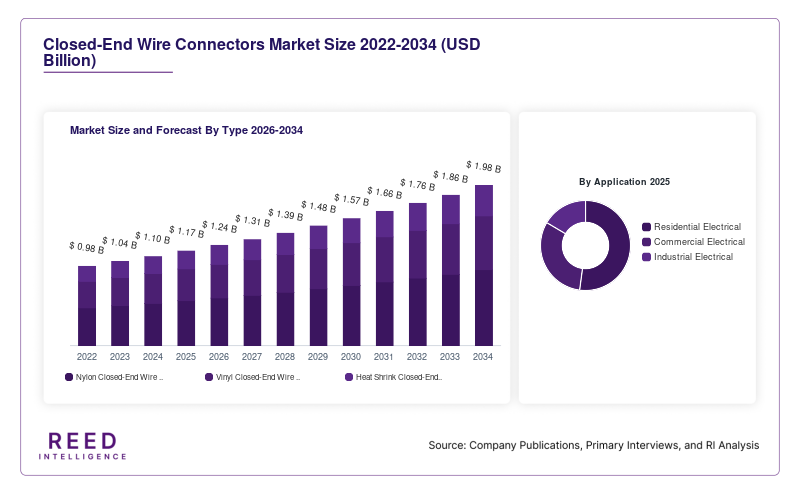
The Closed-End Wire Connectors Market segmentation is based on type and application. Nylon connectors dominate with nearly 42% market share due to affordability and wide usage, while industrial applications represent approximately 38% of total demand because of automation and machinery installations.
By Type
Nylon closed-end wire connectors accounted for approximately 42% of the Closed-End Wire Connectors Market in 2025, with production exceeding 7.5 billion units globally. These connectors are widely used for general electrical applications due to lightweight construction, temperature resistance up to 105°C, and compatibility with copper conductors ranging from 22 AWG to 8 AWG. Residential and commercial electrical installations contributed nearly 70% of nylon connector consumption.
Vinyl closed-end wire connectors represented around 30% market share, generating demand of approximately 5.4 billion units in 2025. These connectors offer cost advantages, easy installation, and insulation protection for low-voltage applications. Small-scale electrical projects and commercial wiring systems accounted for nearly 60% of usage, especially in regions focusing on affordable electrical infrastructure development.
Heat shrink closed-end wire connectors captured nearly 28% market share with global production reaching 5 billion units in 2025. These connectors provide waterproof sealing, improved durability, and resistance against chemicals and environmental exposure. Industrial automation, marine systems, and renewable energy applications contributed more than 65% of demand due to their enhanced reliability.
By Application
Residential electrical applications accounted for approximately 30% of total Closed-End Wire Connectors Market demand, consuming more than 5 billion units in 2025. Increasing housing construction, electrical renovation projects, and smart home installations are driving adoption. Nearly 70% of residential wiring projects use insulated closed-end connectors for secure electrical termination and improved safety performance.
Commercial electrical applications represented around 32% market share, with consumption exceeding 5.7 billion units annually. Offices, retail buildings, hospitals, and educational facilities are major users requiring reliable wiring solutions. Commercial infrastructure projects increased connector demand by approximately 6% in 2025 due to expansion of energy-efficient electrical systems.
Industrial electrical applications dominated with nearly 38% share, accounting for over 6.8 billion units in 2025. Manufacturing plants, automation equipment, and heavy machinery rely on closed-end connectors for vibration-resistant and durable connections. Industrial penetration reached approximately 75% in developed markets, supported by increasing automation investments.
Closed-End Wire Connectors Market Regional Outlook
North America Closed-End Wire Connectors Market
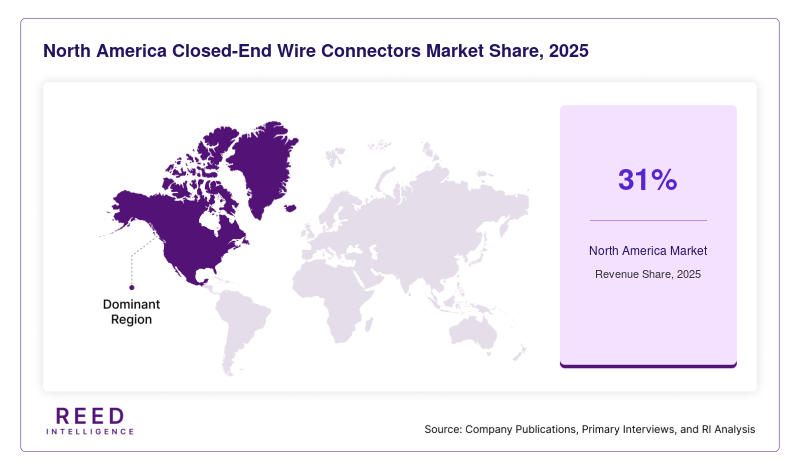
North America accounted for nearly 31% of the global Closed-End Wire Connectors Market in 2025, with consumption exceeding 5.5 billion units. The United States contributed approximately 80% of regional demand due to strong industrial automation, construction activities, and electrical safety regulations. Industrial applications represented nearly 45% of regional consumption.
Europe Closed-End Wire Connectors Market
Europe held around 27% market share, supported by Germany, the United Kingdom, and France. Regional demand surpassed 4.8 billion units in 2025, driven by renewable energy projects and manufacturing automation. Germany represented approximately 35% of European consumption due to its advanced industrial sector.
Asia-Pacific Closed-End Wire Connectors Market
Asia-Pacific emerged as the fastest-growing region with nearly 34% market share and more than 6 billion units consumed in 2025. China, Japan, and India contributed significantly due to infrastructure expansion, electronics manufacturing, and urban development. Industrial applications accounted for nearly 40% of regional demand.
Latin America and Middle East & Africa Closed-End Wire Connectors Market
These regions collectively represented approximately 8% market share with consumption of nearly 1.4 billion units in 2025. Infrastructure modernization, construction growth, and energy projects are supporting gradual adoption of closed-end wire connectors.
Top players in Closed-End Wire Connectors Market
- TE Connectivity Ltd.
- Molex LLC
- 3M Company
- Panduit Corp.
- ABB Ltd.
- Ideal Industries Inc.
- Hubbell Incorporated
- HellermannTyton
- Amphenol Corporation
- WAGO GmbH & Co. KG
- Legrand SA
- Burndy LLC
TE Connectivity Ltd.
- Holds a leading position with an estimated 12–15% share of the global Closed-End Wire Connectors Market.
- The company focuses on high-performance electrical connectivity solutions for industrial, automotive, and energy applications.
- Its product portfolio includes advanced insulated connectors designed for harsh environments, supporting demand growth across automation and renewable energy sectors.
3M Company
- Maintains approximately 8–10% market share through strong distribution networks and electrical product innovation.
- The company provides reliable wire termination solutions used in commercial, industrial, and infrastructure projects.
- Its focus on material technology and safety-certified electrical components strengthens its position in the Closed-End Wire Connectors Market.
Recent Developments in Closed-End Wire Connectors Market
- 2026: Major manufacturers expanded production capacity for heat shrink closed-end connectors to support industrial automation demand.
- 2025: Companies introduced improved polymer-based connector designs offering higher temperature resistance and durability.
- 2025: Electrical component suppliers increased investments in automated connector manufacturing facilities.
Closed-End Wire Connectors Market Segments
By Type
- Nylon Closed-End Wire Connectors
- Vinyl Closed-End Wire Connectors
- Heat Shrink Closed-End Wire Connectors
By Application
- Residential Electrical
- Commercial Electrical
- Industrial Electrical
By Region
- North America
- Europe
- APAC
- Middle East and Africa
- LATAM