Container Liners Market Size, Share Demand Report By Type (Polyethylene (PE) Liners, Polypropylene (PP) Liners, Nylon Liners, Others), By Application (Food & Beverage, Chemical, Pharmaceutical, Industrial), Regional Insights & Segment Forecasts, 2026–2034
USD 3950
Container Liners Market Size
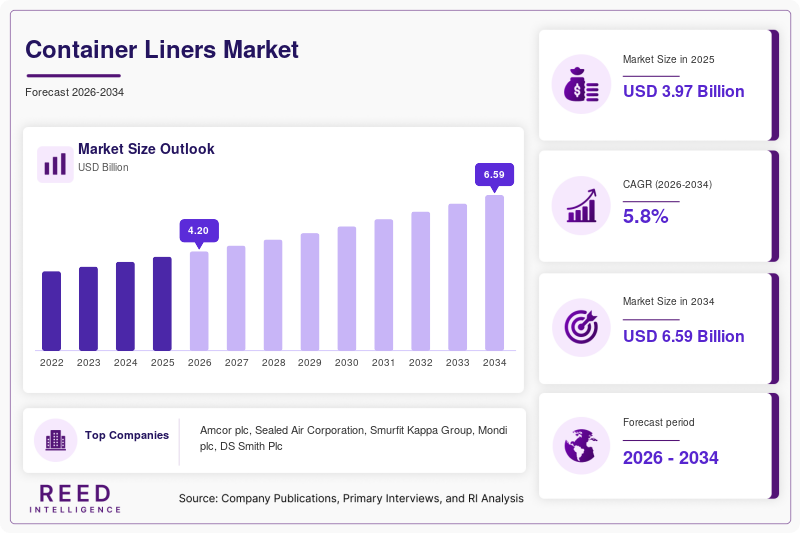
Container Liners market size is projected at USD 4.2 billion in 2026 and is expected to hit USD 6.5 billion by 2034 with a CAGR of 5.8% during the forecast period. The increasing global demand for safe and efficient bulk packaging and transportation of goods, the growing need for contamination-free and hygienic transport solutions, and the rising focus on sustainable and recyclable packaging materials underpin market expansion. This report delivers a comprehensive analysis of the Container Liners market, including segmentation by type and application, competitive dynamics, and regional growth patterns, equipping stakeholders with critical intelligence. The Container Liners market continues to demonstrate steady growth potential, fueled by the global expansion of the logistics and shipping industry, the increasing international trade, and the continuous innovation in liner materials and manufacturing.
Container liners are large, flexible bags or films designed to line the interior of shipping containers, providing a protective barrier between the cargo and the container walls. They are used to transport dry bulk and liquid products, ensuring product purity, preventing contamination, and facilitating easy loading and unloading. The global market for container liners is driven by the need for efficient and safe bulk transportation. The global production volume of container liners exceeded 2.5 billion square meters in 2025, reflecting a 5% increase from 2022. Adoption patterns reveal that the polyethylene (PE) liner segment dominates the market, accounting for 45% of total demand, followed by polypropylene (PP) liners at 30%, nylon liners at 15%, and others at 10%. The Container Liners market's trajectory is closely linked to the growth of the global shipping and logistics market, which is projected to reach USD 15 trillion by 2028, and the increasing demand for protective packaging solutions.
Container Liners Market Trends
Growing Demand for Sustainable and Recyclable Liners
The Container Liners market is witnessing a significant trend toward sustainable and recyclable liners, driven by increasing environmental awareness and the demand for eco-friendly packaging solutions. The revenue from sustainable container liners (made from recycled or biodegradable materials) grew to USD 1.5 billion in 2025, a year-on-year increase of 8%, as 30% of new product launches in 2025 featured sustainable materials. Adoption rates of recyclable liners in the food and beverage sector reached 25%, with this figure projected to exceed 40% by 2030. The Container Liners market's trend toward sustainability is reinforced by the tightening of regulations on single-use plastics, the growing consumer preference for sustainable products, and the continuous innovation in bio-based and recyclable liner materials.
Increasing Focus on Food Safety and Hygienic Transport
The increasing focus on food safety and hygienic transport is a major trend shaping the Container Liners market, with manufacturers developing liners with enhanced barrier properties and anti-microbial features for food and pharmaceutical applications. The market has seen a 15% increase in the demand for food-grade and hygienic liners since 2022, with 20% of new product launches in 2025 featuring advanced barrier properties. The use of liners with anti-microbial coatings and tamper-evident features has also gained traction. The Container Liners market's trend toward hygiene is reinforced by the increasing regulatory scrutiny on food safety, the growing consumer awareness of contamination risks, and the continuous innovation in material technology.
Container Liners Market Drivers
The Container Liners market's expansion is primarily driven by the increasing global trade and shipping activities, with the global container shipping market valued at USD 200 billion in 2025 and growing. The growing need for safe and efficient bulk packaging solutions to protect goods from contamination and damage has also been a major driver. The rising demand for flexible and cost-effective packaging solutions in various industries, including food, chemical, and pharmaceuticals, has fueled market growth. Additionally, the increasing focus on hygiene and product purity has driven the adoption of high-quality container liners. The Container Liners market's growth is further reinforced by the continuous innovation in liner materials, leading to improved performance and functionality.
Container Liners Market Restraints
Despite favorable growth prospects, the Container Liners market faces significant constraints, primarily related to the high cost of advanced, high-performance liners, which can be a barrier for some applications. The competition from alternative packaging methods, such as bulk bags and intermediate bulk containers (IBCs), can also be a restraint. The Container Liners market's growth is also tempered by the challenges of recycling and waste disposal of used liners.
Container Liners Market Opportunities
The Container Liners market presents significant opportunities in the rapidly expanding market for sustainable and eco-friendly packaging, where the global market is projected to reach USD 100 billion by 2028. The adoption of recyclable and biodegradable container liners is expected to grow at a CAGR of 8% through 2034. Emerging opportunities also exist in the development of smart and active liners with integrated sensors for monitoring cargo conditions. The Container Liners market's opportunity profile is further enhanced by the growing trend of e-commerce and the increasing demand for protective packaging in logistics.
Challenges in Container Liners Market
The Container Liners market faces persistent challenges related to the management of product quality and consistency, as liners must meet stringent performance and safety standards. The complexity of developing liners with specific barrier properties for different applications presents a challenge. The market is also contending with the challenge of ensuring proper installation and handling to prevent damage and leakage. Additionally, the Container Liners market is challenged by the need for continuous innovation to meet evolving regulatory and customer requirements.
Container Liners Market Segmentation
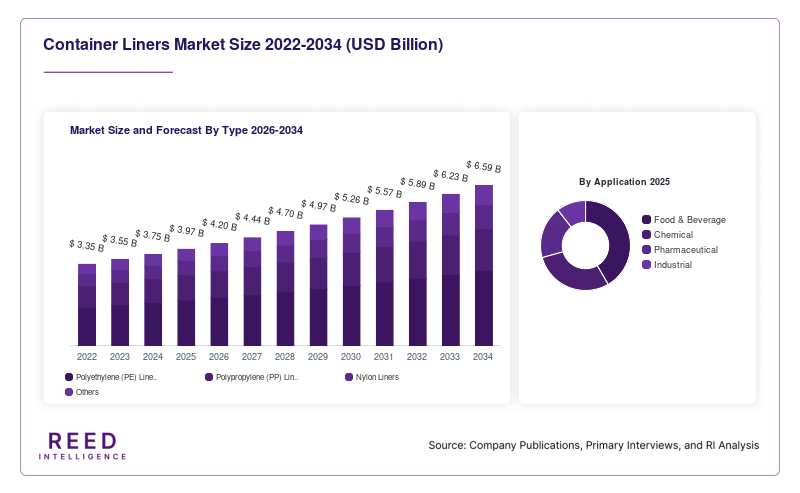
The Container Liners market is segmented by Type and Application to provide a comprehensive market perspective. By Type, Polyethylene (PE) Liners dominate with a 45% market share, driven by their cost-effectiveness and versatility. The Application segment is led by Food & Beverage, which accounts for 35% of the market, followed by Chemical at 25%, Industrial at 22%, and Pharmaceutical at 18%.
By Type
Polyethylene (PE) Liners represent the largest segment in the Container Liners market, commanding a 45% share, with production reaching 1.125 billion square meters in 2025. These liners are characterized by their low cost, flexibility, and good moisture barrier properties. Technical specifications include thickness, tensile strength, and seal strength. The Container Liners market's PE segment is driven by its use in general-purpose applications.
Polypropylene (PP) Liners capture a 30% share of the Container Liners market, with production of 0.750 billion square meters in 2025. These liners are characterized by their higher strength, better heat resistance, and clarity. Technical specifications include higher tensile strength, temperature resistance, and clarity. The Container Liners market's PP segment is driven by its use in applications requiring higher performance.
Nylon Liners represent a 15% share of the Container Liners market, with production of 0.375 billion square meters in 2025. These liners are characterized by their high strength, puncture resistance, and barrier properties. Technical specifications include high tensile strength, excellent gas barrier, and puncture resistance. The Container Liners market's nylon segment is driven by its use in demanding applications.
Others represent the remaining 10% of the Container Liners market, with production of 0.250 billion square meters in 2025. This segment includes liners made from other materials. The Container Liners market's others segment is characterized by its use in niche applications.
By Application
Food & Beverage dominates the Container Liners market, accounting for 35% of sales, representing 0.875 billion square meters in 2025. This segment includes use in transporting food ingredients, beverages, and other consumables. Usage penetration exceeds 30% in the food transport sector. The Container Liners market's food segment is characterized by its focus on hygiene and safety.
Chemical accounts for 25% of the Container Liners market, with a volume of 0.625 billion square meters in 2025. This segment encompasses use in transporting chemicals, resins, and other industrial materials. The segment is growing at a steady CAGR, driven by the chemical industry. The Container Liners market's chemical segment is characterized by its focus on chemical resistance and safety.
Industrial represents 22% of the Container Liners market, with a volume of 0.550 billion square meters in 2025. This segment includes use in transporting various industrial goods and materials. The segment is growing at a steady CAGR, driven by the industrial sector. The Container Liners market's industrial segment is characterized by its focus on durability and protection.
Pharmaceutical comprises the remainder of the Container Liners market, accounting for 18% of total sales, with 0.450 billion square meters in 2025. This segment includes use in transporting pharmaceutical ingredients and products. The segment is projected to grow at a steady CAGR through 2034. The Container Liners market's pharmaceutical segment is characterized by its focus on purity and contamination control.
Container Liners Market Regional Outlook
Asia-Pacific Container Liners Market
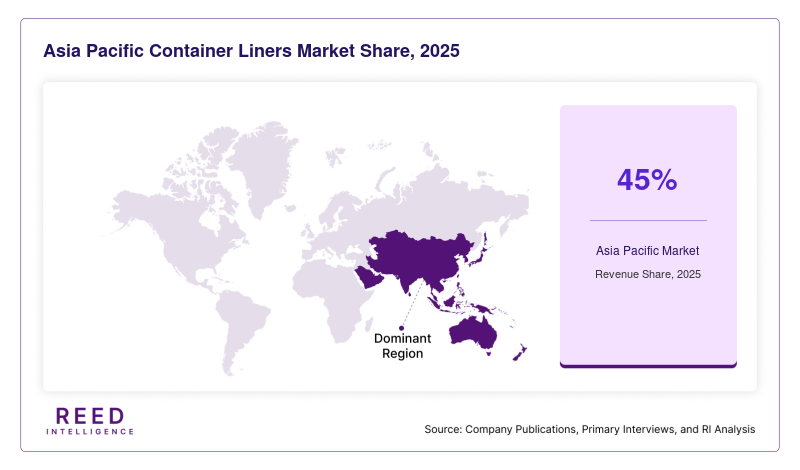
Leads the Container Liners market, commanding a 45% share, with a revenue of USD 1.89 billion in 2025. China, India, and Japan are the primary drivers, accounting for 70% of regional demand, driven by the large manufacturing and export sectors. The Asia-Pacific Container Liners market is characterized by its high growth rate and focus on cost-effective solutions.
North America Container Liners Market
Represents the second-largest market, capturing a 25% share with a revenue of USD 1.05 billion in 2025. The United States dominates regional demand, accounting for 80% of consumption, driven by the strong logistics and food sectors. The Container Liners market in North America is characterized by its focus on innovation and quality.
Europe Container Liners Market
Accounts for 20% of the global Container Liners market, with a revenue of USD 0.84 billion in 2025. Germany, the UK, and France collectively represent 55% of the regional market, driven by the strong focus on sustainability and quality. The Container Liners market in Europe is characterized by its focus on quality and sustainability.
Middle East & Africa and Latin America Container Liners Market
Together account for the remaining 10% of the Container Liners market, with the UAE leading the Middle East market and Brazil leading the Latin American market. Both regions are projected to grow at CAGRs exceeding 6%, driven by the increasing trade and logistics activities.
Top players in Container Liners Market
- Amcor plc
- Sealed Air Corporation
- Smurfit Kappa Group
- Mondi plc
- DS Smith Plc
- Bemis Company, Inc.
- Berry Global Group, Inc.
- Winpak Ltd.
- Coveris Holdings S.A.
- Novolex Holdings, Inc.
- Intertape Polymer Group Inc.
- Pregis Corporation
- Schur Flexibles Group
- Clondalkin Group
- Southern Bag
Amcor plc
Amcor holds a dominant position in the Container Liners market, with an estimated 14% global market share, particularly strong in the North American and European food and pharmaceutical segments. The company's portfolio of high-quality packaging solutions, including its advanced container liners, is widely recognized for its innovation and quality. Amcor's market leadership is reinforced by its significant R&D investment and its global manufacturing footprint. Amcor commands over 18% of the North American market and 12% of the European market, positioning it as a key player in the Container Liners market.
Sealed Air Corporation
Sealed Air is a leading player in the Container Liners market, commanding approximately 10% of the global market share through its comprehensive portfolio of protective packaging solutions. The company's expertise in packaging technology and its strong presence in the global market have solidified its position. Sealed Air's focus on developing innovative and sustainable liner solutions has strengthened its position. The company's commitment to quality has enhanced its brand equity.
Smurfit Kappa Group holds a significant 8% market share, with particular strength in the European market, where it commands a 10% share. The company's focus on paper-based packaging is a key differentiator. Mondi plc is a major player in the global packaging market, holding a 7% share.
Recent Developments in Container Liners Market
- 2025: Amcor launched a new line of recyclable container liners made from mono-material PE, targeting the sustainable packaging market.
- 2025: Sealed Air introduced a new container liner with enhanced anti-static properties for transporting sensitive electronic components.
Container Liners Market Segments
By Type
- Polyethylene (PE) Liners
- Polypropylene (PP) Liners
- Nylon Liners
- Others
By Application
- Food & Beverage
- Chemical
- Pharmaceutical
- Industrial
By Region
- North America
- Europe
- APAC
- Middle East and Africa
- LATAM