Embedded Development Kit Market Size, Share & Demand Report By Type (Microcontroller Development Kits, FPGA Development Kits, System-on-Module Development Kits), By Application (Consumer Electronics, Industrial Automation, Automotive & Transportation), By Region & Segment Forecasts, 2026–2034
USD 3950
Embedded Development Kit Market Size
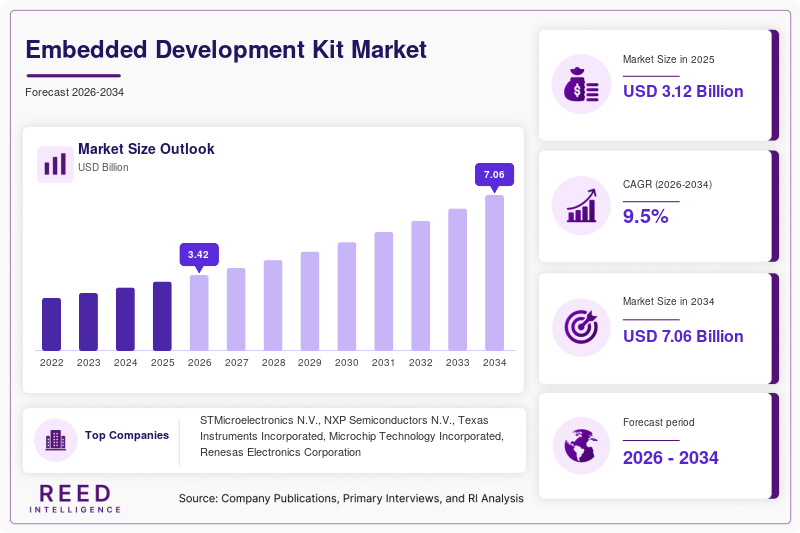
Embedded Development Kit market size is projected at USD 3.42 billion in 2026 and is expected to hit USD 7.08 billion by 2034 with a CAGR of 9.5%. The report provides a comprehensive assessment of market performance, technology evolution, segmentation trends, and competitive positioning. It analyzes historical developments from 2022–2024, establishes 2025 as the base year, and forecasts future opportunities through 2034 across major industries and regions.
Embedded Development Kits are hardware and software platforms designed to support the development, testing, and deployment of embedded systems. These kits typically include processors, microcontrollers, FPGA boards, software development tools, debugging interfaces, and connectivity modules. Global shipments of embedded development kits exceeded 42 million units in 2025, driven by growing adoption of IoT devices, industrial automation, and smart electronics.
Embedded Development Kit Market Trends
Rising Adoption of AI and Edge Computing Platforms
The integration of artificial intelligence and edge computing capabilities into development platforms is a major industry trend. More than 12 million AI-enabled embedded development kits were shipped globally in 2025, representing nearly 29% of total market volume. These solutions support machine learning, computer vision, and real-time analytics applications across multiple industries.
Manufacturers are increasingly integrating processors exceeding 2 GHz clock speeds, memory capacities above 8 GB, and AI acceleration engines into development kits. Adoption rates of AI-capable embedded platforms increased by approximately 18% year-over-year, contributing to Embedded Development Kit market trend expansion.
Growing Demand from IoT and Industrial Automation
The proliferation of connected devices and Industry 4.0 initiatives continues to drive demand for advanced development platforms. Global IoT device deployments exceeded 22 billion units in 2025, while industrial automation investments surpassed USD 280 billion annually. More than 70% of newly deployed industrial IoT solutions utilize embedded development kits during product prototyping and deployment stages.
Advanced connectivity features such as Wi-Fi 6, Bluetooth Low Energy, Zigbee, and 5G modules are increasingly incorporated into development kits. These advancements are reinforcing Embedded Development Kit market demand.
Embedded Development Kit Market Drivers
Expansion of IoT Ecosystems and Smart Devices
The rapid expansion of IoT ecosystems is a major growth driver. More than 22 billion connected devices were operational globally in 2025, with annual device shipments increasing by approximately 14%. Embedded development kits enable rapid prototyping and accelerated product development, reducing engineering cycles by nearly 30%. Increasing adoption of smart home devices, industrial sensors, and connected healthcare products supports Embedded Development Kit market growth.
Embedded Development Kit Market Restraints
High Development Complexity and Technical Expertise Requirements
Developing advanced embedded applications often requires specialized engineering expertise, increasing project complexity and implementation costs. Nearly 42% of small and medium-sized enterprises identify software integration and debugging challenges as barriers to adoption. Additionally, advanced FPGA and AI-enabled kits can cost 35–60% more than standard development boards, limiting accessibility for budget-sensitive organizations and affecting Embedded Development Kit market expansion.
Embedded Development Kit Market Opportunities
Increasing Deployment of AI, Robotics, and Smart Manufacturing
The expansion of robotics, smart manufacturing, and AI-driven applications creates substantial opportunities. Global industrial robot installations exceeded 650,000 units in 2025, while smart factory investments surpassed USD 350 billion. Embedded development kits play a critical role in enabling rapid development of automation systems, edge AI devices, and intelligent control solutions, creating strong opportunities for Embedded Development Kit market growth.
Challenges in Embedded Development Kit Market
Rapid Technology Evolution and Product Obsolescence
Manufacturers face challenges associated with rapid technological advancements and shortened product lifecycles. Processor architectures, communication standards, and software ecosystems evolve continuously, requiring frequent product updates. Approximately 30% of development platforms require major hardware revisions within three years, increasing R&D expenditures and creating challenges for the Embedded Development Kit market.
Embedded Development Kit Market Segmentation
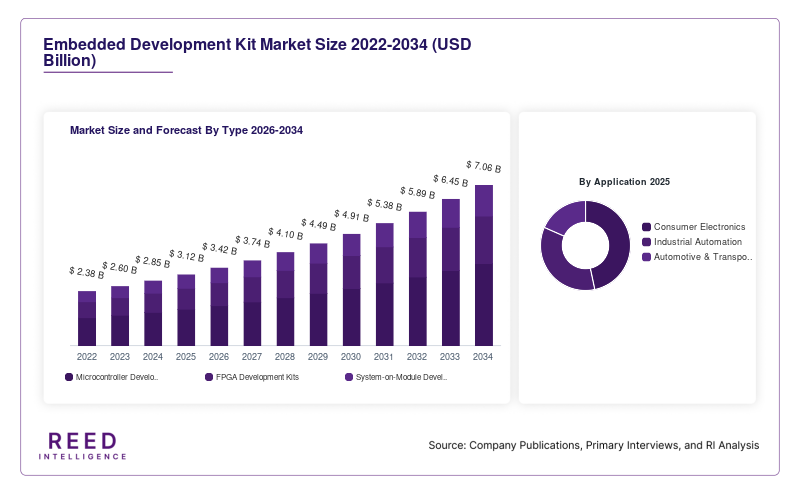
The market is segmented by type and application based on hardware architecture, development requirements, and end-use industries. Microcontroller Development Kits dominated with approximately 48% market share in 2025, while Consumer Electronics accounted for nearly 38% of total application demand.
By Type
Microcontroller Development Kits represented approximately 48% of market share in 2025. Global shipments exceeded 20 million units annually due to extensive use in IoT devices, consumer electronics, and industrial control systems. These kits typically include 32-bit processors operating between 100 MHz and 600 MHz, integrated connectivity modules, and software development environments. Their affordability and ease of use drive widespread adoption.
FPGA Development Kits accounted for nearly 29% of total demand. Annual shipments exceeded 12 million units globally. These platforms support high-performance computing, telecommunications infrastructure, aerospace applications, and AI acceleration projects. Their reconfigurable architecture and processing flexibility make them valuable for advanced engineering applications.
System-on-Module Development Kits contributed approximately 23% market share. More than 10 million units were shipped globally in 2025. These kits integrate processors, memory, storage, and connectivity functions into compact modules, enabling rapid development of embedded systems for industrial, automotive, and medical applications.
By Application
Consumer Electronics accounted for approximately 38% of market demand. More than 16 million development kits were utilized for smart devices, wearable electronics, gaming systems, and connected appliances during 2025. Adoption rates exceeded 75% among electronics product developers due to rapid prototyping requirements and shorter product development cycles.
Industrial Automation represented nearly 34% market share. More than 8 million development kits supported robotics, programmable logic controllers, machine vision systems, and industrial IoT applications. Adoption continues to increase as manufacturers invest in digital transformation and smart factory initiatives.
Automotive & Transportation contributed approximately 21% of market demand. Over 50 million connected vehicles and advanced mobility systems integrated embedded development platforms during product design and testing processes. These kits support ADAS development, vehicle connectivity, infotainment systems, and electric vehicle electronics.
Embedded Development Kit Market Regional Outlook
Asia-Pacific Embedded Development Kit Market
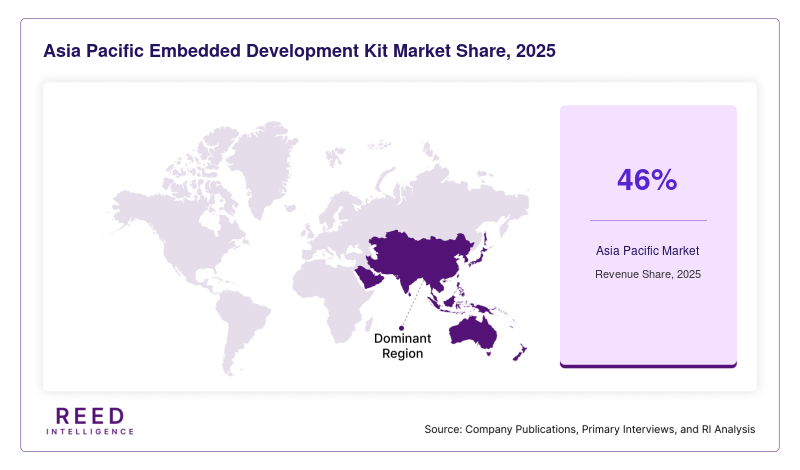
Asia-Pacific dominated the market with approximately 46% share in 2025. China, Japan, South Korea, and Taiwan accounted for more than 65% of global electronics manufacturing activities. Regional shipments exceeded 19 million units annually. Consumer electronics represented nearly 42% of regional demand, while industrial automation accounted for approximately 30%.
North America Embedded Development Kit Market
North America held approximately 26% market share. The United States contributed more than 80% of regional demand due to strong investments in AI, IoT, defense electronics, and industrial automation. Annual shipments exceeded 10 million units, supported by extensive R&D activities and technology innovation.
Europe Embedded Development Kit Market
Europe accounted for approximately 20% of global demand. Germany, France, and the United Kingdom remained leading contributors. Industrial automation represented nearly 40% of regional demand, while automotive applications contributed approximately 28%. Shipments exceeded 8 million units annually.
Rest of the World Embedded Development Kit Market
The Rest of the World represented approximately 8% market share. Increasing digitalization, industrial modernization, and smart infrastructure projects across Latin America, the Middle East, and Africa contributed to growing demand. Annual shipments exceeded 3 million units in 2025.
Top players in Embedded Development Kit Market
- STMicroelectronics N.V.
- NXP Semiconductors N.V.
- Texas Instruments Incorporated
- Microchip Technology Incorporated
- Renesas Electronics Corporation
- Infineon Technologies AG
- Analog Devices, Inc.
- AMD (Xilinx)
- Nordic Semiconductor ASA
- Arduino S.r.l.
- Raspberry Pi Ltd.
- Silicon Labs Inc.
STMicroelectronics N.V.
- Holds a leading position in the market with an estimated share exceeding 11%.
- The company offers a broad portfolio of microcontroller and embedded development platforms serving automotive, industrial, and consumer electronics sectors.
- Strong investments in AI-enabled edge processing, IoT connectivity, and low-power embedded technologies strengthen its market position.
- Its global developer ecosystem and extensive software support contribute significantly to adoption across engineering communities worldwide.
NXP Semiconductors N.V.
- Accounts for an estimated market share above 9% globally.
- The company provides advanced embedded development platforms supporting automotive electronics, industrial automation, smart cities, and IoT applications.
- Its strong focus on secure connectivity, edge computing, and intelligent control systems enhances competitive positioning.
- Continuous investments in automotive-grade processors and AI-enabled solutions support long-term market leadership and innovation.
Recent Developments in Embedded Development Kit Market
- 2026: Leading semiconductor vendors introduced AI-enabled development kits with integrated neural processing accelerators.
- 2025: Multiple manufacturers launched embedded platforms supporting Wi-Fi 7 and advanced edge computing applications.
- 2025: Development kit suppliers expanded software ecosystems for machine learning and industrial IoT deployments.
Embedded Development Kit Market Segments
By Type
- Microcontroller Development Kits
- FPGA Development Kits
- System-on-Module Development Kits
By Application
- Consumer Electronics
- Industrial Automation
- Automotive & Transportation
By Region
- North America
- Europe
- APAC
- Middle East and Africa
- LATAM