Feed Flavors, Sweeteners and Natural Enhancers Market Size, Share, Demand Report By Type (Feed Flavors, Feed Sweeteners, Natural Feed Enhancers), By Application (Poultry Feed, Swine Feed, Ruminant Feed), By Region & Segment Forecasts, 2026–2034
USD 3950
Feed Flavors, Sweeteners and Natural Enhancers Market Size
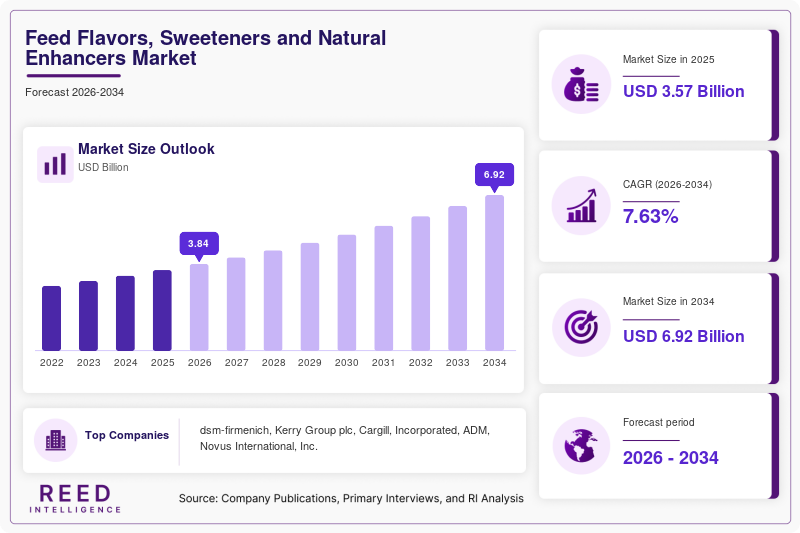
Feed Flavors, Sweeteners and Natural Enhancers market size is projected at USD 3.84 billion in 2026 and is expected to hit USD 6.91 billion by 2034 with a CAGR of 7.63%. Rising focus on feed palatability, animal nutrition efficiency, and sustainable livestock production is accelerating market expansion worldwide. Increasing demand for detailed market data, segment evaluation, and competitive landscape assessment continues to support investment decisions across the industry.
The market includes flavoring agents, sweetening compounds, and natural enhancement additives incorporated into animal feed formulations to improve feed intake, digestibility, and animal performance. Global production exceeded 2.8 million metric tons in 2025, while commercial adoption rates surpassed 67% across organized livestock operations. Feed flavors accounted for approximately 41% of total revenue, followed by natural feed enhancers at 34% and feed sweeteners at 25%. Growing emphasis on feed efficiency and livestock productivity continues to reinforce the feed flavors, sweeteners and natural enhancers market.
Feed Flavors, Sweeteners and Natural Enhancers Market Trends
Increasing Adoption of Natural and Plant-Based Feed Additives
Natural feed additive production exceeded 1.1 million metric tons globally in 2025, representing annual growth of 9.4%. Adoption rates among commercial poultry producers reached 63%, while swine operations recorded adoption levels above 56%. Plant-derived flavor compounds and botanical enhancers improved feed intake by 8% to 15% and supported livestock performance improvements of up to 12%, supporting feed flavors, sweeteners and natural enhancers market trends.
Advancements in encapsulation technology, essential oil extraction, and precision feed formulation are reshaping the industry landscape. More than 38% of newly launched products incorporate natural extracts, organic acids, and botanical ingredients. Demand from antibiotic-free livestock production systems increased by 11.8% during 2025, while feed flavors, sweeteners and natural enhancers market trends continue to benefit from clean-label feed initiatives.
Feed Flavors, Sweeteners and Natural Enhancers Market Drivers
Growing Demand for Improved Feed Palatability and Animal Performance
Global compound feed production surpassed 1.4 billion metric tons in 2025, creating strong demand for feed additives that improve consumption rates and nutritional efficiency. More than 61% of commercial livestock producers now utilize feed enhancement products compared to 47% in 2020. Feed palatability solutions can increase feed intake by 5% to 18% and improve weight gain efficiency by up to 14%, supporting feed flavors, sweeteners and natural enhancers market growth.
Feed Flavors, Sweeteners and Natural Enhancers Market Restraints
Volatility in Raw Material Prices
Prices of botanical extracts, essential oils, and natural sweetening ingredients experienced fluctuations ranging from 10% to 22% during 2024 and 2025. Nearly 34% of manufacturers reported increased production costs due to supply chain disruptions and agricultural commodity volatility. Raw material expenses account for approximately 45% to 60% of total production costs, limiting profitability across the feed flavors, sweeteners and natural enhancers market.
Feed Flavors, Sweeteners and Natural Enhancers Market Opportunities
Expansion of Antibiotic-Free Livestock Production
More than 48% of commercial poultry operations globally have adopted antibiotic-reduction strategies, increasing demand for natural feed enhancement solutions. Livestock producers utilizing natural feed additives reported health performance improvements of 7% to 13% and feed conversion efficiency gains of up to 10%. These developments create significant opportunities within the feed flavors, sweeteners and natural enhancers market.
Challenges in Feed Flavors, Sweeteners and Natural Enhancers Market
Regulatory Compliance and Product Standardization
Regulatory approval timelines for feed additives can range from 12 to 36 months depending on region and product category. More than 27% of manufacturers face compliance-related delays during product commercialization. Variability in ingredient quality and regional feed regulations can increase product development costs by 8% to 15%, presenting challenges for the feed flavors, sweeteners and natural enhancers market.
Feed Flavors, Sweeteners and Natural Enhancers Market Segmentation
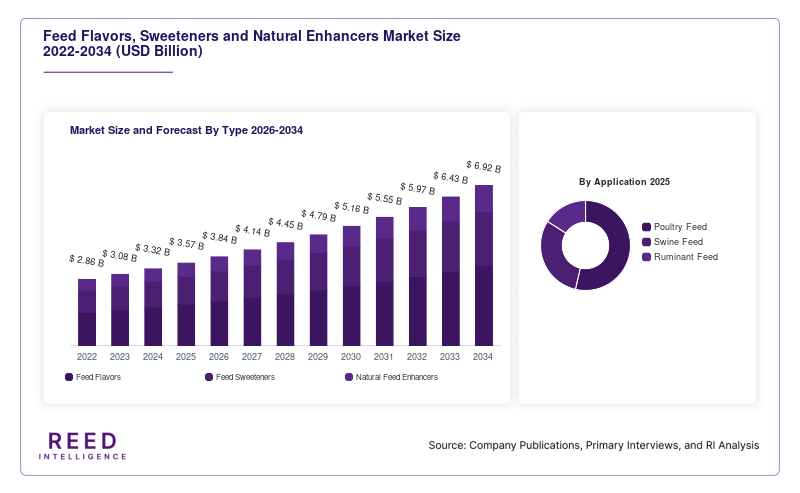
The market is segmented by type and application. Feed flavors dominated with approximately 41% revenue share during 2025, while poultry feed applications contributed nearly 44% of total demand. Rising livestock production and increasing adoption of performance-enhancing feed formulations continue to influence segment growth.
By Type
Feed flavors accounted for approximately 41% of total market revenue. Global production exceeded 1.15 million metric tons in 2025. Products include fruit flavors, dairy flavors, vanilla compounds, and savory flavor formulations designed to improve feed acceptance. Feed intake improvements range from 6% to 16% across livestock categories.
Feed sweeteners represented nearly 25% of market revenue. Production surpassed 700,000 metric tons globally. Common ingredients include saccharin, sucrose derivatives, and natural sweetening compounds. Sweetener inclusion rates typically range between 100 grams and 2 kilograms per ton of feed.Natural feed enhancers contributed approximately 34% of industry revenue. Production exceeded 950,000 metric tons during 2025. Botanical extracts, essential oils, probiotics, and phytogenic additives improve nutrient utilization and animal health. Adoption rates exceeded 58% among commercial livestock producers.
By Application
Poultry feed accounted for approximately 44% of market revenue. More than 620 million metric tons of poultry feed were produced globally in 2025. Feed enhancement additives improve feed conversion ratios by 4% to 10% and support higher growth performance across broiler and layer operations.
Swine feed represented nearly 31% of total demand. More than 310 million metric tons of swine feed incorporated flavoring and enhancement additives during 2025. Product utilization rates exceeded 54% among commercial swine producers and contributed to improved feed consumption efficiency.
Ruminant feed accounted for approximately 25% of market revenue. Global production exceeded 260 million metric tons during 2025. Natural enhancers and flavoring additives improve digestibility, feed utilization, and milk production efficiency across dairy and beef cattle operations.
Feed Flavors, Sweeteners and Natural Enhancers Market Regional Outlook
North America Feed Flavors, Sweeteners and Natural Enhancers Market
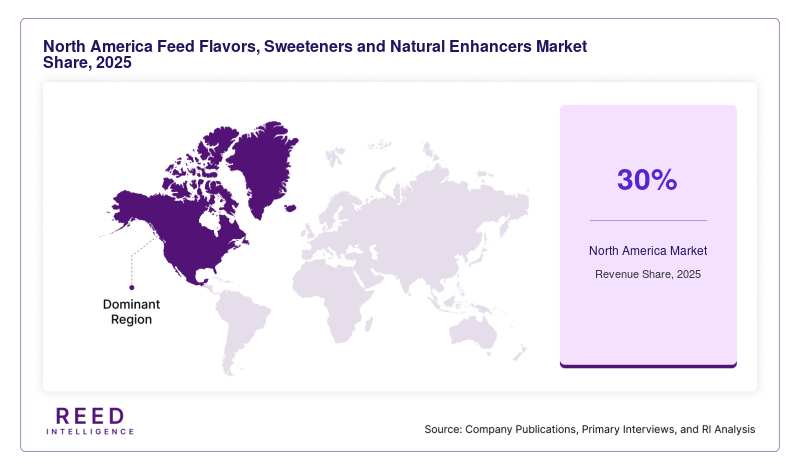
North America accounted for approximately 30% of global revenue in 2025. The United States contributed nearly 79% of regional demand, supported by advanced livestock nutrition practices and high feed additive utilization rates. Regional production exceeded 820,000 metric tons annually.
Europe Feed Flavors, Sweeteners and Natural Enhancers Market
Europe represented approximately 27% of market share. Germany, France, Spain, and the Netherlands collectively accounted for over 60% of regional consumption. Adoption of natural feed enhancement products exceeded 65% among commercial livestock producers.
Asia-Pacific Feed Flavors, Sweeteners and Natural Enhancers Market
Asia-Pacific dominated the market with approximately 33% revenue share. China, India, Japan, and Vietnam contributed nearly 68% of regional demand. Feed additive production surpassed 1 million metric tons in 2025, supported by expanding livestock industries.
Latin America Feed Flavors, Sweeteners and Natural Enhancers Market
Latin America accounted for approximately 6% of global revenue. Brazil represented more than 52% of regional demand due to its large poultry and swine production sectors. Feed additive adoption increased by 8.7% annually.
Middle East & Africa Feed Flavors, Sweeteners and Natural Enhancers Market
The Middle East & Africa held approximately 4% of market revenue. Growing investments in animal nutrition and livestock productivity programs supported regional growth. Commercial feed enhancement product adoption exceeded 21% among large livestock enterprises.
Top players in Feed Flavors, Sweeteners and Natural Enhancers Market
- dsm-firmenich
- Kerry Group plc
- Cargill, Incorporated
- ADM
- Novus International, Inc.
- Kemin Industries, Inc.
- Alltech Inc.
- Nutriad International NV
- Pancosma SA
- Phytobiotics GmbH
- Delacon Biotechnik GmbH
- Biomin Holding GmbH
- Prinova Group LLC
- Trouw Nutrition
- Norel S.A.
dsm-firmenich
- Estimated market share: 15%–17%
- dsm-firmenich maintains a leading position in feed flavoring and nutritional enhancement technologies.
- The company offers a broad portfolio of feed additives, flavor systems, sweetening compounds, and animal nutrition solutions.
- Strong investments in research and development support innovation in natural feed enhancement products.
- Global manufacturing facilities and distribution networks strengthen market reach across more than 100 countries.
- The company continues expanding its presence through sustainable livestock nutrition initiatives and advanced feed formulation technologies.
Kerry Group plc
- Estimated market share: 10%–12%
- Kerry Group is a major supplier of taste, nutrition, and feed enhancement solutions for livestock applications.
- The company provides specialized flavor systems, palatability enhancers, and performance-supporting feed ingredients.
- Strong expertise in sensory science and ingredient innovation supports product differentiation.
- Extensive customer relationships across poultry, swine, and ruminant sectors enhance competitive positioning.
- Ongoing investments in natural ingredient technologies continue supporting long-term market expansion.
Recent Developments in Feed Flavors, Sweeteners and Natural Enhancers Market
- 2025: dsm-firmenich expanded its portfolio of natural feed enhancement products for livestock nutrition.
- 2025: Kerry Group launched advanced botanical feed flavor solutions for poultry and swine applications.
Feed Flavors, Sweeteners and Natural Enhancers Market Segments
By Type
- Feed Flavors
- Feed Sweeteners
- Natural Feed Enhancers
By Application
- Poultry Feed
- Swine Feed
- Ruminant Feed
By Region
- North America
- Europe
- APAC
- Middle East and Africa
- LATAM