Gel Documentation Systems Market Size, Share Demand Report By Type (UV Gel Documentation Systems, LED Gel Documentation Systems, Laser Gel Documentation Systems), By Application (Protein Gel Analysis, DNA Gel Analysis, RNA Gel Analysis), Regional Insights & Segment Forecasts, 2026–2034
USD 3950
Gel Documentation Systems Market Size
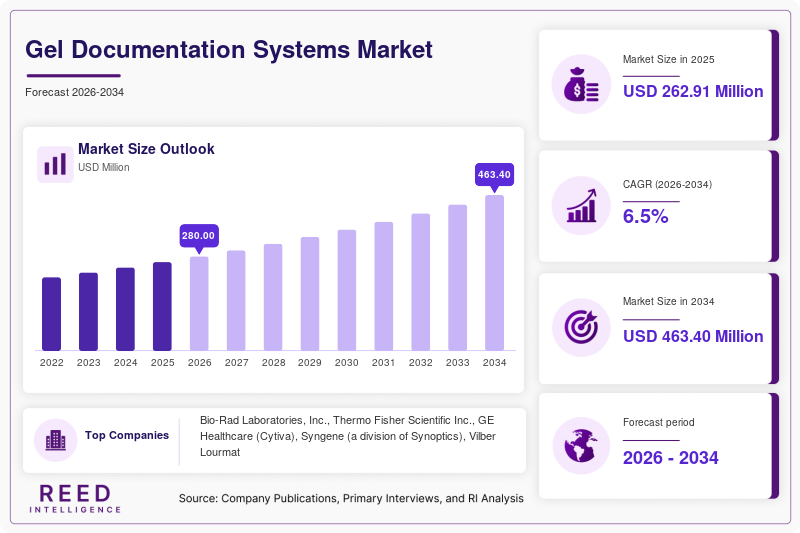
Gel Documentation Systems market size is projected at USD 280 million in 2026 and is expected to hit USD 450 million by 2034 with a CAGR of 6.5% during the forecast period. The increasing demand for advanced molecular biology and proteomics research, the growing need for accurate and efficient gel analysis in academic and pharmaceutical laboratories, and the rising adoption of gel documentation in clinical diagnostics and drug discovery underpin market expansion. This report delivers a comprehensive analysis of the Gel Documentation Systems market, including segmentation by type and application, competitive dynamics, and regional growth patterns, equipping stakeholders with critical intelligence. The Gel Documentation Systems market continues to demonstrate steady growth potential, fueled by the global expansion of life sciences research, the increasing funding for biotechnology, and the continuous innovation in imaging technology.
Gel documentation systems are specialized imaging instruments used to capture, analyze, and document images of gels (such as agarose or polyacrylamide gels) used in molecular biology and biochemistry. These systems are essential for visualizing and analyzing DNA, RNA, and proteins separated by electrophoresis, and are widely used in research, clinical, and industrial laboratories. The global market for gel documentation systems is driven by the need for accurate and reliable gel imaging. The global production volume of gel documentation systems exceeded 18,000 units in 2025, reflecting a 5% increase from 2022. Adoption patterns reveal that the UV gel documentation system segment dominates the market, accounting for 50% of total demand, followed by LED systems at 35%, and laser systems at 15%. The Gel Documentation Systems market's trajectory is closely linked to the growth of the global life sciences research market, which is projected to reach USD 1.5 trillion by 2028, and the increasing demand for high-quality imaging solutions.
Gel Documentation Systems Market Trends
Growing Adoption of LED and Laser-Based Systems
The Gel Documentation Systems market is witnessing a significant trend toward the adoption of LED and laser-based systems, driven by their superior performance, longer lifespan, and lower energy consumption compared to traditional UV systems. The revenue from LED and laser-based gel documentation systems grew to USD 100 million in 2025, a year-on-year increase of 8%, as 30% of new installations in 2025 specified LED or laser technology. Adoption rates of LED systems in the academic research sector reached 25%, with this figure projected to exceed 40% by 2030. The Gel Documentation Systems market's trend toward advanced light sources is reinforced by the need to improve image quality, reduce sample damage, and increase system reliability.
Increasing Focus on Automation and Software Integration
The increasing focus on automation and software integration is a major trend shaping the Gel Documentation Systems market, with manufacturers developing systems with advanced imaging software and automated analysis features. The market has seen a 15% increase in the demand for automated analysis features since 2022, with 20% of new product launches in 2025 featuring advanced software integration. The use of AI-powered image analysis and cloud-based data management has also gained traction. The Gel Documentation Systems market's trend toward digitalization is reinforced by the need to improve workflow efficiency, enhance data management, and enable remote collaboration.
Gel Documentation Systems Market Drivers
The Gel Documentation Systems market's expansion is primarily driven by the increasing demand for molecular biology and proteomics research, with the global life sciences research market growing at a CAGR of 6%. The growing need for accurate and efficient gel analysis in drug discovery and clinical diagnostics has also been a major driver. The rising adoption of gel documentation in academic and pharmaceutical laboratories has fueled demand. Additionally, the increasing funding for biotechnology and life sciences research has driven market growth. The Gel Documentation Systems market's growth is further reinforced by the continuous innovation in imaging technology, leading to improved image quality and analysis capabilities.
Gel Documentation Systems Market Restraints
Despite favorable growth prospects, the Gel Documentation Systems market faces significant constraints, primarily related to the high cost of advanced systems, which can be a barrier for smaller laboratories and educational institutions. The complexity of system operation and data analysis can also be a barrier. The Gel Documentation Systems market's growth is also tempered by the competition from alternative imaging technologies and the potential for rapid technological obsolescence.
Gel Documentation Systems Market Opportunities
The Gel Documentation Systems market presents significant opportunities in the rapidly expanding market for personalized medicine and molecular diagnostics, where the global market is projected to reach USD 200 billion by 2028. The adoption of gel documentation systems for clinical applications is expected to grow at a CAGR of 8% through 2034. Emerging opportunities also exist in the development of compact and portable gel documentation systems for field and point-of-care applications. The Gel Documentation Systems market's opportunity profile is further enhanced by the growing trend of digitalization and the integration of AI in laboratory workflows.
Challenges in Gel Documentation Systems Market
The Gel Documentation Systems market faces persistent challenges related to the management of data and the need for efficient data analysis and storage. The complexity of integrating new systems into existing laboratory workflows presents a challenge. The market is also contending with the challenge of maintaining high image quality and accuracy. Additionally, the Gel Documentation Systems market is challenged by the need for continuous innovation to keep pace with evolving research needs and technologies.
Gel Documentation Systems Market Segmentation
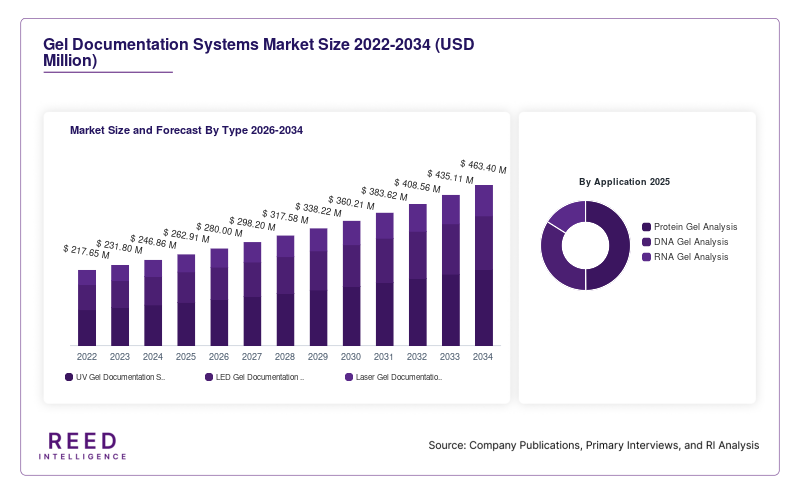
The Gel Documentation Systems market is segmented by Type and Application to provide a comprehensive market perspective. By Type, UV Systems dominate with a 50% market share, driven by their established use and cost-effectiveness. The Application segment is led by DNA Gel Analysis, which accounts for 45% of the market, followed by Protein Gel Analysis at 35%, and RNA Gel Analysis at 20%.
By Type
UV Gel Documentation Systems represent the largest segment in the Gel Documentation Systems market, commanding a 50% share, with production reaching 9,000 units in 2025. These systems are characterized by their use of UV light for nucleic acid visualization. Technical specifications include wavelength (typically 302 nm or 365 nm), camera resolution, and filter options. The Gel Documentation Systems market's UV segment is driven by its widespread use and established protocols.
LED Gel Documentation Systems capture a 35% share of the Gel Documentation Systems market, with production of 6,300 units in 2025. These systems are characterized by their use of LED light sources, offering longer life and lower energy consumption. Technical specifications include wavelength options (blue, green, etc.), uniform illumination, and integration with imaging software. The Gel Documentation Systems market's LED segment is growing at a faster CAGR, driven by the demand for modern, efficient systems.
Laser Gel Documentation Systems represent the remaining 15% of the Gel Documentation Systems market, with production of 2,700 units in 2025. These systems are characterized by their high sensitivity and resolution, using laser excitation. Technical specifications include specific laser wavelengths, high sensitivity detectors, and advanced imaging capabilities. The Gel Documentation Systems market's laser segment is driven by the demand for high-performance imaging.
By Application
DNA Gel Analysis dominates the Gel Documentation Systems market, accounting for 45% of sales, representing 8,100 units in 2025. This segment includes use in DNA fingerprinting, genotyping, and cloning. Usage penetration exceeds 80% in molecular biology labs. The Gel Documentation Systems market's DNA segment is characterized by its focus on nucleic acid analysis.
Protein Gel Analysis accounts for 35% of the Gel Documentation Systems market, with sales of 6,300 units in 2025. This segment encompasses use in Western blotting, protein purification, and proteomics. The segment is growing at a steady CAGR, driven by the expansion of proteomics research. The Gel Documentation Systems market's protein segment is characterized by its focus on protein characterization.
RNA Gel Analysis represents the remainder of the Gel Documentation Systems market, accounting for 20% of total sales, with 3,600 units in 2025. This segment includes use in RNA studies, such as northern blotting and RNA quality analysis. The segment is projected to grow at a steady CAGR through 2034. The Gel Documentation Systems market's RNA segment is characterized by its focus on RNA integrity and analysis.
Gel Documentation Systems Market Regional Outlook
North America Gel Documentation Systems Market
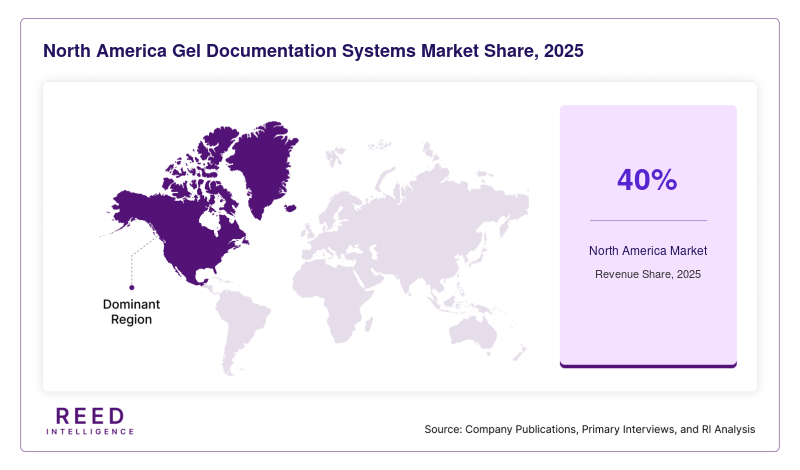
Leads the Gel Documentation Systems market, commanding a 40% share, with a revenue of USD 112 million in 2025. The United States is the primary driver, accounting for 80% of regional demand, driven by the strong life sciences research sector. The North American Gel Documentation Systems market is characterized by its focus on innovation and high-end technology.
Europe Gel Documentation Systems Market
Represents the second-largest market, capturing a 28% share with a revenue of USD 78 million in 2025. Germany, the UK, and France collectively represent 55% of the regional market, driven by the strong academic and pharmaceutical research base. The Gel Documentation Systems market in Europe is characterized by its focus on quality and precision.
Asia-Pacific Gel Documentation Systems Market
Accounts for 22% of the global Gel Documentation Systems market, with a revenue of USD 62 million in 2025. China, Japan, and India are the primary drivers, accounting for 70% of regional demand, driven by the rapidly expanding life sciences research sector. The Asia-Pacific Gel Documentation Systems market is projected to grow at the fastest CAGR of 8% through 2034, presenting attractive opportunities for market expansion.
Middle East & Africa and Latin America Gel Documentation Systems Market
Together account for the remaining 10% of the Gel Documentation Systems market, with South Africa leading the African market and Brazil leading the Latin American market. Both regions are projected to grow at CAGRs exceeding 7%, driven by the increasing investments in research infrastructure.
Top players in Gel Documentation Systems Market
- Bio-Rad Laboratories, Inc.
- Thermo Fisher Scientific Inc.
- GE Healthcare (Cytiva)
- Syngene (a division of Synoptics)
- Vilber Lourmat
- Carestream Health, Inc.
- Analytik Jena AG (Endress+Hauser)
- Cleaver Scientific Ltd.
- Uvitec Cambridge
- BMG Labtech
- Molecular Devices (Danaher)
- Azure Biosystems
- Proteinsimple (Bio-Techne)
- Li-Cor Biosciences
- PerkinElmer, Inc.
Bio-Rad Laboratories, Inc.
Bio-Rad holds a dominant position in the Gel Documentation Systems market, with an estimated 18% global market share, particularly strong in the North American and European academic and research segments. The company's portfolio of gel documentation systems, including its popular Gel Doc and ChemiDoc systems, is widely recognized for its quality and reliability. Bio-Rad's market leadership is reinforced by its significant R&D investment and its strong presence in the life sciences market. Bio-Rad commands over 22% of the North American market and 15% of the European market, positioning it as a key player in the Gel Documentation Systems market.
Thermo Fisher Scientific Inc.
Thermo Fisher is a leading player in the Gel Documentation Systems market, commanding approximately 15% of the global market share through its comprehensive portfolio of scientific instruments and reagents. The company's expertise in life sciences and its strong presence in the global market have solidified its position. Thermo Fisher's focus on developing innovative and integrated solutions has strengthened its position. The company's commitment to quality has enhanced its brand equity.
GE Healthcare (Cytiva) holds a significant 12% market share, with particular strength in the biopharmaceutical and research segments, where it commands a 14% share. The company's focus on integrated solutions is a key differentiator. Syngene is a major player in the global gel documentation market, holding a 10% share.
Recent Developments in Gel Documentation Systems Market
- 2025: Bio-Rad launched a new generation of gel documentation systems with enhanced multi-channel fluorescence imaging capabilities, targeting advanced proteomics and genomics research.
- 2025: Thermo Fisher introduced a new compact gel documentation system for routine lab use, featuring integrated software and touchscreen operation.
Gel Documentation Systems Market Segments
By Type
- UV Gel Documentation Systems
- LED Gel Documentation Systems
- Laser Gel Documentation Systems
By Application
- Protein Gel Analysis
- DNA Gel Analysis
- RNA Gel Analysis
By Region
- North America
- Europe
- APAC
- Middle East and Africa
- LATAM