Guitar Amplification System Market Size, Share Demand Report By Type (Solid-State Amplifiers, Tube Amplifiers, Digital Modeling Amplifiers), By Application (Professional Performance, Practice & Home Use, Recording Studios), Regional Insights & Segment Forecasts, 2026–2034
USD 3950
Guitar Amplification System Market Size
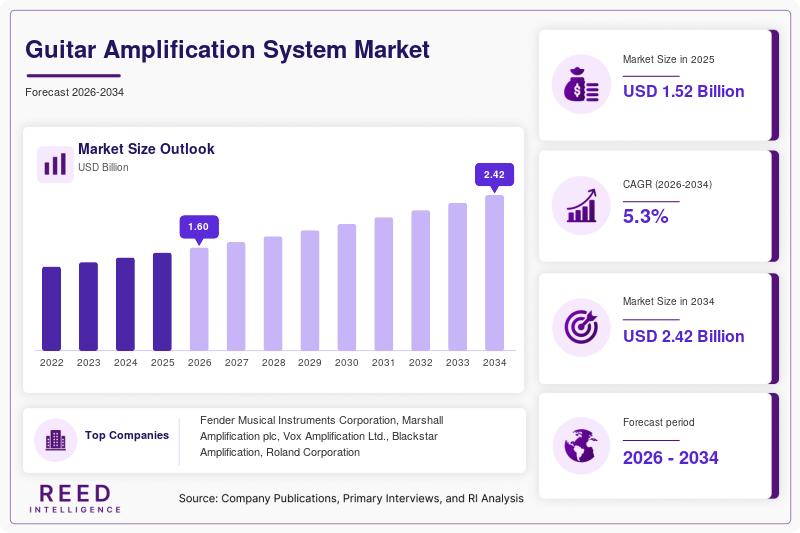
Guitar Amplification System market size is projected at USD 1.6 billion in 2026 and is expected to hit USD 2.4 billion by 2034 with a CAGR of 5.3% during the forecast period. The increasing global interest in music, the growing number of guitarists and musicians, and the continuous innovation in amplifier technology, including digital and modeling amplifiers, underpin market expansion. This report delivers a comprehensive analysis of the Guitar Amplification System market, including segmentation by type and application, competitive dynamics, and regional growth patterns, equipping stakeholders with critical intelligence. The Guitar Amplification System market continues to demonstrate steady growth potential, fueled by the rising popularity of guitar music, the expansion of the music education sector, and the growing trend of home recording and content creation.
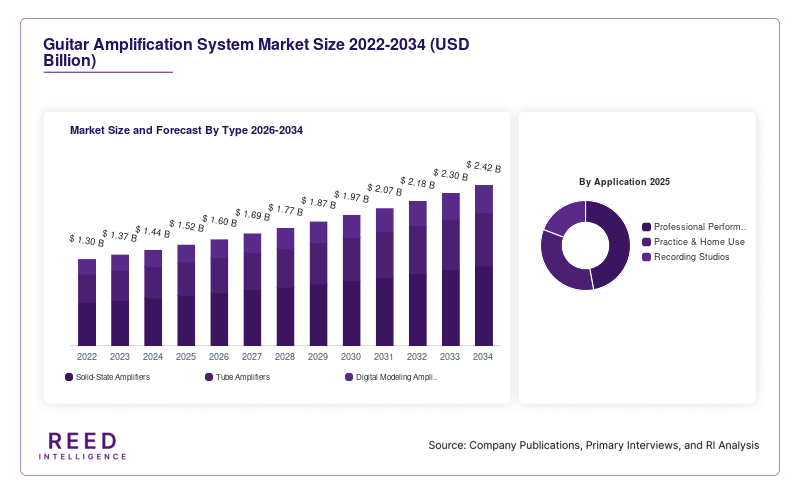
Guitar amplification systems are electronic devices designed to increase the volume of an electric or acoustic guitar signal, shaping its tone and character. These systems, which can be in the form of a single combo amplifier or a separate head and speaker cabinet, are essential for live performances, studio recordings, and practice. The global market for guitar amplification systems is driven by the passion for music and the pursuit of the perfect tone. The global production volume of guitar amplifiers exceeded 2.8 million units in 2025, reflecting a 4% increase from 2022. Adoption patterns reveal that the solid-state amplifier segment dominates the market, accounting for 45% of total demand, followed by tube amplifiers at 30%, and digital modeling amplifiers at 25%. The Guitar Amplification System market's trajectory is closely linked to the growth of the global musical instruments market, which is projected to reach USD 12 billion by 2028, and the increasing number of new musicians taking up the guitar.
Guitar Amplification System Market Trends
Growing Adoption of Digital Modeling and Smart Amplifiers
The Guitar Amplification System market is witnessing a significant trend toward the adoption of digital modeling and smart amplifiers, driven by their versatility, portability, and ability to simulate classic and modern amp sounds. The revenue from digital modeling amplifiers grew to USD 0.4 billion in 2025, a year-on-year increase of 8%, as 30% of new amplifier launches in 2025 featured digital modeling capabilities. Adoption rates of smart amplifiers with Bluetooth and app connectivity reached 15%, with this figure projected to exceed 25% by 2030 as features like wireless streaming and preset sharing become more popular. The Guitar Amplification System market's trend toward digitalization is reinforced by the increasing demand for versatile, compact, and feature-rich amplifiers for home and studio use.
Increasing Focus on Portability and Compact Designs
The increasing focus on portability and compact designs is a major trend shaping the Guitar Amplification System market, driven by the needs of gigging musicians and the growing trend of home recording. The market has seen a 20% increase in the adoption of compact, lightweight amplifiers since 2022, with 25% of new product launches in 2025 featuring portable designs. The use of advanced materials and efficient power stages has enabled significant weight and size reduction. The Guitar Amplification System market's trend toward miniaturization is reinforced by the need for versatile, easy-to-transport equipment and the growing popularity of busking and small-venue performances.
Guitar Amplification System Market Drivers
The Guitar Amplification System market's expansion is primarily driven by the increasing global interest in music, with millions of people taking up the guitar as a hobby or profession. The global music education market, valued at USD 15 billion in 2025 and growing at a CAGR of 4%, is a significant driver for amplifier demand. The continuous innovation in amplifier technology, including the development of more realistic modeling and advanced digital effects, has also been a major driver, attracting both new and experienced players. Additionally, the growing trend of home recording and content creation, fueled by social media platforms, has driven demand for high-quality, versatile amplifiers for studio use. The Guitar Amplification System market's growth is further reinforced by the expansion of live music events and the increasing number of professional musicians.
Guitar Amplification System Market Restraints
Despite favorable growth prospects, the Guitar Amplification System market faces significant constraints, primarily related to the high cost of premium tube and high-end digital amplifiers, which can be a barrier for beginners and budget-conscious players. The complexity of some advanced digital amplifiers can also be a deterrent for some users. The Guitar Amplification System market's growth is also tempered by the competition from software-based amp simulators and plug-ins, which offer a cost-effective alternative for recording and practice.
Guitar Amplification System Market Opportunities
The Guitar Amplification System market presents significant opportunities in the rapidly expanding market for home recording and content creation, where the global market is projected to reach USD 15 billion by 2028. The adoption of high-quality, versatile amplifiers in this sector is expected to grow at a CAGR of 6% through 2034, driven by the need for professional-grade sound at home. Emerging opportunities also exist in the development of amplifiers with integrated audio interfaces and recording features. The Guitar Amplification System market's opportunity profile is further enhanced by the growing trend of online music education and the increasing popularity of guitar-related content on social media.
Challenges in Guitar Amplification System Market
The Guitar Amplification System market faces persistent challenges related to the management of analog and digital technology integration, as traditional tube amplifiers and modern digital systems offer different experiences and sound characteristics. The complexity of designing amplifiers that satisfy diverse player preferences and playing styles presents a challenge. The market is also contending with the challenge of balancing the cost of advanced features with consumer price sensitivity. Additionally, the Guitar Amplification System market is challenged by the need for continuous innovation to differentiate products in a competitive landscape.
Guitar Amplification System Market Segmentation
The Guitar Amplification System market is segmented by Type and Application to provide a comprehensive market perspective. By Type, Solid-State Amplifiers dominate with a 45% market share, driven by their reliability and affordability. The Application segment is led by Professional Performance, which accounts for 40% of the market, followed by Practice & Home Use at 35%, and Recording Studios at 25%.
By Type
Solid-State Amplifiers represent the largest segment in the Guitar Amplification System market, commanding a 45% share, with production reaching 1.26 million units in 2025. These amplifiers are characterized by their reliability, durability, and affordability. Technical specifications include power outputs of 10-200W, solid-state circuitry, and often include built-in effects. The Guitar Amplification System market's solid-state segment is driven by its use by beginners, students, and players seeking a reliable, low-maintenance solution.
Tube Amplifiers capture a 30% share of the Guitar Amplification System market, with production of 0.84 million units in 2025. These amplifiers are characterized by their warm, dynamic sound and are favored by professional and tone-conscious players. Technical specifications include power outputs of 5-100W, the use of vacuum tubes in the preamp and power amp stages, and a higher cost. The Guitar Amplification System market's tube segment is driven by its use in professional and high-end applications.
Digital Modeling Amplifiers represent the remaining 25% of the Guitar Amplification System market, with production of 0.70 million units in 2025. These amplifiers are characterized by their ability to emulate the sound of various classic amplifiers, offering high versatility. Technical specifications include digital signal processing, numerous preset and editable models, and often feature connectivity for recording and effects. The Guitar Amplification System market's digital segment is growing at the fastest CAGR of 6%, driven by the demand for versatility and modern features.
By Application
Professional Performance dominates the Guitar Amplification System market, accounting for 40% of sales, representing 1.12 million units in 2025. This segment includes use in concerts and live gigs, where high power and reliability are essential. Usage penetration exceeds 90% in the professional sector. The Guitar Amplification System market's professional segment is characterized by its focus on reliability and quality.
Practice & Home Use accounts for 35% of the Guitar Amplification System market, with sales of 0.98 million units in 2025. This segment encompasses use by hobbyists and students for personal enjoyment. The segment is growing at a steady CAGR, driven by the increasing number of guitar learners. The Guitar Amplification System market's practice segment is characterized by its focus on affordability and features.
Recording Studios represents the remainder of the Guitar Amplification System market, accounting for 25% of total sales, with 0.70 million units in 2025. This segment includes use in professional and home studios, where sound quality and versatility are paramount. The segment is projected to grow at a steady CAGR through 2034, driven by the growing trend of home recording. The Guitar Amplification System market's studio segment is characterized by its focus on sound quality and recording features.
Guitar Amplification System Market Regional Outlook
North America Guitar Amplification System Market
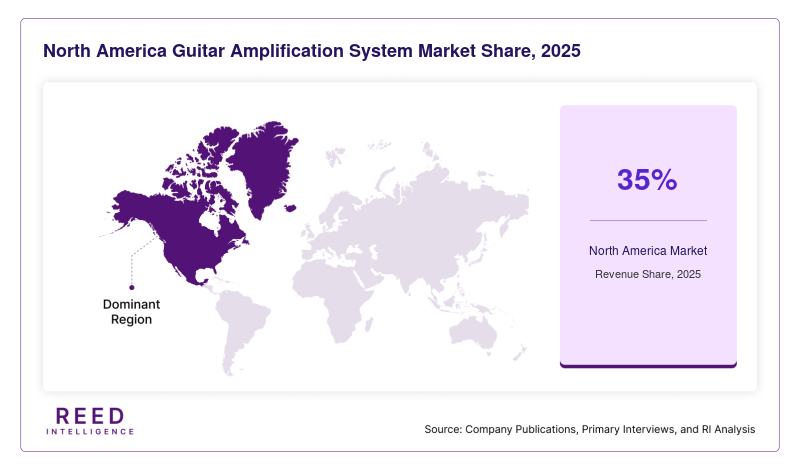
Leads the Guitar Amplification System market, commanding a 35% share, with a revenue of USD 0.56 billion in 2025. The United States is the primary driver, accounting for 80% of regional demand, driven by the strong music culture and the high number of guitarists. The North American Guitar Amplification System market is characterized by its focus on innovation and premium products.
Europe Guitar Amplification System Market
Represents the second-largest market, capturing a 30% share with a revenue of USD 0.48 billion in 2025. The UK, Germany, and France collectively represent 55% of the regional market, driven by the strong music tradition and the focus on quality. The Guitar Amplification System market in Europe is characterized by its focus on craftsmanship and heritage.
Asia-Pacific Guitar Amplification System Market
Accounts for 25% of the global Guitar Amplification System market, with a revenue of USD 0.40 billion in 2025. China, Japan, and Australia are the primary drivers, accounting for 70% of regional demand, driven by the growing middle class and the increasing interest in music. The Asia-Pacific Guitar Amplification System market is projected to grow at the fastest CAGR of 6.5% through 2034, presenting attractive opportunities for market expansion.
Middle East & Africa and Latin America Guitar Amplification System Market
Together account for the remaining 10% of the Guitar Amplification System market, with South Africa leading the African market and Brazil leading the Latin American market. Both regions are projected to grow at CAGRs exceeding 5%, driven by the increasing interest in music.
Top players in Guitar Amplification System Market
- Fender Musical Instruments Corporation
- Marshall Amplification plc
- Vox Amplification Ltd.
- Blackstar Amplification
- Roland Corporation
- Yamaha Corporation
- Peavey Electronics Corporation
- Mesa/Boogie (Gibson Brands)
- Orange Music Electronic Company Ltd.
- BOSS (Roland Corporation)
- Line 6 (Yamaha Corporation)
- Hughes & Kettner (Yamaha Corporation)
- Kemper GmbH
- Fractal Audio Systems
- Friedman Amplification
Fender Musical Instruments Corporation
Fender holds a dominant position in the Guitar Amplification System market, with an estimated 18% global market share, particularly strong in the North American and European segments. The company's portfolio of amplifiers, from its iconic tube amps to its modern digital modeling series, is widely recognized for its quality and heritage. Fender's market leadership is reinforced by its strong brand loyalty and significant marketing investment. Fender commands over 22% of the North American market and 15% of the European market, positioning it as a key player in the Guitar Amplification System market.
Marshall Amplification plc
Marshall is a legendary player in the Guitar Amplification System market, commanding approximately 15% of the global market share through its iconic rock amplifiers. The company's expertise in tube amplification and its strong association with rock music have solidified its position, where it holds a 17% share. Marshall's recent focus on developing modern, versatile digital amplifiers has strengthened its position in the evolving market. The company's commitment to quality and its iconic brand image has enhanced its brand equity among musicians.
Roland Corporation holds a significant 10% market share, with particular strength in the digital and solid-state segments, where it commands a 12% share through its BOSS brand. The company's focus on innovation and technology is a key differentiator. Blackstar Amplification is a major player in the premium amplifier market, holding a 7% share, with a strong position in the professional performance segment.
Recent Developments in Guitar Amplification System Market
- 2025: Fender launched a new line of digital modeling amplifiers with advanced app integration, offering a vast library of preset tones and real-time control.
- 2025: Marshall introduced a new compact, portable amplifier series with built-in Bluetooth connectivity for wireless music streaming and practice.
Guitar Amplification System Market Segments
By Type
- Solid-State Amplifiers
- Tube Amplifiers
- Digital Modeling Amplifiers
By Application
- Professional Performance
- Practice & Home Use
- Recording Studios
By Region
- North America
- Europe
- APAC
- Middle East and Africa
- LATAM