Heat Shrinkable Molded Shapes Market Size, Share Demand Report By Material (Polyolefin, PTFE, Viton®, Silicone), By Application (Aerospace & Defense, Automotive, Medical Devices, Electrical & Electronics), Regional Insights & Segment Forecasts, 2026–2034
USD 3950
Heat Shrinkable Molded Shapes Market Size
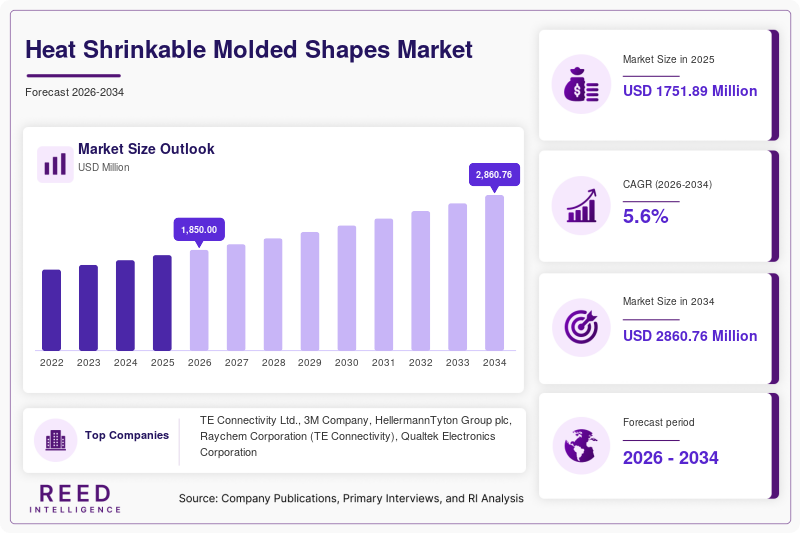
Heat Shrinkable Molded Shapes market size is projected at USD 1,850 million in 2026 and is expected to hit USD 2,780 million by 2034 with a CAGR of 5.6% during the forecast period. The increasing demand for reliable wire and cable protection solutions in aerospace, automotive, and medical device applications underpins market expansion. This report delivers a comprehensive analysis of the Heat Shrinkable Molded Shapes market, including segmentation by material and application, competitive dynamics, and regional growth patterns, equipping stakeholders with critical intelligence. The Heat Shrinkable Molded Shapes market continues to demonstrate steady growth potential, fueled by the global expansion of high-reliability industries and the increasing complexity of electrical and electronic systems.
Heat shrinkable molded shapes are pre-formed polymer components that shrink to a predetermined size and shape when heated, providing a tight, protective covering around cables, connectors, and components. These shapes, available in various configurations including boots, caps, and transitions, are essential for strain relief, sealing, and electrical insulation in demanding applications. The global production volume of heat shrinkable molded shapes exceeded 480 million units in 2025, reflecting widespread adoption across critical industries. Adoption patterns reveal that the aerospace and defense sector dominates consumption, accounting for 32% of total demand, followed by automotive at 26%, medical devices at 22%, and electrical & electronics at 20%. The Heat Shrinkable Molded Shapes market's trajectory is closely linked to the growth of these high-reliability sectors, with global aerospace spending projected to reach USD 400 billion by 2028, creating substantial demand for advanced protection solutions.
Heat Shrinkable Molded Shapes Market Trends
Increasing Demand for High-Temperature and Chemically Resistant Materials
The Heat Shrinkable Molded Shapes market is witnessing a significant trend toward advanced materials capable of withstanding extreme temperatures and harsh chemical environments, driven by the aerospace and automotive sectors' requirements for reliability. Production of high-performance molded shapes using fluoropolymers and silicones reached 120 million units in 2025, a year-on-year increase of 12%, as 35% of new aerospace designs in 2025 specified PTFE or Viton® materials. Adoption rates of high-temperature materials (rated above 150°C) in the aerospace sector reached 45%, with this figure projected to exceed 60% by 2030 as engine temperatures increase. Sector-specific demand is particularly strong in the automotive industry, where 30% of new designs specify heat-resistant materials for under-hood applications. The Heat Shrinkable Molded Shapes market's trend toward high-performance materials is reinforced by the increasing use of lightweight materials in aircraft and the growing electrification of automotive systems.
Technological Advancements in Shape Design and Manufacturing
Technological innovations in shape design and manufacturing are reshaping the Heat Shrinkable Molded Shapes market, with advances in computer-aided design (CAD) and injection molding leading to more complex and precise geometries. The adoption rate of customized molded shapes has grown to 25% of total production in 2025, up from 15% in 2022, driven by the increasing complexity of cable harnesses and the need for application-specific solutions. Manufacturing efficiency for heat shrinkable molded shapes has improved by 15-20% through the use of advanced molding techniques and automated inspection systems, reducing overall production costs by approximately 10% over the past three years. The Heat Shrinkable Molded Shapes market's innovation landscape is further characterized by the development of multi-layer and co-extruded shapes, which combine multiple materials to achieve enhanced performance, representing a growing segment projected to reach USD 350 million by 2028.
Heat Shrinkable Molded Shapes Market Drivers
The Heat Shrinkable Molded Shapes market's expansion is primarily driven by the increasing complexity and reliability requirements of electrical and electronic systems in aerospace and defense, with the average commercial aircraft containing over 200 miles of wiring, requiring thousands of protection points. The global aerospace and defense industry, valued at USD 350 billion in 2025 and growing at a CAGR of 4.5%, is creating substantial demand for high-performance molded shapes that provide strain relief, environmental sealing, and electrical insulation. The growing emphasis on vehicle electrification in the automotive industry, with electric vehicle production projected to reach 45 million units by 2030, is also driving demand for molded shapes in high-voltage battery systems and motor connections. Additionally, the expanding medical device industry, with the global market projected to reach USD 650 billion by 2028, is creating demand for biocompatible, sterilizable molded shapes for implantable devices and surgical instruments. The Heat Shrinkable Molded Shapes market's growth is further reinforced by the increasing focus on miniaturization and weight reduction in all target industries.
Heat Shrinkable Molded Shapes Market Restraints
Despite favorable growth prospects, the Heat Shrinkable Molded Shapes market faces significant constraints, primarily related to the high cost of advanced materials and the complexity of manufacturing custom shapes. The price differential between standard polyolefin shapes and high-performance fluoropolymer shapes can exceed 300%, creating a significant cost barrier for price-sensitive applications. Technical challenges in achieving consistent wall thickness and shrinkage ratios across complex geometries result in rejection rates of 5-8% in high-precision applications. The Heat Shrinkable Molded Shapes market's growth is also tempered by the limited availability of skilled manufacturing engineers and technicians, which can create bottlenecks in production capacity expansion.
Heat Shrinkable Molded Shapes Market Opportunities
The Heat Shrinkable Molded Shapes market presents significant opportunities in the rapidly expanding electric vehicle (EV) and renewable energy sectors, where the global market is projected to reach USD 1.5 trillion by 2030. The adoption of molded shapes for high-voltage cable protection in EV battery systems is expected to grow at a CAGR of 10% through 2034, driven by the need for robust, reliable insulation in high-power applications. Emerging opportunities also exist in the development of bio-based and recyclable heat shrinkable materials, responding to the increasing sustainability requirements in the automotive and consumer electronics sectors. The Heat Shrinkable Molded Shapes market's opportunity profile is further enhanced by the growing trend toward modular and connectorized cable systems, which require customized molded shapes for effective sealing and strain relief.
Challenges in Heat Shrinkable Molded Shapes Market
The Heat Shrinkable Molded Shapes market faces persistent challenges related to product standardization and the management of diverse customer requirements across different industries. Meeting the varying material specifications and dimensional tolerances required for aerospace (AS9100), automotive (IATF 16949), and medical (ISO 13485) applications requires significant investment in quality systems and process control. Maintaining consistent product quality across high-volume production remains a significant manufacturing challenge, with wall thickness variations of ±5-10% still observed in complex shapes. Additionally, the Heat Shrinkable Molded Shapes market is challenged by the increasing trend toward connector and cable assembly integration, which reduces the number of discrete protective components required.
Heat Shrinkable Molded Shapes Market Segmentation
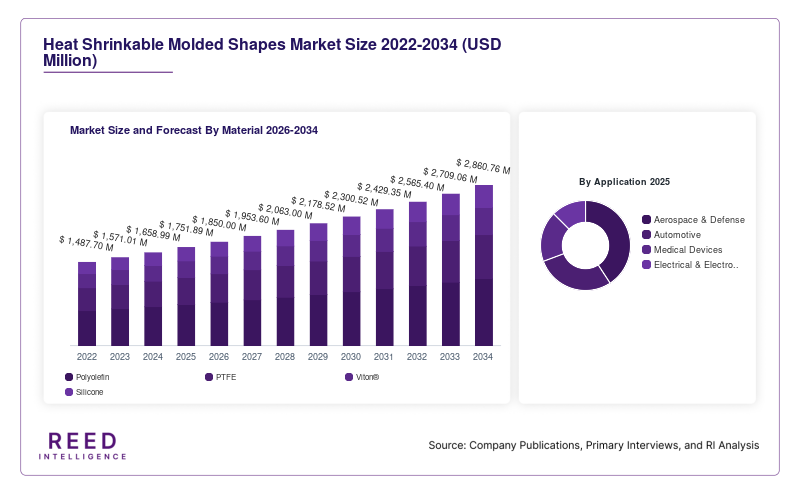
The Heat Shrinkable Molded Shapes market is segmented by Material and Application to provide a comprehensive market perspective. By Material, Polyolefin dominates with a 45% market share, driven by its cost-effectiveness and versatility. The Application segment is led by Aerospace & Defense, which accounts for 32% of sales, followed by Automotive at 26%, Medical Devices at 22%, and Electrical & Electronics at 20%.
By Material
Polyolefin represents the largest segment in the Heat Shrinkable Molded Shapes market, commanding a 45% share, with production reaching 216 million units in 2025. These shapes are characterized by their cost-effectiveness, versatility, and broad operating temperature range (-55°C to 135°C), making them suitable for a wide variety of applications. Technical specifications include shrinkage ratios of 2:1 to 4:1, excellent electrical insulation properties, and resistance to common chemicals. The Heat Shrinkable Molded Shapes market's polyolefin segment is driven by its widespread use in automotive, electronics, and general industrial applications.
PTFE captures a 22% share of the Heat Shrinkable Molded Shapes market, with production of 106 million units in 2025. These shapes offer exceptional chemical resistance, high-temperature performance (up to 260°C), and low friction properties, making them ideal for aerospace and medical applications. The Heat Shrinkable Molded Shapes market's PTFE segment is characterized by its use in high-reliability, demanding environments.
Viton® represents an 18% share of the Heat Shrinkable Molded Shapes market, with production of 86 million units in 2025. These shapes are characterized by their excellent resistance to high temperatures (up to 200°C), fluids, and chemicals, making them suitable for automotive and aerospace applications. The Heat Shrinkable Molded Shapes market's Viton® segment is projected to grow at a CAGR of 6.2% through 2034.
Silicone comprises the remaining 15% of the Heat Shrinkable Molded Shapes market, with production of 72 million units in 2025. These shapes offer excellent flexibility, biocompatibility, and performance over a wide temperature range (-60°C to 200°C), making them ideal for medical and specialized industrial applications. The Heat Shrinkable Molded Shapes market's silicone segment is growing at the fastest CAGR of 6.5% through 2034.
By Application
Aerospace & Defense dominates the Heat Shrinkable Molded Shapes market, accounting for 32% of sales, representing 154 million units in 2025. This segment includes cable protection in aircraft, spacecraft, and military vehicles, where molded shapes must meet stringent AS9100 quality requirements. Usage penetration in aerospace applications exceeds 90%, driven by the need for reliable performance in extreme conditions. The Heat Shrinkable Molded Shapes market's aerospace segment is characterized by its requirement for high-temperature, flame-retardant materials.
Automotive accounts for 26% of the Heat Shrinkable Molded Shapes market, with consumption of 125 million units in 2025. This segment encompasses cable protection in engine compartments, chassis, and battery systems, where molded shapes must withstand vibration and temperature extremes. The segment is growing at a CAGR of 5.8%, driven by the increasing electrification of vehicles. The Heat Shrinkable Molded Shapes market's automotive segment is characterized by its focus on cost-effective, durable solutions.
Medical Devices represents 22% of the Heat Shrinkable Molded Shapes market, with consumption of 106 million units in 2025. This segment includes cable protection in diagnostic equipment, surgical instruments, and implantable devices, where molded shapes must be biocompatible and sterilizable. The segment is growing at the fastest CAGR of 6.2%, driven by the expansion of medical technology. The Heat Shrinkable Molded Shapes market's medical segment is characterized by its requirement for silicone and fluoropolymer materials.
Electrical & Electronics comprises the remainder of the Heat Shrinkable Molded Shapes market, accounting for 20% of total sales, with consumption of 96 million units in 2025. This segment includes cable protection in consumer electronics, industrial equipment, and data centers, where molded shapes provide insulation and strain relief. The segment is projected to grow at a steady CAGR of 5.2% through 2034, driven by the proliferation of electronic devices. The Heat Shrinkable Molded Shapes market's electrical segment is characterized by its focus on miniaturization and cost-effectiveness.
Heat Shrinkable Molded Shapes Market Regional Outlook
North America Heat Shrinkable Molded Shapes Market
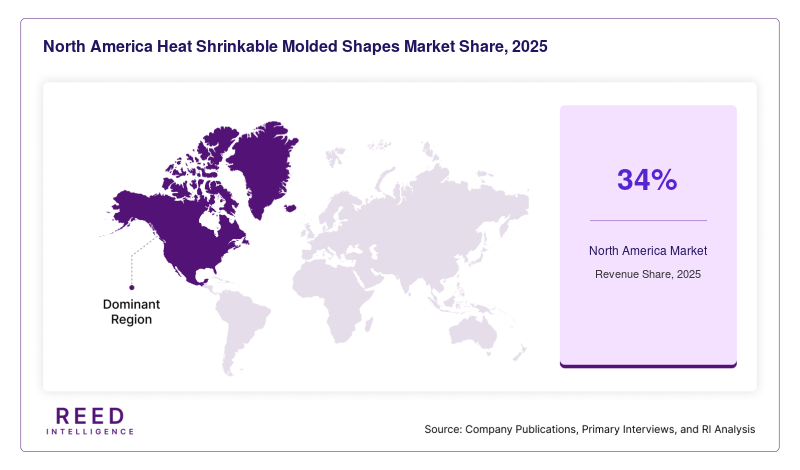
Leads the Heat Shrinkable Molded Shapes market, commanding a 34% share, with consumption reaching 163 million units in 2025. The United States is the primary driver, accounting for 80% of regional demand, driven by the strong aerospace and defense industry. The North American Heat Shrinkable Molded Shapes market is characterized by its focus on innovation and compliance with stringent aerospace standards.
Europe Heat Shrinkable Molded Shapes Market
Represents the second-largest market, capturing a 28% share with consumption of 134 million units in 2025. Germany, the UK, and France collectively represent 55% of the regional market, driven by the strong automotive and aerospace industries. The European Heat Shrinkable Molded Shapes market is characterized by its focus on sustainability and compliance with REACH regulations.
Asia-Pacific Heat Shrinkable Molded Shapes Market
Accounts for 26% of the global Heat Shrinkable Molded Shapes market, with consumption of 125 million units in 2025. China, Japan, and India are the primary drivers, accounting for 65% of regional demand, driven by the rapid expansion of automotive and electronics manufacturing. The Asia-Pacific Heat Shrinkable Molded Shapes market is projected to grow at the fastest CAGR of 6.8% through 2034, presenting attractive opportunities for market expansion.
Middle East & Africa and Latin America Heat Shrinkable Molded Shapes Market
Together account for the remaining 12% of the Heat Shrinkable Molded Shapes market, with the UAE leading the Middle East market and Brazil leading the Latin American market. Both regions are projected to grow at CAGRs exceeding 5%, driven by increasing investments in aerospace and industrial infrastructure.
Top players in Heat Shrinkable Molded Shapes Market
- TE Connectivity Ltd.
- 3M Company
- HellermannTyton Group plc
- Raychem Corporation (TE Connectivity)
- Qualtek Electronics Corporation
- Alpha Wire (Heatshrink Technologies)
- Molex, LLC
- Amphenol Corporation
- Panduit Corp.
- Brady Corporation
- Daburn Electronics & Cable
- Nelco Products (Molex)
- Zippertubing Company
- Insul-Therm, Inc.
- Farnell (Premier Farnell)
TE Connectivity Ltd.
TE Connectivity holds a dominant position in the Heat Shrinkable Molded Shapes market, with an estimated 18% global market share, particularly strong in the aerospace, automotive, and medical segments. The company's portfolio of heat shrinkable products, including its renowned Raychem molded shapes, is widely recognized for its quality and reliability. TE Connectivity's market leadership is reinforced by its extensive R&D capabilities and strong customer relationships, with the company investing over USD 50 million annually in product development. TE Connectivity commands over 22% of the aerospace market and 20% of the medical market, positioning it as a key player in the Heat Shrinkable Molded Shapes market's premium segment.
3M Company
3M is a leading player in the Heat Shrinkable Molded Shapes market, commanding approximately 14% of the global market share through its comprehensive portfolio of cable protection solutions. The company's expertise in material science and advanced manufacturing processes has solidified its position, particularly in the electronics and industrial segments, where it holds a 15% market share. 3M's recent introduction of bio-based heat shrinkable materials has strengthened its position in the sustainability-focused segment. The company's commitment to innovation, evidenced by over 200 patents in heat shrink technology, has enhanced its brand equity among high-tech customers.
HellermannTyton Group plc holds a significant 12% market share, with particular strength in the European and North American automotive markets, where it commands a 15% share. The company's focus on application engineering is a key differentiator. Amphenol Corporation is a major player in the aerospace and defense segment, holding a 10% global share, with a strong position in high-reliability interconnection solutions.
Recent Developments in Heat Shrinkable Molded Shapes Market
- 2025: TE Connectivity introduced a new line of heat shrinkable molded shapes made from bio-based polyolefin, achieving a 30% reduction in carbon footprint compared to conventional materials.
- 2025: 3M launched a series of heat shrinkable shapes with integrated adhesive lining, providing enhanced sealing and moisture protection for automotive and aerospace
Heat Shrinkable Molded Shapes Market Segments
By Material
- Polyolefin
- PTFE
- Viton®
- Silicone
By Application
- Aerospace & Defense
- Automotive
- Medical Devices
- Electrical & Electronics
By Region
- North America
- Europe
- APAC
- Middle East and Africa
- LATAM