Home Air Purifier Market Size, Share Demand Report By Type (HEPA Air Purifiers, Activated Carbon Air Purifiers, UV Light Air Purifiers, Ionizers), By Application (Residential, Home Office, Others), Regional Insights & Segment Forecasts, 2026–2034
USD 3950
Home Air Purifier Market Size
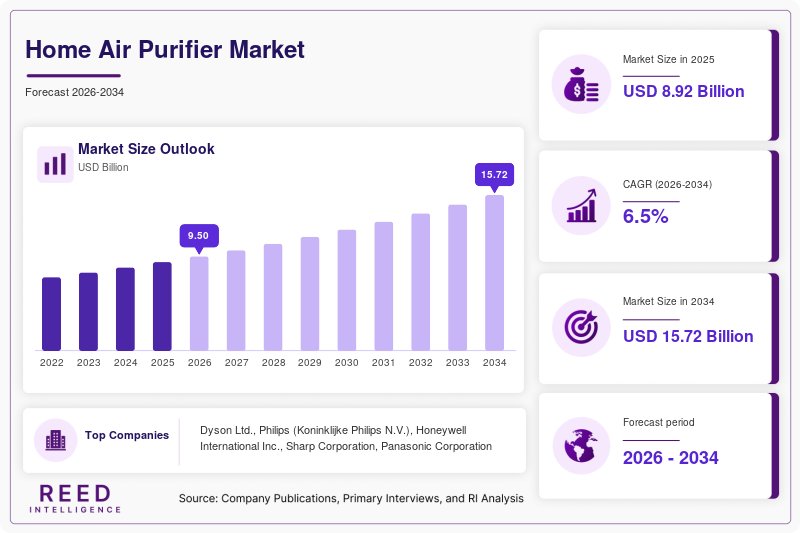
Home Air Purifier market size is projected at USD 9.5 billion in 2026 and is expected to hit USD 15.2 billion by 2034 with a CAGR of 6.5% during the forecast period. The increasing global awareness of indoor air quality and its impact on health, the rising prevalence of respiratory diseases and allergies, and the growing demand for smart and connected home appliances underpin market expansion. This report delivers a comprehensive analysis of the Home Air Purifier market, including segmentation by type and application, competitive dynamics, and regional growth patterns, equipping stakeholders with critical intelligence. The Home Air Purifier market continues to demonstrate robust growth potential, fueled by the global trend toward healthier living, increasing urbanization, and continuous innovation in air purification technology.
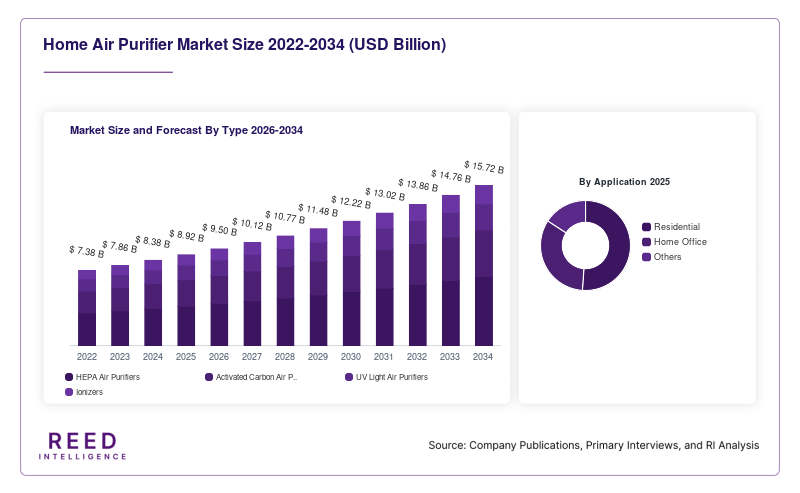
Home air purifiers are devices designed to remove contaminants from the air in residential spaces, improving indoor air quality. They use various technologies, such as HEPA filters, activated carbon, UV light, and ionization, to capture and neutralize pollutants like dust, pollen, smoke, and volatile organic compounds. The global market for home air purifiers is driven by the growing concern over air pollution and its health effects. The global production volume of home air purifiers exceeded 55 million units in 2025, reflecting a 6% increase from 2022. Adoption patterns reveal that the HEPA air purifier segment dominates the market, accounting for 40% of total demand, followed by activated carbon at 25%, UV light at 20%, and ionizers at 15%. The Home Air Purifier market's trajectory is closely linked to the growth of the global home appliance market, which is projected to reach USD 800 billion by 2028, and the increasing consumer focus on health and wellness.
Home Air Purifier Market Trends
Growing Adoption of Smart and Connected Air Purifiers
The Home Air Purifier market is witnessing a significant trend toward smart and connected air purifiers, driven by the demand for convenience, automation, and real-time monitoring. The revenue from smart air purifiers grew to USD 3.0 billion in 2025, a year-on-year increase of 10%, as 35% of new product launches in 2025 featured smart capabilities. Adoption rates of smart purifiers in the residential sector reached 25%, with this figure projected to exceed 40% by 2030. The Home Air Purifier market's trend toward smart technology is reinforced by the increasing integration of IoT and voice control, the growing popularity of smart home ecosystems, and the continuous innovation in sensor and connectivity technology.
Increasing Focus on Multi-Filtration and Advanced Technologies
The increasing focus on multi-filtration and advanced technologies is a major trend shaping the Home Air Purifier market, with manufacturers developing systems that combine multiple filtration methods for enhanced performance. The market has seen a 20% increase in the demand for multi-stage filtration systems since 2022, with 25% of new product launches in 2025 featuring advanced multi-technology designs. The use of technologies like cold plasma and photocatalytic oxidation has also gained traction. The Home Air Purifier market's trend toward advanced technology is reinforced by the need to address a wider range of pollutants, the increasing consumer awareness of air quality issues, and the continuous innovation in air purification science.
Home Air Purifier Market Drivers
The Home Air Purifier market's expansion is primarily driven by the increasing global awareness of indoor air quality and its impact on health, with the global indoor air quality market valued at USD 10 billion in 2025 and growing. The rising prevalence of respiratory diseases and allergies has also been a major driver, as consumers seek solutions to reduce allergens and pollutants. The growing concern over air pollution and the desire for healthier living environments have fueled demand. Additionally, the increasing disposable incomes and the growing trend of home improvement have driven market growth. The Home Air Purifier market's growth is further reinforced by the continuous innovation in technology and the expansion of distribution channels.
Home Air Purifier Market Restraints
Despite favorable growth prospects, the Home Air Purifier market faces significant constraints, primarily related to the high cost of advanced air purifiers, which can be a barrier for budget-conscious consumers. The need for regular filter replacement and maintenance can also add to the total cost of ownership. The Home Air Purifier market's growth is also tempered by the skepticism about the effectiveness of some technologies and the competition from other air quality improvement solutions.
Home Air Purifier Market Opportunities
The Home Air Purifier market presents significant opportunities in the rapidly expanding market for smart home and connected devices, where the global market is projected to reach USD 50 billion by 2028. The integration of air purifiers with smart home systems is expected to grow at a CAGR of 12% through 2034. Emerging opportunities also exist in the development of portable and personal air purifiers for on-the-go use. The Home Air Purifier market's opportunity profile is further enhanced by the growing trend of health and wellness, creating demand for products that contribute to a healthy home environment.
Challenges in Home Air Purifier Market
The Home Air Purifier market faces persistent challenges related to the management of filter replacement costs and the need for consumer education on proper maintenance. The complexity of effectively communicating the benefits of different technologies to consumers presents a challenge. The market is also contending with the challenge of ensuring product efficacy and meeting regulatory standards. Additionally, the Home Air Purifier market is challenged by the need for continuous innovation to improve performance and reduce costs.
Home Air Purifier Market Segmentation
The Home Air Purifier market is segmented by Type and Application to provide a comprehensive market perspective. By Type, HEPA Air Purifiers dominate with a 40% market share, driven by their proven effectiveness. The Application segment is led by Residential, which accounts for 70% of the market, followed by Home Office at 20%, and Others at 10%.
By Type
HEPA Air Purifiers represent the largest segment in the Home Air Purifier market, commanding a 40% share, with production reaching 22 million units in 2025. These purifiers are characterized by their use of High-Efficiency Particulate Air (HEPA) filters to capture 99.97% of particles. Technical specifications include filter efficiency, CADR (Clean Air Delivery Rate), and noise level. The Home Air Purifier market's HEPA segment is driven by its proven effectiveness and wide acceptance.
Activated Carbon Air Purifiers capture a 25% share of the Home Air Purifier market, with production of 13.75 million units in 2025. These purifiers are characterized by their use of activated carbon filters to remove odors and gases. Technical specifications include filter type, carbon weight, and gas removal efficiency. The Home Air Purifier market's activated carbon segment is driven by the demand for odor and VOC removal.
UV Light Air Purifiers represent a 20% share of the Home Air Purifier market, with production of 11 million units in 2025. These purifiers are characterized by their use of UV-C light to kill germs and bacteria. Technical specifications include UV light wavelength, intensity, and bulb life. The Home Air Purifier market's UV segment is driven by the demand for germicidal protection.
Ionizers represent the remaining 15% of the Home Air Purifier market, with production of 8.25 million units in 2025. These purifiers are characterized by their use of ionization to charge and remove particles. Technical specifications include ion output and ozone production. The Home Air Purifier market's ionizer segment is driven by the demand for quiet and filterless operation.
By Application
Residential dominates the Home Air Purifier market, accounting for 70% of sales, representing 38.5 million units in 2025. This segment includes use in homes for general air quality improvement. Usage penetration exceeds 20% in some developed markets. The Home Air Purifier market's residential segment is characterized by its focus on health and comfort.
Home Office accounts for 20% of the Home Air Purifier market, with sales of 11 million units in 2025. This segment encompasses use in home offices and workspaces. The segment is growing at a steady CAGR, driven by the rise of remote work. The Home Air Purifier market's home office segment is characterized by its focus on productivity and health.
Others represents the remainder of the Home Air Purifier market, accounting for 10% of total sales, with 5.5 million units in 2025. This segment includes use in other residential applications. The segment is projected to grow at a steady CAGR through 2034.
Home Air Purifier Market Regional Outlook
Asia-Pacific Home Air Purifier Market
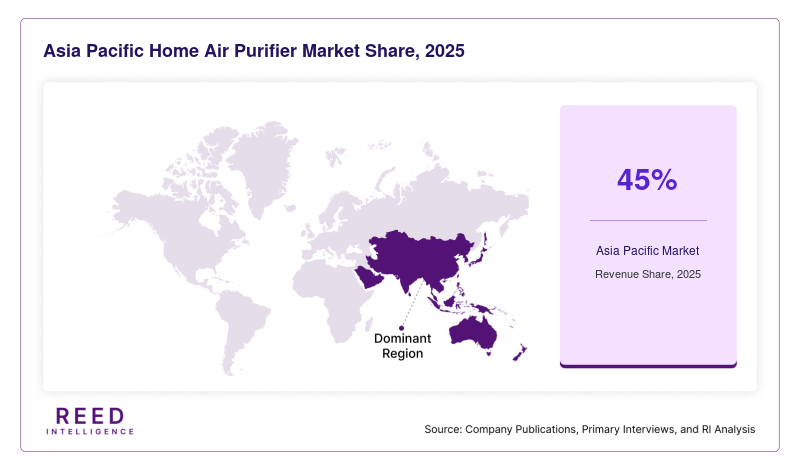
Leads the Home Air Purifier market, commanding a 45% share, with a revenue of USD 4.28 billion in 2025. China, Japan, and India are the primary drivers, accounting for 70% of regional demand, driven by the high air pollution levels and the growing middle class. The Asia-Pacific Home Air Purifier market is characterized by its high growth rate and focus on cost-effective solutions.
North America Home Air Purifier Market
Represents the second-largest market, capturing a 25% share with a revenue of USD 2.38 billion in 2025. The United States dominates regional demand, accounting for 80% of consumption, driven by the high awareness of allergies and respiratory health. The Home Air Purifier market in North America is characterized by its focus on innovation and premium products.
Europe Home Air Purifier Market
Accounts for 20% of the global Home Air Purifier market, with a revenue of USD 1.90 billion in 2025. Germany, the UK, and France collectively represent 55% of the regional market, driven by the strong focus on health and wellness. The Home Air Purifier market in Europe is characterized by its focus on quality and sustainability.
Middle East & Africa and Latin America Home Air Purifier Market
Together account for the remaining 10% of the Home Air Purifier market, with the UAE leading the Middle East market and Brazil leading the Latin American market. Both regions are projected to grow at CAGRs exceeding 7%, driven by the increasing urbanization and health awareness.
Top players in Home Air Purifier Market
- Dyson Ltd.
- Philips (Koninklijke Philips N.V.)
- Honeywell International Inc.
- Sharp Corporation
- Panasonic Corporation
- Daikin Industries, Ltd.
- LG Electronics Inc.
- Samsung Electronics Co., Ltd.
- Blueair (Unilever)
- Coway Co., Ltd.
- Whirlpool Corporation
- Molekule
- Austin Air Systems
- Alen Corporation
- IQAir
Dyson Ltd.
Dyson holds a dominant position in the premium Home Air Purifier market, with an estimated 12% global market share, particularly strong in the North American and European segments. The company's portfolio of high-performance air purifiers, featuring its innovative bladeless fan and HEPA filter technology, is widely recognized for its design and efficiency. Dyson's market leadership is reinforced by its significant R&D investment and its strong brand reputation. Dyson commands over 15% of the North American market and 12% of the European market, positioning it as a key player in the Home Air Purifier market's premium segment.
Philips (Koninklijke Philips N.V.)
Philips is a leading player in the Home Air Purifier market, commanding approximately 10% of the global market share through its comprehensive portfolio of health and wellness products. The company's expertise in consumer electronics and its strong presence in the global market have solidified its position. Philips' focus on developing innovative and user-friendly air purifiers has strengthened its position. The company's commitment to quality has enhanced its brand equity.
Honeywell International Inc. holds a significant 9% market share, with particular strength in the North American market, where it commands a 12% share. The company's focus on environmental control is a key differentiator. Sharp Corporation is a major player in the Asian market, holding a 8% share.
Recent Developments in Home Air Purifier Market
- 2025: Dyson launched a new air purifier with a formaldehyde sensor and catalytic filter, targeting the removal of harmful VOCs.
- 2025: Philips introduced a new smart air purifier with integrated AI, automatically adjusting settings based on air quality data.
Home Air Purifier Market Segments
By Type
- HEPA Air Purifiers
- Activated Carbon Air Purifiers
- UV Light Air Purifiers
- Ionizers
By Application
- Residential
- Home Office
- Others
By Region
- North America
- Europe
- APAC
- Middle East and Africa
- LATAM