Indoor Bike Trainer Market Size, Share Demand Report By Type (Classic Trainers, Smart Trainers), By Application (Personal Use, Commercial Use), Regional Insights & Segment Forecasts, 2026–2034
USD 3950
Indoor Bike Trainer Market Size
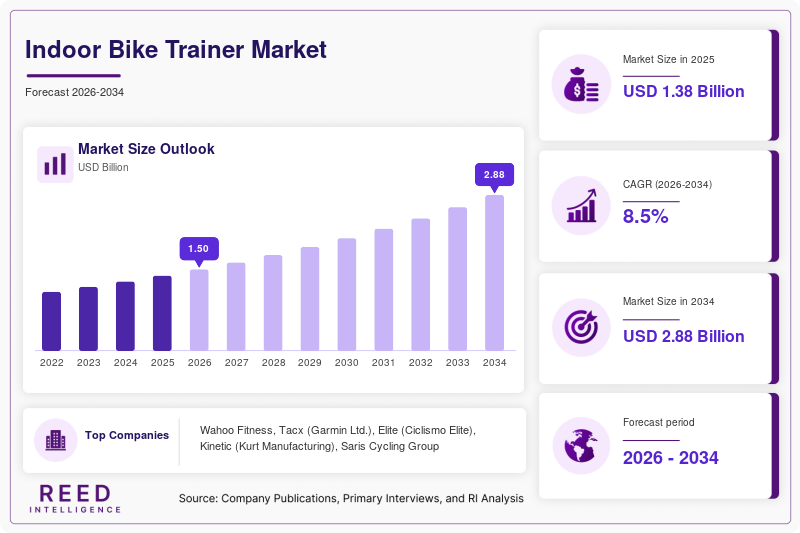
Indoor Bike Trainer market size is projected at USD 1.5 billion in 2026 and is expected to hit USD 2.8 billion by 2034 with a CAGR of 8.5% during the forecast period. The increasing global focus on health and fitness, the growing popularity of indoor cycling and virtual training platforms, and the rising demand for convenient, weather-independent training solutions underpin market expansion. This report delivers a comprehensive analysis of the Indoor Bike Trainer market, including segmentation by type and application, competitive dynamics, and regional growth patterns, equipping stakeholders with critical intelligence. The Indoor Bike Trainer market continues to demonstrate exceptional growth potential, fueled by the global fitness trend, the technological advancements in smart trainers, and the increasing adoption of digital fitness platforms.
Indoor bike trainers are devices that allow cyclists to convert their standard bicycles into stationary exercise bikes for indoor use. They provide a platform for structured training, virtual riding, and off-season conditioning, often integrating with apps and software for an interactive experience. The global market for indoor bike trainers is driven by the need for year-round, convenient, and effective training. The global production volume of indoor bike trainers exceeded 4 million units in 2025, reflecting a 9% increase from 2022. Adoption patterns reveal that the smart trainer segment dominates the market, accounting for 60% of total demand, followed by classic trainers at 40%. The Indoor Bike Trainer market's trajectory is closely linked to the growth of the global fitness equipment market, which is projected to reach USD 15 billion by 2028, and the increasing popularity of cycling as a fitness activity.
Indoor Bike Trainer Market Trends
Growing Adoption of Smart and Interactive Trainers
The Indoor Bike Trainer market is witnessing a significant trend toward the adoption of smart and interactive trainers, driven by the demand for immersive and data-driven training experiences. The revenue from smart trainers grew to USD 0.9 billion in 2025, a year-on-year increase of 12%, as 40% of new trainer purchases in 2025 were for smart models. Adoption rates of smart trainers in the personal use segment reached 35%, with this figure projected to exceed 55% by 2030. The Indoor Bike Trainer market's trend toward smart technology is reinforced by the increasing popularity of virtual cycling platforms like Zwift and Peloton, the demand for performance tracking and connectivity, and the continuous innovation in sensor and software technology.
Increasing Focus on Virtual Training and E-Sports
The increasing focus on virtual training and e-sports is a major trend shaping the Indoor Bike Trainer market, with trainers being used for competitive virtual racing and structured training programs. The market has seen a 25% increase in the demand for trainers with advanced simulation capabilities since 2022, with 15% of new product launches in 2025 featuring enhanced virtual racing features. The use of trainers for competitive e-racing leagues has also gained traction. The Indoor Bike Trainer market's trend toward virtual training is reinforced by the growing esports and virtual sports industry, the need for year-round training, and the increasing social and competitive aspects of indoor cycling.
Indoor Bike Trainer Market Drivers
The Indoor Bike Trainer market's expansion is primarily driven by the increasing global focus on health and fitness, with the global fitness market valued at USD 100 billion in 2025 and growing. The growing popularity of indoor cycling and virtual training platforms, offering structured workouts and social interaction, has also been a major driver. The demand for convenient, weather-independent training solutions has fueled market growth. Additionally, the rising interest in cycling as a sport and recreational activity has driven the adoption of trainers. The Indoor Bike Trainer market's growth is further reinforced by the continuous innovation in trainer technology, leading to more realistic and engaging experiences.
Indoor Bike Trainer Market Restraints
Despite favorable growth prospects, the Indoor Bike Trainer market faces significant constraints, primarily related to the high cost of premium smart trainers, which can be a barrier for entry-level users. The need for a compatible bicycle and the required floor space can also be a limitation. The Indoor Bike Trainer market's growth is also tempered by the competition from other fitness equipment and the potential for noise and vibration issues.
Indoor Bike Trainer Market Opportunities
The Indoor Bike Trainer market presents significant opportunities in the rapidly expanding market for virtual fitness and connected wellness, where the global market is projected to reach USD 50 billion by 2028. The integration of trainers with AI-powered coaching and personalized training programs is expected to grow at a CAGR of 15% through 2034. Emerging opportunities also exist in the development of affordable and entry-level smart trainers to attract a wider audience. The Indoor Bike Trainer market's opportunity profile is further enhanced by the growing trend of hybrid fitness solutions and the increasing importance of home gyms.
Challenges in Indoor Bike Trainer Market
The Indoor Bike Trainer market faces persistent challenges related to the management of noise and vibration, which can be a concern for users in apartments or shared spaces. The complexity of setting up and integrating smart trainers with various software platforms presents a challenge. The market is also contending with the challenge of differentiating products in a competitive landscape. Additionally, the Indoor Bike Trainer market is challenged by the need for continuous innovation to keep pace with evolving fitness trends and consumer expectations.
Indoor Bike Trainer Market Segmentation
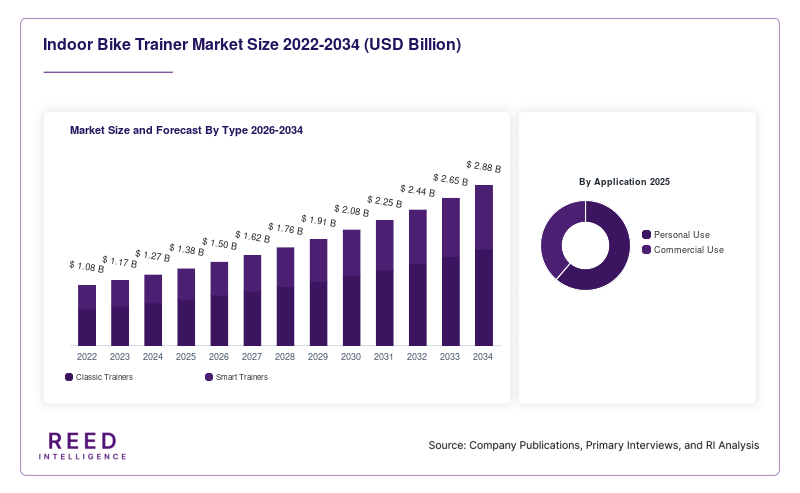
The Indoor Bike Trainer market is segmented by Type and Application to provide a comprehensive market perspective. By Type, Smart Trainers dominate with a 60% market share, driven by their advanced features. The Application segment is led by Personal Use, which accounts for 80% of the market, followed by Commercial Use at 20%.
By Type
Smart Trainers represent the largest segment in the Indoor Bike Trainer market, commanding a 60% share, with production reaching 2.4 million units in 2025. These trainers are characterized by their connectivity, resistance control, and integration with virtual training apps. Technical specifications include power measurement, ERG mode, and communication protocols (Bluetooth, ANT+). The Indoor Bike Trainer market's smart segment is driven by its use in interactive training and virtual riding.
Classic Trainers capture a 40% share of the Indoor Bike Trainer market, with production of 1.6 million units in 2025. These trainers are characterized by their simpler design and lower cost, using a resistance unit (fluid, magnetic, or wind). Technical specifications include resistance type, noise level, and portability. The Indoor Bike Trainer market's classic segment is driven by its use in basic training and warm-ups.
By Application
Personal Use dominates the Indoor Bike Trainer market, accounting for 80% of sales, representing 3.2 million units in 2025. This segment includes use in home settings for individual training and fitness. Usage penetration exceeds 20% among regular cyclists. The Indoor Bike Trainer market's personal segment is characterized by its focus on convenience and performance.
Commercial Use accounts for 20% of the Indoor Bike Trainer market, with sales of 0.8 million units in 2025. This segment encompasses use in gyms, cycling studios, and fitness centers. The segment is growing at a steady CAGR, driven by the expansion of commercial fitness facilities. The Indoor Bike Trainer market's commercial segment is characterized by its focus on durability and high usage.
Indoor Bike Trainer Market Regional Outlook
North America Indoor Bike Trainer Market
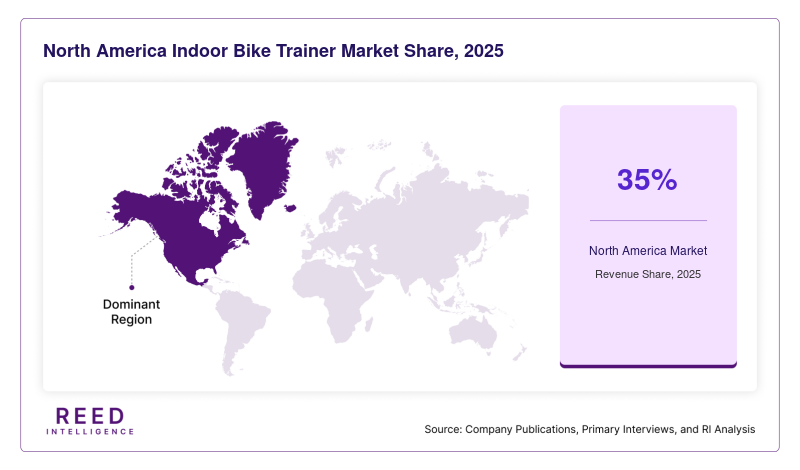
Leads the Indoor Bike Trainer market, commanding a 35% share, with a revenue of USD 0.53 billion in 2025. The United States is the primary driver, accounting for 80% of regional demand, driven by the strong fitness culture and the high adoption of smart trainers. The North American Indoor Bike Trainer market is characterized by its focus on innovation and premium products.
Europe Indoor Bike Trainer Market
Represents the second-largest market, capturing a 30% share with a revenue of USD 0.45 billion in 2025. Germany, the UK, and France collectively represent 55% of the regional market, driven by the strong cycling culture and the focus on fitness. The Indoor Bike Trainer market in Europe is characterized by its focus on quality and performance.
Asia-Pacific Indoor Bike Trainer Market
Accounts for 20% of the global Indoor Bike Trainer market, with a revenue of USD 0.30 billion in 2025. China, Japan, and Australia are the primary drivers, accounting for 70% of regional demand, driven by the growing fitness awareness and the increasing adoption of cycling. The Asia-Pacific Indoor Bike Trainer market is projected to grow at the fastest CAGR of 10% through 2034, presenting attractive opportunities for market expansion.
Middle East & Africa and Latin America Indoor Bike Trainer Market
Together account for the remaining 15% of the Indoor Bike Trainer market, with the UAE leading the Middle East market and Brazil leading the Latin American market. Both regions are projected to grow at CAGRs exceeding 8%, driven by the increasing health and fitness awareness.
Top players in Indoor Bike Trainer Market
- Wahoo Fitness
- Tacx (Garmin Ltd.)
- Elite (Ciclismo Elite)
- Kinetic (Kurt Manufacturing)
- Saris Cycling Group
- Minoura
- BH Fitness
- CycleOps (Saris)
- RacerMate
- JetBlack
- ThinkRider
- Bkool
- Lemond Fitness
- Xplova
- Garmin Ltd.
Wahoo Fitness
Wahoo Fitness holds a dominant position in the high-end Indoor Bike Trainer market, with an estimated 18% global market share, particularly strong in the North American and European smart trainer segments. The company's portfolio of KICKR smart trainers is widely recognized for its quality, performance, and integration with popular virtual training platforms. Wahoo's market leadership is reinforced by its significant R&D investment and its focus on user experience. Wahoo commands over 22% of the North American smart trainer market and 15% of the European market, positioning it as a key player in the Indoor Bike Trainer market.
Tacx (Garmin Ltd.)
Tacx is a leading player in the Indoor Bike Trainer market, commanding approximately 15% of the global market share through its comprehensive portfolio of trainers, including its popular NEO and FLUX series. The company's expertise in trainer technology and its strong presence in the European market have solidified its position. Tacx's focus on developing innovative and realistic training solutions has strengthened its position. The company's commitment to quality has enhanced its brand equity.
Elite (Ciclismo Elite) holds a significant 12% market share, with particular strength in the European market, where it commands a 14% share. The company's focus on innovation is a key differentiator. Kinetic (Kurt Manufacturing) is a major player in the classic trainer segment, holding a 10% share.
Recent Developments in Indoor Bike Trainer Market
- 2025: Wahoo Fitness launched a new KICKR trainer with improved road feel simulation and upgraded connectivity for an enhanced virtual riding experience.
- 2025: Tacx introduced a new generation of smart trainers with advanced power measurement and improved erg mode responsiveness.
Indoor Bike Trainer Market Segments
By Type
- Classic Trainers
- Smart Trainers
By Application
- Personal Use
- Commercial Use
By Region
- North America
- Europe
- APAC
- Middle East and Africa
- LATAM