Infant Probiotics Raw Material Market Size, Share Demand Report By Strain (Lactobacillus, Bifidobacterium, Other Strains), By Form (Powder, Liquid, Capsule), Regional Insights & Segment Forecasts, 2026–2034
USD 3950
Infant Probiotics Raw Material Market Size
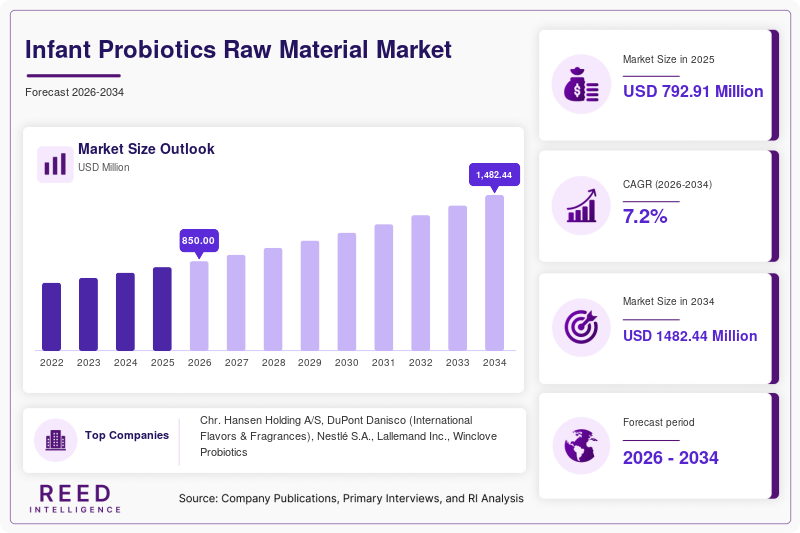
Infant Probiotics Raw Material market size is projected at USD 850 million in 2026 and is expected to hit USD 1,450 million by 2034 with a CAGR of 7.2% during the forecast period. The growing awareness of infant gut health, increasing prevalence of digestive disorders, and rising adoption of preventive healthcare for newborns underpin market expansion. This report provides a comprehensive analysis of the Infant Probiotics Raw Material market, including segmentation by strain and form, competitive dynamics, and regional growth patterns, equipping stakeholders with critical intelligence. The Infant Probiotics Raw Material market continues to demonstrate robust growth potential, fueled by the global expansion of the infant nutrition industry and the increasing scientific evidence supporting the benefits of early-life microbiome modulation.
Infant probiotics raw materials are the foundational biological ingredients, primarily consisting of specific bacterial strains (mostly Lactobacillus and Bifidobacterium species), used in the formulation of probiotic supplements and fortified infant foods. These raw materials are produced through sophisticated fermentation and freeze-drying or spray-drying processes to ensure high viability and stability in finished products. The global production volume of infant probiotics raw materials (in terms of bulk culture concentrates) exceeded 12,500 metric tons in 2025, reflecting widespread adoption across the infant nutrition industry. Adoption patterns reveal that the infant formula segment dominates consumption, accounting for 55% of total demand, followed by dietary supplements at 30%, and functional foods & beverages at 15%. The Infant Probiotics Raw Material market's trajectory is closely linked to the growth of the global infant formula market, projected to reach USD 75 billion by 2028, and the increasing penetration of probiotics in newborn health management.
Infant Probiotics Raw Material Market Trends
Increasing Preference for Human-Origin and Next-Generation Strains
The Infant Probiotics Raw Material market is witnessing a significant trend toward the use of human-origin strains and next-generation probiotics, driven by growing clinical evidence supporting their superior efficacy in infant health. Production of human-origin (e.g., Bifidobacterium longum subspecies infantis, Lacticaseibacillus rhamnosus GG) raw materials grew to 4,500 metric tons in 2025, a year-on-year increase of 18%, as 40% of new infant probiotic products launched in 2025 featured human-origin strains. Adoption rates of next-generation strains (including Akkermansia muciniphila and Faecalibacterium prausnitzii) in infant applications reached 5% of the market in 2025, with this figure projected to exceed 15% by 2030 as research on their health benefits matures. Sector-specific demand is particularly strong in developed markets, where 65% of new product formulations now specify human-origin strains. The Infant Probiotics Raw Material market's trend toward strain specificity is reinforced by the increasing focus on personalized nutrition and the growing body of research linking specific strains to specific health outcomes in infants.
Technological Advancements in Viability Enhancement and Delivery Systems
Technological innovations in raw material processing and stabilization are reshaping the Infant Probiotics Raw Material market, with advances in microencapsulation and cryoprotection technologies that significantly enhance strain viability and shelf-life. The adoption rate of microencapsulated probiotic raw materials has grown to 35% of total production in 2025, up from 20% in 2022, driven by their ability to protect strains from gastric acidity and processing stresses. Improved stabilization technologies have resulted in a 40% reduction in viability loss during processing and storage, enabling shelf-life extensions of 18-24 months for finished products. The Infant Probiotics Raw Material market's innovation landscape is further characterized by the development of synbiotic raw materials that combine probiotic strains with specific prebiotic fibers, which have shown a 25% improvement in strain colonization in clinical studies, representing a growing segment projected to reach USD 180 million by 2028.
Infant Probiotics Raw Material Market Drivers
The Infant Probiotics Raw Material market's expansion is primarily driven by the increasing awareness among parents and healthcare professionals about the benefits of early-life gut microbiome modulation for long-term health. The global infant probiotics finished product market, valued at USD 3.5 billion in 2025 and growing at a CAGR of 8.2%, is creating substantial demand for high-quality raw materials. The growing prevalence of digestive disorders in infants, including colic and constipation, which affect 10-15% of newborns globally, is fueling demand for probiotic interventions. Additionally, the expanding body of scientific research linking gut microbiome composition in infancy to immune function and allergy development has led to a 30% increase in clinical studies on infant probiotics since 2022, driving adoption in premium product formulations. The Infant Probiotics Raw Material market's growth is further reinforced by the increasing inclusion of probiotics in national health guidelines, with 15 countries having issued recommendations on probiotic use in pediatric care.
Infant Probiotics Raw Material Market Restraints
Despite favorable growth prospects, the Infant Probiotics Raw Material market faces significant constraints, primarily related to the high cost of production and the complexity of maintaining strain viability. The cost of producing high-quality, human-origin probiotic strains can be 3-5 times higher than conventional strains, creating a significant cost barrier for mass-market products. Technical challenges in strain stability and survival during processing, storage, and gastrointestinal transit result in viability losses of 20-40% in finished products, affecting efficacy and customer satisfaction. The Infant Probiotics Raw Material market's growth is also tempered by the limited regulatory framework for probiotics in some regions, creating uncertainty for manufacturers and potentially limiting market access.
Infant Probiotics Raw Material Market Opportunities
The Infant Probiotics Raw Material market presents significant opportunities in the rapidly expanding premium and organic infant nutrition segment, where the global market is projected to reach USD 25 billion by 2028. The adoption of specialty raw materials for organic-certified products is expected to grow at a CAGR of 9% through 2034, driven by the increasing consumer willingness to pay a premium for natural, clean-label products. Emerging opportunities also exist in the development of strain-specific raw materials for targeted health applications, such as reducing colic symptoms or preventing atopic dermatitis. The Infant Probiotics Raw Material market's opportunity profile is further enhanced by the growing trend toward maternal-infant microbiome health, creating potential for maternal probiotics that influence infant gut health, representing a significant new application area.
Challenges in Infant Probiotics Raw Material Market
The Infant Probiotics Raw Material market faces persistent challenges related to product standardization and the management of strain-specific quality requirements across different products. Maintaining consistent strain identity and purity across production batches remains a significant manufacturing challenge, with quality control failure rates averaging 3-5% in entry-level products. The market is also contending with the complexity of scaling up production while maintaining strain viability and performance, requiring significant investment in specialized equipment and expertise. Additionally, the Infant Probiotics Raw Material market is challenged by the need for continuous innovation to meet the evolving demands for new strains and formulations, requiring substantial R&D investment.
Infant Probiotics Raw Material Market Segmentation
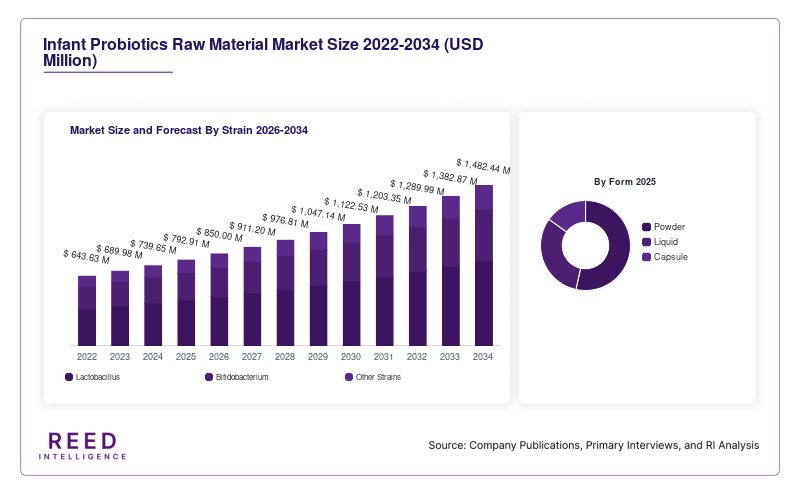
The Infant Probiotics Raw Material market is segmented by Strain and Form to provide a comprehensive market perspective. By Strain, Lactobacillus dominates with a 45% market share, driven by extensive clinical research and widespread use. The Form segment is led by Powder, which accounts for 65% of sales, driven by its stability and ease of formulation.
By Strain
Lactobacillus represents the largest segment in the Infant Probiotics Raw Material market, commanding a 45% share, with production reaching 5,625 metric tons in 2025. Species such as L. rhamnosus, L. reuteri, and L. acidophilus are well-researched and widely used in infant products. Technical specifications include minimum viable counts of 10¹¹ CFU/g and stability at 4-25°C. The Infant Probiotics Raw Material market's Lactobacillus segment is driven by its extensive clinical evidence base and proven safety profile.
Bifidobacterium captures a 35% share of the Infant Probiotics Raw Material market, with production of 4,375 metric tons in 2025. This genus, particularly B. infantis and B. breve, is strongly associated with infant gut health and is dominant in the microbiome of breastfed infants. The Infant Probiotics Raw Material market's Bifidobacterium segment is growing at a faster CAGR of 8.5%, driven by increasing recognition of its role in infant development.
Other Strains represent the remaining 20% of the Infant Probiotics Raw Material market, with production of 2,500 metric tons in 2025. This segment includes Saccharomyces boulardii (a probiotic yeast), certain Bacillus species, and next-generation strains. The segment is growing at the fastest CAGR of 9.2%, driven by ongoing research and the development of novel probiotic solutions. The Infant Probiotics Raw Material market's other strains segment is characterized by its diversity and rapid innovation.
By Form
Powder dominates the Infant Probiotics Raw Material market, accounting for 65% of sales, representing 8,125 metric tons in 2025. Powder forms are preferred for their stability, ease of handling, and versatility in formulation (infant formula, supplements, and foods). Usage penetration exceeds 80% in infant formula manufacturing, driven by the need for consistent, stable raw materials. The Infant Probiotics Raw Material market's powder segment is characterized by its established supply chain and manufacturing infrastructure.
Liquid accounts for 20% of the Infant Probiotics Raw Material market, with consumption of 2,500 metric tons in 2025. Liquid forms are used in specific applications where viability is critical, but they present significant stability challenges. The segment is growing at a moderate CAGR of 4.5%, driven by demand for specific delivery systems. The Infant Probiotics Raw Material market's liquid segment is characterized by its niche applications and need for cold-chain logistics.
Capsule comprises the remainder of the Infant Probiotics Raw Material market, accounting for 15% of total sales, with consumption of 1,875 metric tons in 2025. Capsule forms are primarily used in dietary supplements, offering targeted delivery and protection for the raw material. The segment is projected to grow at a steady CAGR of 5.5% through 2034, driven by the expansion of the supplement industry. The Infant Probiotics Raw Material market's capsule segment is characterized by its focus on high-value, single-strain or targeted formulations.
Infant Probiotics Raw Material Market Regional Outlook
Europe Infant Probiotics Raw Material Market
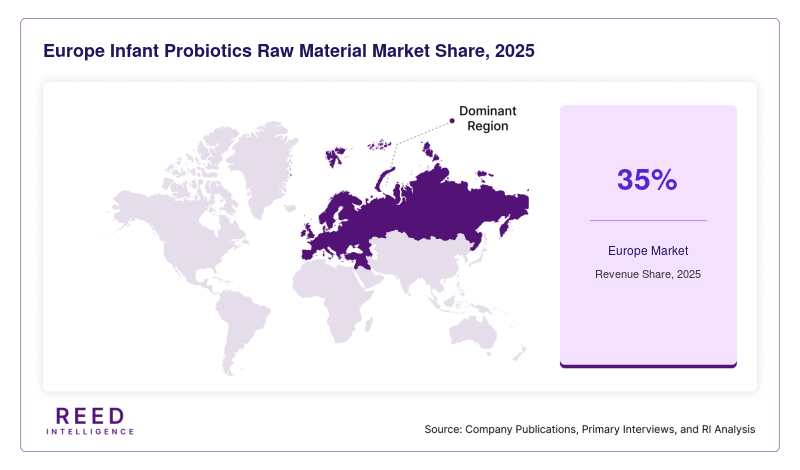
Leads the Infant Probiotics Raw Material market, commanding a 35% share, with consumption reaching 4,375 metric tons in 2025. Germany, France, and the Netherlands are the primary drivers, accounting for 50% of regional demand, driven by strong regulatory frameworks and high consumer awareness. The European Infant Probiotics Raw Material market is characterized by its focus on quality and compliance with EFSA guidelines.
Asia-Pacific Infant Probiotics Raw Material Market
Represents the second-largest market, capturing a 30% share with consumption of 3,750 metric tons in 2025. China, India, and Japan are the primary drivers, accounting for 65% of regional demand, driven by the large birth rate and growing healthcare expenditure. The Asia-Pacific Infant Probiotics Raw Material market is projected to grow at the fastest CAGR of 8.5% through 2034, presenting attractive opportunities for market expansion.
North America Infant Probiotics Raw Material Market
Accounts for 25% of the global Infant Probiotics Raw Material market, with consumption of 3,125 metric tons in 2025. The United States dominates regional demand, accounting for 80% of consumption, driven by the strong supplement industry and high parental awareness. The North American Infant Probiotics Raw Material market is characterized by its focus on innovation and premium products.
Middle East & Africa and Latin America Infant Probiotics Raw Material Market
Together account for the remaining 10% of the Infant Probiotics Raw Material market, with the UAE leading the Middle East market and Brazil leading the Latin American market. Both regions are projected to grow at CAGRs exceeding 7%, driven by increasing healthcare awareness and income levels.
Top players in Infant Probiotics Raw Material Market
- Chr. Hansen Holding A/S
- DuPont Danisco (International Flavors & Fragrances)
- Nestlé S.A.
- Lallemand Inc.
- Winclove Probiotics
- BioGaia AB
- UAS Laboratories (A company of Kerry Group)
- Fonterra Co-operative Group
- Ganeden Biotech (Kerry Group)
- Probi AB
- Bifodan A/S (Chr. Hansen)
- Novozymes A/S
- Morinaga Milk Industry Co., Ltd.
- Yakult Honsha Co., Ltd.
- Biofarma Group
Chr. Hansen Holding A/S
Chr. Hansen holds a dominant position in the Infant Probiotics Raw Material market, with an estimated 20% global market share, particularly strong in the European and North American markets. The company's portfolio of infant-specific probiotic strains, including its flagship Bifidobacterium longum BB536 and Lacticaseibacillus rhamnosus LGG, is widely recognized for its quality and clinical evidence base. Chr. Hansen's market leadership is reinforced by its extensive research and development capabilities, with the company investing over EUR 40 million annually in probiotic research. Chr. Hansen commands over 25% of the European market and 18% of the North American market, positioning it as a key player in the Infant Probiotics Raw Material market's premium segment.
DuPont Danisco (International Flavors & Fragrances)
DuPont Danisco is a leading player in the Infant Probiotics Raw Material market, commanding approximately 15% of the global market share through its comprehensive portfolio of probiotic raw materials. The company's expertise in fermentation technology and its strong presence in the infant formula segment have solidified its position, where it holds a 20% market share. DuPont Danisco's recent introduction of new human-origin strains, including Bifidobacterium infantis, has strengthened its position in the premium segment. The company's commitment to sustainability, including its efforts to reduce the carbon footprint of its production processes, has enhanced its brand equity among environmentally conscious customers.
Nestlé S.A. holds a significant 10% market share, primarily through its internal production and use of probiotics in its infant formula products. The company's focus on research and its strong distribution network are key differentiators. BioGaia AB is a major player in the supplement segment, holding a 7% global share, with a strong position in the Lactobacillus reuteri strain market.
Recent Developments in Infant Probiotics Raw Material Market
- 2025: Chr. Hansen launched a new human-origin Bifidobacterium longum subspecies infantis strain, specifically designed for infant formula applications, demonstrating a 30% improvement in gut colonization compared to conventional strains.
- 2025: DuPont Danisco introduced a novel microencapsulation technology for its infant probiotic raw materials, achieving a 50% reduction in viability loss during processing and a 12-month extension in shelf-life.
Infant Probiotics Raw Material Market Segments
By Strain
- Lactobacillus
- Bifidobacterium
- Other Strains
By Form
- Powder
- Liquid
- Capsule
By Region
- North America
- Europe
- APAC
- Middle East and Africa
- LATAM