Large-Capacity NFC Sticker Market Size, Share Demand Report By Product Type (NTAG-Based NFC Stickers, High-Memory NFC Stickers, Rewritable NFC Stickers, Custom-Encoded NFC Stickers), By Application (Retail & Smart Packaging, Healthcare & Pharmaceuticals, Logistics & Asset Tracking, Consumer Electronics), By Region & Segment Forecasts, 2026–2034
USD 3950
Large-Capacity NFC Sticker Market Size
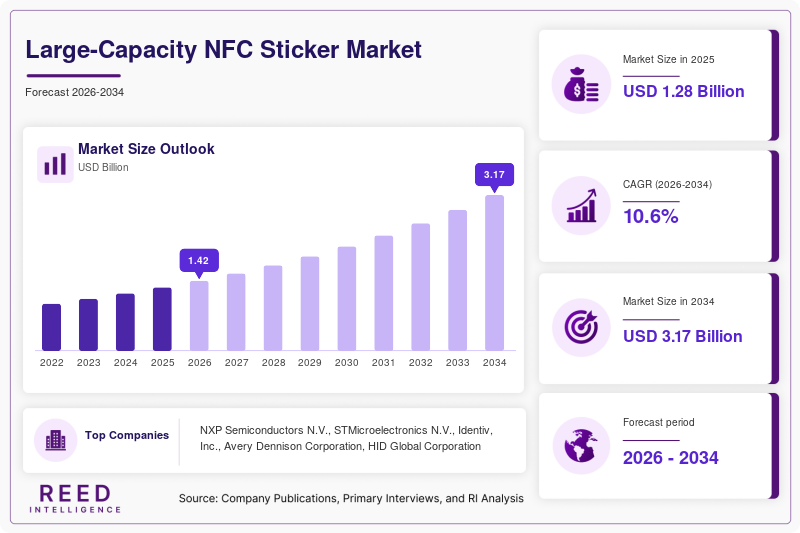
Large-Capacity NFC Sticker market size is projected at USD 1.42 billion in 2026 and is expected to hit USD 3.18 billion by 2034 with a CAGR of 10.6%.The market is witnessing strong expansion due to increasing adoption of contactless technologies, smart packaging solutions, and digital authentication systems. Comprehensive analysis of production capacity, application trends, segmentation patterns, and competitive developments is essential for understanding future opportunities across the market.
Large-capacity NFC stickers are advanced near-field communication tags featuring enhanced memory capacities that enable storage of larger datasets, secure authentication credentials, multimedia content, and tracking information. Global production exceeded 8.6 billion units in 2025, with retail and marketing applications contributing approximately 46% of total demand. Above 1 KB NFC stickers accounted for nearly 38% of installations, while enterprise adoption rates increased by 18.4% year-over-year. Growing digitalization initiatives continue to support Large-Capacity NFC Sticker market growth.
Large-Capacity NFC Sticker Market Trends
Rising Adoption of Smart Packaging and Connected Products
Brands are increasingly integrating NFC-enabled packaging solutions to improve customer engagement and product traceability. More than 2.4 billion smart packaging units incorporated NFC technology in 2025, while consumer interaction rates increased by 27%. Enhanced memory capacities allow manufacturers to store promotional content, product information, warranty details, and authentication records. This development remains a major Large-Capacity NFC Sticker market trend.
The adoption of NFC-based authentication technologies has expanded significantly across luxury goods, pharmaceuticals, and electronics industries. Over 63% of premium consumer brands implemented NFC verification programs during 2025. Increased integration with mobile applications and cloud-based databases continues to strengthen the Large-Capacity NFC Sticker market trend.
Expansion of Digital Asset Tracking Infrastructure
Organizations are increasingly deploying NFC-based tracking systems for inventory management and asset monitoring. More than 1.7 billion NFC-enabled assets were tracked globally during 2025, while deployment rates across logistics and industrial facilities increased by 22%. Higher memory capacities support storage of maintenance histories, compliance records, and operational information, accelerating Large-Capacity NFC Sticker market demand.
Large-Capacity NFC Sticker Market Drivers
Growing Demand for Contactless Authentication and Smart Labeling
The rapid growth of digital authentication and anti-counterfeiting initiatives is a key market driver. Counterfeit-related losses exceeded USD 500 billion globally in 2025, encouraging adoption of secure NFC-based verification systems. More than 4.1 billion NFC tags were deployed for authentication applications, while enterprise implementation rates increased by 21%, supporting Large-Capacity NFC Sticker market growth.
Large-Capacity NFC Sticker Market Restraints
Higher Costs Compared to Conventional RFID and Barcode Labels
Large-capacity NFC stickers typically cost 30% to 60% more than standard RFID labels and traditional barcode solutions. Cost-sensitive industries often prioritize lower-cost identification technologies for high-volume applications. Production expenses associated with advanced memory chips and secure encryption features may restrain growth across portions of the Large-Capacity NFC Sticker market.
Large-Capacity NFC Sticker Market Opportunities
Emergence of Smart Consumer Engagement Platforms
The increasing use of mobile commerce, digital loyalty programs, and interactive product experiences creates substantial opportunities. More than 6.3 billion smartphone users globally can access NFC-enabled services, while NFC transaction volumes exceeded USD 3 trillion during 2025. These developments present significant opportunities for the Large-Capacity NFC Sticker market.
Challenges in Large-Capacity NFC Sticker
Data Security and Interoperability Concerns
As NFC stickers store larger datasets and support cloud connectivity, security requirements become increasingly complex. More than 18% of enterprises cited concerns regarding unauthorized data access and compatibility issues. Maintaining secure encryption standards while ensuring compatibility across multiple devices remains a challenge for the Large-Capacity NFC Sticker market.
Large-Capacity NFC Sticker Market Segmentation
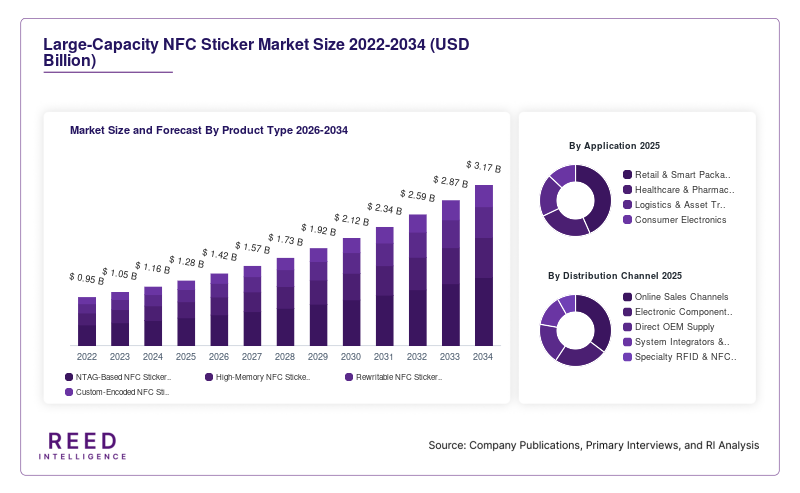
The market is segmented by type and application based on memory capacity requirements and end-user deployment needs. Above 1 KB NFC Stickers accounted for approximately 38% market share in 2025, while Retail & Marketing represented nearly 46% of application demand.
By Type
512 Bytes NFC Stickers accounted for approximately 29% of market share in 2025. Production exceeded 2.5 billion units. These stickers are widely used for basic information sharing, website linking, customer engagement campaigns, and product identification purposes.
1 KB NFC Stickers represented nearly 33% of total demand. More than 2.8 billion units were manufactured globally. Their larger storage capacity supports customer loyalty programs, smart packaging applications, and asset identification systems.
Above 1 KB NFC Stickers held approximately 38% market share. Production surpassed 3.3 billion units during 2025. These advanced solutions support encrypted authentication, multimedia content delivery, supply chain visibility, and secure enterprise applications.
By Application
Retail & Marketing dominated the market with approximately 46% share. More than 3.9 billion units were deployed across smart packaging, promotional campaigns, customer engagement initiatives, and loyalty programs. Adoption rates among premium consumer brands exceeded 60%.
Asset Tracking accounted for approximately 31% of market demand. More than 2.6 billion NFC stickers supported inventory management, equipment monitoring, and logistics operations. Enhanced memory capacity allows storage of maintenance records and operational data.
Authentication & Security represented nearly 23% market share. More than 2 billion units were deployed across pharmaceuticals, electronics, luxury goods, and government applications. Secure encryption capabilities contribute significantly to adoption.
Large-Capacity NFC Sticker Market Regional Outlook
North America Large-Capacity NFC Sticker Market
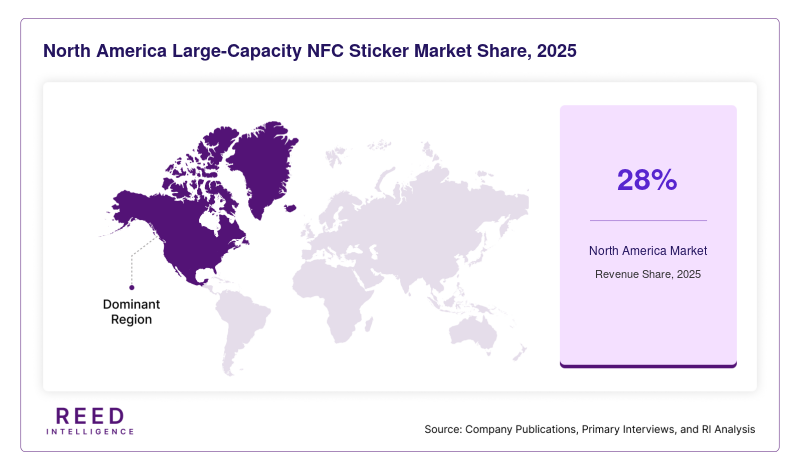
North America accounted for approximately 28% of global demand in 2025. The United States represented nearly 81% of regional consumption. More than 2.4 billion NFC stickers were deployed across retail, logistics, and authentication applications.
Europe Large-Capacity NFC Sticker Market
Europe held approximately 25% market share. Germany, France, the United Kingdom, and Italy were major contributors. Regional deployment exceeded 2.1 billion units, supported by strong adoption of smart packaging and anti-counterfeiting technologies.
Asia-Pacific Large-Capacity NFC Sticker Market
Asia-Pacific dominated the market with approximately 39% share. China, Japan, South Korea, and India accounted for over 75% of regional demand. More than 3.3 billion units were deployed during 2025, supported by large-scale manufacturing and digital transformation initiatives.
Rest of the World Large-Capacity NFC Sticker Market
The Rest of the World contributed approximately 8% of total demand. Latin America, the Middle East, and Africa experienced increasing adoption across retail, healthcare, and logistics sectors, supporting deployment of more than 700 million units annually.
Top players in Large-Capacity NFC Sticker Market
- NXP Semiconductors N.V.
- Identiv, Inc.
- STMicroelectronics N.V.
- Avery Dennison Corporation
- Smartrac Technology GmbH
- Checkpoint Systems, Inc.
- Confidex Ltd.
- HID Global Corporation
- Invengo Technology Pte. Ltd.
- Muehlbauer Holding AG
- Tageos SAS
- CCL Industries Inc.
NXP Semiconductors N.V.
- Estimated market share exceeds 19% globally.
- NXP is a leading supplier of NFC chipsets and secure connectivity solutions supporting smart packaging, authentication, and IoT applications.
- The company benefits from strong relationships with consumer electronics manufacturers, retail brands, and industrial enterprises.
- Continuous investments in secure memory architectures and NFC innovation strengthen its competitive positioning.
- Extensive global distribution and technology leadership contribute significantly to long-term market presence.
Avery Dennison Corporation
- Estimated market share exceeds 12% globally.
- Avery Dennison provides advanced intelligent labeling and RFID/NFC solutions for retail, logistics, healthcare, and consumer goods sectors.
- The company leverages extensive manufacturing capabilities and strong customer relationships across global markets.
- Strategic investments in connected packaging and digital identification technologies support market expansion.
- Strong expertise in smart labels and sustainable packaging solutions enhances competitive differentiation.
Recent Developments in Large-Capacity NFC Sticker Market
- 2026: Multiple manufacturers introduced NFC stickers featuring enhanced memory capacities exceeding 2 KB for enterprise applications.
- 2025: Leading smart packaging providers expanded NFC-enabled product authentication programs across consumer goods markets.
- 2025: NFC sticker suppliers launched encrypted authentication solutions for luxury products and pharmaceutical packaging.
Large-Capacity NFC Sticker Market Segments
By Product Type
- NTAG-Based NFC Stickers
- High-Memory NFC Stickers
- Rewritable NFC Stickers
- Custom-Encoded NFC Stickers
By Application
- Retail & Smart Packaging
- Healthcare & Pharmaceuticals
- Logistics & Asset Tracking
- Consumer Electronics
By Distribution Channel
- Online Sales Channels
- Electronic Component Distributors
- Direct OEM Supply
- System Integrators & Solution Providers
- Specialty RFID & NFC Retailers
By Region
- North America
- Europe
- APAC
- Middle East and Africa
- LATAM