Liquid Boron Market Size, Share Demand Report By Type (Boron Fertilizer Solutions, Boron Chemical Solutions, Industrial Boron Liquids), By Application (Agriculture, Electronics & Semiconductors, Industrial Manufacturing), By Region & Segment Forecasts, 2026–2034
USD 3950
Liquid Boron Market Size
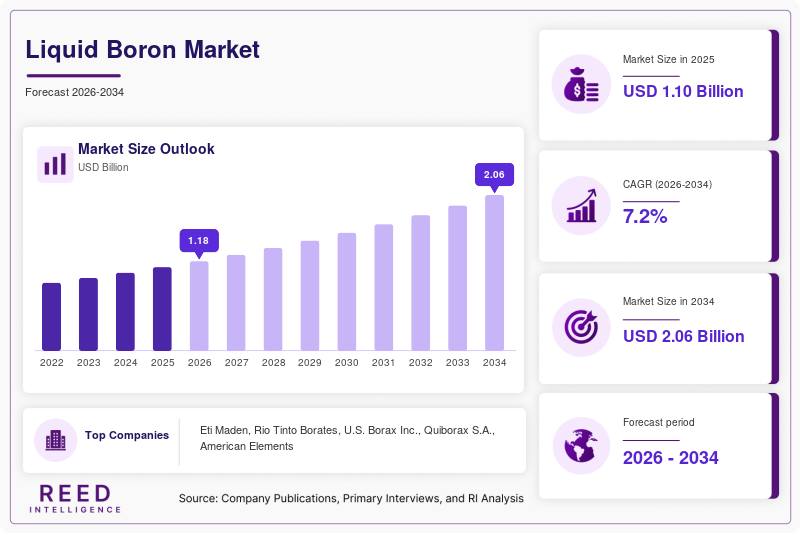
Liquid Boron market size is projected at USD 1.18 billion in 2026 and is expected to hit USD 2.05 billion by 2034 with a CAGR of 7.2%. The increasing demand for micronutrient fertilizers, advanced industrial chemicals, and high-purity boron compounds is supporting market expansion. This report provides detailed segmentation, competitive landscape analysis, production trends, technological developments, and regional insights influencing the Liquid Boron Market.
The Liquid Boron Market includes liquid-based boron compounds and solutions used across agriculture, industrial processing, electronics manufacturing, and specialty chemical applications. Global liquid boron production exceeded 1.9 million metric tons in 2025, driven by rising fertilizer consumption and industrial applications. Agricultural boron solutions accounted for nearly 58% of total consumption due to increasing micronutrient management practices, while industrial-grade liquid boron represented approximately 25% of demand.
Liquid Boron Trends
Growing Adoption of Precision Agriculture-Based Boron Applications
The Liquid Boron Market is experiencing strong adoption of precision agriculture technologies, where liquid micronutrient delivery improves crop nutrient efficiency. Global liquid fertilizer consumption exceeded 220 million metric tons in 2025, with boron-based formulations accounting for approximately 3–5% of micronutrient fertilizer usage. Advanced spraying technologies and controlled-release formulations improved nutrient absorption efficiency by nearly 20%, increasing adoption among commercial farming operations. Rising demand from high-value crops such as fruits, vegetables, and oilseeds continues to influence Liquid Boron Market trends.
Increasing Demand for High-Purity Boron Compounds
Industrial demand for high-purity liquid boron solutions is increasing due to applications in electronics, ceramics, and specialty chemicals. Global consumption of high-purity boron materials exceeded 500,000 metric tons in 2025, with electronics and semiconductor applications contributing approximately 18% of demand. Improvements in purification technologies have enhanced boron concentration levels above 99%, supporting advanced manufacturing requirements and shaping Liquid Boron Market trends.
Liquid Boron Market Drivers
Rising Demand for Agricultural Micronutrients
Increasing global food production requirements are driving the Liquid Boron Market. Agricultural applications represented nearly 58% of total consumption in 2025, with more than 1 million metric tons used in crop nutrition programs. Boron deficiency management increased fertilizer adoption by approximately 9% annually in developing agricultural regions. Growing precision farming practices, where liquid fertilizers improve application efficiency by 15–25%, continue supporting Liquid Boron Market growth.
Liquid Boron Market Restraints
Limited Awareness and Fluctuating Raw Material Costs
Limited farmer awareness and raw material price fluctuations restrict broader adoption of liquid boron solutions. Production costs for boron-based formulations increased by approximately 12% between 2023 and 2025 due to mining and processing expenses. Small-scale agricultural users in developing regions represent nearly 35% of potential demand but face affordability challenges, impacting overall Liquid Boron Market expansion.
Liquid Boron Market Opportunities
Expansion of Advanced Crop Nutrition and Semiconductor Applications
Growing investment in agricultural technology and electronics manufacturing creates significant opportunities for the Liquid Boron Market. Semiconductor production capacity expansion increased specialty boron demand by approximately 10% annually, while advanced crop management programs increased liquid micronutrient adoption by more than 15%. Emerging applications in renewable energy components and specialty glass manufacturing provide additional growth opportunities.
Challenges in Liquid Boron Market
Supply Chain Dependency and Environmental Regulations
The Liquid Boron Market faces challenges related to boron mineral supply concentration and regulatory requirements. More than 70% of global boron resources originate from limited mining regions, creating supply risks. Environmental compliance costs account for approximately 8–12% of production expenses, requiring manufacturers to invest in sustainable processing technologies.
Liquid Boron Market Segmentation
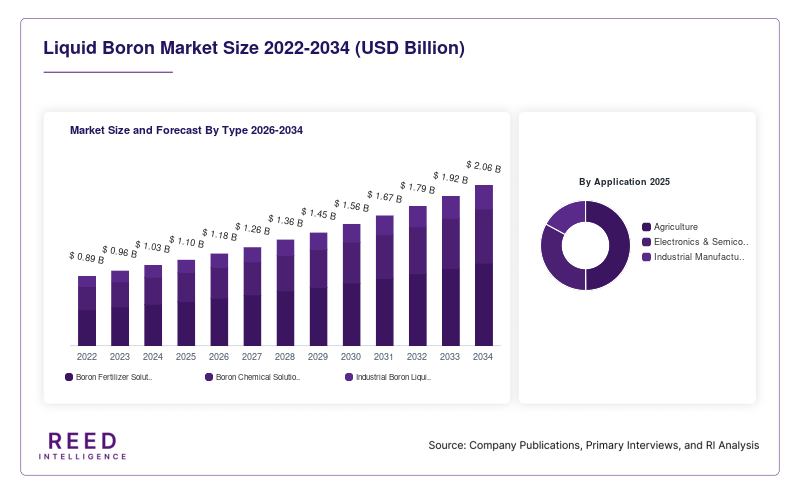
The Liquid Boron Market segmentation is categorized by type and application. Boron fertilizer solutions dominate with approximately 58% market share due to agricultural demand, while industrial manufacturing applications contribute nearly 30% of total consumption. The segmentation analysis evaluates product adoption, production volumes, and end-user requirements.
By Type
Boron fertilizer solutions accounted for nearly 58% of the Liquid Boron Market in 2025, with consumption exceeding 1 million metric tons globally. These solutions typically contain boron concentrations ranging from 5% to 15% and are used for foliar sprays, fertigation, and soil applications. Crop nutrition programs across cereals, fruits, vegetables, and oilseeds contributed more than 65% of agricultural liquid boron consumption.
Boron chemical solutions represented approximately 25% market share, with production reaching nearly 475,000 metric tons in 2025. These solutions are used in chemical synthesis, glass manufacturing, ceramics, and specialty materials. High-purity formulations with boron concentrations above 10% are increasingly adopted in industrial applications requiring precise chemical properties.
Industrial boron liquids captured around 17% market share, accounting for over 320,000 metric tons annually. These products support electronics manufacturing, metallurgy, and advanced material processing. Industrial-grade solutions require strict purity levels and contribute significantly to high-value boron applications.
By Application
Agriculture dominated the Liquid Boron Market with approximately 58% share and consumption exceeding 1 million metric tons in 2025. Liquid boron solutions are used in crop nutrition, flowering improvement, fruit development, and yield enhancement. Adoption penetration exceeded 50% among commercial farms in developed markets due to precision agriculture technologies.
Electronics and semiconductor applications accounted for nearly 18% market share, consuming more than 330,000 metric tons in 2025. Liquid boron compounds are utilized in semiconductor processing, doping materials, and advanced electronic components. Demand increased by approximately 10% annually due to semiconductor manufacturing expansion.
Industrial manufacturing represented around 24% market share with consumption exceeding 450,000 metric tons. Applications include glass production, ceramics, metal processing, and chemical manufacturing. Industrial users require high-purity formulations with consistent chemical characteristics, supporting continued market development.
Liquid Boron Market Regional Outlook
North America Liquid Boron Market
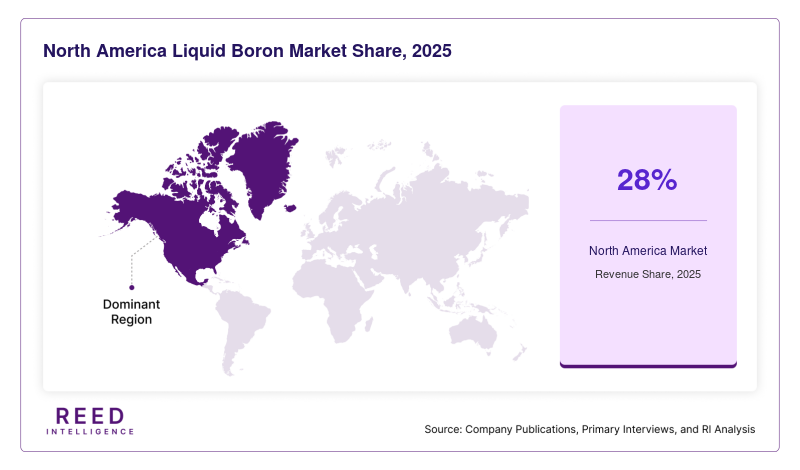
North America accounted for approximately 28% of the Liquid Boron Market in 2025, with consumption exceeding 520,000 metric tons. The United States contributed nearly 75% of regional demand due to advanced agriculture and industrial manufacturing sectors. Agriculture represented around 55% of regional consumption, while industrial applications accounted for 30%.
Europe Liquid Boron Market
Europe held nearly 24% market share, consuming more than 450,000 metric tons in 2025. Germany, France, and the United Kingdom contributed significantly through agricultural technology and specialty chemical industries. Industrial applications represented approximately 40% of European demand due to advanced manufacturing capabilities.
Asia-Pacific Liquid Boron Market
Asia-Pacific dominated with approximately 38% market share and consumption exceeding 700,000 metric tons in 2025. China and India were major contributors due to agricultural expansion and industrial growth. Agriculture accounted for nearly 65% of regional consumption, supported by increasing fertilizer optimization programs.
Latin America and Middle East & Africa Liquid Boron Market
These regions represented nearly 10% market share with consumption of approximately 190,000 metric tons in 2025. Brazil, Argentina, and Middle Eastern agricultural economies increased adoption due to crop productivity improvement initiatives.
Top players in Liquid Boron Market
- Eti Maden
- Rio Tinto Borates
- U.S. Borax Inc.
- Quiborax S.A.
- American Elements
- Orocobre Limited
- Borax Argentina S.A.
- Searles Valley Minerals
- Fertibor
- Yara International ASA
Eti Maden
- Holds a leading position with an estimated 20–25% share of the global Liquid Boron Market.
- The company benefits from extensive boron reserves and integrated production capabilities.
- Its portfolio includes agricultural boron solutions and industrial boron compounds supplied across global markets.
- Strong export networks and investment in processing technologies support its positioning in fertilizer and specialty chemical applications.
Rio Tinto Borates
- Maintains approximately 15–18% market share through advanced boron mining and processing operations.
- The company supplies high-quality boron products for agriculture, industrial manufacturing, and specialty applications.
- Its focus on sustainable mining practices and technology-driven production strengthens its competitive position in the Liquid Boron Market.
Recent Developments in Liquid Boron Market
- 2026: Manufacturers expanded liquid boron fertilizer production capacity to meet increasing agricultural demand.
- 2025: Companies introduced advanced high-concentration boron formulations for precision farming applications.
- 2025: Boron suppliers increased investments in sustainable processing and purification technologies.
Liquid Boron Market Segments
By Type
- Boron Fertilizer Solutions
- Boron Chemical Solutions
- Industrial Boron Liquids
By Application
- Agriculture
- Electronics & Semiconductors
- Industrial Manufacturing
By Region
- North America
- Europe
- APAC
- Middle East and Africa
- LATAM