Livestock Monitoring and Management Solutions Market Size, Share, Demand Report By Type (Hardware Solutions, Software Solutions, Services), By Application (Dairy Farm Management, Poultry Monitoring, Swine Monitoring), By Region & Segment Forecasts, 2026–2034
USD 3950
Livestock Monitoring and Management Solutions Market Size
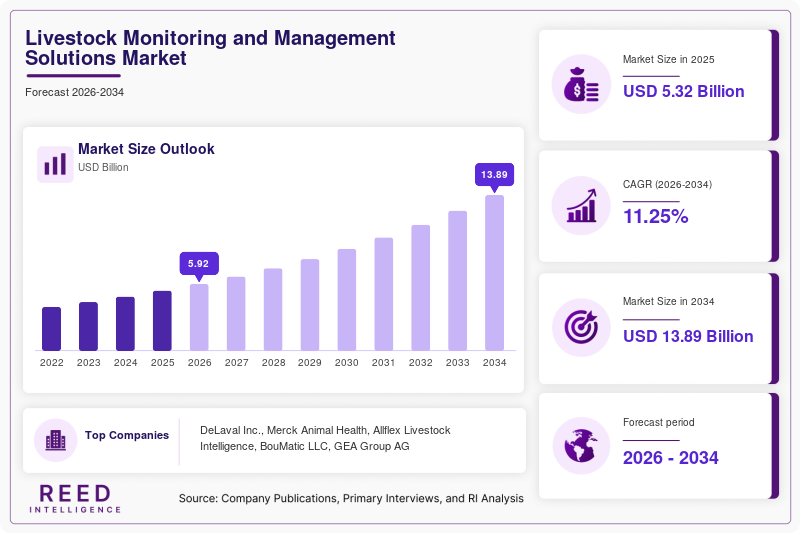
Livestock Monitoring and Management Solutions market size is projected at USD 5.92 billion in 2026 and is expected to hit USD 13.87 billion by 2034 with a CAGR of 11.25%. Growing digitalization across livestock operations, increasing adoption of connected farming technologies, and rising demand for real-time animal health analytics are driving market expansion. Detailed segmentation analysis, technology assessment, and competitive landscape evaluation remain essential for stakeholders participating in the global industry.
The market comprises hardware devices, software platforms, and service solutions designed to monitor livestock health, feeding behavior, reproduction, location tracking, and farm productivity. More than 420 million connected livestock devices were deployed globally in 2025, while smart monitoring system adoption exceeded 37% across commercial livestock farms. Hardware solutions contributed approximately 49% of total revenue, and dairy farm management represented nearly 42% of industry demand. Increasing investments in precision livestock farming continue to strengthen the livestock monitoring and management solutions market.
Livestock Monitoring and Management Solutions Market Trends
Growing Adoption of IoT and AI-Based Livestock Analytics
More than 185 million IoT-enabled livestock monitoring devices were installed globally during 2025, representing annual growth of 14.2%. Adoption rates exceeded 58% among large commercial dairy farms and 46% among organized swine operations. Artificial intelligence-powered monitoring platforms improved disease detection accuracy by 18% to 26% while reducing livestock mortality rates by 5% to 9%, supporting livestock monitoring and management solutions market trends.
Cloud-based livestock management systems processed over 3.8 billion animal health records during 2025. More than 41% of newly deployed monitoring platforms incorporated predictive analytics, automated alert systems, and remote management capabilities. Demand from dairy and poultry operations increased by 12.8% year-over-year, while livestock monitoring and management solutions market trends continue to benefit from ongoing digital transformation initiatives.
Livestock Monitoring and Management Solutions Market Drivers
Increasing Demand for Precision Livestock Farming
Global livestock production exceeded 37 billion animals annually, creating substantial demand for automated monitoring technologies. More than 52% of large-scale livestock operators have adopted digital management systems compared to 34% in 2020. Precision livestock solutions improve feed efficiency by 10% to 18% and reproductive performance by 8% to 15%, accelerating livestock monitoring and management solutions market growth.
Livestock Monitoring and Management Solutions Market Restraints
High Deployment and Integration Costs
Comprehensive livestock monitoring systems can require investments ranging from USD 15,000 to USD 250,000 depending on farm size and automation requirements. Nearly 43% of small-scale livestock producers continue to rely on traditional management methods due to financial constraints. Integration and maintenance expenses account for 12% to 20% of total ownership costs, limiting broader adoption across developing agricultural economies and affecting livestock monitoring and management solutions market growth.
Livestock Monitoring and Management Solutions Market Opportunities
Expansion of Smart Farming and Connected Agriculture
Smart agriculture adoption surpassed 31% globally during 2025 and is expected to expand rapidly through 2034. More than 650 million livestock animals are projected to be monitored through connected systems by the end of the forecast period. Real-time health monitoring solutions reduce veterinary expenses by 10% to 16% and improve operational productivity by nearly 20%, creating major opportunities within the livestock monitoring and management solutions market.
Challenges in Livestock Monitoring and Management Solutions Market
Data Security and Connectivity Limitations
Approximately 28% of rural livestock farms continue to face limited broadband connectivity, affecting real-time monitoring capabilities. Data storage volumes exceeded 9 petabytes across livestock monitoring platforms in 2025, increasing cybersecurity requirements. System downtime and connectivity disruptions can reduce monitoring efficiency by 6% to 11%, presenting ongoing challenges for the livestock monitoring and management solutions market.
Livestock Monitoring and Management Solutions Market Segmentation
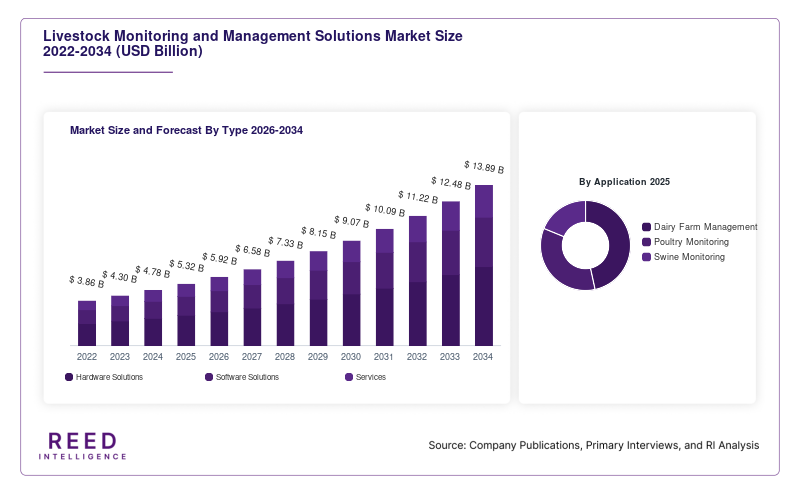
The market is segmented by type and application. Hardware solutions accounted for approximately 49% of total revenue in 2025, while dairy farm management contributed nearly 42% of overall demand. Increasing investments in animal health monitoring and operational automation continue to influence segment performance.
By Type
Hardware solutions represented approximately 49% of market revenue. More than 210 million devices, including wearable sensors, RFID tags, GPS trackers, and automated feeding monitors, were deployed globally in 2025. Device accuracy rates exceeded 95%, while battery life ranged from 12 to 60 months depending on application requirements.
Software solutions accounted for nearly 33% of industry revenue. More than 95,000 livestock management platforms were actively deployed worldwide. These systems provide analytics dashboards, health monitoring capabilities, breeding management tools, and predictive maintenance features. Cloud-based software adoption exceeded 44% among commercial livestock enterprises.
Services contributed approximately 18% of total market revenue. More than 35,000 implementation and maintenance projects were completed during 2025. Consulting, integration, training, and technical support services continue to support increasing technology adoption across livestock operations.
By Application
Dairy farm management accounted for approximately 42% of market revenue. More than 110 million dairy cattle were monitored using connected technologies globally. Monitoring systems improved milk yield efficiency by 7% to 14% and reproductive performance by up to 12%.
Poultry monitoring represented nearly 34% of industry demand. Over 14 billion poultry birds were managed through automated environmental monitoring and health tracking systems. Adoption rates exceeded 39% among large-scale poultry production facilities.
Swine monitoring accounted for approximately 24% of market revenue. More than 320 million pigs were monitored through digital health, feeding, and environmental management platforms. Automated monitoring technologies reduced mortality rates by 4% to 8% and improved feed conversion efficiency by 10%.
Livestock Monitoring and Management Solutions Market Regional Outlook
North America Livestock Monitoring and Management Solutions Market
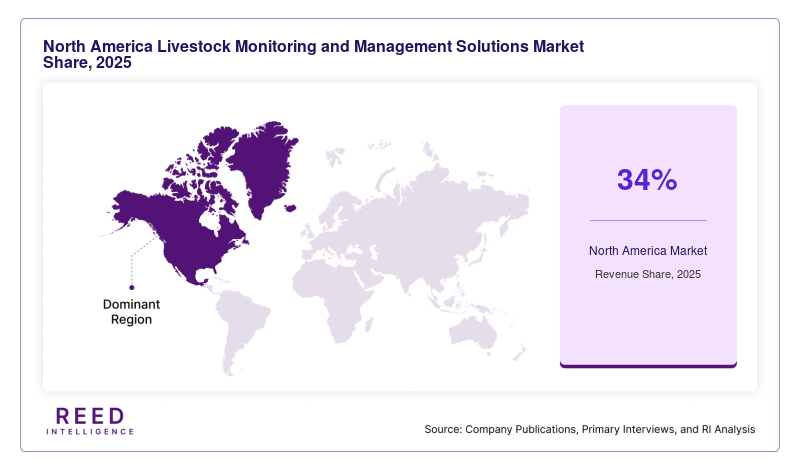
North America accounted for approximately 34% of global revenue during 2025. The United States contributed nearly 79% of regional demand, supported by widespread adoption of precision livestock farming technologies. More than 120 million connected livestock devices were operational throughout the region.
Europe Livestock Monitoring and Management Solutions Market
Europe represented approximately 28% of market share. Germany, the United Kingdom, France, and the Netherlands collectively accounted for over 61% of regional demand. Digital livestock management adoption exceeded 53% among commercial farming operations.
Asia-Pacific Livestock Monitoring and Management Solutions Market
Asia-Pacific captured nearly 27% of global revenue and remains the fastest-growing regional market. China, India, Japan, and Australia contributed more than 68% of regional demand. Connected livestock monitoring deployments exceeded 140 million devices during 2025.
Latin America Livestock Monitoring and Management Solutions Market
Latin America accounted for approximately 7% of total market revenue. Brazil represented nearly 55% of regional demand due to its extensive cattle and poultry industries. Smart livestock technology adoption increased by 10.4% annually.
Middle East & Africa Livestock Monitoring and Management Solutions Market
The Middle East & Africa held around 4% of global market revenue. Livestock modernization programs and increasing agricultural technology investments supported regional expansion. Adoption of digital monitoring systems exceeded 19% among large-scale livestock enterprises.
Top players in Livestock Monitoring and Management Solutions Market
- DeLaval Inc.
- Merck Animal Health
- Allflex Livestock Intelligence
- BouMatic LLC
- GEA Group AG
- Lely International N.V.
- Afimilk Ltd.
- Zoetis Inc.
- Fancom B.V.
- Nedap N.V.
- Dairymaster
- CowManager B.V.
- SCR Dairy Inc.
- Cainthus
- Connecterra B.V.
DeLaval Inc.
- Estimated market share: 13%–15%
- DeLaval maintains a leading position in dairy farm automation and livestock monitoring technologies.
- The company provides integrated solutions covering milking automation, animal health monitoring, feeding management, and herd analytics.
- Its monitoring platforms are deployed across thousands of dairy farms worldwide, supporting millions of livestock animals.
- Strong investments in sensor technologies, AI-based analytics, and cloud-connected farm management systems continue to enhance its competitive positioning.
- Extensive global distribution networks strengthen its presence across North America, Europe, and Asia-Pacific.
Merck Animal Health
- Estimated market share: 10%–12%
- Merck Animal Health is a major provider of livestock intelligence and monitoring solutions through advanced connected technologies.
- The company offers health monitoring systems, identification technologies, and predictive livestock management platforms.
- Strong focus on disease detection, reproductive management, and performance optimization supports customer adoption.
- Continuous innovation in wearable livestock sensors and data analytics strengthens market presence.
- Strategic partnerships with livestock producers and technology providers support long-term expansion across global agricultural markets.
Recent Developments in Livestock Monitoring and Management Solutions Market
- 2025: Merck Animal Health expanded connected livestock intelligence offerings with advanced predictive analytics capabilities.
- 2025: DeLaval introduced next-generation AI-powered herd monitoring systems for dairy farms.
Livestock Monitoring and Management Solutions Market Segments
By Type
- Hardware Solutions
- Software Solutions
- Services
By Application
- Dairy Farm Management
- Poultry Monitoring
- Swine Monitoring
By Region
- North America
- Europe
- APAC
- Middle East and Africa
- LATAM