Locker Locks Market Size, Share Demand Report By Type (Key Locks, Combination Locks, Electronic Locks, Smart Locks), By Application (Educational Institutions, Healthcare Facilities, Corporate & Commercial, Gyms & Fitness Centers), Regional Insights & Segment Forecasts, 2026–2034
USD 3950
Locker Locks Market Size
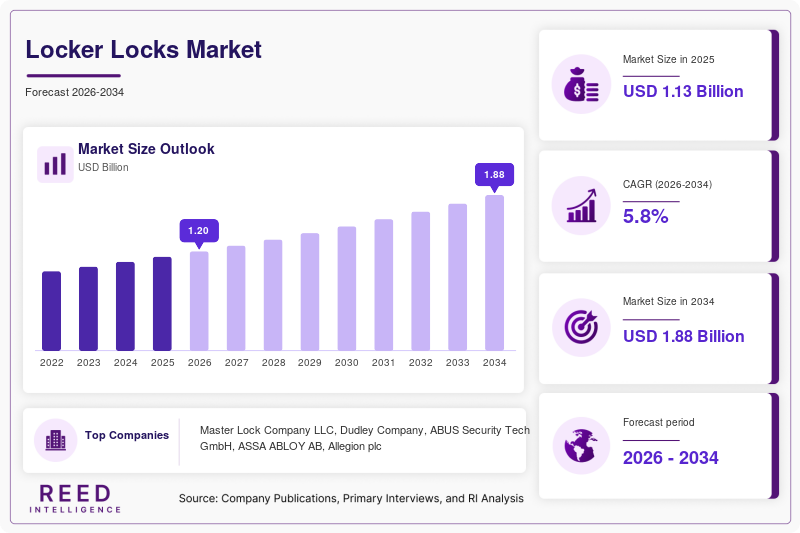
Locker Locks market size is projected at USD 1.2 billion in 2026 and is expected to hit USD 1.9 billion by 2034 with a CAGR of 5.8% during the forecast period. The increasing demand for secure and convenient storage solutions in various sectors, the growing adoption of smart and electronic locking systems for enhanced security and access control, and the rising focus on user convenience and operational efficiency underpin market expansion. This report delivers a comprehensive analysis of the Locker Locks market, including segmentation by type and application, competitive dynamics, and regional growth patterns, equipping stakeholders with critical intelligence. The Locker Locks market continues to demonstrate steady growth potential, fueled by the expansion of the education, healthcare, and commercial sectors, and the continuous innovation in lock technology.
Locker locks are security devices used to secure lockers in various settings, including schools, gyms, workplaces, and hospitals. They come in a range of types, from traditional key and combination locks to advanced electronic and smart locks, offering different levels of security, convenience, and access management. The global market for locker locks is driven by the need for reliable and secure personal storage solutions. The global production volume of locker locks exceeded 25 million units in 2025, reflecting a 5% increase from 2022. Adoption patterns reveal that the key lock segment dominates the market, accounting for 40% of total demand, followed by combination locks at 30%, electronic locks at 20%, and smart locks at 10%. The Locker Locks market's trajectory is closely linked to the growth of the global facility management market, which is projected to reach USD 1.5 trillion by 2028, and the increasing focus on security and automation in public and commercial spaces.
Locker Locks Market Trends
Growing Adoption of Smart and Electronic Locking Systems
The Locker Locks market is witnessing a significant trend toward the adoption of smart and electronic locking systems, driven by the demand for enhanced security, convenience, and access management. The revenue from electronic and smart locker locks grew to USD 0.3 billion in 2025, a year-on-year increase of 10%, as 25% of new locker installations in 2025 specified electronic or smart locks. Adoption rates of smart locks in the corporate and gym sectors reached 20%, with this figure projected to exceed 35% by 2030. The Locker Locks market's trend toward smart technology is reinforced by the increasing integration of IoT and mobile connectivity, the demand for keyless and contactless access, and the growing focus on operational efficiency and user experience.
Increasing Focus on Hygiene and Antimicrobial Solutions
The increasing focus on hygiene and antimicrobial solutions is a major trend shaping the Locker Locks market, driven by the heightened awareness of cleanliness and infection control in public spaces. The market has seen a 15% increase in the demand for antimicrobial locker locks since 2022, with 20% of new product launches in 2025 featuring antimicrobial coatings or materials. The use of easy-to-clean and germ-resistant designs has also gained traction. The Locker Locks market's trend toward hygiene is reinforced by the growing focus on health and safety in public facilities, the increasing adoption of antimicrobial materials in high-touch surfaces, and the continuous innovation in material science.
Locker Locks Market Drivers
The Locker Locks market's expansion is primarily driven by the increasing demand for secure and convenient storage solutions in various sectors, with the global security market valued at USD 100 billion in 2025 and growing. The growing adoption of smart and electronic locking systems, offering enhanced security and convenience, has also been a major driver. The expansion of the education, healthcare, and commercial sectors has fueled the demand for locker locks. Additionally, the increasing focus on user convenience and operational efficiency has driven the adoption of advanced locking solutions. The Locker Locks market's growth is further reinforced by the continuous innovation in lock technology, leading to improved security, durability, and ease of use.
Locker Locks Market Restraints
Despite favorable growth prospects, the Locker Locks market faces significant constraints, primarily related to the higher cost of advanced electronic and smart locks compared to traditional key and combination locks, which can be a barrier for some applications. The need for power and network connectivity for electronic and smart locks can also be a constraint. The Locker Locks market's growth is also tempered by the potential for technical malfunctions and the need for ongoing maintenance.
Locker Locks Market Opportunities
The Locker Locks market presents significant opportunities in the rapidly expanding market for smart building and facility management solutions, where the global market is projected to reach USD 50 billion by 2028. The adoption of integrated smart locker lock systems for access control and management is expected to grow at a CAGR of 10% through 2034. Emerging opportunities also exist in the development of locks for new applications, such as parcel lockers and rental storage. The Locker Locks market's opportunity profile is further enhanced by the growing trend of cashless and mobile-based access solutions.
Challenges in Locker Locks Market
The Locker Locks market faces persistent challenges related to the management of security and access control, as ensuring the integrity of locking systems is critical. The complexity of integrating electronic and smart locks with existing infrastructure presents a challenge. The market is also contending with the challenge of ensuring the reliability and durability of locks in high-use environments. Additionally, the Locker Locks market is challenged by the need for continuous innovation to keep pace with evolving security threats and user expectations.
Locker Locks Market Segmentation
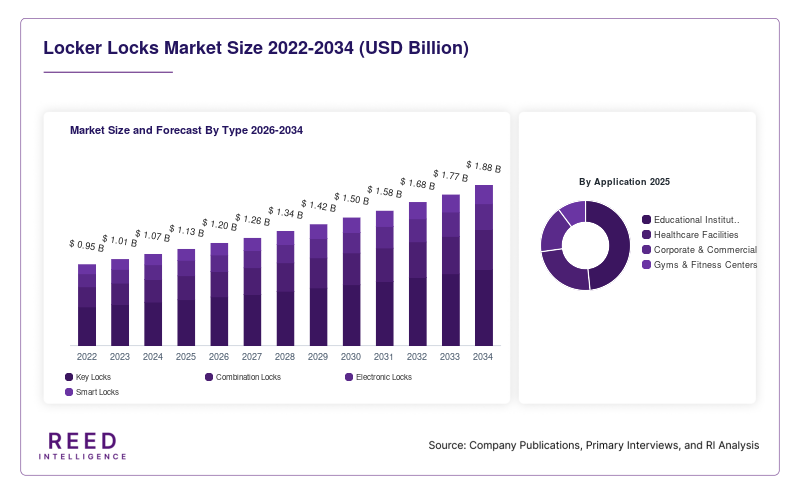
The Locker Locks market is segmented by Type and Application to provide a comprehensive market perspective. By Type, Key Locks dominate with a 40% market share, driven by their simplicity and cost-effectiveness. The Application segment is led by Educational Institutions, which accounts for 35% of the market, followed by Healthcare Facilities at 25%, Corporate & Commercial at 22%, and Gyms & Fitness Centers at 18%.
By Type
Key Locks represent the largest segment in the Locker Locks market, commanding a 40% share, with production reaching 10 million units in 2025. These locks are characterized by their simplicity, low cost, and reliability. Technical specifications include various key types, durability, and security levels. The Locker Locks market's key segment is driven by its use in educational and low-security applications.
Combination Locks capture a 30% share of the Locker Locks market, with production of 7.5 million units in 2025. These locks are characterized by their keyless operation and are often used in gyms and schools. Technical specifications include dial or push-button mechanisms, resettable combinations, and durability. The Locker Locks market's combination segment is driven by its use in high-traffic environments.
Electronic Locks represent a 20% share of the Locker Locks market, with production of 5 million units in 2025. These locks are characterized by their use of electronic keypads or card readers for access. Technical specifications include power source (battery or wired), keypad or RFID reader, and audit trail capabilities. The Locker Locks market's electronic segment is growing at a steady CAGR, driven by the demand for enhanced security.
Smart Locks represent the remaining 10% of the Locker Locks market, with production of 2.5 million units in 2025. These locks are characterized by their wireless connectivity and mobile app integration. Technical specifications include Bluetooth/Wi-Fi connectivity, mobile app control, and user management features. The Locker Locks market's smart segment is growing at the fastest CAGR, driven by the demand for convenience and integration.
By Application
Educational Institutions dominates the Locker Locks market, accounting for 35% of sales, representing 8.75 million units in 2025. This segment includes use in schools and universities for student lockers. Usage penetration exceeds 80% in the education sector. The Locker Locks market's educational segment is characterized by its focus on cost-effectiveness and ease of use.
Healthcare Facilities accounts for 25% of the Locker Locks market, with sales of 6.25 million units in 2025. This segment encompasses use in hospitals and clinics for staff and patient lockers. The segment is growing at a steady CAGR, driven by the healthcare sector. The Locker Locks market's healthcare segment is characterized by its focus on hygiene and durability.
Corporate & Commercial represents 22% of the Locker Locks market, with sales of 5.5 million units in 2025. This segment includes use in offices and commercial buildings for employee lockers. The segment is growing at a steady CAGR, driven by the commercial sector. The Locker Locks market's corporate segment is characterized by its focus on security and integration.
Gyms & Fitness Centers comprises the remainder of the Locker Locks market, accounting for 18% of total sales, with 4.5 million units in 2025. This segment includes use in fitness centers for member lockers. The segment is projected to grow at a steady CAGR through 2034. The Locker Locks market's gym segment is characterized by its focus on durability and user convenience.
Locker Locks Market Regional Outlook
North America Locker Locks Market
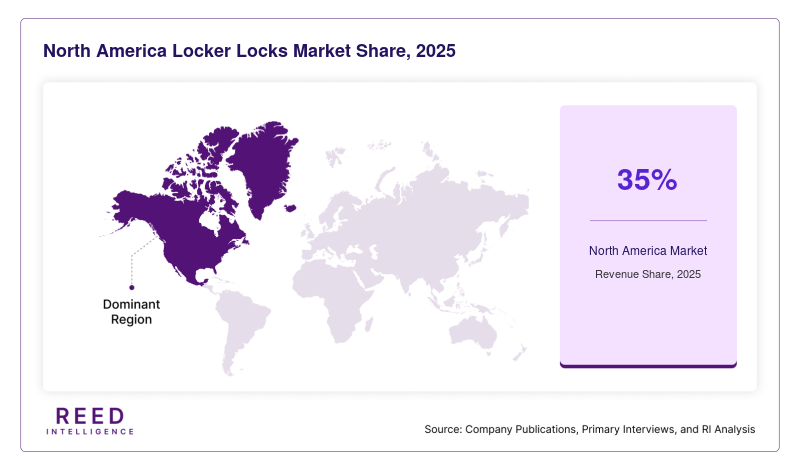
Leads the Locker Locks market, commanding a 35% share, with a revenue of USD 0.42 billion in 2025. The United States is the primary driver, accounting for 80% of regional demand, driven by the strong education and commercial sectors. The North American Locker Locks market is characterized by its focus on innovation and advanced security solutions.
Europe Locker Locks Market
Represents the second-largest market, capturing a 28% share with a revenue of USD 0.34 billion in 2025. Germany, the UK, and France collectively represent 55% of the regional market, driven by the strong focus on security and quality. The Locker Locks market in Europe is characterized by its focus on quality and durability.
Asia-Pacific Locker Locks Market
Accounts for 22% of the global Locker Locks market, with a revenue of USD 0.26 billion in 2025. China, India, and Japan are the primary drivers, accounting for 70% of regional demand, driven by the expanding education and commercial sectors. The Asia-Pacific Locker Locks market is projected to grow at the fastest CAGR of 7% through 2034, presenting attractive opportunities for market expansion.
Middle East & Africa and Latin America Locker Locks Market
Together account for the remaining 15% of the Locker Locks market, with the UAE leading the Middle East market and Brazil leading the Latin American market. Both regions are projected to grow at CAGRs exceeding 6%, driven by the increasing infrastructure investments.
Top players in Locker Locks Market
- Master Lock Company LLC
- Dudley Company
- ABUS Security Tech GmbH
- ASSA ABLOY AB
- Allegion plc
- Hafele GmbH & Co KG
- Stanley Black & Decker, Inc.
- Kaba Group (Dormakaba)
- Salto Systems S.L.
- ZKTeco Co., Ltd.
- HID Global (Assa Abloy)
- Nokē (Janus International)
- Mul-T-Lock (Assa Abloy)
- DIGILOCK
- Locko
Master Lock Company LLC
Master Lock holds a dominant position in the Locker Locks market, with an estimated 18% global market share, particularly strong in the North American and European segments. The company's portfolio of locker locks, including its renowned combination and key locks, is widely recognized for its quality and reliability. Master Lock's market leadership is reinforced by its significant brand recognition and its extensive distribution network. Master Lock commands over 22% of the North American market and 15% of the European market, positioning it as a key player in the Locker Locks market.
ASSA ABLOY AB
ASSA ABLOY is a leading player in the Locker Locks market, commanding approximately 14% of the global market share through its comprehensive portfolio of locking solutions, including its advanced electronic and smart locks. The company's expertise in access control and its strong presence in the global market have solidified its position. ASSA ABLOY's focus on developing innovative and secure locking solutions has strengthened its position. The company's commitment to quality has enhanced its brand equity.
Allegion plc holds a significant 10% market share, with particular strength in the North American and commercial segments, where it commands a 12% share. The company's focus on security solutions is a key differentiator. Dudley Company is a major player in the combination lock segment, holding a 9% share.
Recent Developments in Locker Locks Market
- 2025: Master Lock launched a new line of smart locker locks with Bluetooth connectivity and mobile app integration for access control and management.
- 2025: ASSA ABLOY introduced a new series of electronic locker locks with RFID card access and audit trail capabilities for corporate and healthcare applications.
Locker Locks Market Segments
By Type
- Key Locks
- Combination Locks
- Electronic Locks
- Smart Locks
By Application
- Educational Institutions
- Healthcare Facilities
- Corporate & Commercial
- Gyms & Fitness Centers
By Region
- North America
- Europe
- APAC
- Middle East and Africa
- LATAM