Nafion Market Size, Share & Demand Report By Form (Membrane, Dispersion, Resin), By Application (Fuel Cells, Electrochemical Sensors, Chlor-Alkali Production, Energy Storage) By Region & Segment Forecasts, 2026–2034
USD 3950
Nafion Market Size
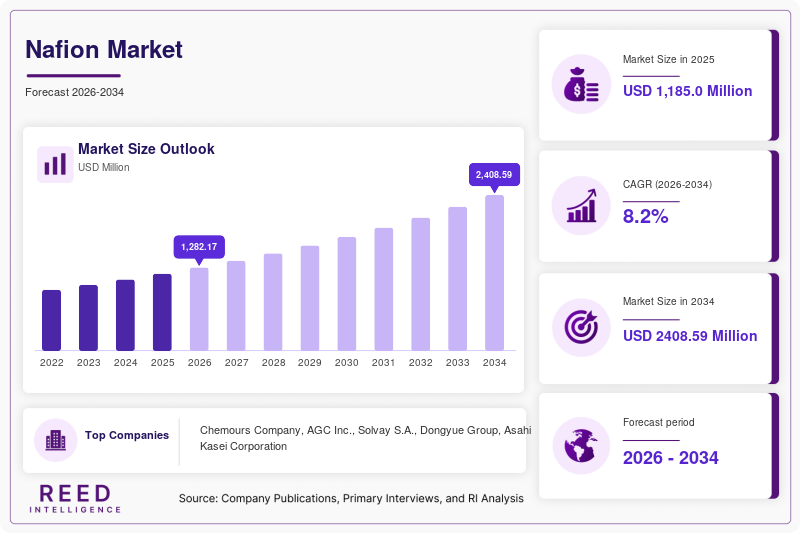
The Nafion market size is projected at USD 1,285.0 million in 2026 and is expected to hit USD 2,410.0 million by 2034 with a CAGR of 8.2% during the forecast period. The increasing demand for efficient ion-exchange membranes in fuel cell technology, coupled with the growing adoption of Nafion in energy storage and electrochemical applications, underpins market expansion. This report delivers a comprehensive analysis of the Nafion market, including segmentation by form and application, competitive dynamics, and regional growth patterns, equipping stakeholders with critical intelligence to navigate this specialized fluoropolymer landscape.
Key Takeaways
- Dominant Region: North America leads the Nafion market with a 38% share, while Asia-Pacific is the fastest-growing region with a projected CAGR of 10.5% through 2034.
- Dominant Segment: The Membrane form dominates the market with a 55% share, while the Fuel Cells application is the leading segment with a 45% share.
- Emerging Country: China is projected to reach USD 385.0 million by 2034, expanding at a CAGR of 11.5%.
- Key Drivers: The increasing demand for clean energy solutions, the growing adoption of hydrogen fuel cell technology, and the rising need for advanced electrochemical sensors are driving market growth.
The Nafion market encompasses a specialized family of sulfonated tetrafluoroethylene-based fluoropolymer-copolymers, known for their exceptional ionic conductivity and chemical stability. These materials are critical components in various electrochemical applications, including proton exchange membrane (PEM) fuel cells, electrolyzers, sensors, and chlor-alkali production. Globally, the production of Nafion materials has grown substantially, with an estimated 1,200 metric tons manufactured in 2025. In terms of revenue, the Membrane form accounted for roughly 55% of the total market share, driven by its indispensable role in fuel cell and electrolysis systems, while Dispersion and Resin forms followed with 25% and 20% shares, respectively. The market is further characterized by a penetration rate exceeding 70% in the fuel cell industry for mobile and stationary applications, whereas emerging economies represent a growing adoption frontier due to increasing investments in renewable energy infrastructure and hydrogen economies. This Nafion market growth is underpinned by the global shift toward decarbonization and the development of hydrogen-based energy systems.
Nafion Market Trends
Accelerated Adoption in Hydrogen Fuel Cell Technology
The Nafion market is witnessing a significant trend toward increased adoption in hydrogen fuel cell technology, driven by the global push for clean energy and zero-emission vehicles. The hydrogen fuel cell market, valued at over USD 20 billion in 2025, relies heavily on Nafion membranes for efficient proton exchange. The adoption rate of Nafion in PEM fuel cells has increased by 15% year-over-year, with over 65% of new fuel cell stack designs utilizing this material. Production volumes of Nafion membranes for fuel cell applications are projected to grow at a CAGR of 12% through 2034. This Nafion market trend is reinforced by major automotive manufacturers scaling up fuel cell vehicle production and investments in hydrogen infrastructure.
Growing Demand for Advanced Electrochemical Sensors
The increasing demand for advanced electrochemical sensors in healthcare, environmental monitoring, and industrial safety is a major trend shaping the Nafion market. Nafion's unique ion-selective properties make it ideal for use in sensors that detect glucose, heavy metals, and hazardous gases. The global electrochemical sensor market is expected to reach USD 12 billion by 2028, driving a 9% annual increase in Nafion demand for this application. The development of wearable and implantable sensors is creating new opportunities for Nafion dispersion and coating technologies. This Nafion market trend is supported by the growing focus on personalized healthcare and real-time environmental monitoring.
Nafion Market Market Dynamics
Surge in Clean Energy Investments and Government Initiatives Drives Nafion Market Growth
The primary driver of the Nafion market is the substantial increase in global clean energy investments and supportive government policies promoting hydrogen and fuel cell technologies. Governments worldwide have committed over USD 200 billion to hydrogen development projects, with the U.S. Department of Energy allocating USD 7 billion to establish regional hydrogen hubs. This has led to a 20% increase in demand for Nafion membranes for electrolyzers and fuel cells. The global hydrogen generation market, estimated at USD 150 billion in 2025, is expected to create a significant pull for Nafion. These initiatives are accelerating Nafion market demand, positioning it as a critical enabler of the energy transition.
High Production Costs and Complex Manufacturing Limits Nafion Market Penetration
Despite its advantages, the Nafion market faces significant restraints due to the high production costs and complex manufacturing processes associated with its fluoropolymer chemistry. The cost of producing Nafion membranes can be up to 40% higher than alternative hydrocarbon-based membranes, limiting its adoption in cost-sensitive applications. The complex manufacturing process, involving stringent quality control, results in a market where supply is often limited by production capacity, leading to price volatility. This price sensitivity is a major barrier in the emerging hydrogen sector, where cost reduction is paramount, and it limits Nafion market penetration in price-competitive regions.
Development of Composite and Reinforced Nafion Membranes for Durability
The Nafion market presents significant opportunities through the development of composite and reinforced membrane technologies that enhance durability and performance. The integration of inorganic nanoparticles and reinforcements such as poly(tetrafluoroethylene) (PTFE) fibers can improve mechanical strength and reduce swelling, extending membrane life by up to 40%. The global market for advanced fuel cell membranes is projected to reach USD 1.5 billion by 2030, with composite membranes expected to capture a 30% share. This Nafion market opportunity is driven by the need for longer-lasting components in high-demand automotive and stationary power applications.
Challenges in Nafion Market
The Nafion market grapples with persistent challenges related to material degradation and performance loss at high temperatures and low humidity, which limits its operational window. Approximately 25% of Nafion membranes experience performance degradation above 80°C, restricting their use in high-temperature fuel cell designs. Furthermore, the dependence on a limited number of suppliers for raw materials and specialized manufacturing equipment creates supply chain vulnerabilities. These challenges are driving R&D investment in alternative materials and membrane modifications, impacting Nafion market stability and long-term competitive positioning.
Nafion Market Segmentation
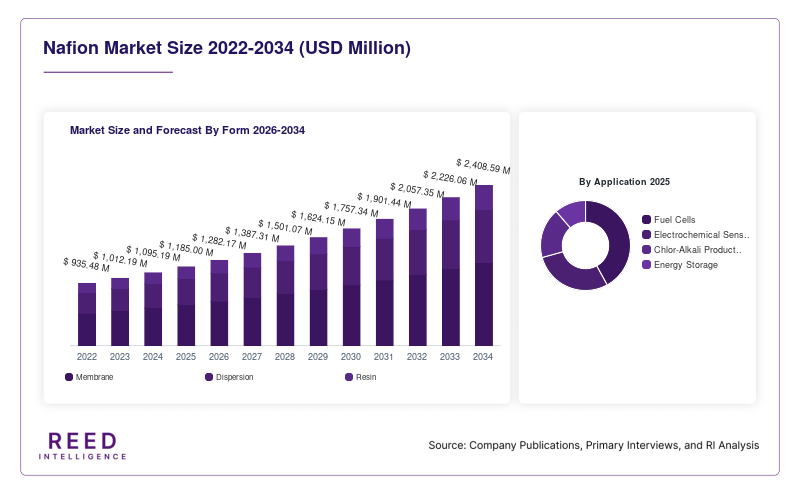
The Nafion market is segmented by Form and Application to provide a comprehensive market perspective. By Form, the Membrane segment holds the largest share at 55%, driven by fuel cell and electrolyzer demand. The Application segment is led by Fuel Cells at 45%, followed by Energy Storage at 28%, Electrochemical Sensors at 18%, and Chlor-Alkali Production at 9%.
By Form
Membrane represents the largest segment in the Nafion market, commanding a 55% share, with revenue exceeding USD 707 million in 2025. These are thin, solid sheets used as proton exchange membranes in fuel cells and electrolyzers. Technical specifications include thickness (typically 50-200 µm), equivalent weight, and conductivity. The market's Membrane segment is driven by its critical role in enabling hydrogen-based energy conversion and storage.
Dispersion captures a 25% share of the Nafion market, with revenue of USD 321 million in 2025. These are liquid formulations containing Nafion polymer in a solvent, used for coating electrodes and casting thin films. Technical specifications include solid content, viscosity, and solvent type. The market's Dispersion segment is driven by its use in sensor manufacturing and the development of catalyst coatings for fuel cells, where precise application and film uniformity are essential.
Resin accounts for 20% of the market, with revenue of USD 257 million in 2025. This form involves the polymer in a pellet or powder form for compounding and extrusion. Technical specifications include melt flow rate, ion exchange capacity, and thermal stability. The market's Resin segment is driven by its use in producing custom shapes, fittings, and components for electrochemical systems.
By Application
Fuel Cells dominates the Nafion market, accounting for 45% of sales, representing USD 579 million in 2025. This segment includes PEM fuel cells for automotive and stationary power, which rely on Nafion membrane technology for proton conduction. Usage penetration exceeds 70% in automotive fuel cell stacks. The market's Fuel Cells segment is characterized by its focus on performance, durability, and cost reduction, driving innovation in composite membranes.
Energy Storage accounts for 28% of the Nafion market, with revenue of USD 360 million in 2025. This segment includes flow batteries and regenerative fuel cells, where Nafion is used as a membrane separator. The segment is growing at a significant 10% CAGR, driven by the need for grid-scale energy storage solutions. The market's Energy Storage segment is characterized by its focus on reliability and long cycle life, requiring robust membrane materials.
Electrochemical Sensors represents 18% of the market, with revenue of USD 231 million in 2025. This segment uses Nafion as a selective membrane or coating in gas and ion sensors. The segment is growing rapidly, fueled by demand for environmental monitoring and portable diagnostics. The market's Electrochemical Sensors segment is characterized by its need for high sensitivity and selectivity, leveraging Nafion's unique ion-exchange properties.
Chlor-Alkali Production accounts for 9% of the market, with revenue of USD 116 million in 2025. This traditional application uses Nafion membranes in electrolytic cells for producing chlorine and caustic soda. The segment is mature but stable, driven by the ongoing demand for chlorine in water treatment and chemical manufacturing. The market's Chlor-Alkali segment is characterized by its focus on efficiency and long-term operational stability.
Nafion Market Regional Outlook
North America Nafion Market
Leads the Nafion market, commanding a 38% share, with revenue of USD 489 million in 2025. The United States is the primary driver, accounting for 85% of regional demand, driven by significant government funding for hydrogen fuel cell technology and a strong industrial base. The region's focus on innovation in fuel cell and membrane technology secures its leading position.
Europe Nafion Market
Represents the second-largest market, capturing a 30% share with revenue of USD 386 million in 2025. Germany, the United Kingdom, and France are the primary drivers, together accounting for 60% of regional demand, driven by the EU's ambitious green hydrogen targets and a robust automotive sector. The European market is projected to grow at a steady CAGR, supported by innovation in renewable energy.
Asia-Pacific Nafion Market
Accounts for 25% of the global Nafion market, with revenue of USD 321 million in 2025. China, Japan, and South Korea are the primary drivers, accounting for 65% of regional demand, fueled by massive investments in hydrogen infrastructure and fuel cell vehicle production. The Asia-Pacific market is projected to grow at the fastest CAGR of 10.5% through 2034, driven by government policies and industrial expansion.
Latin America and Middle East & Africa Nafion Market
Together account for the remaining 7% of the Nafion market, with Brazil and the UAE leading their respective regions. Both regions are projected to grow at CAGRs exceeding 9%, driven by increasing interest in renewable energy and hydrogen projects.
Top players in Nafion Market
- Chemours Company
- AGC Inc.
- Solvay S.A.
- Dongyue Group
- Asahi Kasei Corporation
- Sumitomo Chemical Co., Ltd.
- W.L. Gore & Associates
- Ionix Technology
- Spectrum Materials
- Fumatech BWT
- Ballard Power Systems
- Gore Fuel Cell Technologies
- Donaldson Company
- Johnson Matthey
Chemours Company
Chemours Company is a dominant player in the Nafion market, holding an estimated 45% share. As the original developer of Nafion, the company's products are the industry benchmark for performance. Chemours maintains its leadership through continuous innovation in membrane technology and a robust patent portfolio. Their materials are widely used in fuel cells, chlor-alkali production, and advanced sensors, with a strong market position reinforced by their global supply chain and technical support, giving them a unique competitive advantage.
AGC Inc.
AGC Inc. is a major global player with a significant 18% share in the Nafion market. The company has invested heavily in expanding its fluoropolymer production capacity for ion-exchange membranes. Their Fluon ion-exchange membranes are renowned for their durability and high chemical stability. AGC's strategic focus on the Asian and European markets, where hydrogen and fuel cell adoption is surging, has positioned them as a key supplier of high-performance materials, catering to the growing demand for reliable electrochemical components.
Nafion Market Segments
By Form
- Membrane
- Dispersion
- Resin
By Application
- Fuel Cells
- Electrochemical Sensors
- Chlor-Alkali Production
- Energy Storage
By Region
- North America
- Europe
- APAC
- Middle East and Africa
- LATAM