Packaged Seeds Market Size, Share, Demand Report By Type (Cereal Seeds, Oilseed Seeds, Vegetable Seeds), By Application (Agriculture, Horticulture, Commercial Farming), By Region & Segment Forecasts, 2026–2034
USD 3950
Packaged Seeds Market Size
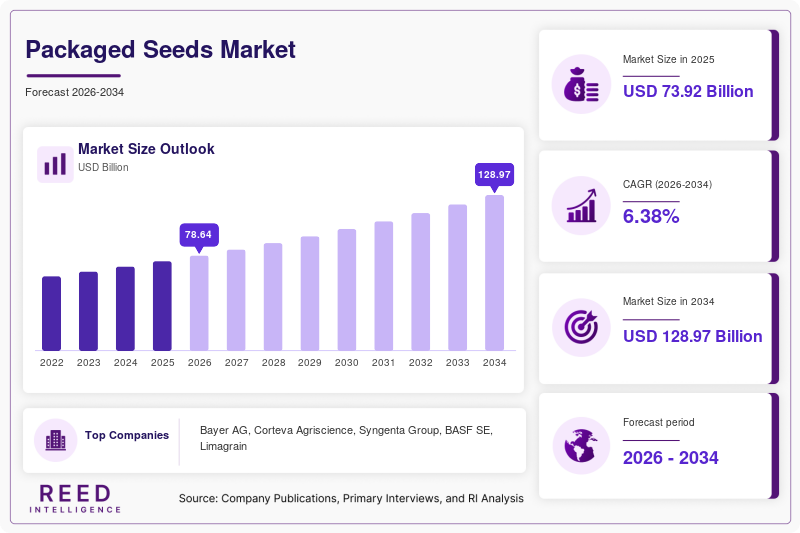
Packaged Seeds market size is projected at USD 78.64 billion in 2026 and is expected to hit USD 128.92 billion by 2034 with a CAGR of 6.38%. The market is witnessing increasing investments in seed treatment technologies, precision farming, and certified seed distribution networks. Growing demand for high-yield crop varieties, detailed segmentation analysis, and competitive landscape evaluation continues to support strategic decision-making across the global agricultural sector.
The packaged seeds market comprises commercially processed, certified, labeled, and distributed seeds used across agricultural and horticultural applications. Global packaged seed production exceeded 62 million metric tons in 2025, while certified seed penetration reached nearly 71% of total commercial crop cultivation. Cereal seeds accounted for approximately 46% of industry revenue, followed by oilseed seeds with 31% and vegetable seeds with 23%. More than 1.8 billion hectares of cultivated land globally rely on improved seed varieties, reinforcing the importance of the packaged seeds market.
Packaged Seeds Market Trends
Rising Adoption of Genetically Improved and Hybrid Seeds
Global hybrid and improved seed production surpassed 38 million metric tons during 2025, representing over 61% of total commercial seed output. Adoption rates among large-scale farmers exceeded 74% in North America and 68% in Europe, while several Asian countries reported adoption growth above 9% annually. Enhanced germination rates of 92% to 98% and yield improvements of 15% to 30% are accelerating investment across the packaged seeds market.
Increasing integration of seed coating technologies, biological treatments, and digital traceability systems is transforming commercial seed distribution. More than 45% of newly launched seed products now include protective coatings and micronutrient enhancements. Commercial farming operations utilizing treated seeds reported crop loss reductions of 12% to 18%, supporting long-term packaged seeds market trends.
Packaged Seeds Market Drivers
Growing Demand for High-Yield Agricultural Production
Global food consumption is projected to increase by more than 35% by 2034, creating substantial demand for quality seed varieties. Certified seed usage improved from 63% in 2022 to nearly 71% in 2025, while hybrid seed sales expanded by 8.4% annually. More than 850 million hectares of farmland currently utilize packaged seeds for yield optimization and disease resistance, strengthening packaged seeds market growth.
Packaged Seeds Market Restraints
High Cost of Premium and Hybrid Seed Varieties
Premium seed products often cost 25% to 60% more than conventional alternatives, limiting adoption among small-scale farmers. In several developing economies, nearly 38% of growers continue to use farm-saved seeds due to affordability concerns. Seed replacement rates remain below 35% in certain agricultural regions, while distribution inefficiencies increase procurement costs by 8% to 15%, restricting expansion of the packaged seeds market.
Packaged Seeds Market Opportunities
Expansion of Precision Agriculture and Sustainable Farming
Precision agriculture adoption exceeded 29% globally in 2025 and continues to rise across major farming regions. More than 420 million hectares are expected to integrate advanced farm management technologies by 2034. Demand for climate-resilient, drought-tolerant, and disease-resistant seeds is increasing at over 10% annually, creating significant opportunities within the packaged seeds market.
Challenges in Packaged Seeds Market
Climate Variability and Supply Chain Disruptions
Extreme weather events affected nearly 14% of global seed production areas during 2024 and 2025. Temperature fluctuations reduced seed yield quality by 5% to 12% in several producing regions. Transportation costs increased by approximately 11%, while inventory management challenges impacted distribution efficiency by 7% to 9%, creating operational difficulties for the packaged seeds market.
Packaged Seeds Market Segmentation
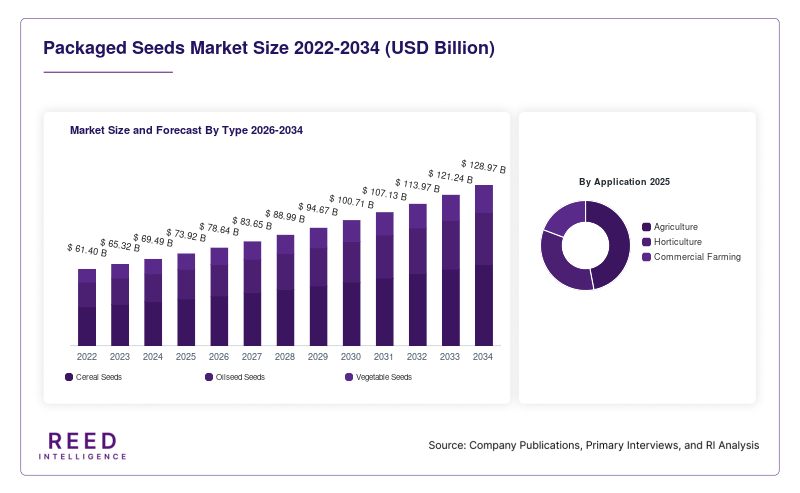
The market is segmented based on type and application. Cereal seeds maintained the leading position with approximately 46% market share during 2025, while agriculture applications contributed nearly 58% of total revenue. Increasing commercialization of farming activities and growing adoption of certified seed products continue to influence segment performance.
By Type
Cereal seeds represent the largest segment, accounting for nearly 46% of industry revenue. Annual production exceeded 28 million metric tons in 2025. Wheat, rice, and maize varieties dominate this category, with germination rates typically ranging between 90% and 98%. Advanced hybrid cereal seeds improve productivity by 18% to 32%.
Oilseed seeds contribute approximately 31% of market revenue. Global production surpassed 19 million metric tons, supported by increasing demand for soybean, sunflower, and canola cultivation. Enhanced disease resistance technologies have improved crop performance by 12% to 20% across commercial farming operations.
Vegetable seeds account for nearly 23% of total revenue. Production exceeded 15 million metric tons in 2025, supported by rising horticulture activities and greenhouse cultivation. Hybrid vegetable varieties demonstrate yield improvements of 20% to 35% and adoption rates above 65% in commercial operations.
By Application
Agriculture remains the largest application segment with approximately 58% market share. More than 1 billion hectares of cultivated land utilize packaged seeds for staple crop production. Adoption of certified seeds has increased productivity by 15% to 28% while reducing crop losses by up to 12%.
Horticulture accounts for around 24% of market demand. Commercial fruit and vegetable production exceeded 2 billion metric tons globally in 2025. High-performance seed varieties support uniform growth, improved shelf life, and productivity gains ranging from 10% to 25%.
Commercial farming contributes nearly 18% of market revenue. Large-scale farming enterprises increasingly utilize treated and hybrid seeds across more than 350 million hectares globally. Seed technology adoption rates exceed 70% among organized farming operations.
Packaged Seeds Market Regional Outlook
North America Packaged Seeds Market
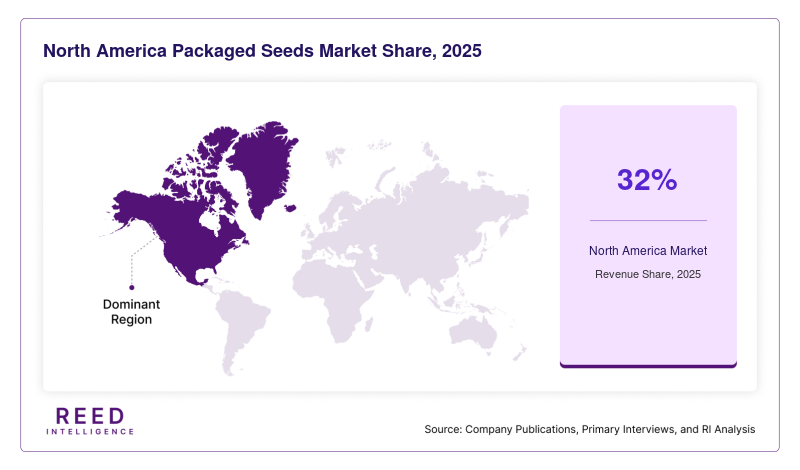
North America held approximately 32% of global revenue in 2025. The United States contributed nearly 78% of regional demand, supported by advanced farming practices and hybrid seed adoption exceeding 80%. Annual regional seed production surpassed 14 million metric tons.
Europe Packaged Seeds Market
Europe accounted for around 24% of market revenue. Germany, France, and Spain collectively represented more than 56% of regional consumption. Certified seed utilization rates exceeded 75%, while sustainable agriculture initiatives expanded by 11% annually.
Asia-Pacific Packaged Seeds Market
Asia-Pacific represented approximately 30% of total market share and remains the fastest-growing region. China and India together contributed nearly 63% of regional seed demand. Agricultural production across the region exceeded 28 million metric tons of packaged seed output during 2025.
Latin America Packaged Seeds Market
Latin America captured nearly 8% of global revenue. Brazil represented over 45% of regional demand due to extensive soybean and corn cultivation. Hybrid seed penetration surpassed 67% across commercial farms.
Middle East & Africa Packaged Seeds Market
The Middle East & Africa accounted for about 6% of market revenue. Increasing government support for food security programs and improved seed distribution networks contributed to annual demand growth exceeding 7%.
Top players in Packaged Seeds Market
- Bayer AG
- Corteva Agriscience
- Syngenta Group
- BASF SE
- Limagrain
- KWS SAAT SE
- Sakata Seed Corporation
- Rijk Zwaan
- DLF Seeds
- Takii & Co., Ltd.
- Advanta Seeds
- Nuziveedu Seeds
- East-West Seed
- UPL Ltd.
- Mahyco Seeds
Bayer AG
- Estimated market share: 16%-18%
- Strong presence in hybrid corn, soybean, and vegetable seed categories.
- Extensive global distribution across more than 100 countries.
- Significant investments in biotechnology and seed trait development.
- Advanced seed treatment portfolio supporting yield improvement and crop protection.
Corteva Agriscience
- Estimated market share: 13%-15%
- Leading position in corn and soybean seed technologies.
- Strong research infrastructure with multiple breeding facilities worldwide.
- Focus on climate-resilient and high-yield seed varieties.
- Broad commercial farming customer base across North America, Europe, and Asia-Pacific.
Recent Developments in Packaged Seeds Market
- 2025: Bayer expanded digital seed traceability solutions across major agricultural markets.
- 2025: Corteva introduced new drought-tolerant hybrid seed varieties for commercial farming.
Packaged Seeds Market Segments
By Type
- Cereal Seeds
- Oilseed Seeds
- Vegetable Seeds
By Application
- Agriculture
- Horticulture
- Commercial Farming
By Region
- North America
- Europe
- APAC
- Middle East and Africa
- LATAM