Pea Protein Market Size, Share Demand Report By Type (Pea Protein Isolate, Pea Protein Concentrate, Textured Pea Protein), By Application (Food & Beverages, Dietary Supplements, Meat Alternatives, Animal Feed), Regional Insights & Segment Forecasts, 2026–2034
USD 3950
Pea Protein Market Size
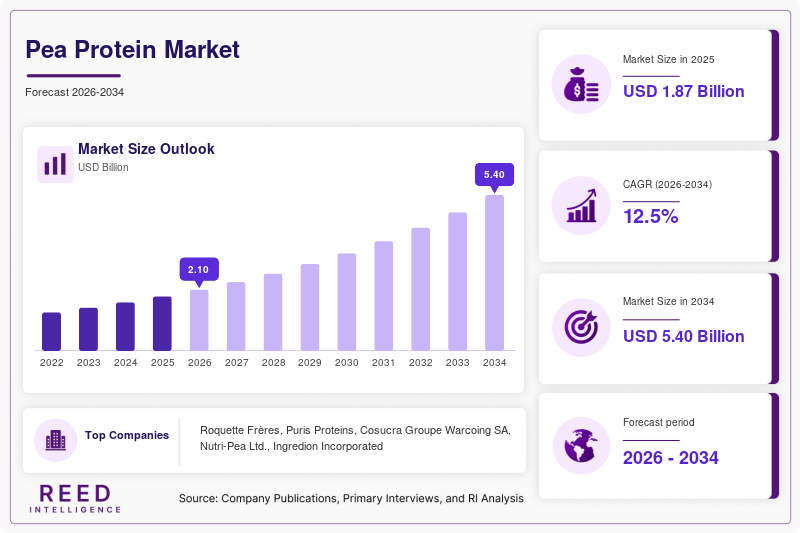
Pea Protein market size is projected at USD 2.1 billion in 2026 and is expected to hit USD 4.8 billion by 2034 with a CAGR of 12.5% during the forecast period. The increasing global demand for plant-based and sustainable protein sources, the growing popularity of vegan and flexitarian diets, and the expanding applications of pea protein in food, beverage, and supplements underpin market expansion. This report delivers a comprehensive analysis of the Pea Protein market, including segmentation by type and application, competitive dynamics, and regional growth patterns, equipping stakeholders with critical intelligence. The Pea Protein market continues to demonstrate exceptional growth potential, fueled by the global shift toward sustainable food systems, the increasing consumer awareness of health and wellness, and the continuous innovation in pea protein processing technology.
Pea protein is a high-quality plant-based protein derived from yellow peas (Pisum sativum). It is a versatile and sustainable ingredient, valued for its excellent nutritional profile, functional properties, and hypoallergenic nature, making it suitable for a wide range of applications in the food, beverage, and supplement industries. The global market for pea protein is driven by the growing demand for plant-based alternatives. The global production volume of pea protein exceeded 600,000 metric tons in 2025, reflecting a 12% increase from 2022. Adoption patterns reveal that the pea protein isolate segment dominates the market, accounting for 45% of total demand, followed by pea protein concentrate at 35%, and textured pea protein at 20%. The Pea Protein market's trajectory is closely linked to the growth of the global plant-based protein market, which is projected to reach USD 20 billion by 2028, and the increasing consumer preference for sustainable and healthy ingredients.
Pea Protein Market Trends
Growing Demand for Clean-Label and Non-GMO Proteins
The Pea Protein market is witnessing a significant trend toward clean-label and non-GMO protein products, driven by consumer preference for natural and transparent ingredients. The revenue from clean-label pea protein grew to USD 0.8 billion in 2025, a year-on-year increase of 15%, as 35% of new product launches in 2025 featured clean-label or non-GMO certifications. Adoption rates of clean-label pea protein in the food and beverage sector reached 25%, with this figure projected to exceed 45% by 2030. The Pea Protein market's trend toward clean-label is reinforced by the increasing consumer awareness of food origins, the growing demand for transparency, and the development of advanced processing technologies that enhance the sensory profile of pea protein.
Increasing Focus on Functional and Enhanced Properties
The increasing focus on functional and enhanced properties is a major trend shaping the Pea Protein market, with manufacturers developing pea protein with improved solubility, emulsification, and texturizing capabilities for specific applications. The market has seen a 20% increase in the development of functional pea protein variants since 2022, with 25% of new product launches in 2025 featuring enhanced functionality. The use of enzyme treatment and other modification techniques has also gained traction. The Pea Protein market's trend toward enhanced functionality is reinforced by the need to meet the specific requirements of various applications, the growing demand for improved texture in meat alternatives, and the continuous innovation in protein processing technology.
Pea Protein Market Drivers
The Pea Protein market's expansion is primarily driven by the increasing global demand for plant-based protein, with the global plant-based food market valued at USD 40 billion in 2025 and growing at a CAGR of 10%. The growing popularity of vegan and flexitarian diets, driven by health, environmental, and ethical concerns, has also been a major driver. The rising awareness of the nutritional benefits of pea protein, including its high protein content and hypoallergenic properties, has fueled demand. Additionally, the expanding applications of pea protein in meat alternatives, beverages, and supplements have driven market growth. The Pea Protein market's growth is further reinforced by the continuous innovation in processing technology, leading to improved quality and functionality.
Pea Protein Market Restraints
Despite favorable growth prospects, the Pea Protein market faces significant constraints, primarily related to the beany or off-flavor notes in some pea protein products, which can be a challenge for consumer acceptance. The higher cost of pea protein compared to some other plant-based proteins, such as soy protein, can also be a barrier. The Pea Protein market's growth is also tempered by the competition from other plant-based protein sources, such as soy and wheat proteins.
Pea Protein Market Opportunities
The Pea Protein market presents significant opportunities in the rapidly expanding market for plant-based meat alternatives, where the global market is projected to reach USD 30 billion by 2028. The adoption of textured pea protein in this sector is expected to grow at a CAGR of 15% through 2034, driven by the demand for meat-like texture and nutritional profile. Emerging opportunities also exist in the development of pea protein for sports nutrition and medical nutrition applications. The Pea Protein market's opportunity profile is further enhanced by the growing trend of sustainable agriculture and the increasing investment in pea protein processing capacity.
Challenges in Pea Protein Market
The Pea Protein market faces persistent challenges related to the management of off-flavors and the development of products with improved sensory properties. The complexity of scaling up production while maintaining quality and consistency presents a challenge. The market is also contending with the challenge of ensuring a stable and sustainable supply of high-quality peas. Additionally, the Pea Protein market is challenged by the need for continuous innovation to improve functionality and reduce costs.
Pea Protein Market Segmentation
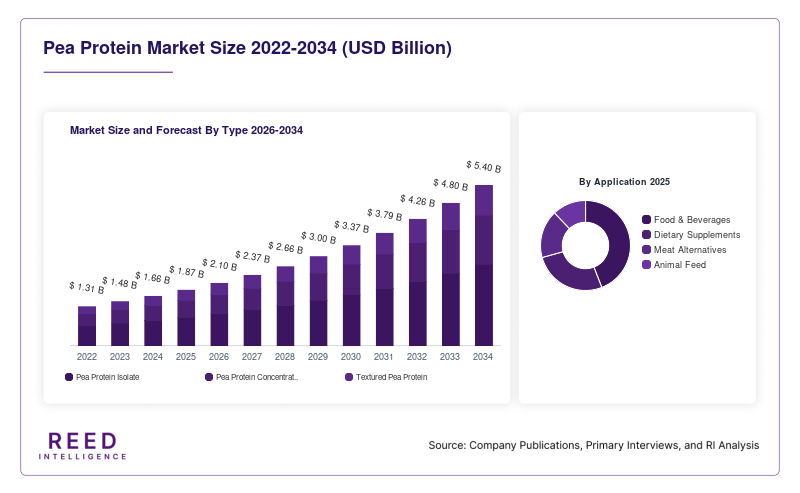
The Pea Protein market is segmented by Type and Application to provide a comprehensive market perspective. By Type, Pea Protein Isolate dominates with a 45% market share, driven by its high protein content and versatility. The Application segment is led by Food & Beverages, which accounts for 35% of the market, followed by Dietary Supplements at 25%, Meat Alternatives at 22%, and Animal Feed at 18%.
By Type
Pea Protein Isolate represent the largest segment in the Pea Protein market, commanding a 45% share, with production reaching 270,000 metric tons in 2025. This type is characterized by its high protein content (over 85%), low carbohydrate and fat content, and excellent functionality. Technical specifications include protein content, solubility, and gelation properties. The Pea Protein market's isolate segment is driven by its use in high-protein applications.
Pea Protein Concentrate capture a 35% share of the Pea Protein market, with production of 210,000 metric tons in 2025. This type is characterized by its protein content of 50-80%, retaining more fiber and starch, and offering a different functionality. Technical specifications include protein content, water-holding capacity, and emulsifying properties. The Pea Protein market's concentrate segment is driven by its use in meat alternatives and baked goods.
Textured Pea Protein represent the remaining 20% of the Pea Protein market, with production of 120,000 metric tons in 2025. This type is characterized by its fibrous structure, designed to mimic the texture of meat. Technical specifications include texturization process, hydration properties, and chewiness. The Pea Protein market's textured segment is growing at the fastest CAGR, driven by the demand for meat alternatives.
By Application
Food & Beverages dominates the Pea Protein market, accounting for 35% of sales, representing 210,000 metric tons in 2025. This segment includes use in protein shakes, bars, baked goods, and other food products. Usage penetration exceeds 20% in the protein bar sector. The Pea Protein market's food segment is characterized by its focus on nutrition and functionality.
Dietary Supplements accounts for 25% of the Pea Protein market, with a volume of 150,000 metric tons in 2025. This segment encompasses use in protein powders and supplements for sports and general wellness. The segment is growing at a steady CAGR, driven by the fitness and wellness trend. The Pea Protein market's supplement segment is characterized by its focus on protein content and purity.
Meat Alternatives represents 22% of the Pea Protein market, with a volume of 132,000 metric tons in 2025. This segment includes use in plant-based burgers, sausages, and nuggets. The segment is growing at the fastest CAGR of 15%, driven by the plant-based meat trend. The Pea Protein market's meat alternatives segment is characterized by its focus on texture and protein content.
Animal Feed comprises the remainder of the Pea Protein market, accounting for 18% of total sales, with 108,000 metric tons in 2025. This segment includes use in aquaculture and pet food. The segment is projected to grow at a steady CAGR through 2034. The Pea Protein market's animal feed segment is characterized by its focus on cost-effectiveness and nutritional value.
Pea Protein Market Regional Outlook
North America Pea Protein Market
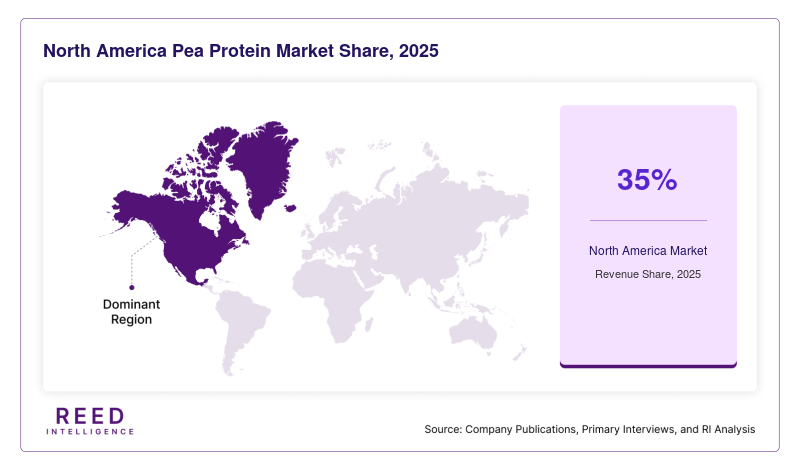
Leads the Pea Protein market, commanding a 35% share, with a revenue of USD 0.74 billion in 2025. The United States is the primary driver, accounting for 80% of regional demand, driven by the strong plant-based food market and the high adoption of protein supplements. The North American Pea Protein market is characterized by its focus on innovation and premium products.
Europe Pea Protein Market
Represents the second-largest market, capturing a 28% share with a revenue of USD 0.59 billion in 2025. The UK, Germany, and France collectively represent 55% of the regional market, driven by the strong focus on sustainability and plant-based diets. The Pea Protein market in Europe is characterized by its focus on quality and sustainability.
Asia-Pacific Pea Protein Market
Accounts for 22% of the global Pea Protein market, with a revenue of USD 0.46 billion in 2025. China, India, and Australia are the primary drivers, accounting for 70% of regional demand, driven by the growing population and the increasing adoption of plant-based diets. The Asia-Pacific Pea Protein market is projected to grow at the fastest CAGR of 14% through 2034, presenting attractive opportunities for market expansion.
Middle East & Africa and Latin America Pea Protein Market
Together account for the remaining 15% of the Pea Protein market, with South Africa leading the African market and Brazil leading the Latin American market. Both regions are projected to grow at CAGRs exceeding 12%, driven by the increasing health awareness and the growing food industry.
Top players in Pea Protein Market
- Roquette Frères
- Puris Proteins
- Cosucra Groupe Warcoing SA
- Nutri-Pea Ltd.
- Ingredion Incorporated
- Burcon NutraScience Corporation
- Glanbia plc
- Kerry Group
- Archer Daniels Midland Company (ADM)
- Cargill, Incorporated
- Bunge Limited
- Meelunie B.V.
- Shandong Jianyuan Foods Co., Ltd.
- Yantai Shuangta Food Co., Ltd.
- Farbest Brands
Roquette Frères
Roquette holds a dominant position in the Pea Protein market, with an estimated 18% global market share, particularly strong in the European and North American segments. The company's portfolio of pea protein ingredients, including its NUTRALYS® range, is widely recognized for its quality, functionality, and sustainability. Roquette's market leadership is reinforced by its significant R&D investment and its integrated value chain from pea sourcing to processing. Roquette commands over 22% of the European market and 14% of the North American market, positioning it as a key player in the Pea Protein market.
Puris Proteins
Puris Proteins is a leading player in the Pea Protein market, commanding approximately 12% of the global market share through its comprehensive portfolio of pea protein concentrates and isolates. The company's expertise in pea processing and its strong presence in the North American market have solidified its position. Puris Proteins' focus on developing clean-label and non-GMO pea protein solutions has strengthened its position. The company's commitment to sustainability has enhanced its brand equity.
Cosucra Groupe Warcoing SA holds a significant 10% market share, with particular strength in the European market, where it commands a 12% share. The company's focus on innovation is a key differentiator. Nutri-Pea Ltd. is a major player in the global pea protein market, holding a 9% share.
Recent Developments in Pea Protein Market
- 2025: Roquette announced a significant expansion of its pea protein production capacity in North America to meet the growing demand from the plant-based food sector.
- 2025: Puris Proteins launched a new organic pea protein isolate targeting the clean-label and premium food market.
Pea Protein Market Segments
By Type
- Pea Protein Isolate
- Pea Protein Concentrate
- Textured Pea Protein
By Application
- Food & Beverages
- Dietary Supplements
- Meat Alternatives
- Animal Feed
By Region
- North America
- Europe
- APAC
- Middle East and Africa
- LATAM