Radio Modem Market Size, Share Demand Report By Type (Licensed Radio Modems, Unlicensed Radio Modems), By Application (Telecommunications, Industrial Automation, Public Safety & Defense, Transportation), Regional Insights & Segment Forecasts, 2026–2034
USD 3950
Radio Modem Market Size
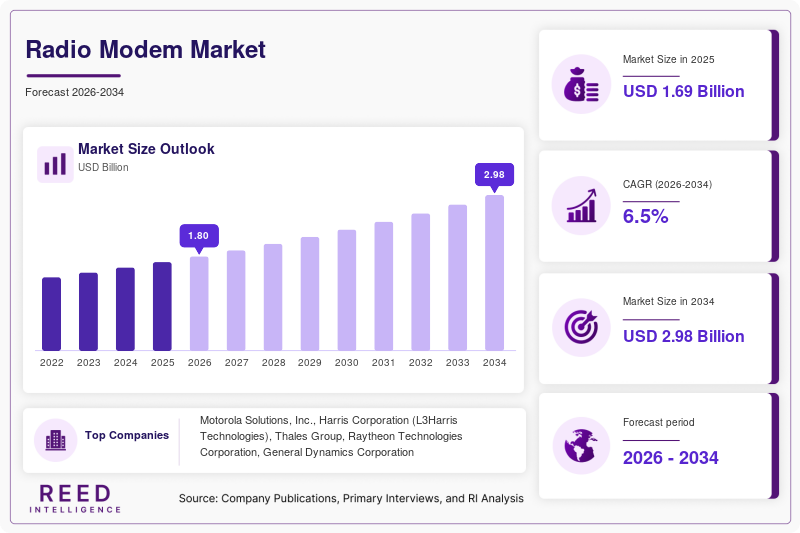
Radio Modem market size is projected at USD 1.8 billion in 2026 and is expected to hit USD 2.9 billion by 2034 with a CAGR of 6.5% during the forecast period. The increasing demand for reliable and long-range wireless communication, the growing adoption of industrial IoT and automation, and the rising need for secure communication in public safety and defense underpin market expansion. This report delivers a comprehensive analysis of the Radio Modem market, including segmentation by type and application, competitive dynamics, and regional growth patterns, equipping stakeholders with critical intelligence. The Radio Modem market continues to demonstrate robust growth potential, fueled by the global digital transformation, the expansion of critical communication infrastructure, and the continuous innovation in radio technology.
Radio modems are communication devices that enable the transmission of data over radio frequencies, providing wireless connectivity for a wide range of applications. They are used to establish point-to-point or point-to-multipoint links, offering reliable and often long-range communication for industrial, public safety, and telecommunications networks. The global market for radio modems is driven by the need for robust and secure wireless data transmission. The global production volume of radio modems exceeded 5 million units in 2025, reflecting a 6% increase from 2022. Adoption patterns reveal that the unlicensed radio modem segment dominates the market, accounting for 60% of total demand, followed by licensed radio modems at 40%. The Radio Modem market's trajectory is closely linked to the growth of the global wireless communication market, which is projected to reach USD 1 trillion by 2028, and the increasing demand for reliable connectivity in various sectors.
Radio Modem Market Trends
Growing Adoption of Software-Defined Radio (SDR) Technology
The Radio Modem market is witnessing a significant trend toward the adoption of Software-Defined Radio (SDR) technology, driven by the need for flexibility, upgradability, and multi-band/multi-mode operation. The revenue from SDR-based radio modems grew to USD 0.5 billion in 2025, a year-on-year increase of 10%, as 25% of new radio modem developments in 2025 featured SDR technology. Adoption rates of SDR in the defense and public safety sectors reached 30%, with this figure projected to exceed 50% by 2030. The Radio Modem market's trend toward SDR is reinforced by the need for cognitive and adaptive radio systems, the growing demand for interoperability, and the decreasing cost of high-performance digital signal processing.
Increasing Focus on Security and Encryption
The increasing focus on security and encryption is a major trend shaping the Radio Modem market, driven by the need to protect sensitive data in critical communications. The market has seen a 20% increase in the demand for radio modems with advanced encryption features since 2022, with 25% of new product launches in 2025 featuring high-grade security protocols. The use of AES-256 and other advanced encryption standards has also gained traction. The Radio Modem market's trend toward security is reinforced by the increasing threats to communication networks, the growing stringency of data protection regulations, and the continuous innovation in cryptographic technology.
Radio Modem Market Drivers
The Radio Modem market's expansion is primarily driven by the increasing demand for reliable and long-range wireless communication in industrial automation, with the global industrial IoT market valued at USD 200 billion in 2025 and growing. The growing need for secure and resilient communication in public safety and defense sectors has also been a major driver. The rising adoption of radio modems in telecommunications for backhaul and last-mile connectivity has fueled market growth. Additionally, the increasing demand for wireless communication in transportation and logistics has driven the market. The Radio Modem market's growth is further reinforced by the continuous innovation in radio technology, leading to higher data rates, greater range, and improved reliability.
Radio Modem Market Restraints
Despite favorable growth prospects, the Radio Modem market faces significant constraints, primarily related to the high cost of licensed spectrum and the complexity of radio frequency (RF) design and regulation. The potential for interference and the limited availability of spectrum can also be a barrier. The Radio Modem market's growth is also tempered by the competition from other wireless technologies, such as cellular and satellite communication.
Radio Modem Market Opportunities
The Radio Modem market presents significant opportunities in the rapidly expanding market for smart grid and utility communication, where the global market is projected to reach USD 50 billion by 2028. The adoption of radio modems for smart metering and grid automation is expected to grow at a CAGR of 8% through 2034, driven by the need for reliable and secure communication. Emerging opportunities also exist in the development of radio modems for IoT and LPWAN applications. The Radio Modem market's opportunity profile is further enhanced by the growing trend of network modernization and the increasing use of unlicensed spectrum.
Challenges in Radio Modem Market
The Radio Modem market faces persistent challenges related to the management of spectrum availability and interference, as the radio frequency spectrum is a finite and shared resource. The complexity of meeting diverse regulatory requirements in different regions presents a challenge. The market is also contending with the challenge of ensuring interoperability and backward compatibility. Additionally, the Radio Modem market is challenged by the need for continuous innovation to keep pace with evolving communication standards and technologies.
Radio Modem Market Segmentation
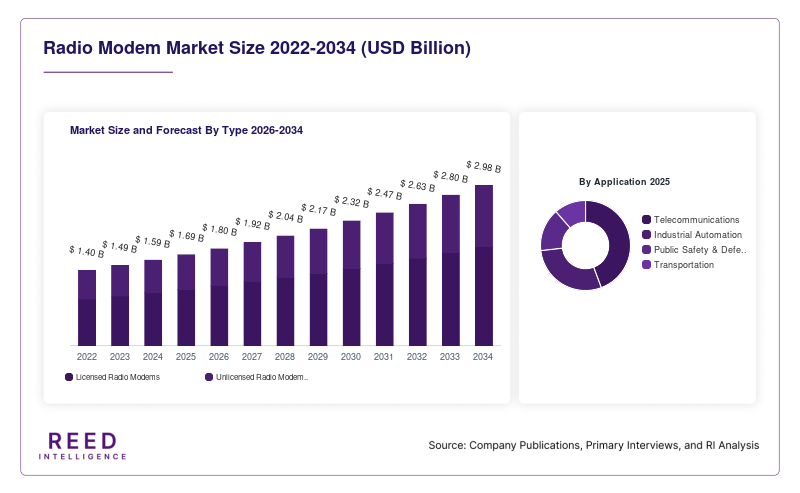
The Radio Modem market is segmented by Type and Application to provide a comprehensive market perspective. By Type, Unlicensed Radio Modems dominate with a 60% market share, driven by their ease of deployment and lower cost. The Application segment is led by Industrial Automation, which accounts for 30% of the market, followed by Telecommunications at 25%, Public Safety & Defense at 23%, and Transportation at 22%.
By Type
Unlicensed Radio Modems represent the largest segment in the Radio Modem market, commanding a 60% share, with production reaching 3 million units in 2025. These modems are characterized by their use of ISM bands, offering lower cost and easier deployment. Technical specifications include frequency bands (900 MHz, 2.4 GHz, etc.), data rates, and range. The Radio Modem market's unlicensed segment is driven by its use in industrial and commercial applications.
Licensed Radio Modems capture a 40% share of the Radio Modem market, with production of 2 million units in 2025. These modems are characterized by their use of licensed spectrum, offering guaranteed performance and reliability. Technical specifications include specific frequency bands, higher power, and robust security features. The Radio Modem market's licensed segment is driven by its use in public safety, defense, and critical infrastructure.
By Application
Industrial Automation dominates the Radio Modem market, accounting for 30% of sales, representing 1.5 million units in 2025. This segment includes use in SCADA, remote monitoring, and control systems. Usage penetration exceeds 40% in industrial settings. The Radio Modem market's industrial segment is characterized by its focus on reliability and range.
Telecommunications accounts for 25% of the Radio Modem market, with sales of 1.25 million units in 2025. This segment encompasses use in backhaul, point-to-point links, and rural connectivity. The segment is growing at a steady CAGR, driven by the need for network expansion. The Radio Modem market's telecommunications segment is characterized by its focus on high data rates and capacity.
Public Safety & Defense represents 23% of the Radio Modem market, with sales of 1.15 million units in 2025. This segment includes use in emergency communication, military networks, and secure government systems. The segment is growing at a steady CAGR, driven by the focus on security and resilience. The Radio Modem market's public safety segment is characterized by its focus on security and reliability.
Transportation comprises the remainder of the Radio Modem market, accounting for 22% of total sales, with 1.1 million units in 2025. This segment includes use in traffic management, fleet tracking, and railway communication. The segment is projected to grow at a steady CAGR through 2034. The Radio Modem market's transportation segment is characterized by its focus on mobility and robustness.
Radio Modem Market Regional Outlook
North America Radio Modem Market
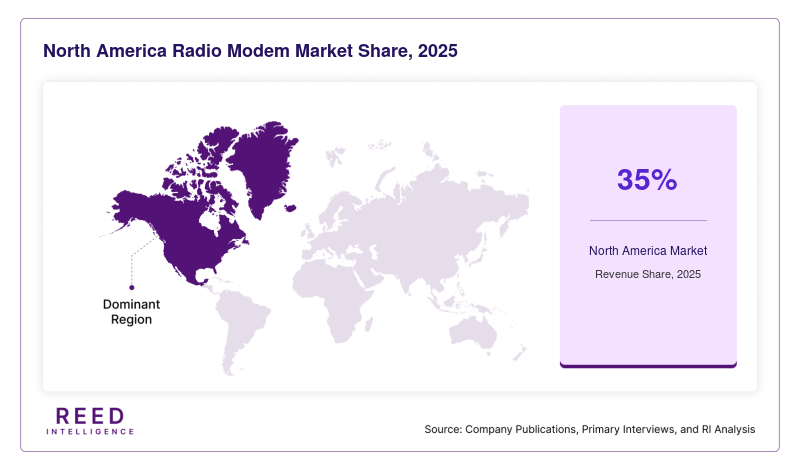
Leads the Radio Modem market, commanding a 35% share, with a revenue of USD 0.63 billion in 2025. The United States is the primary driver, accounting for 80% of regional demand, driven by the strong defense, public safety, and industrial sectors. The North American Radio Modem market is characterized by its focus on innovation and high-security solutions.
Europe Radio Modem Market
Represents the second-largest market, capturing a 28% share with a revenue of USD 0.50 billion in 2025. Germany, the UK, and France collectively represent 55% of the regional market, driven by the strong industrial and defense sectors. The Radio Modem market in Europe is characterized by its focus on quality and regulatory compliance.
Asia-Pacific Radio Modem Market
Accounts for 22% of the global Radio Modem market, with a revenue of USD 0.40 billion in 2025. China, Japan, and Australia are the primary drivers, accounting for 70% of regional demand, driven by the rapid industrialization and the growing telecommunications sector. The Asia-Pacific Radio Modem market is projected to grow at the fastest CAGR of 8% through 2034, presenting attractive opportunities for market expansion.
Middle East & Africa and Latin America Radio Modem Market
Together account for the remaining 15% of the Radio Modem market, with the UAE leading the Middle East market and Brazil leading the Latin American market. Both regions are projected to grow at CAGRs exceeding 7%, driven by the increasing infrastructure investments.
Top players in Radio Modem Market
- Motorola Solutions, Inc.
- Harris Corporation (L3Harris Technologies)
- Thales Group
- Raytheon Technologies Corporation
- General Dynamics Corporation
- Rohde & Schwarz GmbH & Co. KG
- Datum Systems, Inc.
- CalAmp Corp.
- Sierra Wireless, Inc.
- Digi International Inc.
- FreeWave Technologies, Inc.
- Elpro Technologies
- ABB Ltd.
- Schneider Electric SE
- Siemens AG
Motorola Solutions, Inc.
Motorola Solutions holds a dominant position in the Radio Modem market, with an estimated 16% global market share, particularly strong in the North American and European public safety and defense segments. The company's portfolio of radio communication solutions is widely recognized for its quality, reliability, and security. Motorola's market leadership is reinforced by its significant R&D investment and its strong customer relationships. Motorola Solutions commands over 20% of the North American market and 14% of the European market, positioning it as a key player in the Radio Modem market.
Harris Corporation (L3Harris Technologies)
L3Harris is a leading player in the Radio Modem market, commanding approximately 14% of the global market share through its comprehensive portfolio of tactical and secure communication systems. The company's expertise in defense and government communications and its strong presence in the global market have solidified its position. L3Harris' focus on developing advanced and secure radio modem solutions has strengthened its position.
Thales Group holds a significant 10% market share, with particular strength in the European and defense markets, where it commands a 12% share. The company's focus on integrated systems is a key differentiator. Raytheon Technologies Corporation is a major player in the global defense market, holding a 9% share.
Recent Developments in Radio Modem Market
- 2025: Motorola Solutions launched a new series of software-defined radio modems with enhanced security and interoperability features for public safety networks.
- 2025: L3Harris introduced a new high-capacity radio modem for tactical communications, offering higher data rates and improved range.
Radio Modem Market Segments
By Type
- Licensed Radio Modems
- Unlicensed Radio Modems
By Application
- Telecommunications
- Industrial Automation
- Public Safety & Defense
- Transportation
By Region
- North America
- Europe
- APAC
- Middle East and Africa
- LATAM