Global Silver Powder Market Size, Share, Growth Report By Type (Atomized Silver Powder, Flake Silver Powder, Nano Silver Powder, Spherical Silver Powder), By Application (Electronics Manufacturing, Photovoltaic Applications, Automotive Electronics, Medical & Healthcare Devices, Industrial Conductive Materials), By End-Use Industry (Consumer Electronics, Automotive Industry, Energy & Power, Industrial Manufacturing, Healthcare & Medical Devices) – Industry Forecast Analysis, 2026–2034
USD 3950
Market Overview
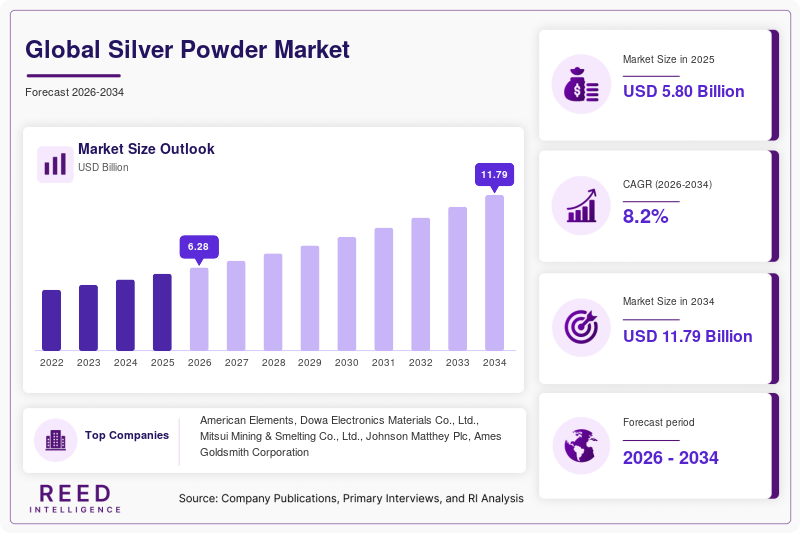
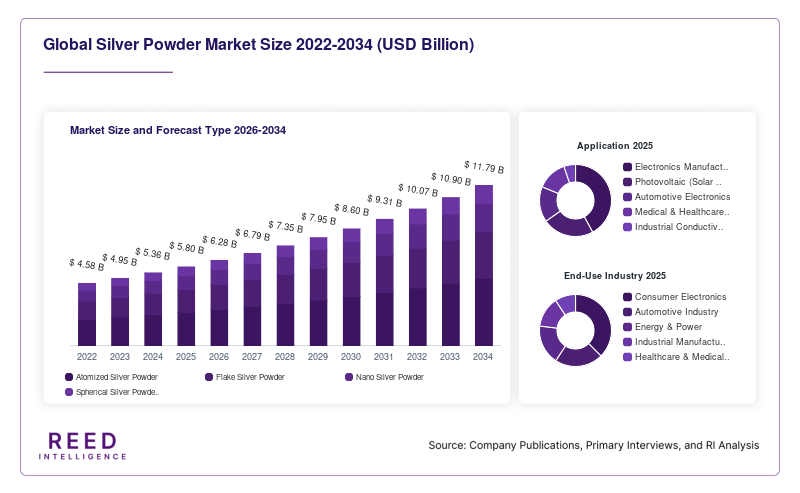
The Global Silver Powder Market size was valued at USD 5.8 billion in 2026 and is projected to reach USD 10.9 billion by 2034, expanding at a CAGR of 8.2% during the forecast period. Silver powder is widely used in conductive pastes, electronic components, photovoltaics, antimicrobial coatings, and advanced industrial applications due to its electrical conductivity, thermal stability, and corrosion resistance. The market continues to gain traction as manufacturers focus on miniaturized electronics, high-performance conductive materials, and renewable energy technologies. Demand from the electronics and solar industries remains one of the strongest contributors to market expansion across developed and emerging economies.
The rapid expansion of global semiconductor manufacturing and electric vehicle production has supported market growth over the past few years. Silver powder plays a critical role in conductive inks and multilayer ceramic capacitors used in advanced electronic systems. Growing investment in solar photovoltaic installations has also accelerated product demand, particularly in Asia Pacific and Europe. Manufacturers are increasingly introducing micron-sized and nano-scale silver powders to improve conductivity and reduce material consumption in printed electronics and battery technologies. In addition, the healthcare industry is adopting silver-based antimicrobial formulations for coatings and medical devices, creating additional opportunities for market participants.
Key Highlights
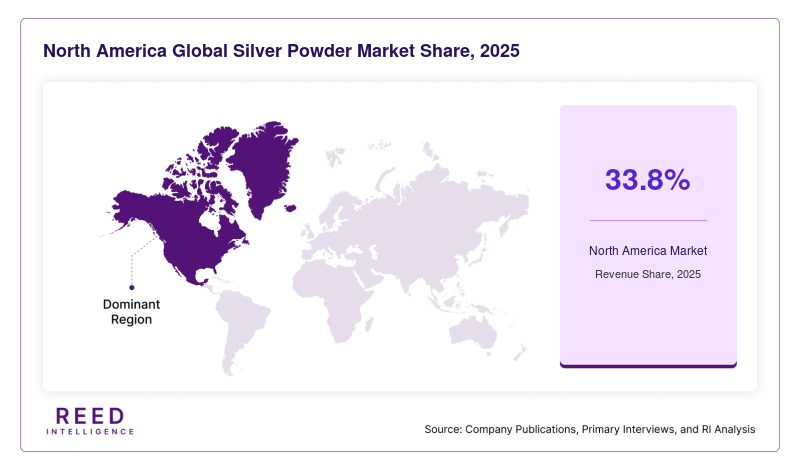
- North America dominated the market with a 33.8% share in 2025.
- Asia Pacific is expected to grow at the fastest CAGR of 9.6% during 2026–2034.
- By type, flake silver powder accounted for the largest share of 39.4%, while nano silver powder is projected to grow at a CAGR of 10.8%.
- By application, electronics and electrical components led with a 44.1% share, whereas photovoltaic cells are expected to expand at a CAGR of 11.3%.
- By end-use industry, electronics manufacturing held the dominant share of 42.6%, while healthcare and medical devices are forecast to grow at a CAGR of 9.9%. The United States remained the dominant country, with market values of USD 1.42 billion in 2024 and USD 1.56 billion in 2025.
Market Trends
Growing Adoption of Nano Silver Powder in Printed Electronics
The increasing use of printed electronics across consumer devices, automotive systems, and wearable technologies is emerging as a major trend in the Global Silver Powder Market. Manufacturers are adopting nano silver powder because of its superior conductivity, fine particle distribution, and compatibility with flexible substrates. Conductive inks based on nano silver are widely used in touch panels, RFID tags, sensors, and flexible circuits. The rise of foldable smartphones and lightweight electronic devices has further increased the requirement for compact conductive materials that can maintain performance under bending and stretching conditions. Companies are investing in research to improve dispersion stability and reduce sintering temperatures, enabling broader integration into advanced electronics manufacturing.
The trend is also supported by the expansion of smart packaging and Internet of Things devices, where miniaturized conductive materials are essential. Electronics producers are increasingly shifting toward additive manufacturing methods that reduce material waste and production costs. Nano silver powder is becoming an important material in these production systems due to its precision and conductivity. The market is expected to witness continued innovation in particle engineering and hybrid conductive formulations, particularly in Asia Pacific and North America.
Rising Demand from Solar Photovoltaic Manufacturing
The growing deployment of solar photovoltaic systems is significantly influencing the Global Silver Powder Market. Silver powder is an essential raw material used in conductive pastes for photovoltaic cells, where it supports efficient energy transfer and electrical conductivity. Governments across several countries are increasing investments in renewable energy infrastructure and introducing incentives for solar energy adoption. This has resulted in higher production of photovoltaic modules and a corresponding increase in silver powder consumption.
Manufacturers are developing advanced silver powder formulations that improve panel efficiency while reducing material usage per cell. The trend toward high-efficiency solar cells, including TOPCon and heterojunction technologies, is creating additional demand for premium-grade silver powders. China, India, Germany, and the United States are among the major countries expanding solar installations, which is supporting long-term market growth. Rising concerns related to energy security and carbon reduction targets are expected to sustain the expansion of solar manufacturing over the forecast period.
Market Drivers
Expansion of Global Electronics Manufacturing
The continued growth of the electronics manufacturing industry is a major driver for the Global Silver Powder Market. Silver powder is widely used in conductive adhesives, multilayer ceramic capacitors, printed circuit boards, and conductive pastes because of its high electrical conductivity and reliability. The rapid production of smartphones, laptops, consumer appliances, and communication equipment has created consistent demand for advanced conductive materials. Expansion of 5G infrastructure and data centers is also increasing the use of high-performance electronic components, supporting market growth.
Several semiconductor manufacturers are increasing capital investment to expand production capacity in North America, Europe, and Asia Pacific. This industrial expansion has accelerated the consumption of silver powder in precision electronic applications. In addition, the increasing use of electric vehicles and autonomous driving systems is creating higher demand for sensors and electronic modules. These developments are expected to strengthen long-term market opportunities for silver powder producers focused on electronics-grade materials.
Increasing Use of Antimicrobial Silver-Based Products
The growing awareness regarding hygiene and infection control is driving the adoption of antimicrobial silver-based materials across healthcare and consumer industries. Silver powder is increasingly incorporated into coatings, textiles, wound dressings, water filtration systems, and medical equipment due to its antimicrobial properties. Hospitals and healthcare facilities are using silver-coated products to reduce bacterial contamination and improve patient safety standards.
The demand for antimicrobial materials has also increased in public infrastructure, food packaging, and consumer appliances. Manufacturers are introducing silver-infused coatings for air purification systems, refrigerators, and high-contact surfaces in commercial buildings. Regulatory support for infection prevention technologies and increased healthcare spending are contributing to market expansion. The trend is particularly strong in developed economies where healthcare institutions are investing in advanced sterilization and antimicrobial solutions.
Market Restraint
Volatility in Silver Prices and Raw Material Supply
Price volatility in silver raw materials remains a major restraint for the Global Silver Powder Market. Silver prices are influenced by mining output, geopolitical conditions, industrial demand fluctuations, and investment activities in precious metals markets. Sudden increases in silver prices can significantly affect manufacturing costs for conductive pastes, electronics components, and photovoltaic materials. Small and medium-sized manufacturers often face challenges in maintaining profit margins when raw material prices rise rapidly.
The market is also affected by supply chain disruptions related to mining operations and international trade restrictions. Limited availability of high-purity silver used in electronics-grade powder production can create procurement difficulties for manufacturers. For example, fluctuations in silver mining output in Latin America and changes in export policies have periodically impacted global supply stability. End-use industries such as solar energy and consumer electronics may delay procurement or shift toward lower-cost alternatives during periods of price uncertainty. These factors can restrict market growth and influence investment decisions among producers.
Market Opportunities
Development of Conductive Materials for Electric Vehicles
The rapid growth of electric vehicle production presents strong opportunities for the Global Silver Powder Market. Electric vehicles require advanced conductive materials for battery systems, sensors, charging infrastructure, and power electronics. Silver powder is increasingly used in conductive adhesives and electronic circuitry because of its high conductivity and thermal performance. Automakers are investing in lightweight and energy-efficient electronic systems, which is increasing the need for reliable conductive materials.
Government policies supporting vehicle electrification are accelerating investments in EV battery manufacturing facilities across Asia Pacific, Europe, and North America. This trend is expected to create sustained demand for high-performance silver powders used in electronic connectors and battery management systems. Manufacturers are also developing fine-particle silver powders for next-generation automotive electronics that require precision and durability under high temperatures.
Expansion of Advanced Healthcare Applications
The increasing use of silver-based technologies in healthcare applications is creating new opportunities for market participants. Silver powder is being integrated into wound care products, orthopedic coatings, antimicrobial medical textiles, and implantable devices. Rising healthcare expenditure and growing awareness regarding infection prevention are encouraging hospitals and medical device manufacturers to adopt advanced silver-based solutions.
Research activities focused on nano silver applications are also expanding opportunities in drug delivery systems and diagnostic technologies. Healthcare companies are developing antimicrobial coatings for surgical instruments and hospital surfaces to reduce healthcare-associated infections. Emerging economies are investing in healthcare infrastructure modernization, which is expected to increase demand for medical-grade silver materials. As regulatory approvals for antimicrobial technologies expand, manufacturers are likely to strengthen their product portfolios in healthcare applications.
Segmental Analysis
By Type
Flake silver powder accounted for the largest share of 39.4% in 2024 within the Global Silver Powder Market. The segment maintains a strong position because of its broad use in conductive pastes, coatings, and thick-film electronic applications. Flake silver powder offers excellent electrical conductivity and surface coverage, making it suitable for printed electronics and photovoltaic manufacturing. The electronics industry continues to rely heavily on flake silver formulations for conductive inks used in printed circuit boards and membrane switches. In addition, manufacturers prefer this form because of its stable dispersion properties and compatibility with industrial production processes.
The dominance of the segment is also linked to increasing demand from automotive electronics and industrial sensors. Conductive adhesives produced using flake silver powder are widely used in semiconductor packaging and electronic assemblies. The material provides strong conductivity while supporting efficient thermal management in high-performance applications. Producers are focusing on improving particle uniformity and reducing oxidation risks to enhance product performance. Strong demand from solar panel manufacturing and consumer electronics production is expected to support sustained growth of the flake silver powder segment.
By Application
Electronics and electrical components represented the dominant application segment with a 44.1% share in 2024. Silver powder is extensively used in multilayer ceramic capacitors, conductive adhesives, printed circuit boards, and semiconductor packaging because of its superior conductivity and thermal efficiency. Growing demand for smartphones, data processing systems, industrial sensors, and communication equipment continues to drive the segment. The rapid expansion of 5G infrastructure and connected devices has increased the requirement for reliable conductive materials in advanced electronic systems.
The segment is also supported by rising production of electric vehicles and intelligent automotive systems. Automotive manufacturers are integrating more sensors, battery control units, and electronic safety systems that rely on conductive silver materials. Increasing investment in semiconductor manufacturing plants across Asia Pacific and North America is further accelerating product demand. Producers are introducing specialized silver powders with enhanced particle consistency and conductivity to meet evolving requirements in high-performance electronics manufacturing.
By End-Use Industry
Electronics manufacturing held the largest share of 42.6% in 2024 within the Global Silver Powder Market. The industry relies heavily on silver powder for conductive coatings, soldering materials, and precision electronic assemblies. Rising production of consumer electronics, industrial automation equipment, and communication devices has strengthened demand for conductive silver materials. Manufacturers are increasingly adopting advanced silver powders in miniaturized electronic components where high conductivity and thermal reliability are essential.
The segment is also supported by rapid expansion of semiconductor production and data communication infrastructure. Companies are investing in advanced packaging technologies and high-density electronic circuits that require precision conductive materials. Silver powder is widely used in multilayer ceramic capacitors and electronic connectors that are critical for modern electronic systems. Growing demand for electric vehicles and smart appliances is expected to further strengthen the position of the electronics manufacturing segment over the forecast period.
Regional Analysis
North America
North America accounted for 33.8% of the Global Silver Powder Market in 2025 and is expected to maintain steady growth at a CAGR of 7.6% during the forecast period. The region benefits from strong electronics manufacturing capabilities, advanced healthcare infrastructure, and growing investments in renewable energy projects. The United States and Canada continue to adopt high-performance conductive materials in semiconductor production, printed electronics, and industrial automation systems. Increasing demand for electric vehicles and expansion of battery manufacturing facilities are also contributing to market growth across the region.
The United States remains the dominant country in North America due to its large electronics industry and ongoing investments in advanced semiconductor manufacturing. The country is also witnessing increasing demand for silver-based conductive materials in defense electronics and aerospace applications. One unique growth factor supporting the regional market is the rapid expansion of domestic solar panel manufacturing facilities, which are increasing the consumption of conductive silver pastes and specialized silver powders.
Europe
Europe represented 24.5% of the Global Silver Powder Market in 2025 and is projected to grow at a CAGR of 7.9% from 2026 to 2034. The regional market is supported by strong demand from automotive electronics, renewable energy systems, and industrial automation sectors. European manufacturers are increasingly investing in sustainable production technologies and recycling methods for precious metals. Demand for high-purity silver powders is also increasing in medical devices and antimicrobial coatings used in healthcare applications.
Germany remains the leading country in the European market because of its strong automotive manufacturing base and advanced industrial infrastructure. The country has seen increasing adoption of silver powder in electric vehicle electronics and photovoltaic systems. A unique growth factor in Germany is the integration of smart manufacturing technologies within industrial production facilities, which is boosting the use of conductive materials in sensors, robotics, and precision electronic components.
Asia Pacific
Asia Pacific held 28.7% of the Global Silver Powder Market in 2025 and is anticipated to register the fastest CAGR of 9.6% during the forecast period. Rapid industrialization, expansion of consumer electronics production, and large-scale solar energy installations are driving market growth across the region. China, Japan, South Korea, and India are major contributors to demand due to their strong electronics and semiconductor manufacturing capabilities. Rising investments in 5G infrastructure and electric mobility are also increasing the use of silver-based conductive materials.
China dominates the Asia Pacific market owing to its large photovoltaic manufacturing industry and strong electronics supply chain. The country has become a major production hub for conductive silver pastes used in solar cells and electronic devices. One unique growth factor supporting the Chinese market is government-backed renewable energy expansion programs that continue to increase domestic photovoltaic manufacturing capacity and silver powder consumption.
Middle East & Africa
The Middle East & Africa accounted for 6.1% of the Global Silver Powder Market in 2025 and is projected to expand at a CAGR of 6.8% through 2034. Market growth in the region is supported by increasing investments in healthcare infrastructure, renewable energy projects, and industrial modernization. Countries in the Gulf region are focusing on economic diversification strategies that include the development of electronics assembly and clean energy technologies. Demand for antimicrobial silver coatings and conductive materials is gradually increasing across healthcare and construction sectors.
Saudi Arabia remains the dominant country in the regional market due to rising investments in renewable energy and industrial development projects. The country is witnessing higher adoption of solar photovoltaic systems as part of its long-term energy transition initiatives. A unique growth factor in Saudi Arabia is the rapid establishment of smart city infrastructure projects, which is creating additional demand for electronic sensors, conductive materials, and advanced industrial technologies.
Latin America
Latin America captured 6.9% of the Global Silver Powder Market in 2025 and is expected to grow at a CAGR of 7.1% during the forecast period. The region is benefiting from expanding electronics assembly operations, mining activities, and gradual growth in renewable energy investments. Countries including Brazil and Mexico are increasing adoption of conductive materials in automotive electronics and industrial applications. Healthcare demand for antimicrobial silver-based products is also supporting regional market development.
Brazil remains the leading country in the Latin American market because of its growing industrial manufacturing sector and rising investment in renewable energy installations. The country is increasingly adopting solar energy systems and advanced electronics in automotive production. One unique growth factor supporting the Brazilian market is the expansion of domestic industrial automation projects, which is driving demand for conductive materials used in sensors and electronic control systems.
Competitive Landscape
The Global Silver Powder Market is moderately consolidated, with several multinational and regional manufacturers competing through product innovation, capacity expansion, and strategic partnerships. Leading companies are focusing on advanced conductive materials, nano silver technologies, and sustainable silver recycling methods to strengthen their market positions. The competitive environment is influenced by increasing demand from electronics manufacturing, photovoltaic systems, and healthcare applications.
Fukuda Metal Foil & Powder Co., Ltd. remains one of the leading participants in the market due to its extensive portfolio of conductive silver powders and strong presence in electronics applications. The company recently expanded its high-purity silver powder production capabilities to support growing demand from semiconductor and photovoltaic manufacturers. Other major companies are investing in research activities focused on reducing material consumption while improving conductivity and thermal stability.
Key Players
- Fukuda Metal Foil & Powder Co., Ltd.
- Ames Goldsmith Corporation
- DOWA Electronics Materials Co., Ltd.
- Mitsui Mining & Smelting Co., Ltd.
- Johnson Matthey Plc
- Metalor Technologies International SA
- Shoei Chemical Inc.
- Technic Inc.
- Cermet Materials Inc.
- TANAKA Precious Metals
- Heraeus Holding GmbH
- DuPont de Nemours, Inc.
- American Elements
- Sumitomo Metal Mining Co., Ltd.
- NovaCentrix
Recent Developments
- In February 2026, Heraeus Holding GmbH introduced a new low-temperature sintering silver powder designed for flexible electronic circuits and printed sensors.
- In July 2025, DOWA Electronics Materials Co., Ltd. expanded its silver powder production facility in Japan to support rising demand from semiconductor and photovoltaic industries.
- In November 2025, Ames Goldsmith Corporation announced a strategic partnership with a solar cell manufacturer to develop high-conductivity silver paste materials for next-generation photovoltaic technologies.
- In March 2026, TANAKA Precious Metals launched an advanced nano silver powder portfolio aimed at wearable electronics and medical coating applications.
- In September 2025, DuPont de Nemours, Inc. strengthened its conductive materials business through investments in electronic ink formulations used in automotive electronics and smart devices.
Global Silver Powder Market Segments
Type
- Atomized Silver Powder
- Flake Silver Powder
- Nano Silver Powder
- Spherical Silver Powder
Application
- Electronics Manufacturing
- Photovoltaic (Solar Energy) Applications
- Automotive Electronics
- Medical & Healthcare Devices
- Industrial Conductive Materials
End-Use Industry
- Consumer Electronics
- Automotive Industry
- Energy & Power
- Industrial Manufacturing
- Healthcare & Medical Devices
By Region
- North America
- Europe
- APAC
- Middle East and Africa
- LATAM