Smart Eye Massager Market Size, Share & Demand Report By Type (Heating Type, Vibration Type, Air Compression Type, Multi-Function Type), By Application (Home Use, Commercial Use, Healthcare Use, Travel Use), By Distribution Channel (Online Retail, Specialty Stores, Electronics Stores, Hypermarkets & Supermarkets, Direct Sales) By Region & Segment Forecasts, 2026–2034
USD 3950
Smart Eye Massager Market Size
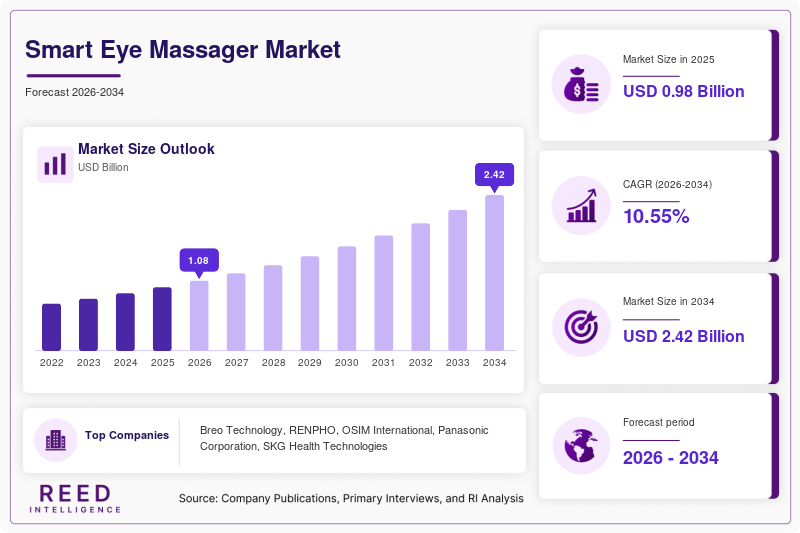
Smart Eye Massager market size is projected at USD 1.08 billion in 2026 and is expected to hit USD 2.41 billion by 2034 with a CAGR of 10.55%. The market is gaining momentum due to increasing consumer awareness regarding eye fatigue management, digital wellness, and portable healthcare devices. Growing investments in product innovation, expanding distribution channels, detailed segmentation analysis, and a competitive landscape featuring global wellness technology providers continue to support market expansion across developed and emerging economies.
The Smart Eye Massager Market comprises wearable devices designed to reduce eye strain, improve blood circulation, and provide relaxation through heating, vibration, air compression, and intelligent control technologies. Global production exceeded 14.8 million units in 2025, while adoption among working professionals and digital device users surpassed 29%. Home-use products accounted for nearly 58% of total shipments, while healthcare-related applications contributed approximately 18% of revenue generation. Increasing screen exposure exceeding 7 hours per day among more than 65% of urban consumers continues to strengthen Smart Eye Massager Market Share.
Smart Eye Massager Market Trends
Rising Integration of AI and Personalized Wellness Features
Manufacturers are increasingly integrating AI-enabled massage programs, Bluetooth connectivity, voice assistance, and biometric monitoring into eye massagers. More than 42% of newly launched devices in 2025 included smart app integration compared to 24% in 2022. Annual production volumes surpassed 15 million units, while demand from technology-savvy consumers increased by 31%. The trend toward personalized wellness experiences and connected healthcare ecosystems continues to shape the Smart Eye Massager Market Trend.
The emergence of rechargeable lithium battery systems, foldable designs, and multi-mode massage technologies is improving product usability. Nearly 48% of consumers prefer devices featuring heating and vibration combinations, while 36% seek customizable massage settings. Commercial wellness centers increased adoption by 22% during the last three years, supporting continuous Smart Eye Massager Market Trend.
Smart Eye Massager Market Drivers
Growing Digital Eye Strain and Screen Exposure
More than 5.4 billion people globally use smartphones, while average daily screen time exceeds 6.8 hours. Approximately 62% of office workers report symptoms of digital eye strain, creating significant demand for eye relaxation products. Global shipments increased from 9.2 million units in 2022 to 14.8 million units in 2025. Rising awareness regarding preventive wellness solutions and portable healthcare devices is accelerating Smart Eye Massager Market Growth.
Smart Eye Massager Market Restraints
Premium Product Pricing and Consumer Awareness Gaps
Advanced smart eye massagers with AI features and premium materials often retail between USD 80 and USD 250, limiting penetration in price-sensitive regions. Nearly 39% of consumers in developing economies remain unaware of smart eye wellness devices. In addition, replacement cycles exceeding 3 years and competition from traditional eye care products continue to restrict Smart Eye Massager Market Growth.
Smart Eye Massager Market Opportunities
Expansion of Home Wellness and Preventive Healthcare
The global wellness economy exceeded USD 6 trillion, while home healthcare device adoption increased by 27% during the past five years. More than 45% of consumers now prioritize preventive health solutions. Increasing e-commerce penetration exceeding 68% and growing demand from aging populations present substantial opportunities for manufacturers to expand Smart Eye Massager Market Demand.
Challenges in Smart Eye Massager Market
Product Differentiation and Regulatory Compliance
Manufacturers face challenges associated with product certification, safety regulations, and technological differentiation. More than 120 brands compete globally, while over 55% of products share similar functional features. Compliance costs increased by approximately 14% between 2022 and 2025. These factors create operational complexities within the Smart Eye Massager Market.
Smart Eye Massager Market Segmentation
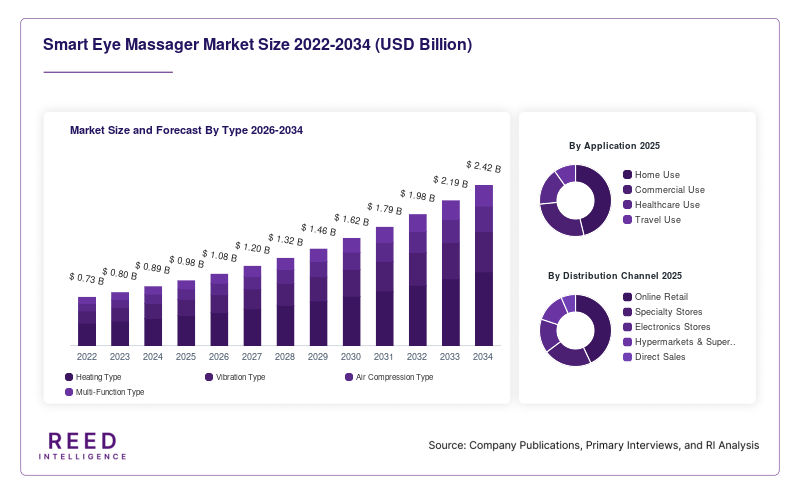
The market is segmented based on type and application. Heating type devices account for nearly 37% market dominance, while home-use applications contribute approximately 58% of overall revenue. Increasing consumer preference for multifunctional wellness devices continues to drive segmentation growth.
By Type
Heating-type eye massagers represent around 37% of market revenue and generated production exceeding 5.4 million units in 2025. These devices typically operate at temperatures between 38°C and 45°C, improving blood circulation and reducing eye fatigue.
Vibration-type products account for nearly 33% market share and surpassed 4.8 million units in annual production. These devices use frequencies ranging from 50 Hz to 120 Hz and are widely adopted among office workers and students.
Air compression eye massagers hold approximately 30% market share with annual output exceeding 4.3 million units. These products utilize intelligent pressure systems and multiple massage zones to improve relaxation effectiveness.
By Application
Home-use applications account for approximately 58% market share and generated sales exceeding 8.5 million units in 2025. Rising remote work trends, increasing screen exposure, and growing wellness awareness support segment expansion. Consumer penetration exceeded 34% among urban households.
Commercial applications contribute nearly 24% of market revenue. Wellness centers, spas, airports, and relaxation lounges increasingly deploy smart eye massagers. Annual installations surpassed 650,000 units globally, with utilization rates exceeding 70%.
Healthcare applications represent around 18% market share. Hospitals, rehabilitation centers, and vision care clinics use these devices for stress reduction and patient comfort. Annual procurement exceeded 420,000 units during 2025.
Smart Eye Massager Market Regional Outlook
North America Smart Eye Massager Market
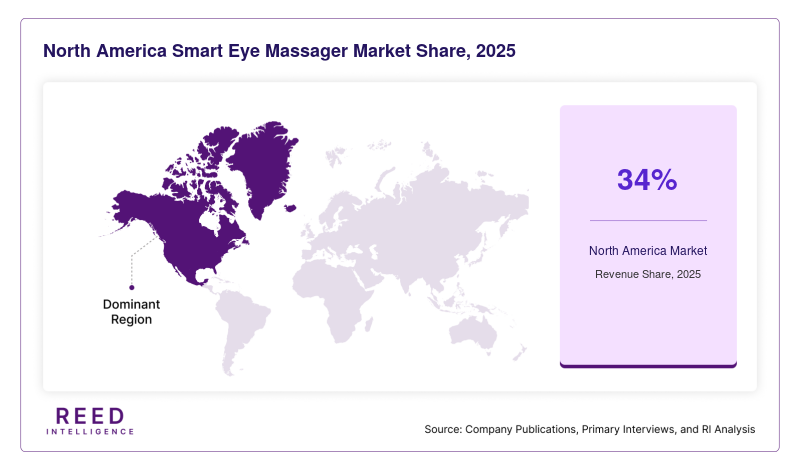
North America accounts for approximately 34% of global revenue. The United States contributes more than 78% of regional demand, while annual shipments exceeded 4.6 million units. High consumer spending and strong wellness awareness support regional expansion.
Europe Smart Eye Massager Market
Europe holds nearly 28% market share, led by Germany, the UK, and France. Regional production surpassed 3.1 million units, while smart wellness device adoption increased by 21% between 2022 and 2025.
Asia-Pacific Smart Eye Massager Market
Asia-Pacific accounts for approximately 30% of global demand. China, Japan, South Korea, and India collectively contribute over 72% of regional revenue. Production exceeded 5.8 million units, supported by strong manufacturing capabilities and rising middle-class spending.
Latin America Smart Eye Massager Market
Latin America represents around 5% market share. Brazil and Mexico account for more than 60% of regional demand. Shipments increased by 18% during the last three years.
Middle East & Africa Smart Eye Massager Market
Middle East & Africa contribute approximately 3% of global revenue. UAE, Saudi Arabia, and South Africa lead adoption, while wellness technology spending increased by 16% annually.
Top players in Smart Eye Massager Market
- Breo Technology
- RENPHO
- OSIM International
- Panasonic Corporation
- SKG Health Technologies
- Xiaomi Corporation
- HoMedics
- iSee4
- Naipo
- Konka Group
- Momoda
- Philips
- LifePro
- Human Touch
- Jare
Breo Technology
- Estimated market share of approximately 14%.
- Strong presence in premium wellness and portable healthcare devices.
- Extensive product portfolio featuring AI-enabled massage systems, heating technology, and Bluetooth connectivity.
- Strong distribution across North America, Europe, and Asia-Pacific markets.
- Continuous investment in product innovation and smart wellness ecosystems supports competitive positioning. The company focuses on premium consumers seeking advanced relaxation and eye care solutions, strengthening brand visibility and customer retention globally.
RENPHO
- Estimated market share of approximately 11%.
- Leading presence in online wellness device sales.
- Strong e-commerce penetration across major global marketplaces.
- Focus on affordable smart eye massagers with heating, vibration, and app-control functions.
- Expanding consumer base through digital marketing and product diversification. The company benefits from growing consumer demand for cost-effective wellness devices and maintains strong market penetration among younger demographics and home-use consumers worldwide.
Recent Developments in Smart Eye Massager Market
- 2025: Breo Technology launched an AI-powered eye massager featuring adaptive pressure adjustment and mobile app integration.
- 2025: RENPHO introduced a next-generation heating eye massager with enhanced battery life exceeding 180 minutes.
Smart Eye Massager Market Segments
By Type
- Heating Type
- Vibration Type
- Air Compression Type
- Multi-Function Type
By Application
- Home Use
- Commercial Use
- Healthcare Use
- Travel Use
By Distribution Channel
- Online Retail
- Specialty Stores
- Electronics Stores
- Hypermarkets & Supermarkets
- Direct Sales
By Region
- North America
- Europe
- APAC
- Middle East and Africa
- LATAM