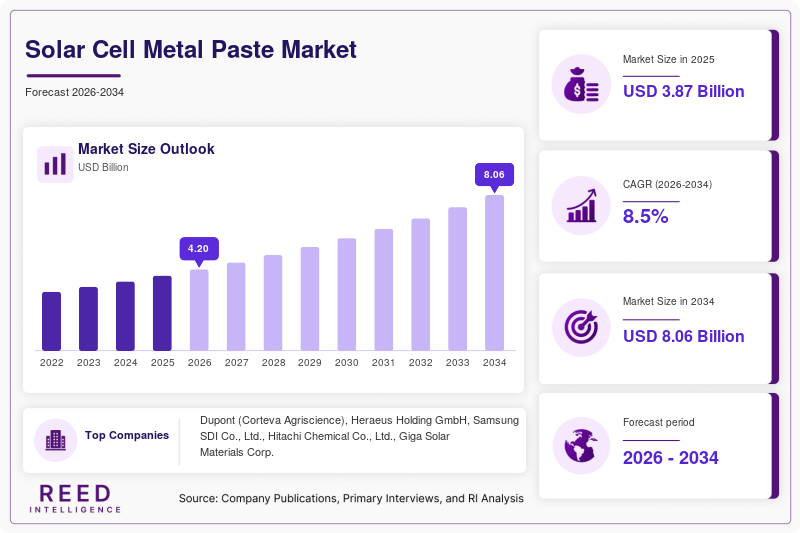
The Solar Cell Metal Paste market size is projected to reach USD 7.8 billion by 2034, expanding at a CAGR of 8.5% (2026–2034). Rising solar PV demand, high-efficiency cell adoption, and advanced material innovation drive market growth across monocrystalline and polycrystalline silicon solar cell applications.
USD 3950
Solar Cell Metal Paste Market Size
Solar Cell Metal Paste market size is projected at USD 4.2 billion in 2026 and is expected to hit USD 7.8 billion by 2034 with a CAGR of 8.5% during the forecast period. The increasing global demand for solar energy, the growing adoption of high-efficiency photovoltaic (PV) cells, and the rising need for advanced materials to improve solar cell performance underpin market expansion. This report delivers a comprehensive analysis of the Solar Cell Metal Paste market, including segmentation by type and application, competitive dynamics, and regional growth patterns, equipping stakeholders with critical intelligence. The Solar Cell Metal Paste market continues to demonstrate exceptional growth potential, fueled by the global energy transition, the decreasing cost of solar energy, and the continuous innovation in paste formulations to enhance cell efficiency.
Solar cell metal paste is a critical conductive material used in the manufacturing of photovoltaic (PV) cells. It is applied to the front and back surfaces of silicon wafers to form the metal electrodes (grid lines) that collect and conduct the electrical current generated by the solar cell. The global market for solar cell metal paste is driven by the growth of the solar PV industry. The global consumption volume of solar cell metal paste exceeded 25,000 metric tons in 2025, reflecting a 10% increase from 2022. Adoption patterns reveal that the front-side silver paste segment dominates the market, accounting for 50% of total demand, followed by aluminum paste at 30%, and back-side silver paste at 20%. The Solar Cell Metal Paste market's trajectory is closely linked to the growth of the global solar PV market, which is projected to reach USD 200 billion by 2028, and the increasing demand for high-efficiency solar cells.
Solar Cell Metal Paste Market Trends
Growing Demand for High-Efficiency and Passivated Emitter and Rear Contact (PERC) Cells
The Solar Cell Metal Paste market is witnessing a significant trend toward high-efficiency cell technologies, such as PERC (Passivated Emitter and Rear Contact), which require advanced metal pastes with specific properties to achieve higher efficiency. The revenue from metal pastes for high-efficiency cells grew to USD 2.0 billion in 2025, a year-on-year increase of 12%, as 45% of new paste formulations in 2025 were developed for PERC and other high-efficiency cell architectures. Adoption rates of advanced pastes for PERC cells reached 35%, with this figure projected to exceed 60% by 2030. The Solar Cell Metal Paste market's trend toward high-efficiency is reinforced by the need to reduce the levelized cost of energy (LCOE) of solar power, the increasing production of premium solar panels, and the continuous innovation in cell design.
Increasing Focus on Silver Consumption Reduction and Cost Optimization
The increasing focus on reducing silver consumption and optimizing costs is a major trend shaping the Solar Cell Metal Paste market, driven by the high cost of silver and the need to reduce material costs in solar cell manufacturing. The market has seen a 15% increase in the development of pastes with lower silver content since 2022, with 20% of new product launches in 2025 featuring reduced silver loading. The use of copper-based and other alternative metal pastes has also gained traction. The Solar Cell Metal Paste market's trend toward cost optimization is reinforced by the pressure to reduce the cost of solar panels, the volatility of silver prices, and the continuous research into alternative conductive materials.
Solar Cell Metal Paste Market Drivers
The Solar Cell Metal Paste market's expansion is primarily driven by the increasing global demand for solar photovoltaic (PV) installations, with the global solar PV capacity projected to exceed 2,000 GW by 2030. The growing need for high-efficiency solar cells to maximize energy output and reduce system costs has also been a major driver. The continuous innovation in paste formulations, leading to improved cell efficiency and performance, has fueled market growth. Additionally, the increasing investments in solar manufacturing capacity and the expansion of solar projects worldwide have driven demand. The Solar Cell Metal Paste market's growth is further reinforced by the supportive government policies and incentives promoting solar energy adoption.
Solar Cell Metal Paste Market Restraints
Despite favorable growth prospects, the Solar Cell Metal Paste market faces significant constraints, primarily related to the high cost and price volatility of silver, a key raw material. The potential for supply chain disruptions and the need for continuous innovation to meet evolving cell designs can also be a barrier. The Solar Cell Metal Paste market's growth is also tempered by the competition from alternative cell technologies and the pressure to reduce material costs.
Solar Cell Metal Paste Market Opportunities
The Solar Cell Metal Paste market presents significant opportunities in the rapidly expanding market for next-generation solar cell technologies, such as heterojunction (HJT) and tandem cells, where the global market is projected to reach USD 50 billion by 2028. The adoption of specialized metal pastes for these advanced cells is expected to grow at a CAGR of 15% through 2034. Emerging opportunities also exist in the development of metal pastes for building-integrated photovoltaics (BIPV) and perovskite solar cells. The Solar Cell Metal Paste market's opportunity profile is further enhanced by the growing trend of localizing solar manufacturing and the increasing focus on sustainable and recyclable materials.
Challenges in Solar Cell Metal Paste Market
The Solar Cell Metal Paste market faces persistent challenges related to the management of paste properties and cell compatibility, as achieving optimal contact resistance and line resolution is critical for cell efficiency. The complexity of developing pastes that meet the specific requirements of different cell architectures presents a challenge. The market is also contending with the challenge of reducing silver content without compromising performance. Additionally, the Solar Cell Metal Paste market is challenged by the need for continuous innovation to keep pace with evolving cell technologies and the pressure to reduce costs.
Solar Cell Metal Paste Market Segmentation
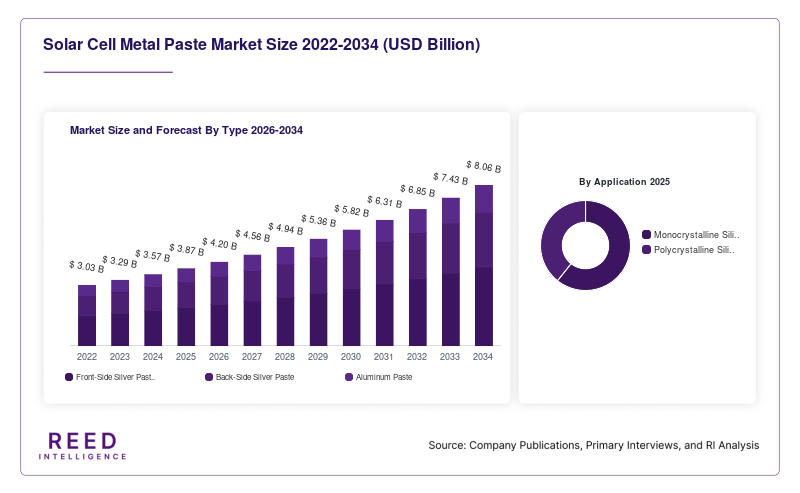
The Solar Cell Metal Paste market is segmented by Type and Application to provide a comprehensive market perspective. By Type, Front-Side Silver Paste dominates with a 50% market share, driven by its critical role in grid formation. The Application segment is led by Monocrystalline Silicon Solar Cells, which accounts for 55% of the market, followed by Polycrystalline Silicon Solar Cells at 45%.
By Type
Front-Side Silver Paste represent the largest segment in the Solar Cell Metal Paste market, commanding a 50% share, with consumption reaching 12,500 metric tons in 2025. This paste is characterized by its use on the front side of the cell to form the fine grid lines, requiring high conductivity and excellent contact properties. Technical specifications include particle size, sintering temperature, and viscosity. The Solar Cell Metal Paste market's front-side silver segment is driven by its critical role in cell performance.
Aluminum Paste capture a 30% share of the Solar Cell Metal Paste market, with consumption of 7,500 metric tons in 2025. This paste is characterized by its use on the back side of the cell to form the rear electrode and passivation layer. Technical specifications include aluminum content, particle size, and adhesion properties. The Solar Cell Metal Paste market's aluminum segment is driven by its use in forming the back surface field (BSF).
Back-Side Silver Paste represent the remaining 20% of the Solar Cell Metal Paste market, with consumption of 5,000 metric tons in 2025. This paste is characterized by its use on the back side for silver electrodes in certain cell designs. Technical specifications include conductivity and compatibility with the aluminum layer. The Solar Cell Metal Paste market's back-side silver segment is used in specific high-efficiency cell architectures.
By Application
Monocrystalline Silicon Solar Cells dominates the Solar Cell Metal Paste market, accounting for 55% of sales, representing 13,750 metric tons in 2025. This segment includes use in high-efficiency monocrystalline cells, where paste performance is critical. Usage penetration exceeds 60% in the monocrystalline cell sector. The Solar Cell Metal Paste market's monocrystalline segment is characterized by its focus on high efficiency and performance.
Polycrystalline Silicon Solar Cells accounts for 45% of the Solar Cell Metal Paste market, with a volume of 11,250 metric tons in 2025. This segment encompasses use in polycrystalline cells, which have a large existing market share. The segment is growing at a steady CAGR, driven by the large installed base. The Solar Cell Metal Paste market's polycrystalline segment is characterized by its focus on cost-effectiveness.
Solar Cell Metal Paste Market Regional Outlook
Asia-Pacific Solar Cell Metal Paste Market
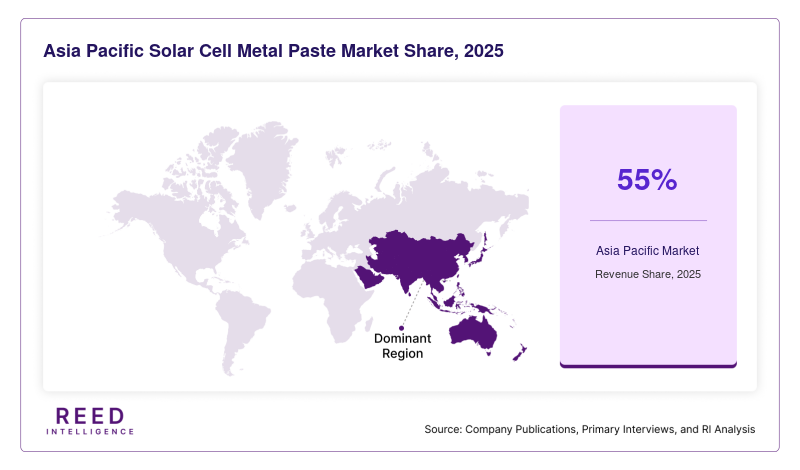
Leads the Solar Cell Metal Paste market, commanding a 55% share, with a revenue of USD 2.31 billion in 2025. China, Taiwan, and South Korea are the primary drivers, accounting for 70% of regional demand, driven by the large solar cell manufacturing base. The Asia-Pacific Solar Cell Metal Paste market is characterized by its high growth rate and focus on cost-effective solutions.
North America Solar Cell Metal Paste Market
Represents the second-largest market, capturing a 20% share with a revenue of USD 0.84 billion in 2025. The United States dominates regional demand, accounting for 80% of consumption, driven by the growing solar installations and manufacturing expansion. The Solar Cell Metal Paste market in North America is characterized by its focus on innovation and high-performance materials.
Europe Solar Cell Metal Paste Market
Accounts for 15% of the global Solar Cell Metal Paste market, with a revenue of USD 0.63 billion in 2025. Germany, Spain, and France collectively represent 55% of the regional market, driven by the strong solar energy adoption. The Solar Cell Metal Paste market in Europe is characterized by its focus on sustainability and quality.
Middle East & Africa and Latin America Solar Cell Metal Paste Market
Together account for the remaining 10% of the Solar Cell Metal Paste market, with the UAE leading the Middle East market and Brazil leading the Latin American market. Both regions are projected to grow at CAGRs exceeding 10%, driven by the increasing solar energy investments.
Top players in Solar Cell Metal Paste Market
- Dupont (Corteva Agriscience)
- Heraeus Holding GmbH
- Samsung SDI Co., Ltd.
- Hitachi Chemical Co., Ltd.
- Giga Solar Materials Corp.
- Suzhou Good-Ark Electronics Co., Ltd.
- Namics Corporation
- Fujikura Kasei Co., Ltd.
- Johnson Matthey plc
- Nippon Electric Glass Co., Ltd.
- AGC Inc.
- BASF SE
- Dow Inc.
- Korea Circuit Co., Ltd.
- Linde plc
Dupont (Corteva Agriscience)
Dupont holds a dominant position in the Solar Cell Metal Paste market, with an estimated 18% global market share, particularly strong in the North American and Asian segments. The company's portfolio of Solamet® photovoltaic metallization pastes is widely recognized for its quality and innovation. Dupont's market leadership is reinforced by its significant R&D investment and its close collaboration with leading solar cell manufacturers. Dupont commands over 22% of the North American market and 15% of the Asian market, positioning it as a key player in the Solar Cell Metal Paste market.
Heraeus Holding GmbH
Heraeus is a leading player in the Solar Cell Metal Paste market, commanding approximately 15% of the global market share through its comprehensive portfolio of high-performance metal pastes for the solar industry. The company's expertise in materials science and its strong presence in the global market have solidified its position. Heraeus' focus on developing innovative and sustainable paste solutions has strengthened its position. The company's commitment to quality has enhanced its brand equity.
Samsung SDI Co., Ltd. holds a significant 12% market share, with particular strength in the Asian market, where it commands a 14% share. The company's focus on integrated electronic materials is a key differentiator. Hitachi Chemical Co., Ltd. is a major player in the global electronic materials market, holding a 10% share.
Recent Developments in Solar Cell Metal Paste Market
- 2025: Dupont launched a new generation of Solamet® pastes for heterojunction (HJT) solar cells, offering improved contact performance and higher efficiency.
- 2025: Heraeus introduced a new low-silver front-side paste, reducing silver consumption by 15% without compromising performance.
Solar Cell Metal Paste Market Segments
By Type
- Front-Side Silver Paste
- Back-Side Silver Paste
- Aluminum Paste
By Application
- Monocrystalline Silicon Solar Cells
- Polycrystalline Silicon Solar Cells
By Region
- North America
- Europe
- APAC
- Middle East and Africa
- LATAM