Spin Galvanizing Market Size, Share Demand Report By Type (Batch Spin Galvanizing, Centrifugal Spin Galvanizing, Automated Spin Galvanizing), By Application (Fasteners & Bolts, Construction Components, Automotive Parts) By Region & Segment Forecasts, 2026–2034
USD 3950
Spin Galvanizing Market Size
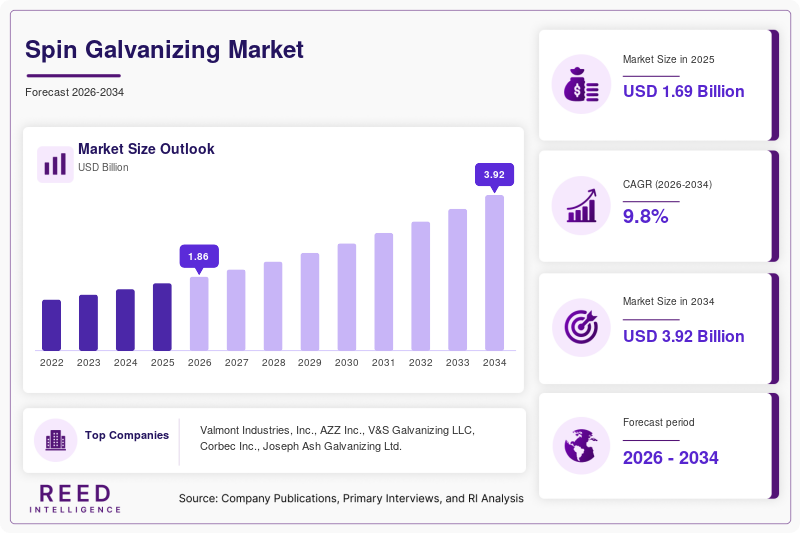
Spin Galvanizing market size is projected at USD 1.86 billion in 2026 and is expected to hit USD 3.94 billion by 2034 with a CAGR of 9.8%. The market is benefiting from increasing infrastructure investments, expanding industrial manufacturing activities, and rising demand for corrosion-resistant steel components. Growth in construction, transportation, utilities, and heavy engineering sectors continues to drive the adoption of spin galvanizing services. Comprehensive market segmentation, pricing analysis, and competitive benchmarking remain essential for stakeholders operating in the industry.
The spin galvanizing market refers to the process of applying a protective zinc coating to small steel components through centrifugal spinning after hot-dip galvanization. Global processing volume exceeded 9.8 million metric tons in 2025, while annual production of galvanized fasteners surpassed 210 billion units. Fasteners and bolts accounted for approximately 49% of total consumption, followed by construction components at 31% and automotive parts at 20%. More than 62% of industrial manufacturers utilize galvanized components for long-term corrosion protection, reinforcing the Spin Galvanizing market.
Spin Galvanizing Market Trends
Increasing Demand for Corrosion-Resistant Infrastructure Components
Infrastructure modernization projects are accelerating the use of galvanized steel products worldwide. More than 180 million metric tons of galvanized steel were consumed globally in 2025, while demand for corrosion-resistant fasteners increased by 17% year-over-year. Public infrastructure investments exceeded USD 2.3 trillion globally, creating sustained demand for zinc-coated steel components. These developments continue to shape Spin Galvanizing market trends.
Manufacturers are increasingly adopting automated centrifuge systems capable of processing more than 12 tons per hour while reducing zinc consumption by 8%–12%. Advanced process controls and environmentally efficient galvanizing technologies were adopted by over 39% of facilities in 2025. Demand from renewable energy projects, transmission towers, and industrial facilities increased by 19%, supporting Spin Galvanizing market trends.
Spin Galvanizing Market Drivers
Growth in Construction and Industrial Infrastructure
Global construction spending surpassed USD 15 trillion in 2025, while steel-intensive infrastructure projects increased by 14%. More than 72% of structural fasteners used in bridges, highways, and utility installations require corrosion-resistant coatings. Demand for galvanized bolts, nuts, and washers exceeded 220 billion units annually, supporting Spin Galvanizing market growth.
Spin Galvanizing Market Restraints
Volatility in Zinc and Energy Prices
Zinc prices fluctuated between USD 2,500 and USD 3,400 per metric ton during 2025, significantly impacting production costs. Energy expenses accounted for approximately 18%–24% of operational expenditures for galvanizing facilities. Nearly 33% of service providers reported margin pressures resulting from raw material volatility, affecting Spin Galvanizing market growth.
Spin Galvanizing Market Opportunities
Expansion of Renewable Energy Infrastructure
Global renewable energy investments exceeded USD 1.8 trillion in 2025, with wind and solar installations requiring substantial quantities of galvanized steel components. More than 28 million metric tons of corrosion-resistant steel products were utilized across renewable energy projects. Adoption of galvanized fasteners in utility-scale energy systems increased by 21%, creating opportunities within the Spin Galvanizing market.
Challenges in Spin Galvanizing Market
Environmental Compliance and Emission Control Requirements
Environmental regulations governing zinc emissions, wastewater management, and energy consumption continue to tighten globally. Compliance costs increased by approximately 12% during 2025, while nearly 27% of facilities invested in upgraded filtration and waste treatment systems. Regulatory complexity and capital expenditure requirements remain key challenges influencing Spin Galvanizing market demand.
Spin Galvanizing Market Segmentation
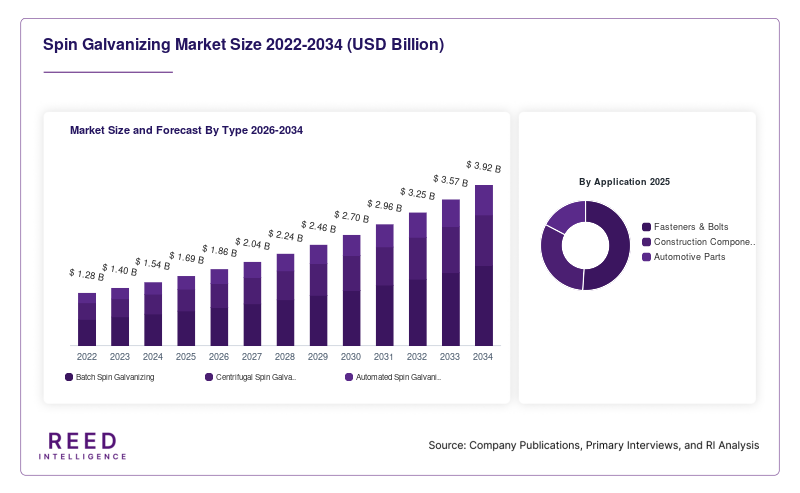
The market is segmented by type and application. Batch spin galvanizing accounts for approximately 45% of total revenue, followed by centrifugal spin galvanizing at 34% and automated spin galvanizing at 21%. By application, fasteners and bolts dominate with 49% share, followed by construction components at 31% and automotive parts at 20%.
By Type
Batch spin galvanizing accounted for approximately 45% of market revenue in 2025. Processing volume exceeded 4.4 million metric tons globally. The process is widely used for bolts, nuts, washers, and threaded components requiring coating thickness between 40 and 85 microns. Its cost efficiency and flexibility continue to support widespread adoption.
Centrifugal spin galvanizing represented nearly 34% of market revenue. More than 3.3 million metric tons of steel components were processed using centrifugal systems during 2025. These systems provide uniform coating distribution, reduced zinc buildup, and enhanced surface quality for precision-engineered products.
Automated spin galvanizing held approximately 21% of market share. Processing volumes exceeded 2.1 million metric tons annually. Advanced automation technologies improve throughput by up to 25%, reduce material waste by 10%, and support consistent coating performance across high-volume production environments.
By Application
Fasteners and bolts generated approximately 49% of total market revenue. More than 210 billion galvanized fasteners were produced globally in 2025. Adoption penetration exceeded 74% across construction, utility, and industrial sectors due to superior corrosion resistance and long service life.
Construction components accounted for nearly 31% of market demand. More than 3 million metric tons of galvanized brackets, anchors, connectors, and structural accessories were consumed during 2025. Utilization increased by 16% due to rising infrastructure and commercial building activities.
Automotive parts represented approximately 20% of total revenue. More than 1.9 million metric tons of galvanized automotive components were produced globally. Adoption rates exceeded 58% among commercial vehicle manufacturers seeking enhanced durability and corrosion protection.
Spin Galvanizing Market Regional Outlook
North America Spin Galvanizing Market
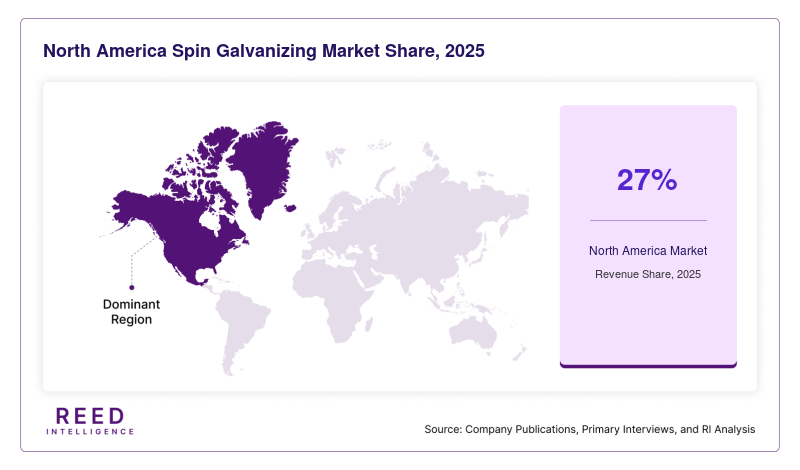
North America accounted for approximately 27% of global revenue in 2025. The United States represented nearly 78% of regional demand, supported by infrastructure modernization projects and industrial manufacturing growth. Processing volumes exceeded 2.3 million metric tons across the region.
Europe Spin Galvanizing Market
Europe held approximately 30% market share. Germany, France, Italy, and the United Kingdom collectively accounted for over 64% of regional demand. More than 2.8 million metric tons of steel components underwent spin galvanizing treatment during 2025.
Asia-Pacific Spin Galvanizing Market
Asia-Pacific dominated the industry with approximately 36% of total revenue. China contributed nearly 48% of regional demand, followed by India at 18% and Japan at 12%. Regional processing volumes exceeded 3.9 million metric tons due to extensive construction and manufacturing activities.
Latin America Spin Galvanizing Market
Latin America represented approximately 4% of global revenue. Brazil accounted for nearly 46% of regional demand, while Mexico contributed 29%. Infrastructure development and industrial expansion continue to support market growth.
Middle East & Africa Spin Galvanizing Market
The Middle East & Africa region accounted for approximately 3% of total revenue. Saudi Arabia, the UAE, and South Africa collectively represented more than 55% of regional demand. Investments in utilities, transportation, and energy infrastructure are driving adoption.
Top players in Spin Galvanizing Market
- Valmont Industries, Inc.
- AZZ Inc.
- V&S Galvanizing LLC
- Corbec Inc.
- Joseph Ash Galvanizing Ltd.
- WIEGEL Hot Dip Galvanizing
- Galvan Industries, Inc.
- Korns Galvanizing Co.
- Premier Galvanizing Ltd.
- Zinkpower Group
- Western Technologies Inc.
- South Atlantic Galvanizing
- Industrial Galvanizers Corporation
- TOOLOX Galvanizing Services
- Dongbu Steel Galvanizing Division
Valmont Industries, Inc.
- Estimated market share: 13%–15%.
- Maintains a strong position in infrastructure, utility, and industrial galvanizing services.
- Operates multiple galvanizing facilities with annual processing capacity exceeding several hundred thousand metric tons.
- Strong presence across transmission, telecommunications, transportation, and renewable energy sectors.
- Extensive customer relationships and integrated steel infrastructure solutions strengthen competitive positioning.
- Continuous investments in automation and environmental compliance technologies support long-term growth.
AZZ Inc.
- Estimated market share: 10%–12%.
- One of the largest providers of galvanizing and metal coating services globally.
- Processes millions of steel components annually across North America and international markets.
- Broad service portfolio includes hot-dip galvanizing, spin galvanizing, and specialty coating solutions.
- Strong focus on operational efficiency, sustainability, and advanced process technologies.
- Strategic facility expansions continue to enhance production capabilities and market presence.
Recent Developments in Spin Galvanizing Market
- 2026: Major galvanizing service providers introduced automated centrifuge systems with enhanced zinc recovery capabilities.
- 2025: Several facilities expanded processing capacity to support growing renewable energy and infrastructure demand.
- 2025: Advanced emission control technologies were implemented to improve environmental compliance and operational efficiency.
Spin Galvanizing Market Segments
By Type
- Batch Spin Galvanizing
- Centrifugal Spin Galvanizing
- Automated Spin Galvanizing
By Application
- Fasteners & Bolts
- Construction Components
- Automotive Parts
By Region
- North America
- Europe
- APAC
- Middle East and Africa
- LATAM