Spiralizer Market Size, Share Demand Report By Product Type (Manual Spiralizers, Electric Spiralizers, Multifunction Spiralizers), By Application (Residential Use, Commercial Kitchens, Food Processing), By Distribution Channel (Online Retail, Supermarkets & Hypermarkets, Specialty Kitchen Stores, Department Stores, Direct Sales) By Region & Segment Forecasts, 2026–2034
USD 3950
Spiralizer Market Size
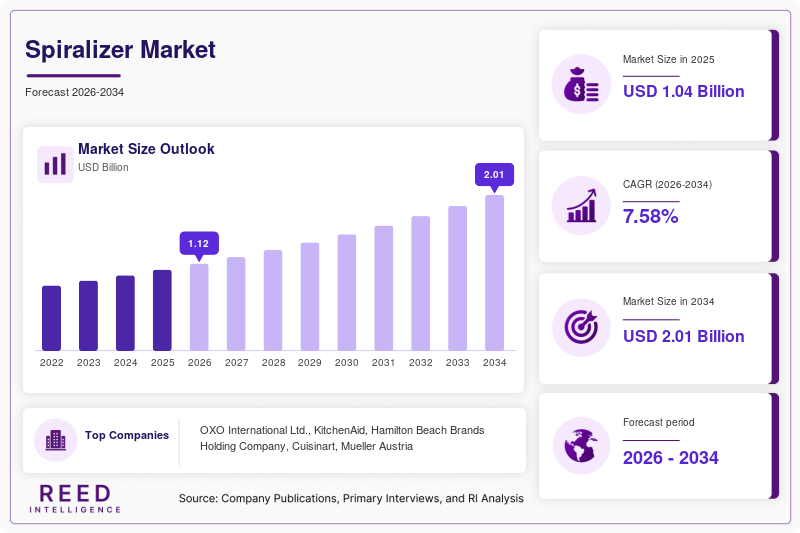
Spiralizer market size is projected at USD 1.12 billion in 2026 and is expected to hit USD 2.01 billion by 2034 with a CAGR of 7.58%. Increasing consumer preference for healthy eating habits, vegetable-based diets, and innovative kitchen appliances continues to support industry expansion. The report provides detailed analysis of market segmentation, production volumes, consumer adoption, and competitive landscape across key global regions.
The Spiralizer market consists of kitchen tools and appliances designed to transform vegetables and fruits into noodle-like strands, ribbons, and decorative cuts. Global production exceeded 48 million units in 2025, with manual spiralizers accounting for approximately 51% of total shipments. Residential users contributed nearly 72% of overall demand, while commercial kitchens represented 18%. Consumer adoption of healthy food preparation tools surpassed 43% among urban households, reinforcing the Spiralizer market.
Spiralizer Market Trends
Rising Popularity of Plant-Based and Low-Carbohydrate Diets
Growing consumer interest in low-carb meals and vegetable-based alternatives is increasing spiralizer adoption worldwide. More than 22 million units were sold through online retail channels during 2025, accounting for approximately 46% of total sales volume. Adoption among health-conscious consumers increased from 29% in 2022 to 45% in 2025. These developments continue to shape Spiralizer trends.
Manufacturers are introducing multifunction appliances featuring interchangeable blades, automated cutting systems, and dishwasher-safe components. Nearly 37% of products launched during 2025 incorporated multiple slicing functions and advanced safety mechanisms. Electric spiralizer shipments increased by 11.2% year-over-year, while premium kitchen gadget sales rose by 8.9%. Product innovation remains a major influence on Spiralizer trends.
Spiralizer Market Drivers
Growing Demand for Healthy Food Preparation Solutions
Global spending on healthy food and wellness products exceeded USD 1.8 trillion in 2025. More than 58% of consumers reported increasing vegetable consumption as part of healthier lifestyles. Sales of vegetable preparation appliances increased by 10.4%, while demand for multifunction kitchen tools expanded by 8.7%. These factors continue to drive Spiralizer market growth.
Spiralizer Market Restraints
Limited Consumer Awareness in Emerging Markets
Consumer awareness regarding spiralizer products remains relatively low across several developing economies. Less than 28% of households in emerging regions are familiar with vegetable noodle preparation tools. Traditional food preparation methods continue to dominate more than 65% of kitchens in these markets, limiting broader penetration of the Spiralizer market.
Spiralizer Market Opportunities
Expansion of E-Commerce and Smart Kitchen Appliances
Global online kitchen appliance sales exceeded USD 95 billion in 2025. E-commerce contributed nearly 49% of spiralizer sales worldwide, compared with 35% in 2022. Smart kitchen appliance adoption increased by 14.3% annually, creating opportunities for connected and automated spiralizer solutions. These trends generate significant opportunities within the Spiralizer market.
Challenges in Spiralizer Market
Intense Competition from Alternative Kitchen Gadgets
The market faces competition from food processors, mandoline slicers, and multifunction blenders. More than 320 brands compete globally, resulting in pricing pressure across entry-level products. Average selling prices declined by approximately 3.1% during 2025 despite increasing manufacturing costs. Such conditions create challenges for the Spiralizer market.
Spiralizer Market Segmentation
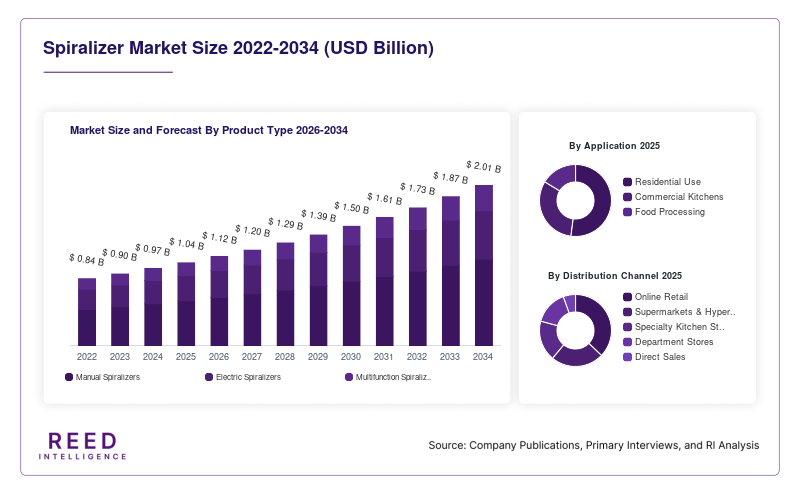
The market is segmented by type and application, with manual spiralizers accounting for approximately 51% of total revenue during 2025. Residential use dominated the industry with nearly 72% share due to rising adoption among health-conscious consumers and home cooking enthusiasts.
By Type
Manual spiralizers accounted for approximately 51% of market revenue in 2025. Production exceeded 24 million units globally. These products offer affordability, portability, and ease of use, making them popular among household consumers seeking convenient vegetable preparation solutions.
Electric spiralizers represented nearly 29% of total revenue. Production surpassed 14 million units during 2025. These appliances provide automated operation, higher processing efficiency, and enhanced convenience for frequent users and commercial kitchens.
Multifunction spiralizers held approximately 20% of market share. Production exceeded 10 million units annually. These products combine spiralizing, slicing, shredding, and ribbon-cutting functions, supporting versatile food preparation requirements.
By Application
Residential applications generated approximately 72% of total market revenue. More than 34 million units were sold to households globally during 2025. Usage penetration exceeded 43% among health-conscious consumers and home cooks focused on low-carbohydrate meal preparation.
Commercial kitchens accounted for nearly 18% of industry revenue. Annual demand exceeded 8 million units across restaurants, cafes, and catering businesses. Consistent demand for vegetable-based menu offerings supports segment growth.
Food processing applications represented approximately 10% of market revenue. More than 5 million units were utilized across food manufacturing facilities for vegetable preparation and specialty product production. Industrial efficiency requirements continue to support adoption.
Spiralizer Market Regional Outlook
North America Spiralizer Market
North America accounted for approximately 34% of global revenue during 2025. The United States contributed nearly 82% of regional demand. Annual consumption exceeded 16 million units, supported by strong healthy eating trends and kitchen appliance spending.
Europe Spiralizer Market
Europe represented approximately 29% of market revenue. Germany, the United Kingdom, France, and Italy collectively accounted for more than 68% of regional demand. Total annual sales exceeded 14 million units during 2025.
Asia-Pacific Spiralizer Market
Asia-Pacific held approximately 25% of total revenue. China, Japan, South Korea, and Australia emerged as key markets. Production exceeded 18 million units annually, supported by expanding middle-class populations and increasing health awareness.
Latin America Spiralizer Market
Latin America accounted for nearly 7% of global revenue. Brazil and Mexico generated over 60% of regional demand. Annual consumption surpassed 3 million units across residential and commercial applications.
Middle East & Africa Spiralizer Market
The Middle East & Africa represented approximately 5% of total revenue. The UAE, Saudi Arabia, and South Africa led regional demand. Annual sales exceeded 2 million units, supported by increasing urbanization and modern retail expansion.

Top players in Spiralizer Market
- OXO International Ltd.
- KitchenAid
- Hamilton Beach Brands Holding Company
- Cuisinart
- Mueller Austria
- Paderno World Cuisine
- Zyliss
- Veggetti
- Brieftons
- GEFU GmbH
- Westmark GmbH
- Princess Household Appliances
- Kenwood Limited
- BLACK+DECKER
- NutriChef
OXO International Ltd.
- Estimated market share ranges between 14% and 16%.
- Maintains a strong position in premium kitchen tools and food preparation equipment.
- Extensive product portfolio includes manual and multifunction spiralizers designed for household use.
- Strong distribution across North America, Europe, and Asia-Pacific enhances market penetration.
- Continuous investment in ergonomic designs and consumer-friendly features supports brand loyalty.
- The company's innovation-driven strategy strengthens leadership within the Spiralizer market.
KitchenAid
- Estimated market share ranges between 11% and 13%.
- Recognized globally for high-quality kitchen appliances and accessories.
- Offers electric and attachment-based spiralizer solutions compatible with stand mixers.
- Strong retail presence and premium brand positioning support sustained demand.
- Ongoing product development and advanced kitchen technology integration improve competitiveness.
- Established consumer trust contributes to long-term growth within the industry.
Recent Developments in Spiralizer Market
- 2026: Manufacturers introduced smart electric spiralizers with automated cutting controls and enhanced safety features.
- 2025: Several brands launched multifunction spiralizers featuring up to seven interchangeable blade options.
- 2025: E-commerce sales channels expanded significantly, improving product availability across emerging markets.
Spiralizer Market Segments
By Product Type
- Manual Spiralizers
- Electric Spiralizers
- Multifunction Spiralizers
By Application
- Residential Use
- Commercial Kitchens
- Food Processing
By Distribution Channel
- Online Retail
- Supermarkets & Hypermarkets
- Specialty Kitchen Stores
- Department Stores
- Direct Sales
By Region
- North America
- Europe
- APAC
- Middle East and Africa
- LATAM