Sport Bottle Market Size, Share Demand Report By Type (Plastic Sport Bottles, Stainless Steel Sport Bottles, Glass Sport Bottles), By Application (Sports & Fitness, Outdoor Activities, Everyday Use), Regional Insights & Segment Forecasts, 2026–2034
USD 3950
Sport Bottle Market Size
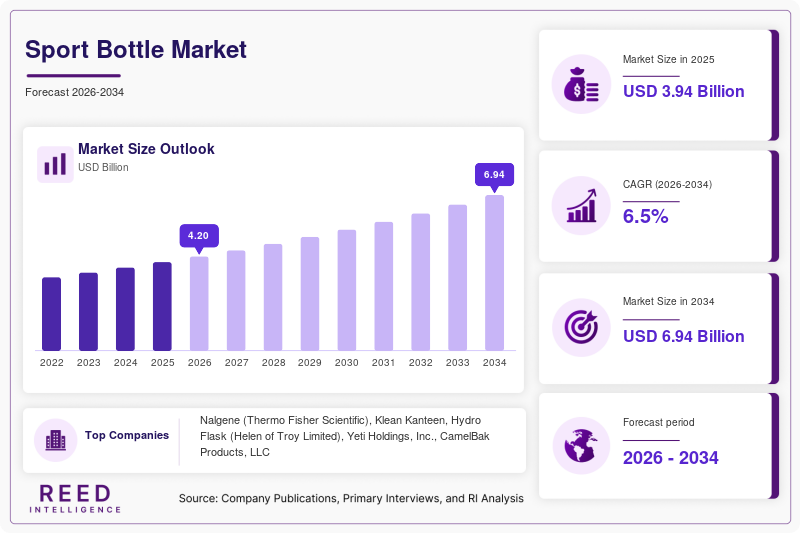
Sport Bottle market size is projected at USD 4.2 billion in 2026 and is expected to hit USD 6.8 billion by 2034 with a CAGR of 6.5% during the forecast period. The increasing global focus on health and fitness, the growing demand for sustainable and reusable hydration solutions, and the rising popularity of outdoor and sports activities underpin market expansion. This report delivers a comprehensive analysis of the Sport Bottle market, including segmentation by type and application, competitive dynamics, and regional growth patterns, equipping stakeholders with critical intelligence. The Sport Bottle market continues to demonstrate robust growth potential, fueled by the global trend toward active lifestyles, the increasing awareness of environmental issues related to single-use plastics, and the continuous innovation in bottle design and materials.
Sport bottles are reusable containers designed for carrying and dispensing beverages, specifically for active individuals and athletes. They are made from various materials, including plastic, stainless steel, and glass, and come in a wide range of designs with features like leak-proof lids, insulation, and easy-to-carry handles. The global market for sport bottles is driven by the need for convenient and sustainable hydration. The global production volume of sport bottles exceeded 2.5 billion units in 2025, reflecting a 6% increase from 2022. Adoption patterns reveal that the plastic sport bottle segment dominates the market, accounting for 50% of total demand, followed by stainless steel at 35%, and glass at 15%. The Sport Bottle market's trajectory is closely linked to the growth of the global sports and fitness market, which is projected to reach USD 1 trillion by 2028, and the increasing consumer preference for reusable and eco-friendly products.
Sport Bottle Market Trends
Growing Demand for Sustainable and Eco-Friendly Materials
The Sport Bottle market is witnessing a significant trend toward sustainable and eco-friendly materials, driven by consumer awareness of plastic pollution and the demand for reusable alternatives. The revenue from sustainable sport bottles (made from recycled or bio-based materials) grew to USD 1.5 billion in 2025, a year-on-year increase of 10%, as 35% of new product launches in 2025 featured sustainable materials. Adoption rates of eco-friendly bottles in the outdoor and fitness segments reached 30%, with this figure projected to exceed 50% by 2030. The Sport Bottle market's trend toward sustainability is reinforced by the increasing regulatory pressure on single-use plastics, the growing consumer preference for environmentally responsible brands, and the development of innovative sustainable materials like bioplastics and recycled stainless steel.
Increasing Focus on Smart and Insulated Features
The increasing focus on smart and insulated features is a major trend shaping the Sport Bottle market, with manufacturers developing bottles with temperature control, tracking, and other advanced functionalities. The market has seen a 20% increase in the demand for insulated sport bottles since 2022, with 25% of new product launches in 2025 featuring enhanced insulation or smart features. The use of smart caps with hydration tracking and temperature indicators has also gained traction. The Sport Bottle market's trend toward innovation is reinforced by the need to differentiate products in a competitive market, the increasing consumer demand for premium and functional products, and the continuous integration of technology into everyday items.
Sport Bottle Market Drivers
The Sport Bottle market's expansion is primarily driven by the increasing global focus on health and fitness, with the number of people participating in sports and fitness activities projected to grow significantly. The growing awareness of the health benefits of hydration and the need for convenient water intake during activities has also been a major driver. The rising consumer preference for sustainable and reusable products over single-use plastics has fueled the demand for sport bottles. Additionally, the expansion of the outdoor recreation and travel sectors has driven market growth. The Sport Bottle market's growth is further reinforced by the continuous innovation in design, materials, and features, making sport bottles more attractive and functional.
Sport Bottle Market Restraints
Despite favorable growth prospects, the Sport Bottle market faces significant constraints, primarily related to the competition from single-use plastic bottles and other beverage containers, which remain cheaper and more convenient for some consumers. The higher cost of premium sustainable and insulated bottles can also be a barrier for price-sensitive consumers. The Sport Bottle market's growth is also tempered by the challenges of recycling and proper disposal of some bottle types.
Sport Bottle Market Opportunities
The Sport Bottle market presents significant opportunities in the rapidly expanding market for smart hydration and wellness technology, where the global market is projected to reach USD 10 billion by 2028. The adoption of smart sport bottles with integrated tracking and connectivity is expected to grow at a CAGR of 12% through 2034. Emerging opportunities also exist in the development of biodegradable and compostable sport bottle materials. The Sport Bottle market's opportunity profile is further enhanced by the growing trend of customization and personalization, creating demand for bespoke and branded bottles.
Challenges in Sport Bottle Market
The Sport Bottle market faces persistent challenges related to the management of product durability and safety, as bottles must be leak-proof, durable, and safe for repeated use. The complexity of developing new materials that are both sustainable and functional presents a challenge. The market is also contending with the challenge of managing the environmental impact of production and end-of-life disposal. Additionally, the Sport Bottle market is challenged by the need for continuous innovation to differentiate products and meet evolving consumer preferences.
Sport Bottle Market Segmentation
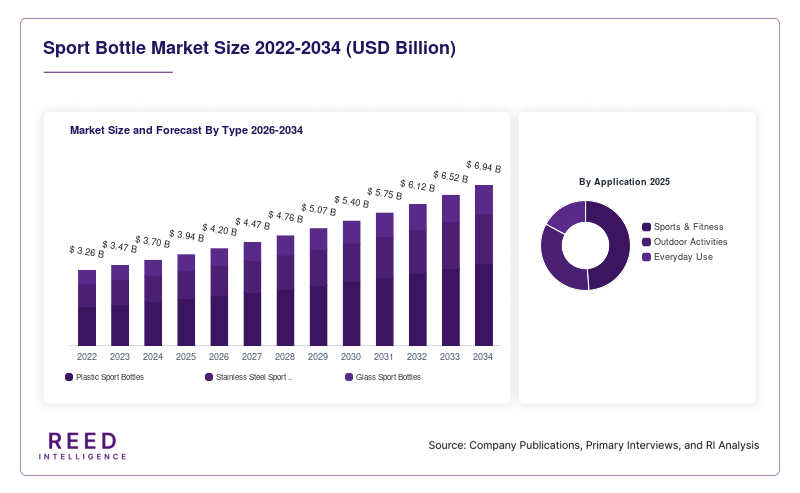
The Sport Bottle market is segmented by Type and Application to provide a comprehensive market perspective. By Type, Plastic Sport Bottles dominate with a 50% market share, driven by their affordability and lightweight. The Application segment is led by Sports & Fitness, which accounts for 45% of the market, followed by Outdoor Activities at 30%, and Everyday Use at 25%.
By Type
Plastic Sport Bottles represent the largest segment in the Sport Bottle market, commanding a 50% share, with production reaching 1.25 billion units in 2025. These bottles are characterized by their lightweight, durability, and affordability. Technical specifications include various materials (PET, HDPE, Tritan), capacities, and closure types. The Sport Bottle market's plastic segment is driven by its widespread use and cost-effectiveness.
Stainless Steel Sport Bottles capture a 35% share of the Sport Bottle market, with production of 0.875 billion units in 2025. These bottles are characterized by their durability, insulation properties, and premium feel. Technical specifications include vacuum insulation, stainless steel grade, and capacity. The Sport Bottle market's stainless steel segment is growing at a faster CAGR, driven by the demand for premium and insulated products.
Glass Sport Bottles represent the remaining 15% of the Sport Bottle market, with production of 0.375 billion units in 2025. These bottles are characterized by their inert nature, making them suitable for various beverages. Technical specifications include glass type, protective sleeves, and closures. The Sport Bottle market's glass segment is driven by the demand for chemical-free and taste-neutral hydration.
By Application
Sports & Fitness dominates the Sport Bottle market, accounting for 45% of sales, representing 1.125 billion units in 2025. This segment includes use in gyms, sports activities, and athletic training. Usage penetration exceeds 60% among regular exercisers. The Sport Bottle market's sports segment is characterized by its focus on functionality and convenience.
Outdoor Activities accounts for 30% of the Sport Bottle market, with a volume of 0.750 billion units in 2025. This segment encompasses use in hiking, camping, and travel. The segment is growing at a steady CAGR, driven by the expansion of outdoor recreation. The Sport Bottle market's outdoor segment is characterized by its focus on durability and portability.
Everyday Use represents the remainder of the Sport Bottle market, accounting for 25% of total sales, with 0.625 billion units in 2025. This segment includes use for daily hydration at work, school, and home. The segment is projected to grow at a steady CAGR through 2034. The Sport Bottle market's everyday segment is characterized by its focus on convenience and style.
Sport Bottle Market Regional Outlook
North America Sport Bottle Market
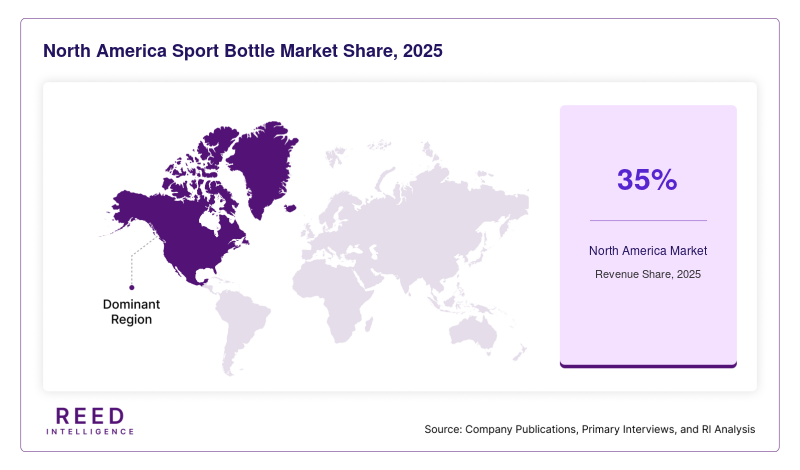
Leads the Sport Bottle market, commanding a 35% share, with a revenue of USD 1.47 billion in 2025. The United States is the primary driver, accounting for 80% of regional demand, driven by the strong fitness culture and the high adoption of reusable products. The North American Sport Bottle market is characterized by its focus on innovation and premium products.
Europe Sport Bottle Market
Represents the second-largest market, capturing a 28% share with a revenue of USD 1.18 billion in 2025. Germany, the UK, and France collectively represent 55% of the regional market, driven by the strong focus on sustainability and outdoor activities. The Sport Bottle market in Europe is characterized by its focus on quality and eco-friendly materials.
Asia-Pacific Sport Bottle Market
Accounts for 22% of the global Sport Bottle market, with a revenue of USD 0.92 billion in 2025. China, Japan, and Australia are the primary drivers, accounting for 70% of regional demand, driven by the growing health awareness and the expanding middle class. The Asia-Pacific Sport Bottle market is projected to grow at the fastest CAGR of 8% through 2034, presenting attractive opportunities for market expansion.
Middle East & Africa and Latin America Sport Bottle Market
Together account for the remaining 15% of the Sport Bottle market, with the UAE leading the Middle East market and Brazil leading the Latin American market. Both regions are projected to grow at CAGRs exceeding 7%, driven by the increasing health and fitness awareness.
Top players in Sport Bottle Market
- Nalgene (Thermo Fisher Scientific)
- Klean Kanteen
- Hydro Flask (Helen of Troy Limited)
- Yeti Holdings, Inc.
- CamelBak Products, LLC
- Contigo (Newell Brands)
- Aquafit
- Bottled (Bottle Company)
- Hydracy
- Brumate
- Mira Brands
- S'well Bottle
- Thermos L.L.C.
- Stanley (PMI)
- Owala
Hydro Flask (Helen of Troy Limited)
Hydro Flask holds a dominant position in the premium insulated Sport Bottle market, with an estimated 15% global market share, particularly strong in the North American segment. The company's portfolio of vacuum-insulated stainless steel bottles is widely recognized for its quality, performance, and stylish design. Hydro Flask's market leadership is reinforced by its strong brand identity and significant marketing investment. Hydro Flask commands over 20% of the North American premium market and 12% of the European market, positioning it as a key player in the Sport Bottle market.
Yeti Holdings, Inc.
Yeti is a leading player in the premium Sport Bottle market, commanding approximately 12% of the global market share through its comprehensive portfolio of durable and high-performance drinkware. The company's expertise in outdoor and rugged products and its strong brand presence have solidified its position. Yeti's focus on developing innovative and durable products has strengthened its position. The company's commitment to quality has enhanced its brand equity.
CamelBak Products, LLC holds a significant 10% market share, with particular strength in the sports and outdoor segments, where it commands a 12% share. The company's focus on hydration solutions is a key differentiator. Nalgene (Thermo Fisher Scientific) is a major player in the plastic bottle segment, holding a 9% share.
Recent Developments in Sport Bottle Market
- 2025: Hydro Flask launched a new line of sport bottles made with recycled stainless steel, reducing its environmental footprint.
- 2025: Yeti introduced a new smart sport bottle with temperature tracking and hydration reminders, integrating technology into its classic design.
Sport Bottle Market Segments
By Type
- Plastic Sport Bottles
- Stainless Steel Sport Bottles
- Glass Sport Bottles
By Application
- Sports & Fitness
- Outdoor Activities
- Everyday Use
By Region
- North America
- Europe
- APAC
- Middle East and Africa
- LATAM