Surface Drip Irrigation Tubes Market Size, Share Demand Report By Type (Inline Drip Tubes, Online Drip Tubes, Pressure Compensating Drip Tubes), By Application (Agricultural Fields, Orchards & Vineyards, Greenhouses & Nurseries) By Region & Segment Forecasts, 2026–2034
USD 3950
Surface Drip Irrigation Tubes Market Size
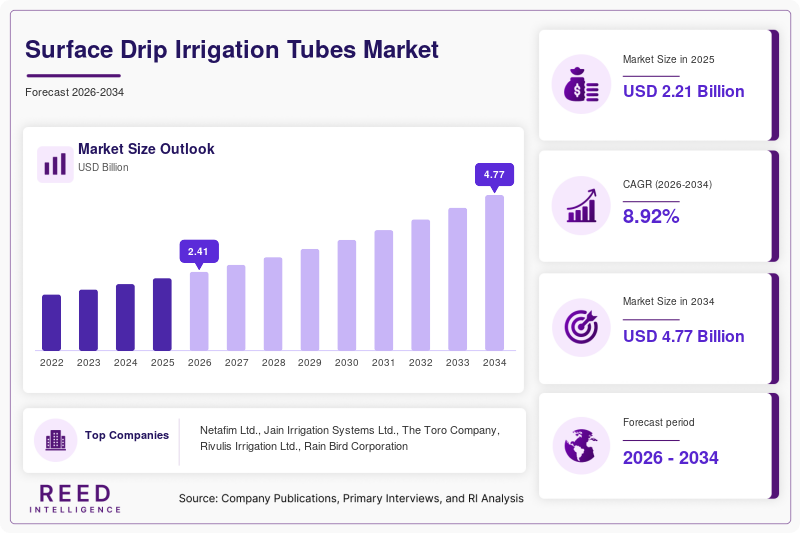
Surface Drip Irrigation Tubes market size is projected at USD 2.41 billion in 2026 and is expected to hit USD 4.78 billion by 2034 with a CAGR of 8.92%. Rising water conservation initiatives, increasing adoption of precision irrigation systems, and expanding commercial farming operations are accelerating market expansion globally. The report provides comprehensive data on production volumes, technology adoption, segment performance, and competitive landscape across major agricultural regions.
The market comprises polyethylene-based irrigation tubing systems designed to deliver water directly to crop root zones through controlled emitter spacing and flow rates. Global production exceeded 8.6 billion meters in 2025, with agricultural field applications accounting for approximately 56% of total consumption. Adoption of drip irrigation systems surpassed 29 million hectares worldwide, while water savings of 30%–60% compared to conventional irrigation methods have supported increasing implementation. Growing investments in efficient irrigation infrastructure continue to strengthen Surface Drip Irrigation Tubes market share.
Surface Drip Irrigation Tubes Market Trends
Rising Adoption of Precision Irrigation Technologies
Precision farming practices are driving demand for advanced surface drip irrigation systems across major agricultural economies. In 2025, production of surface drip irrigation tubes exceeded 8.6 billion meters, representing an annual increase of 9.1%. More than 41% of newly installed micro-irrigation systems incorporated automated flow management technologies. Smart irrigation integration and sensor-based water delivery systems continue to support Surface Drip Irrigation Tubes market trend.
Increasing cultivation of high-value crops such as fruits, vegetables, and plantation crops is creating strong demand for efficient irrigation infrastructure. Greenhouse cultivation areas expanded by 7.8% globally in 2025, while orchards and vineyards increased drip irrigation adoption to nearly 63%. Technological improvements in emitter clog resistance and pressure regulation continue to support Surface Drip Irrigation Tubes market trend.
Surface Drip Irrigation Tubes Market Drivers
Growing Need for Water Conservation in Agriculture
Agriculture accounts for nearly 70% of global freshwater consumption, creating substantial pressure to improve irrigation efficiency. Surface drip irrigation systems can reduce water use by 35%–60% while increasing crop productivity by 20%–40%. More than 18 million hectares of farmland adopted drip irrigation systems between 2020 and 2025. These benefits continue to accelerate Surface Drip Irrigation Tubes market growth.
Surface Drip Irrigation Tubes Market Restraints
High Initial Installation and Infrastructure Costs
Initial installation costs for drip irrigation systems range from USD 800 to USD 3,000 per hectare depending on crop type and field configuration. Small-scale farmers in developing economies face investment constraints, with adoption rates remaining below 22% in several regions. Maintenance expenses and filtration requirements add operational costs, limiting broader market penetration.
Surface Drip Irrigation Tubes Market Opportunities
Government Subsidies and Irrigation Modernization Programs
Governments worldwide allocated more than USD 12 billion toward irrigation modernization programs during 2025. Subsidy schemes covering 30%–70% of installation costs have significantly improved adoption rates among farmers. More than 5.4 million hectares were brought under new micro-irrigation systems through public support programs. These initiatives create substantial opportunities for Surface Drip Irrigation Tubes market demand.
Challenges in Surface Drip Irrigation Tubes Market
Emitter Clogging and Product Durability Concerns
Emitter clogging affects approximately 8%–12% of installed systems annually, particularly in regions with poor water quality. Tube degradation due to ultraviolet exposure and extreme temperatures contributes to replacement rates of nearly 15% over five years. Limited technical expertise and maintenance practices in some agricultural markets continue to create challenges for Surface Drip Irrigation Tubes market development.
Surface Drip Irrigation Tubes Market Segmentation
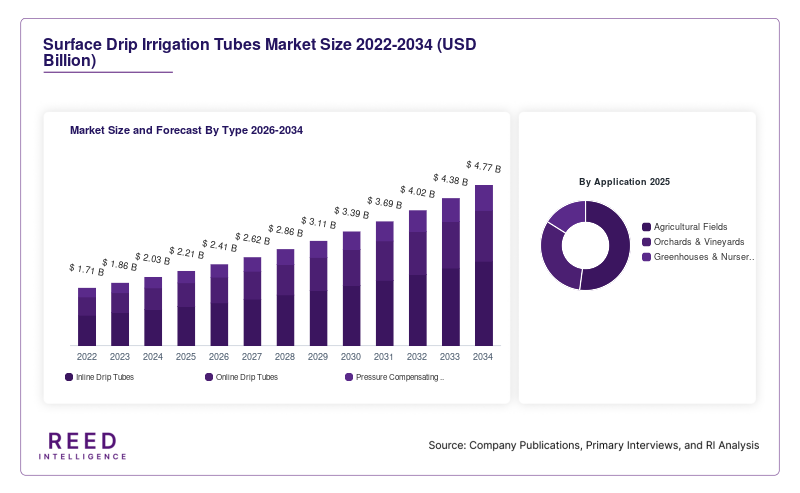
The market is segmented by type and application, with inline drip tubes accounting for approximately 47% of total revenue and agricultural fields contributing nearly 56% of market demand. Growing adoption across commercial farming and horticulture sectors continues to support segment expansion.
By Type
Inline drip tubes held approximately 47% market share in 2025. Production exceeded 4.0 billion meters, supported by large-scale row crop cultivation. Typical emitter spacing ranges from 20 cm to 60 cm, with flow rates between 1 and 4 liters per hour. Their cost efficiency and ease of installation contribute to widespread adoption.
Online drip tubes accounted for nearly 31% of market demand. Production surpassed 2.7 billion meters during 2025. These systems provide flexible emitter placement and are extensively used in orchards, vineyards, and specialty crops requiring customized irrigation layouts.
Pressure compensating drip tubes represented approximately 22% of global revenue. Production exceeded 1.9 billion meters in 2025. These products maintain consistent water discharge across varying elevations and pressure conditions, improving irrigation uniformity by more than 90%.
By Application
Agricultural fields accounted for approximately 56% of total market consumption. More than 4.8 billion meters of tubing were deployed across cereal, oilseed, and vegetable cultivation areas in 2025. Adoption rates increased by 10.2% due to water scarcity concerns and productivity improvements.
Orchards and vineyards represented nearly 28% of market demand. Annual consumption exceeded 2.4 billion meters, supported by precision irrigation requirements and increasing fruit production. Drip irrigation utilization exceeded 63% across commercial orchards in major producing countries.
Greenhouses and nurseries accounted for approximately 16% of market volume. Consumption surpassed 1.4 billion meters in 2025. High-value crop cultivation and controlled-environment agriculture continue to support segment growth through efficient water and nutrient management.
Surface Drip Irrigation Tubes Market Regional Outlook
North America Surface Drip Irrigation Tubes Market
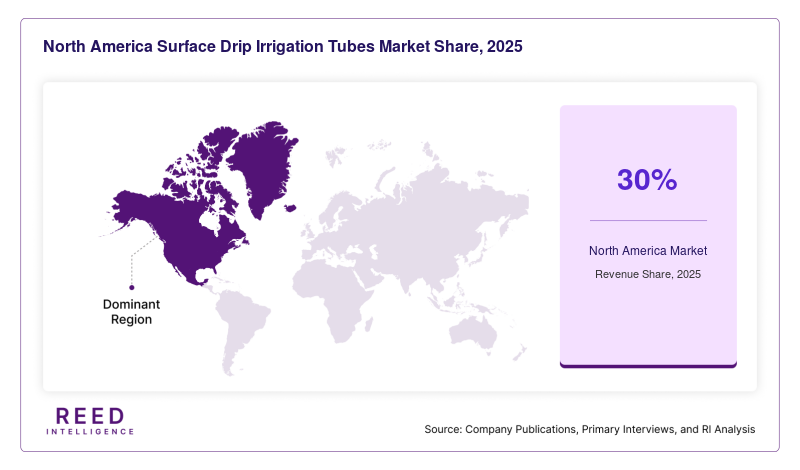
North America accounted for approximately 30% of global revenue in 2025. The United States represented nearly 79% of regional demand, supported by more than 4.5 million hectares under drip irrigation systems. Canada contributed approximately 12% of regional consumption.
Europe Surface Drip Irrigation Tubes Market
Europe held nearly 25% market share. Spain, Italy, France, and Greece collectively accounted for over 65% of regional demand. Production and installation volumes exceeded 1.8 billion meters during 2025, driven by water conservation regulations and advanced farming practices.
Asia-Pacific Surface Drip Irrigation Tubes Market
Asia-Pacific represented approximately 33% of global demand. China contributed 38% of regional consumption, while India accounted for 29%. More than 10 million hectares were equipped with drip irrigation systems, making the region the fastest-growing market globally.
Latin America Surface Drip Irrigation Tubes Market
Latin America accounted for nearly 8% of global revenue. Brazil represented approximately 51% of regional demand, followed by Mexico at 22%. Growing commercial agriculture and water efficiency programs continue to support adoption.
Middle East & Africa Surface Drip Irrigation Tubes Market
The region contributed approximately 4% of total market demand. Israel, Saudi Arabia, and South Africa remain key markets due to limited water resources and increasing irrigation investments. Consumption exceeded 340 million meters during 2025.
Top players in Surface Drip Irrigation Tubes Market
- Netafim Ltd.
- Jain Irrigation Systems Ltd.
- The Toro Company
- Rivulis Irrigation Ltd.
- Rain Bird Corporation
- Lindsay Corporation
- Hunter Industries
- Chinadrip Irrigation Equipment Co., Ltd.
- Elgo Irrigation Ltd.
- Metzer Group
- Mahindra EPC Irrigation Ltd.
- Eurodrip S.A.
- Kisan Irrigation Ltd.
- Microjet Irrigation Systems
- DripWorks Inc.
Netafim Ltd.
- Estimated market share ranges between 15% and 18%.
- Netafim is recognized as a global leader in precision irrigation technologies and operates across more than 110 countries.
- The company offers advanced surface drip irrigation tube systems, pressure-compensating technologies, and digital irrigation management solutions.
- Strong investments in R&D and smart agriculture platforms enhance product performance and water-use efficiency.
- Extensive distribution networks and strategic partnerships with agricultural enterprises strengthen its competitive position across developed and emerging markets.
Jain Irrigation Systems Ltd.
- Estimated market share ranges between 10% and 13%.
- Jain Irrigation maintains a strong presence in Asia-Pacific, Africa, Europe, and North America through comprehensive irrigation product portfolios.
- The company specializes in micro-irrigation systems, water management technologies, and agricultural sustainability solutions.
- Continuous investments in manufacturing expansion and product innovation support long-term growth.
- Strong government project participation and farmer outreach programs contribute to sustained market leadership.
Recent Developments in Surface Drip Irrigation Tubes Market
- 2025: Netafim expanded production capacity for advanced drip irrigation tubing systems.
- 2025: Jain Irrigation introduced enhanced pressure-compensating drip tube technologies.
Surface Drip Irrigation Tubes Market Segments
By Type
- Inline Drip Tubes
- Online Drip Tubes
- Pressure Compensating Drip Tubes
By Application
- Agricultural Fields
- Orchards & Vineyards
- Greenhouses & Nurseries
By Region
- North America
- Europe
- APAC
- Middle East and Africa
- LATAM