Swine Feed Dispenser Market Size, Share, Demand Report By Type (Automatic Feed Dispensers, Semi-Automatic Feed Dispensers, Manual Feed Dispensers), By Application (Pig Farms, Breeding Facilities, Commercial Livestock Operations), By Region & Segment Forecasts, 2026–2034
USD 3950
Swine Feed Dispenser Market Size
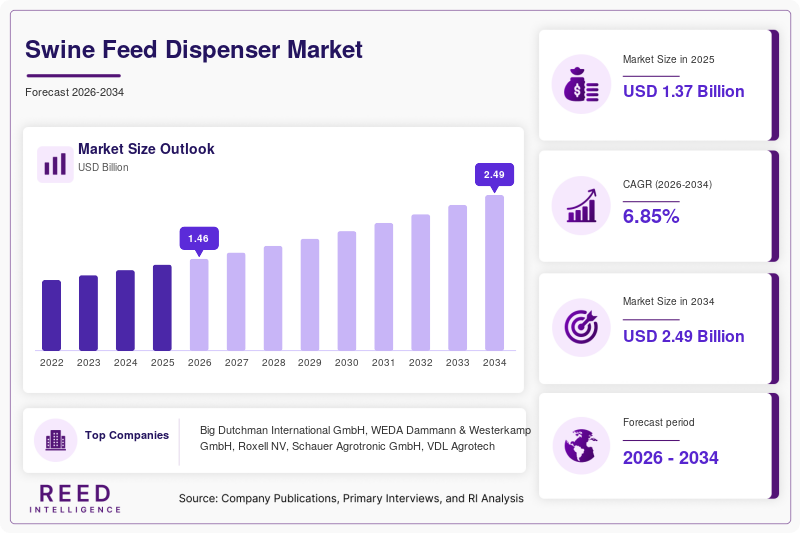
Swine Feed Dispenser market size is projected at USD 1.46 billion in 2026 and is expected to hit USD 2.48 billion by 2034 with a CAGR of 6.85%. Rising investments in livestock automation, precision feeding technologies, and modern pig farming infrastructure are driving industry expansion. Detailed market data, segment-level evaluation, and competitive landscape assessment are becoming increasingly important for stakeholders operating in the global swine feed dispenser industry.
The swine feed dispenser market comprises automated and manual feeding systems designed to distribute feed efficiently across pig production facilities. More than 9.8 million swine feed dispenser units were operational globally in 2025, serving over 780 million pigs across commercial farms. Automatic systems accounted for nearly 52% of installations, while commercial livestock operations contributed approximately 48% of total demand. Increasing adoption of feeding automation, labor optimization, and feed efficiency solutions continues to strengthen the swine feed dispenser market.
Swine Feed Dispenser Market Trends
Growing Adoption of Precision Feeding Technologies
Advanced feeding systems equipped with sensors, programmable controls, and feed monitoring platforms exceeded 4.2 million installed units globally in 2025. Adoption rates surpassed 68% among large-scale pig producers in North America and 61% in Europe. Precision feeding solutions have reduced feed wastage by 12% to 18% and improved feed conversion ratios by 8% to 14%, supporting long-term swine feed dispenser market trends.
The integration of IoT-enabled dispensers and smart livestock management platforms is accelerating across commercial operations. More than 35% of newly installed dispensers now include remote monitoring features and automated feed scheduling capabilities. Demand from intensive pig farming facilities increased by 9.6% during 2025, while automated feed management systems processed over 125 million metric tons of feed annually, reinforcing swine feed dispenser market trends.
Swine Feed Dispenser Market Drivers
Expansion of Commercial Pig Farming Operations
Global pork production exceeded 122 million metric tons in 2025, creating substantial demand for efficient feeding infrastructure. More than 56% of commercial pig farms now utilize automated feeding equipment, compared to 43% in 2020. Feed accounts for nearly 65% of livestock production costs, making dispenser efficiency a critical factor in profitability. These developments continue to accelerate swine feed dispenser market growth.
Swine Feed Dispenser Market Restraints
High Initial Investment and Installation Costs
Advanced automatic feed dispensers can cost between USD 2,500 and USD 12,000 per unit depending on capacity and automation level. Nearly 39% of small and medium-sized pig farms continue to rely on conventional feeding methods due to budget limitations. Installation and maintenance expenses represent an additional 10% to 18% of total ownership costs, limiting wider adoption within the swine feed dispenser market.
Swine Feed Dispenser Market Opportunities
Rising Demand for Smart Livestock Management Systems
Smart farming adoption in livestock operations increased from 18% in 2022 to approximately 31% in 2025. More than 2.5 million connected livestock devices are now integrated into feeding and monitoring systems worldwide. Data-driven feeding technologies improve feed utilization by up to 15% while reducing labor requirements by nearly 20%, creating significant opportunities within the swine feed dispenser market.
Challenges in Swine Feed Dispenser Market
Technical Maintenance and Equipment Reliability Issues
Equipment downtime affects nearly 7% of automated feeding operations annually, resulting in productivity losses ranging from 3% to 6%. Component replacement costs account for approximately 8% of annual operating expenditures. In regions with limited technical support infrastructure, maintenance delays can exceed 72 hours, presenting challenges for the swine feed dispenser market.
Swine Feed Dispenser Market Segmentation
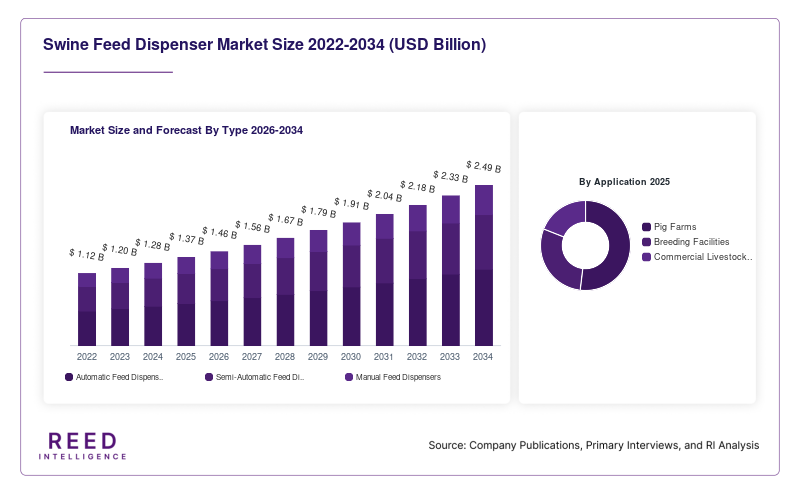
The market is segmented by type and application. Automatic feed dispensers dominated with approximately 52% revenue share in 2025, while pig farms accounted for nearly 45% of global installations. Increasing automation adoption and operational efficiency requirements continue to influence segment performance.
By Type
Automatic feed dispensers held approximately 52% of total market revenue. More than 5.1 million units were operational globally in 2025. These systems feature programmable controls, sensor-based feed release mechanisms, and storage capacities ranging from 200 kg to 2,500 kg. Feed distribution accuracy exceeds 95%, supporting efficient livestock management.
Semi-automatic feed dispensers accounted for nearly 30% of market revenue. Global installations exceeded 2.9 million units. These systems combine manual supervision with automated feed delivery functions and are widely adopted across medium-sized livestock operations. Feed efficiency improvements range between 8% and 12%.
Manual feed dispensers represented approximately 18% of market demand. More than 1.8 million units remained operational in 2025, particularly in developing agricultural economies. Typical capacities range from 50 kg to 500 kg and remain popular due to lower acquisition costs.
By Application
Pig farms accounted for approximately 45% of market revenue. More than 4.4 million dispenser units were installed across commercial pig production facilities globally. Automation penetration exceeded 58%, improving feed utilization and reducing wastage by up to 15%.
Breeding facilities contributed nearly 27% of total demand. Specialized feeding systems support nutritional management for breeding sows and piglets. More than 2.6 million units were utilized across breeding operations, with adoption rates increasing by 7% annually.
Commercial livestock operations represented approximately 28% of market revenue. Large-scale integrated farming enterprises processed over 80 million metric tons of feed through automated dispensing systems during 2025. Technology penetration exceeded 70% among organized livestock producers.
Swine Feed Dispenser Market Regional Outlook
North America Swine Feed Dispenser Market
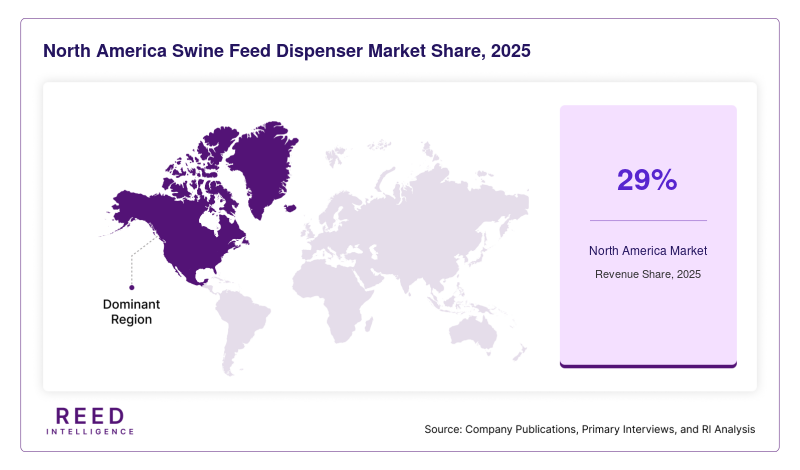
North America accounted for approximately 29% of global revenue in 2025. The United States contributed nearly 76% of regional demand, supported by advanced livestock automation and large-scale commercial pig farming. More than 2.3 million dispenser units were operational across the region.
Europe Swine Feed Dispenser Market
Europe represented nearly 26% of market share. Germany, Spain, Denmark, and the Netherlands collectively accounted for over 58% of regional demand. Automated feeding system adoption exceeded 64% among intensive pig farming operations.
Asia-Pacific Swine Feed Dispenser Market
Asia-Pacific dominated the market with approximately 34% revenue share. China accounted for nearly 49% of regional demand, while Vietnam, India, and South Korea showed increasing adoption rates. More than 3.8 million dispenser units were installed throughout the region in 2025.
Latin America Swine Feed Dispenser Market
Latin America captured around 7% of global revenue. Brazil contributed over 52% of regional demand due to its expanding pork production industry. Automation adoption increased by approximately 8% annually across commercial farms.
Middle East & Africa Swine Feed Dispenser Market
The Middle East & Africa accounted for roughly 4% of market revenue. Livestock modernization initiatives and increasing investments in food security programs supported regional growth. Automated feeding system penetration exceeded 22% among large commercial operations.
Top players in Swine Feed Dispenser Market
- Big Dutchman International GmbH
- WEDA Dammann & Westerkamp GmbH
- Roxell NV
- Schauer Agrotronic GmbH
- VDL Agrotech
- AP Company
- Skiold A/S
- Fancom B.V.
- AgriSys A/S
- Osborne Industries Inc.
- Hog Slat Inc.
- Jyga Technologies
- Pellon Group Oy
- Tuffigo Rapidex
- Gestal Inc.
Big Dutchman International GmbH
- Estimated market share: 14%-16%
- Leading provider of automated feeding and livestock management systems.
- Strong presence across Europe, North America, and Asia-Pacific.
- Offers integrated dispenser solutions with feed monitoring, storage, and distribution technologies.
- Supplies equipment to thousands of commercial pig farming operations worldwide.
- Maintains a strong competitive position through continuous product innovation and digital livestock management capabilities.
WEDA Dammann & Westerkamp GmbH
- Estimated market share: 10%-12%
- Recognized for precision feeding systems and automated swine management solutions.
- Strong customer base across intensive pig production facilities.
- Focuses on feed efficiency optimization and animal welfare improvements.
- Provides advanced sensor-enabled dispensing systems with real-time performance monitoring.
- Continues expanding through technology upgrades and partnerships with livestock producers globally.
Recent Developments in Swine Feed Dispenser Market
- 2025: Big Dutchman launched next-generation IoT-enabled swine feeding systems with cloud connectivity.
- 2025: Roxell expanded automated feeding equipment production capacity in Europe.
Swine Feed Dispenser Market Segments
By Type
- Automatic Feed Dispensers
- Semi-Automatic Feed Dispensers
- Manual Feed Dispensers
By Application
- Pig Farms
- Breeding Facilities
- Commercial Livestock Operations
By Region
- North America
- Europe
- APAC
- Middle East and Africa
- LATAM