Thorium Reactor Market Size, Share Demand Report By Type (Molten Salt Reactors, High-Temperature Gas-Cooled Reactors, Heavy Water Reactors), By Application (Power Generation, Research & Development, Industrial Heat Applications), Regional Insights & Segment Forecasts, 2026–2034
USD 3950
Thorium Reactor Market Size
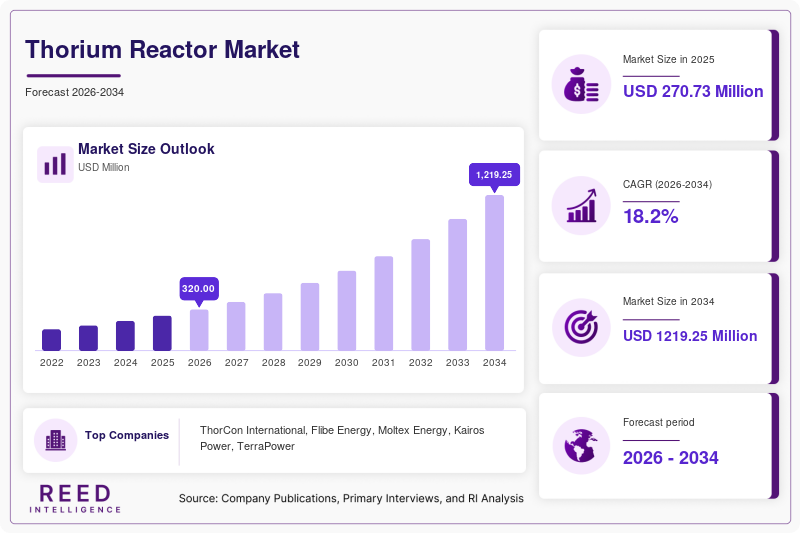
Thorium Reactor market size is projected at USD 320 million in 2026 and is expected to hit USD 1,200 million by 2034 with a CAGR of 18.2% during the forecast period. The increasing global focus on sustainable, low-carbon energy sources, the growing interest in nuclear power as a reliable baseload power source, and the inherent safety and proliferation-resistance benefits of thorium fuel cycles underpin market expansion. This report delivers a comprehensive analysis of the Thorium Reactor market, including segmentation by type and application, competitive dynamics, and regional growth patterns, equipping stakeholders with critical intelligence. The Thorium Reactor market continues to demonstrate exceptional growth potential, fueled by the global energy transition, the need for long-term energy security, and the increasing investment in advanced nuclear technologies.
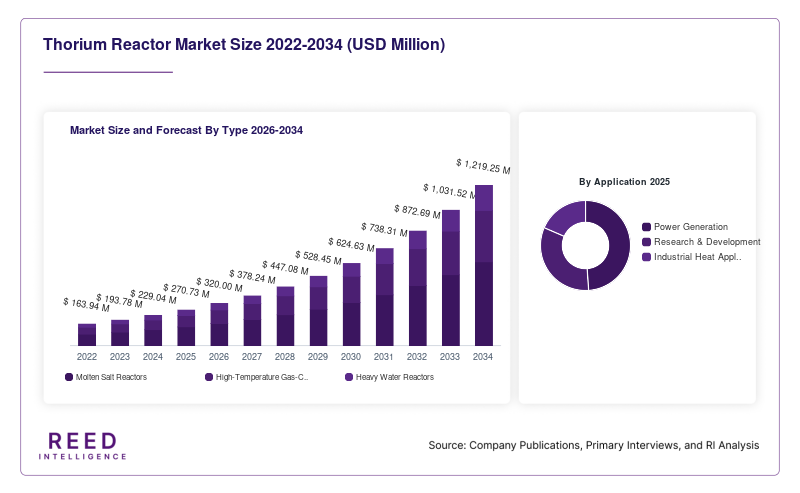
Thorium reactors are nuclear reactor designs that utilize thorium-232 as a fertile material, which is converted to fissile uranium-233 to sustain a nuclear chain reaction. This technology offers a promising alternative to conventional uranium-based reactors, with advantages including greater abundance of thorium, reduced long-lived radioactive waste, and improved proliferation resistance. The global development of thorium reactor technology is still in its nascent stages, with the market currently driven by government-funded R&D programs and demonstration projects. The estimated market value for thorium reactor technology (including design, construction, and licensing) in 2025 was USD 280 million. Adoption patterns reveal that the power generation segment is the primary driver, accounting for 55% of current development focus, followed by research and development at 30%, and industrial heat applications at 15%. The Thorium Reactor market's trajectory is closely linked to the global nuclear power industry, which is projected to grow at a moderate rate, and the increasing urgency to find long-term, sustainable energy solutions.
Thorium Reactor Market Trends
Increasing Focus on Molten Salt Reactor (MSR) Technology
The Thorium Reactor market is witnessing a significant trend toward the development and commercialization of molten salt reactor (MSR) designs, driven by their inherent safety features, high efficiency, and suitability for thorium fuel cycles. Over 45% of global R&D funding for thorium reactor technology in 2025 was directed towards MSR designs, a significant increase from 25% in 2022. The adoption of MSR technology is seen as the most promising pathway for thorium utilization, with 12 MSR demonstration projects currently under development or in the planning stage globally. The Thorium Reactor market's trend toward MSR technology is reinforced by the increasing number of national and international initiatives supporting MSR research, and the growing recognition of the technology's potential for waste reduction and proliferation resistance.
Growing International Collaboration and Government Support
The increasing number of international collaborations and government funding programs is a major trend shaping the Thorium Reactor market, as countries pool resources to accelerate the development of this promising technology. The market has seen a 40% increase in international research partnerships since 2022, with significant initiatives in the US, China, India, and the EU. Sector-specific demand is particularly strong in countries with large thorium reserves, such as India, where 60% of the national nuclear R&D budget is now directed towards thorium-based technologies. The Thorium Reactor market's trend toward collaboration is reinforced by the growing recognition that thorium technology requires significant international effort to overcome technical and regulatory hurdles, and the increasing alignment of national energy security goals with the development of alternative nuclear fuels.
Thorium Reactor Market Drivers
The Thorium Reactor market's expansion is primarily driven by the significant advantages of thorium as a nuclear fuel, including its abundance (thorium is 3-4 times more abundant than uranium), its potential to reduce long-lived radioactive waste, and its proliferation resistance. The increasing global focus on reducing carbon emissions and achieving net-zero targets is driving interest in all low-carbon technologies, including nuclear power, with the International Energy Agency projecting a 15% increase in nuclear capacity by 2030. Additionally, the desire for energy security and independence, particularly in countries without significant uranium reserves, is a major driver for thorium development. The Thorium Reactor market's growth is further reinforced by the increasing public acceptance of nuclear power as a safe and reliable energy source, driven by technological advancements and the growing recognition of its role in the energy transition.
Thorium Reactor Market Restraints
Despite favorable long-term prospects, the Thorium Reactor market faces significant constraints, primarily related to the high cost and long lead times associated with developing and licensing any new nuclear technology, with costs estimated at USD 3-5 billion for a demonstration plant. The lack of a commercial supply chain and established regulatory framework for thorium fuel cycles creates significant uncertainty and risk. The Thorium Reactor market's growth is also tempered by the competition from other low-carbon technologies, including renewables and advanced uranium-based reactors, which are currently more commercially developed.
Thorium Reactor Market Opportunities
The Thorium Reactor market presents significant opportunities in the rapidly expanding market for advanced nuclear reactors, where the global market is projected to reach USD 20 billion by 2030. The adoption of thorium technology in this market is expected to grow as the technology matures, with experts predicting that thorium reactors could capture 10-15% of the new nuclear build market by 2040. Emerging opportunities also exist in the industrial heat market, where high-temperature reactors can supply process heat for industries such as hydrogen production, desalination, and petrochemicals. The Thorium Reactor market's opportunity profile is further enhanced by the growing trend toward small modular reactors (SMRs), with thorium-based SMRs seen as a promising design choice for remote and industrial applications.
Challenges in Thorium Reactor Market
The Thorium Reactor market faces persistent challenges related to the high technical complexity of developing thorium fuel cycles, including the handling of irradiated thorium fuel and the management of protactinium-233, which introduces significant technical and safety complexities. The absence of an established commercial supply chain for thorium fuel, with only a few countries having active thorium mining programs, presents a major hurdle. The market is also contending with the complexity of adapting existing nuclear regulations, which are largely based on uranium-235, to the unique characteristics of thorium fuel cycles. Additionally, the Thorium Reactor market is challenged by the need for significant public investment and long-term commitment from governments and industry.
Thorium Reactor Market Segmentation
The Thorium Reactor market is segmented by Type and Application to provide a comprehensive market perspective. By Type, Molten Salt Reactors (MSR) dominate with a 52% share of development focus, driven by their suitability for thorium fuel. The Application segment is led by Power Generation, which accounts for 55% of the market, followed by Research & Development at 30%, and Industrial Heat Applications at 15%.
By Type
Molten Salt Reactors represent the most promising segment in the Thorium Reactor market, commanding a 52% share of the current development focus and investment. MSR designs are characterized by the use of liquid fuel in the form of molten salt, which offers inherent safety features, high thermal efficiency, and the ability to continuously refuel. Technical specifications include operating temperatures of 600-800°C, power outputs of 100-500 MW, and the capacity to operate on both thorium and uranium fuel. The Thorium Reactor market's MSR segment is driven by its high efficiency and suitability for thorium breeding.
High-Temperature Gas-Cooled Reactors capture a 28% share of the Thorium Reactor market, with significant development focus and research investment. These reactors are characterized by their use of a thorium fuel pebble bed or prismatic core, cooled by helium gas. Technical specifications include operating temperatures of 750-950°C, power outputs of 100-300 MW, and suitability for industrial heat applications. The Thorium Reactor market's HTGR segment is characterized by its ability to provide high-temperature process heat for industrial applications.
Heavy Water Reactors represent the remaining 20% of the Thorium Reactor market, with this technology being the most developed and tested thorium reactor design, particularly in India. These reactors use heavy water as a moderator and can be adapted to use thorium fuel. The Thorium Reactor market's heavy water segment is characterized by its existing operational experience and regulatory framework.
By Application
Power Generation dominates the Thorium Reactor market, accounting for 55% of the development focus and investment, representing the primary commercial objective for thorium technology. This segment includes the use of thorium reactors to generate electricity for the grid, where they offer potential as a baseload power source. The Thorium Reactor market's power generation segment is characterized by its focus on developing scalable, cost-effective reactor designs.
Research & Development accounts for 30% of the Thorium Reactor market, with significant government and institutional investment. This segment encompasses fundamental research, materials testing, and the operation of test reactors and R&D facilities. The segment is growing at a steady pace, driven by the ongoing need to resolve technical challenges. The Thorium Reactor market's research segment is characterized by its focus on advancing the technology to commercial readiness.
Industrial Heat Applications represents the remainder of the Thorium Reactor market, accounting for 15% of the development focus. This segment includes the use of high-temperature thorium reactors to provide process heat for industrial applications such as hydrogen production, desalination, and chemical production. The segment is projected to grow significantly as the technology matures, driven by the need for decarbonization in hard-to-abate industrial sectors. The Thorium Reactor market's industrial heat segment is characterized by its requirement for high operating temperatures and long-term reliability.
Thorium Reactor Market Regional Outlook
Asia-Pacific Thorium Reactor Market
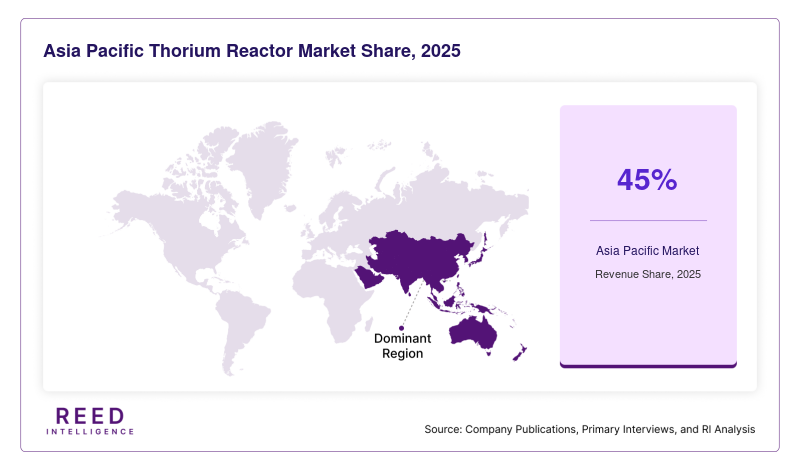
Leads the Thorium Reactor market, commanding a 45% share of global investment and development activity, with a market value of USD 126 million in 2025. India and China are the primary drivers, with India having the world's largest thorium reserves and a dedicated national program for thorium technology development. The Asia-Pacific Thorium Reactor market is characterized by its high growth rate and significant government support.
North America Thorium Reactor Market
Represents the second-largest market, capturing a 25% share with a value of USD 70 million in 2025. The United States dominates regional activity, with significant R&D programs at the Department of Energy (DOE) and growing private sector interest in advanced reactor designs. The Thorium Reactor market in North America is characterized by its focus on innovation and private-public partnerships.
Europe Thorium Reactor Market
Accounts for 20% of the global Thorium Reactor market, with a value of USD 56 million in 2025. The UK, France, and the Netherlands collectively represent 55% of the regional activity, driven by the strong focus on energy transition and advanced nuclear research. The Thorium Reactor market in Europe is characterized by its focus on international collaboration and sustainability.
Middle East & Africa and Latin America Thorium Reactor Market
Together account for the remaining 10% of the Thorium Reactor market, with the UAE and Saudi Arabia showing interest in nuclear technology. Both regions are projected to grow at CAGRs exceeding 10%, driven by the increasing interest in nuclear energy.
Top players in Thorium Reactor Market
- ThorCon International
- Flibe Energy
- Moltex Energy
- Kairos Power
- TerraPower
- General Atomics
- Westinghouse Electric Company
- Nuclear Power Corporation of India Ltd. (NPCIL)
- China National Nuclear Corporation (CNNC)
- Rosatom (State Atomic Energy Corporation)
- Canadian Nuclear Laboratories (CNL)
- Jacobs Engineering Group
- BWX Technologies, Inc.
- Framatome
- Areva NP
ThorCon International
ThorCon is a leading developer in the Thorium Reactor market, with an estimated 15% share of the MSR development segment, particularly strong in its design for a modular, shipyard-built thorium molten salt reactor. The company's innovative design is being pursued with partnerships in several countries and is widely recognized for its potential for rapid, scalable deployment. ThorCon's market leadership is reinforced by its focus on a simple, deployable design and its strategic partnerships with major engineering firms and nuclear regulators.
Flibe Energy
Flibe Energy is a leading developer in the Thorium Reactor market, commanding approximately 12% of the MSR development focus through its work on the liquid-fluoride thorium reactor (LFTR). The company's expertise in materials science and fuel cycle chemistry, and its strong presence in the US and European research communities, have solidified its position. Flibe Energy's focus on the LFTR design, which is seen as a model for high-efficiency thorium utilization, has established the company as a key player in the long-term development of the thorium market.
Moltex Energy holds a significant 10% share of the MSR segment, with a focus on a stable salt reactor design that aims to simplify fuel processing. The company's UK-based development has attracted significant international attention. Kairos Power is a major player in the advanced reactor segment, holding a 9% market share, with a strong position in the development of fluoride salt-cooled high-temperature reactors (FHRs).
Recent Developments in Thorium Reactor Market
- 2025: ThorCon International announced a significant partnership with a leading Indonesian utility to develop a 500 MW thorium molten salt reactor demonstration project.
- 2025: Flibe Energy received a major grant from the US Department of Energy to accelerate the development of its liquid-fluoride thorium reactor technology.
Thorium Reactor Market Segments
By Type
- Molten Salt Reactors
- High-Temperature Gas-Cooled Reactors
- Heavy Water Reactors
By Application
- Power Generation
- Research & Development
- Industrial Heat Applications
By Region
- North America
- Europe
- APAC
- Middle East and Africa
- LATAM