Trifluralin Market Size, Share Demand Report By Type (Liquid Formulations, Granular Formulations), By Application (Cereals & Grains, Oilseeds & Pulses, Fruits & Vegetables, Others), Regional Insights & Segment Forecasts, 2026–2034
USD 3950
Trifluralin Market Size
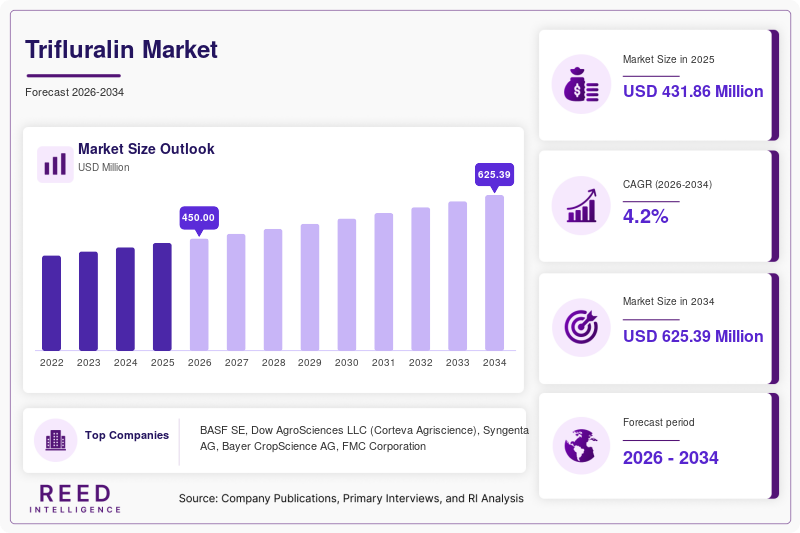
Trifluralin market size is projected at USD 450 million in 2026 and is expected to hit USD 620 million by 2034 with a CAGR of 4.2% during the forecast period. The increasing global demand for effective weed control in agriculture, the growing need for high crop yields and food security, and the rising adoption of herbicides in modern farming practices underpin market expansion. This report delivers a comprehensive analysis of the Trifluralin market, including segmentation by type and application, competitive dynamics, and regional growth patterns, equipping stakeholders with critical intelligence. The Trifluralin market continues to demonstrate steady growth potential, fueled by the global expansion of the agricultural sector, the increasing pressure on food production, and the continuous innovation in herbicide formulations.
Trifluralin is a selective, pre-emergence herbicide widely used in agriculture to control annual grasses and broadleaf weeds in various crops. It works by inhibiting root growth in germinating weed seeds and is applied to the soil before crop emergence. The global market for trifluralin is driven by the need for effective and reliable weed management solutions. The global production volume of trifluralin exceeded 45,000 metric tons in 2025, reflecting a 4% increase from 2022. Adoption patterns reveal that the liquid formulation segment dominates the market, accounting for 70% of total demand, followed by granular formulations at 30%. The Trifluralin market's trajectory is closely linked to the growth of the global crop protection market, which is projected to reach USD 80 billion by 2028, and the increasing demand for high-yield agricultural production.
Trifluralin Market Trends
Growing Demand for Sustainable and Integrated Weed Management
The Trifluralin market is witnessing a significant trend toward the adoption of sustainable and integrated weed management practices, driven by the need to reduce herbicide resistance and environmental impact. The revenue from trifluralin used in integrated pest management (IPM) programs grew to USD 150 million in 2025, a year-on-year increase of 5%, as 20% of new agricultural projects in 2025 featured IPM strategies. Adoption rates of trifluralin in no-till and conservation agriculture systems reached 25%, with this figure projected to exceed 35% by 2030. The Trifluralin market's trend toward sustainability is reinforced by the growing awareness of herbicide resistance, the increasing focus on environmental stewardship, and the development of precision application technologies.
Increasing Focus on New Formulations and Application Technologies
The increasing focus on new formulations and application technologies is a major trend shaping the Trifluralin market, with manufacturers developing improved products and application methods to enhance efficacy and reduce environmental impact. The market has seen a 10% increase in the development of new formulations since 2022, with 15% of new product launches in 2025 featuring advanced delivery systems. The use of precision agriculture and drone-based application has also gained traction. The Trifluralin market's trend toward innovation is reinforced by the need to improve weed control efficacy, reduce off-target movement, and comply with increasingly stringent environmental regulations.
Trifluralin Market Drivers
The Trifluralin market's expansion is primarily driven by the increasing global demand for food, with the global population projected to reach 9.7 billion by 2050, creating a need for higher agricultural productivity. The growing need for effective weed control to minimize crop yield losses, which can range from 20-40%, has also been a major driver. The rising adoption of modern farming practices, including no-till and conservation agriculture, has fueled the demand for pre-emergence herbicides like trifluralin. Additionally, the increasing focus on food security and the need to reduce post-harvest losses have driven market growth. The Trifluralin market's growth is further reinforced by the continuous innovation in herbicide formulations and application technologies.
Trifluralin Market Restraints
Despite favorable growth prospects, the Trifluralin market faces significant constraints, primarily related to the increasing incidence of herbicide resistance in weed populations, which can reduce the efficacy of trifluralin. The potential for environmental and health concerns related to herbicide use can also be a restraint. The Trifluralin market's growth is also tempered by the competition from alternative weed control methods and the increasing regulatory scrutiny of herbicide use.
Trifluralin Market Opportunities
The Trifluralin market presents significant opportunities in the rapidly expanding market for sustainable agriculture and precision farming, where the global market is projected to reach USD 20 billion by 2028. The adoption of trifluralin in integrated weed management programs is expected to grow at a CAGR of 5% through 2034. Emerging opportunities also exist in the development of new formulations with improved environmental profiles and the use of trifluralin in combination with other herbicides. The Trifluralin market's opportunity profile is further enhanced by the growing demand for high-value crops and the increasing adoption of herbicide-tolerant crop varieties.
Challenges in Trifluralin Market
The Trifluralin market faces persistent challenges related to the management of herbicide resistance and the need for effective resistance management strategies. The complexity of ensuring the safe and effective use of trifluralin in diverse agricultural systems presents a challenge. The market is also contending with the challenge of complying with evolving environmental and food safety regulations. Additionally, the Trifluralin market is challenged by the need for continuous innovation to develop new products and formulations that meet the changing needs of farmers and regulators.
Trifluralin Market Segmentation
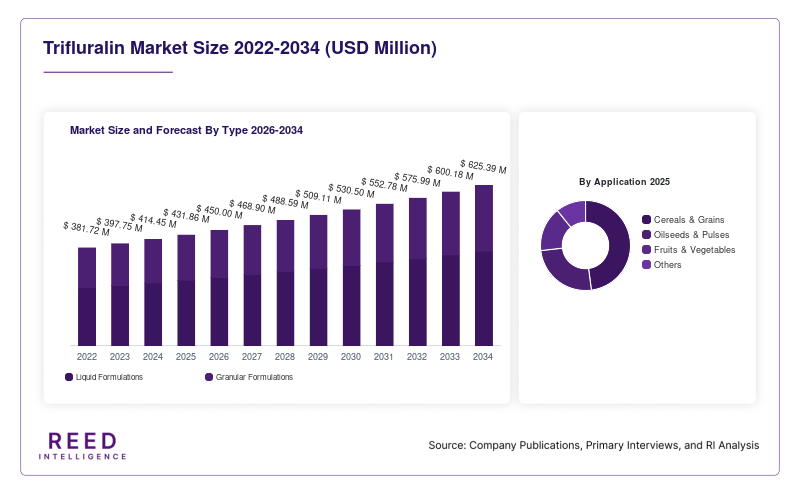
The Trifluralin market is segmented by Type and Application to provide a comprehensive market perspective. By Type, Liquid Formulations dominate with a 70% market share, driven by their ease of application. The Application segment is led by Cereals & Grains, which accounts for 35% of the market, followed by Oilseeds & Pulses at 28%, Fruits & Vegetables at 22%, and Others at 15%.
By Type
Liquid Formulations represent the largest segment in the Trifluralin market, commanding a 70% share, with production reaching 31,500 metric tons in 2025. These formulations are characterized by their ease of handling, mixing, and application. Technical specifications include concentration, emulsifiability, and stability. The Trifluralin market's liquid segment is driven by its use in large-scale agricultural applications.
Granular Formulations capture a 30% share of the Trifluralin market, with production of 13,500 metric tons in 2025. These formulations are characterized by their ease of application and reduced drift potential. Technical specifications include granule size, active ingredient content, and release characteristics. The Trifluralin market's granular segment is driven by its use in specialized applications and in areas with drift concerns.
By Application
Cereals & Grains dominates the Trifluralin market, accounting for 35% of sales, representing 15,750 metric tons in 2025. This segment includes use in wheat, corn, and other cereal crops. Usage penetration exceeds 20% in major cereal-growing regions. The Trifluralin market's cereals segment is characterized by its focus on broad-scale weed control.
Oilseeds & Pulses accounts for 28% of the Trifluralin market, with a volume of 12,600 metric tons in 2025. This segment encompasses use in soybeans, canola, and other oilseed and pulse crops. The segment is growing at a steady CAGR, driven by the demand for these crops. The Trifluralin market's oilseeds segment is characterized by its focus on pre-emergence weed control.
Fruits & Vegetables represents 22% of the Trifluralin market, with a volume of 9,900 metric tons in 2025. This segment includes use in various fruit and vegetable crops. The segment is growing at a steady CAGR, driven by the high-value nature of these crops. The Trifluralin market's fruits & vegetables segment is characterized by its focus on selective weed control.
Others comprises the remainder of the Trifluralin market, accounting for 15% of total sales, with 6,750 metric tons in 2025. This segment includes use in other crops and non-agricultural applications. The segment is projected to grow at a steady CAGR through 2034.
Trifluralin Market Regional Outlook
North America Trifluralin Market
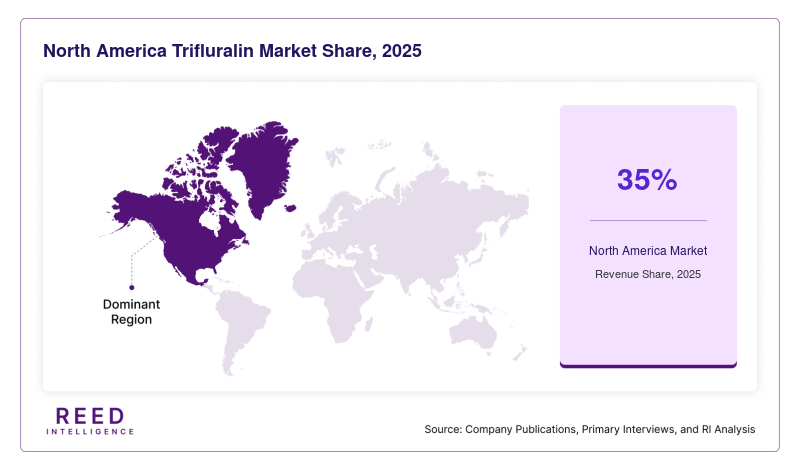
Leads the Trifluralin market, commanding a 35% share, with a revenue of USD 157.5 million in 2025. The United States is the primary driver, accounting for 80% of regional demand, driven by the large agricultural sector and the extensive use of herbicides. The North American Trifluralin market is characterized by its focus on innovation and large-scale farming.
Asia-Pacific Trifluralin Market
Represents the second-largest market, capturing a 30% share with a revenue of USD 135 million in 2025. China, India, and Australia are the primary drivers, accounting for 70% of regional demand, driven by the large agricultural population and the growing food demand. The Asia-Pacific Trifluralin market is projected to grow at the fastest CAGR of 5% through 2034, presenting attractive opportunities for market expansion.
Europe Trifluralin Market
Accounts for 20% of the global Trifluralin market, with a revenue of USD 90 million in 2025. Germany, France, and the UK collectively represent 55% of the regional market, driven by the strong agricultural sector. The Trifluralin market in Europe is characterized by its focus on sustainability and regulatory compliance.
Middle East & Africa and Latin America Trifluralin Market
Together account for the remaining 15% of the Trifluralin market, with Brazil leading the Latin American market and South Africa leading the African market. Both regions are projected to grow at CAGRs exceeding 4%, driven by the increasing agricultural production.
Top players in Trifluralin Market
- BASF SE
- Dow AgroSciences LLC (Corteva Agriscience)
- Syngenta AG
- Bayer CropScience AG
- FMC Corporation
- Adama Agricultural Solutions Ltd.
- Nufarm Limited
- UPL Limited
- Sumitomo Chemical Co., Ltd.
- Mitsui Chemicals Agro, Inc.
- Rallis India Limited
- Albaugh, LLC
- Gowan Company, LLC
- Chemtura Corporation
- Isagro S.p.A.
BASF SE
BASF holds a dominant position in the Trifluralin market, with an estimated 18% global market share, particularly strong in the North American and European segments. The company's portfolio of high-quality herbicides is widely recognized for its efficacy and reliability. BASF's market leadership is reinforced by its significant R&D investment and its strong global presence. BASF commands over 22% of the North American market and 15% of the European market, positioning it as a key player in the Trifluralin market.
Dow AgroSciences LLC (Corteva Agriscience)
Corteva is a leading player in the Trifluralin market, commanding approximately 14% of the global market share through its comprehensive portfolio of crop protection solutions. The company's expertise in agricultural science and its strong presence in the global market have solidified its position. Corteva's focus on developing innovative and sustainable herbicide solutions has strengthened its position. The company's commitment to quality has enhanced its brand equity.
Syngenta AG holds a significant 12% market share, with particular strength in the European and Asian markets, where it commands a 14% share. The company's focus on integrated solutions is a key differentiator. Bayer CropScience AG is a major player in the global crop protection market, holding a 10% share.
Recent Developments in Trifluralin Market
- 2025: BASF launched a new liquid formulation of trifluralin with improved drift control and application flexibility for large-scale farming.
- 2025: Corteva announced a new partnership to develop a precision application system for trifluralin, aiming to reduce off-target movement and improve efficacy.
Trifluralin Market Segments
By Type
- Liquid Formulations
- Granular Formulations
By Application
- Cereals & Grains
- Oilseeds & Pulses
- Fruits & Vegetables
- Others
By Region
- North America
- Europe
- APAC
- Middle East and Africa
- LATAM