Water Retention Agent Market Size, Share Demand Report By Type (Synthetic Water Retention Agents, Natural Water Retention Agents), By Application (Agriculture, Personal Care & Cosmetics, Food & Beverages, Construction), Regional Insights & Segment Forecasts, 2026–2034
USD 3950
Water Retention Agent Market Size
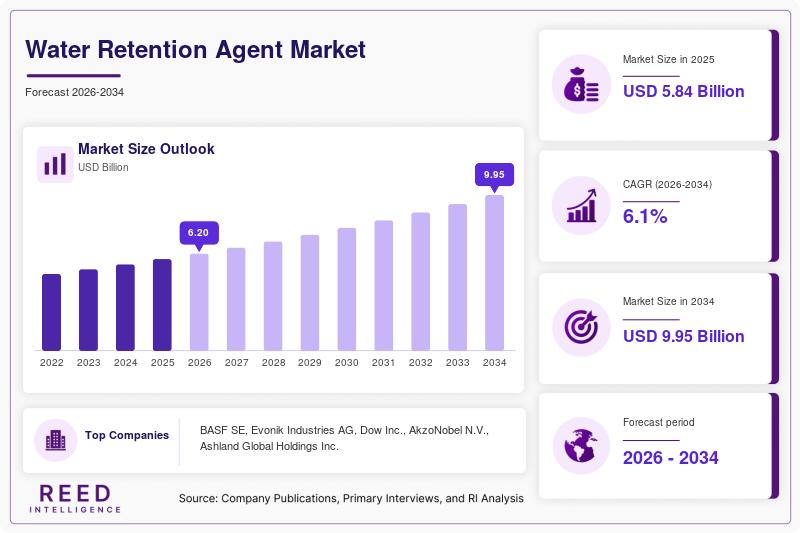
Water Retention Agent market size is projected at USD 6.2 billion in 2026 and is expected to hit USD 9.8 billion by 2034 with a CAGR of 6.1% during the forecast period. The increasing demand for water conservation in agriculture, the growing need for moisture retention in personal care and cosmetic products, and the rising awareness of sustainable water management practices underpin market expansion. This report delivers a comprehensive analysis of the Water Retention Agent market, including segmentation by type and application, competitive dynamics, and regional growth patterns, equipping stakeholders with critical intelligence. The Water Retention Agent market continues to demonstrate robust growth potential, fueled by the global push for sustainable agriculture, the expansion of the personal care industry, and the increasing focus on water efficiency in various industrial and consumer applications.
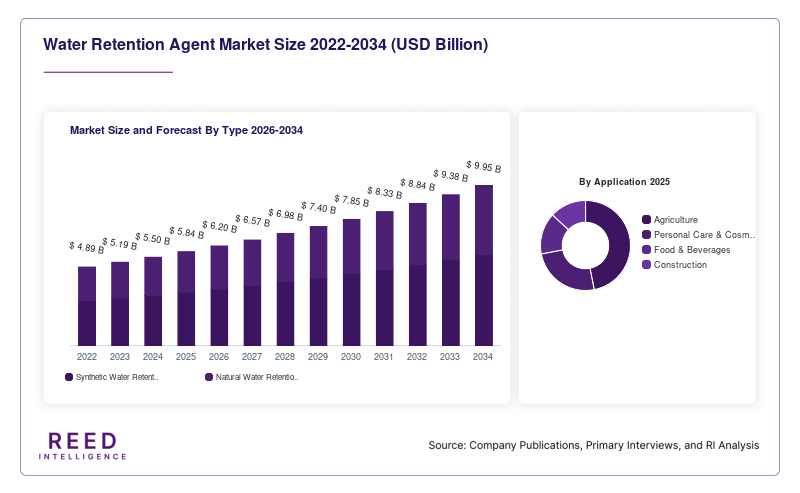
Water retention agents are substances that absorb and retain significant amounts of water, releasing it slowly over time to provide moisture for plants, products, or processes. These agents, which include synthetic polymers like polyacrylamide and natural materials like cellulose derivatives and plant-based gums, are used across agriculture, personal care, food, and construction industries to improve water efficiency and product performance. The global production volume of water retention agents exceeded 4.5 million metric tons in 2025, reflecting a 5% increase from 2022. Adoption patterns reveal that the agricultural sector dominates the market, accounting for 45% of total demand, followed by personal care and cosmetics at 25%, food and beverages at 18%, and construction at 12%. The Water Retention Agent market's trajectory is closely linked to the global need for improved water management, the increasing prevalence of drought conditions, and the growing demand for sustainable and efficient solutions across multiple industries.
Water Retention Agent Market Trends
Growing Demand for Bio-Based and Biodegradable Agents
The Water Retention Agent market is witnessing a significant trend toward bio-based and biodegradable agents, driven by increasing environmental concerns and the desire for sustainable products. The production of natural water retention agents, such as cellulose derivatives and plant-based gums, grew to 1.8 million metric tons in 2025, a year-on-year increase of 8%, as 30% of new product launches in 2025 featured bio-based formulations. Adoption rates of natural agents in the personal care sector reached 35%, with this figure projected to exceed 50% by 2030 as sustainability becomes a key purchase driver. The Water Retention Agent market's trend toward bio-based products is reinforced by the increasing consumer awareness of environmental issues, the growing availability of cost-effective natural alternatives, and the rising number of regulatory restrictions on synthetic polymers.
Increasing Focus on Application-Specific Formulations
The increasing focus on application-specific formulations and the development of custom solutions is a major trend shaping the Water Retention Agent market, as manufacturers seek to optimize performance for different applications. The market has seen a 25% increase in the development of targeted formulations since 2022, with 20% of new product launches in 2025 featuring application-specific solutions. The use of advanced formulation technologies, such as encapsulation and cross-linking, has also gained traction, with 15% of new products utilizing these technologies to improve performance. The Water Retention Agent market's trend toward specialization is reinforced by the need to meet the specific demands of various industries, from agriculture to cosmetics, and the growing understanding of the performance benefits of customized formulations.
Water Retention Agent Market Drivers
The Water Retention Agent market's expansion is primarily driven by the increasing need for water conservation in agriculture, where water retention agents can improve soil moisture retention and reduce irrigation frequency by 20-50%. The global agricultural sector, valued at USD 5.2 trillion in 2025 and facing increasing water scarcity, is a significant driver for agent demand. The growing demand for personal care and cosmetic products with enhanced moisture retention properties, with the global personal care market projected to reach USD 650 billion by 2028, has also been a major driver. Additionally, the rising awareness of the benefits of water retention agents in food applications (improving texture and shelf life) and construction (enhancing mortar and concrete properties) has fueled market growth. The Water Retention Agent market's growth is further reinforced by the increasing frequency of droughts and the growing global focus on sustainable water management.
Water Retention Agent Market Restraints
Despite favorable growth prospects, the Water Retention Agent market faces significant constraints, primarily related to the higher cost of natural and biodegradable agents compared to synthetic alternatives, which can be 20-50% more expensive. The performance of some natural agents under extreme conditions, such as high salinity or temperature, can be less robust than that of synthetic polymers. The Water Retention Agent market's growth is also tempered by the competition from alternative technologies and the potential for environmental concerns over the use of certain synthetic polymers.
Water Retention Agent Market Opportunities
The Water Retention Agent market presents significant opportunities in the rapidly expanding market for sustainable agriculture, where the global market is projected to reach USD 450 billion by 2028. The adoption of advanced water retention agents in precision agriculture is expected to grow at a CAGR of 8% through 2034, driven by the need to maximize water use efficiency. Emerging opportunities also exist in the development of agents for emerging applications, such as water retention in building materials and the use of agents in the treatment of industrial wastewater. The Water Retention Agent market's opportunity profile is further enhanced by the growing trend toward circular economy principles, creating demand for biodegradable and compostable agents.
Challenges in Water Retention Agent Market
The Water Retention Agent market faces persistent challenges related to the management of agent performance and consistency, as natural agents can exhibit batch-to-batch variability. The complexity of achieving the desired balance between water retention, release rate, and compatibility with other ingredients requires significant formulation expertise. The market is also contending with the challenge of scaling up production of bio-based agents sustainably and cost-effectively. Additionally, the Water Retention Agent market is challenged by the need for continuous innovation to improve the performance and cost-effectiveness of natural alternatives.
Water Retention Agent Market Segmentation
The Water Retention Agent market is segmented by Type and Application to provide a comprehensive market perspective. By Type, Synthetic Water Retention Agents dominate with a 62% market share, driven by their established performance and lower cost. The Application segment is led by Agriculture, which accounts for 45% of the market, followed by Personal Care & Cosmetics at 25%, Food & Beverages at 18%, and Construction at 12%.
By Type
Synthetic Water Retention Agents represent the largest segment in the Water Retention Agent market, commanding a 62% share, with production reaching 2.8 million metric tons in 2025. These agents, including polyacrylamide and polyacrylate, are characterized by their high absorption capacity, consistent performance, and cost-effectiveness. Technical specifications include absorption capacity of 200-500 times their weight and good durability. The Water Retention Agent market's synthetic segment is driven by its widespread use in agriculture and construction.
Natural Water Retention Agents capture a 38% share of the Water Retention Agent market, with production of 1.7 million metric tons in 2025. These agents, including cellulose derivatives, plant-based gums, and alginates, are characterized by their biodegradability, non-toxicity, and consumer appeal. Technical specifications include absorption capacity of 50-200 times their weight and good compatibility with natural products. The Water Retention Agent market's natural segment is growing at a faster CAGR of 8.5%, driven by the demand for sustainable and clean-label solutions.
By Application
Agriculture dominates the Water Retention Agent market, accounting for 45% of sales, representing 2.0 million metric tons in 2025. This segment includes use in soil conditioners and hydrogels for crop production, where agents improve water use efficiency, reduce irrigation frequency, and enhance soil health. Usage penetration exceeds 15% in drought-prone regions. The Water Retention Agent market's agricultural segment is characterized by its focus on water efficiency and cost-effectiveness.
Personal Care & Cosmetics accounts for 25% of the Water Retention Agent market, with sales of 1.1 million metric tons in 2025. This segment encompasses use in skincare, haircare, and cosmetic products, where agents provide moisturizing and thickening properties. The segment is growing at a CAGR of 7.5%, driven by the demand for natural and sustainable ingredients. The Water Retention Agent market's personal care segment is characterized by its focus on product performance and consumer safety.
Food & Beverages represents 18% of the Water Retention Agent market, with sales of 0.8 million metric tons in 2025. This segment includes use in processed meat, dairy, and bakery products, where agents improve texture, moisture retention, and shelf life. The segment is growing at a steady CAGR, driven by the demand for improved food texture and quality. The Water Retention Agent market's food segment is characterized by its requirement for food-grade safety and functionality.
Construction comprises the remainder of the Water Retention Agent market, accounting for 12% of total sales, with 0.5 million metric tons in 2025. This segment includes use in mortar, concrete, and dry-mix products, where agents improve workability and water retention. The segment is projected to grow at a steady CAGR through 2034, driven by the expansion of the construction industry. The Water Retention Agent market's construction segment is characterized by its requirement for high performance and consistency.
Water Retention Agent Market Regional Outlook
Asia-Pacific Water Retention Agent Market
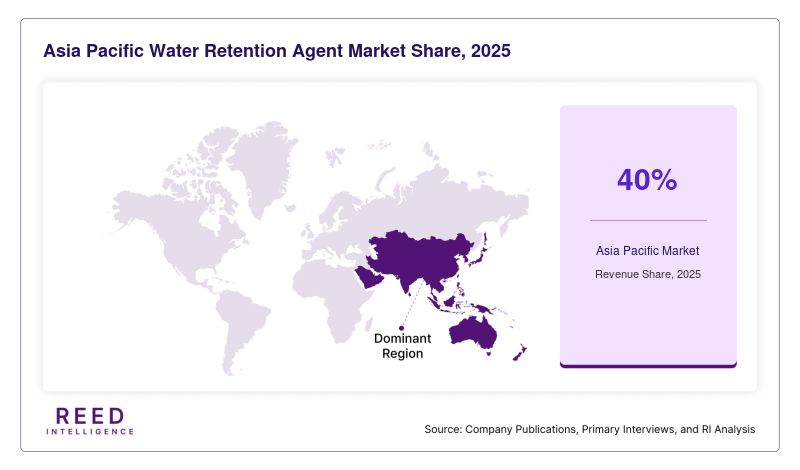
Leads the Water Retention Agent market, commanding a 40% share, with consumption reaching 1.8 million metric tons in 2025. China, India, and Australia are the primary drivers, accounting for 70% of regional demand, driven by the large agricultural sector and the growing need for water conservation. The Asia-Pacific Water Retention Agent market is characterized by its high growth rate and focus on cost-effective solutions.
North America Water Retention Agent Market
Represents the second-largest market, capturing a 25% share with consumption of 1.1 million metric tons in 2025. The United States dominates regional demand, accounting for 80% of consumption, driven by the strong agricultural and personal care sectors. The Water Retention Agent market in North America is characterized by its focus on innovation and sustainability.
Europe Water Retention Agent Market
Accounts for 22% of the global Water Retention Agent market, with consumption of 1.0 million metric tons in 2025. Germany, France, and the UK collectively represent 55% of the regional market, driven by the strong focus on sustainability and the personal care industry. The Water Retention Agent market in Europe is characterized by its focus on quality and environmental compliance.
Middle East & Africa and Latin America Water Retention Agent Market
Together account for the remaining 13% of the Water Retention Agent market, with Saudi Arabia leading the Middle East market and Brazil leading the Latin American market. Both regions are projected to grow at CAGRs exceeding 7%, driven by the increasing focus on agricultural water management.
Top players in Water Retention Agent Market
- BASF SE
- Evonik Industries AG
- Dow Inc.
- AkzoNobel N.V.
- Ashland Global Holdings Inc.
- Nouryon (formerly AkzoNobel Specialty Chemicals)
- CP Kelco
- Kerry Group
- Ingredion Incorporated
- Archer Daniels Midland Company (ADM)
- DuPont de Nemours, Inc.
- Sika AG
- Mapei S.p.A.
- RPM International Inc.
- Givaudan SA
BASF SE
BASF holds a dominant position in the Water Retention Agent market, with an estimated 14% global market share, particularly strong in the European and North American agricultural and personal care segments. The company's portfolio of synthetic and natural water retention agents is widely recognized for its quality, performance, and sustainability. BASF's market leadership is reinforced by its significant R&D investment, with the company allocating over EUR 30 million annually to the development of innovative water management solutions. BASF commands over 18% of the European market and 12% of the North American market, positioning it as a key player in the Water Retention Agent market's premium segment.
Evonik Industries AG
Evonik is a leading player in the Water Retention Agent market, commanding approximately 10% of the global market share through its comprehensive portfolio of specialty chemicals, including its advanced water retention products. The company's expertise in polymer chemistry and its strong presence in the construction and personal care sectors have solidified its position, where it holds a 12% share. Evonik's recent focus on developing sustainable, bio-based water retention agents has strengthened its position in the premium segment. The company's commitment to innovation, evidenced by its investment in green chemistry, has enhanced its brand equity among environmentally conscious customers.
Dow Inc. holds a significant 9% market share, with particular strength in the agricultural and industrial segments, where it commands a 10% share. The company's focus on integrated solutions is a key differentiator. AkzoNobel N.V. is a major player in the personal care and construction segments, holding an 8% global share, with a strong position in sustainable water retention solutions.
Recent Developments in Water Retention Agent Market
- 2025: BASF launched a new line of biodegradable water retention agents for agriculture, derived from renewable raw materials, offering a 30% reduction in carbon footprint compared to conventional products.
- 2025: Evonik introduced a new bio-based water retention agent for personal care applications, featuring a 20% improvement in moisture retention and enhanced skin compatibility.
Water Retention Agent Market Segments
By Type
- Synthetic Water Retention Agents
- Natural Water Retention Agents
By Application
- Agriculture
- Personal Care & Cosmetics
- Food & Beverages
- Construction
By Region
- North America
- Europe
- APAC
- Middle East and Africa
- LATAM